Brookings: ‘Big Issues for ACOs Going Forward’

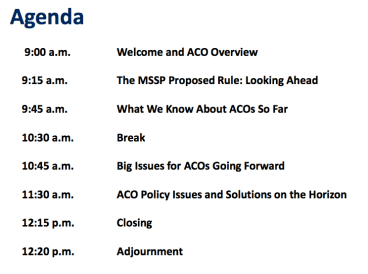
On October 20, 2014 the Engelberg Center for Health Care Reform hosted a half day forum to assess the latest evidence on accountable care, discuss strategies to overcome unique ACO challenges, and provide an overview of accountable care reforms.

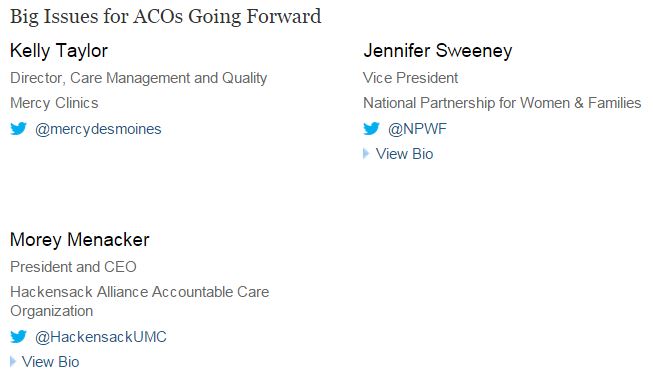
Panel participants included:

brookings aco's big issues going forward

Population Health, Social Determinants & the ‘All Hands on Deck’ Race to Matter

by Gregg A. Masters, MPH

Population Health Alliance (PHA) Executive Director and current Board Chair Fred Goldstein and I just finished chatting with Rain Henderson, the CEO of the Clinton Health Matters Initiative (CHMI) a project of the Clinton Global Foundation.

Rain covered quite a bit of ground from the mission of the Foundation to it’s current relevance and impact given recent signs of less than optimal hand offs between the public health community and umbrella acute care American Medicine infrastructure. We also learn more about CHMI and the broader goals of the Clinton Global Foundation.

To access this timely exchange click here.  pha keynotes2

Rain will provide the introductory remarks at the PHA member session in advance of Esther Dyson’s keynote presentation on ‘The Way to Wellville’, an initiative of HiCCUp.

This will be a powerful gathering of data driven and best practices supported participants in the general pursuit of a sustainable U.S. health care ecosystem and economy aka ‘the triple aim’.

For more information on the PHA Forum see full agenda and schedule.

The State of Accountable Care: Evidence to Date and Next Steps

by Gregg A. Masters, MPH

Brookings Med: ACOfuture

So I registered for the webcast version of this Brookings event titled: ‘The State of Accountable Care: Evidence to Date and Next Steps‘ which noted at 9AM start time. My assumption was Pacific time, so when I dialed in (really logged onto twitter to monitor the webcast hashtag #ACOfuture), the first tweet I saw was thanking everyone for a great program. Yup, the start time was 9AM Eastern, so I missed the live stream. The good news is this event was recorded and is now available for archived replay.

The full program agenda is here and principal deck here.

The line up is impressive and well worth watching for continuing insights into the accountable care theater. What’s working, what’s not, and why?

Enjoy this timely event!

Ebola: What’s Accountable Care Got To Do With It?

by Gregg A. Masters, MPH

I proudly display the ‘MPH” (master of public health) tag awarded by the School of Public Health from UCLA (a long time ago) and have both tweeted and blogged about the ‘we need more MPH’s and less MBA’s’ to solve America’s pressing healthcare challenges (access, affordability and quality imperative or ‘triple aim’) to which we now need to apparently add more robust ‘communicable disease control’ to the ‘value prop’ calculus.

Earlier today I tweeted:

Rick Santelli et al

I meant it…. minimally it’s about your lens, but more importantly ‘values’ in this scramble for purposeful behavior.

It use to be career minded and service oriented professionals where drawn into clinical medicine, the allied health professions (collectively ‘the helping professions’) and healthcare administrative services (their enablers) out of a sense of mission and giving back. So when I enrolled at UCLA in the School of Public Health the ‘route’ into hospital or health services administration was principally via the ‘MHA’ (Master of Health Administration), the ‘MPH’ (Master of Public Health) or even ‘MPA’ (Master of Public Administration) graduate degree programs.

The ‘MBA psychology’ had yet to infect the career progression glidepath, albeit that fire was in part stoked by the emergence of the proprietary hospital management industry (where I spent a fair amount of my time) intent on driving both revenue and share gains, but principally by deploying ‘secret sauce’ (superior management chops) operating efficiencies in exchange for quarterly earnings growth. Yet, since those early days the MBA strain seems to have dominated the current cultural pool of professionals entering the ‘admin’ or professional manager theater. Unfortunately, and while I generalize, most MBA students/graduates are really good at the profitability thing (sometimes squeezing out the last bit of profit from failing business models or burning platforms) and usually from an investor exit frame of reference. Rarely do we see a ‘community benefit’ or ‘sustainability of the healthcare delivery ecosystem’ sit on top of the MBA cultural indoctrination.

So as we watch the systemic exposure of the operational and worse yet horrific cultural gaps on display between the acute care health system and the ‘clean up crew’ as represented by ‘public health types’ i.e., both state departments of health or public health and their federal overlords at CDC, one must wonder about the viability of these apparently ‘parallel worlds’ with different incentives, values and cheerleaders.

Perhaps via this historically rationalized ‘financial class’ disconnect we’ve reached a teachable moment? Might we actually think about how public health and acute care medicine can work together for the greater good?

I think so! Will you join me?

Originally posted at PublicHealthHQ


ACO Alignment: The Holy Grail?

By Gregg A. Masters, MPH

So one view holds, ‘the more things change, the more they stay the same’ (i.e., it’s deja vu all over again), while the present day, ‘enlightened’ [or perhaps event horizon naive] view suggests, ‘no this time, things really are/can be different’. Just enter the key enabler: [ _________ ] e.g, technology, ubiquitous internet/device access, healthcare costs are now threatening countries, not just industries, patient empowerment, better ‘skin-in-the-game’ plan design, pure desperation, you name it, etc.

ACO Alignment Summit MastheadEven at this late stage in the early implementation of the Patient Protection and Affordable Care Act (ACA) we still find ourselves in a muddled and often confusing if not selectively implemented [or waived] regulatory market with respect to the ability of the Act to achieve its ends via the proscribed means. Yet, ACA is the law and most of us ‘on the ground’ [or closely following the action] are either muddling though and/or boldly going forward amidst a vague and ambitious yet mandatory journey – enabling the ‘triple aim‘.

One large moving part of the ACA that disproportionately bears the burden of the Act’s efficacy, that is mission critical and must be interstitially infused inside delivery system [and financing/risk sharing if not assumption] transformational efforts is ‘the ACO’ – including it’s many non Federal derivatives operating in the commercial space.

Unfortunately once you’ve seen an ACO, well, you’ve seen one ACO

[NOTE: For some context see More or Less Confusion in ACO World: Who Really ‘Certifies’ ACOs?‘Accountable Care: In Search of Anchor Business Model(s) for the ‘All In’ Healthcare Eco-system’, and ‘IPA 2.0 the Preferred ACO Chassis?’].

Other then some broad brush guidance in the ACA and the regulatory follow-up via rules implementation, there is much room for variation on how the ‘Ark’ is to be built, governed and operated. Ergo the continuing conversation around one key pillar in the launch of a viable ACO, i.e., physician alignment with enterprise and market goals, or by proxy achieving the underlying clinical integration essential to seamless, coordinated, efficient and appropriate delivery of evidenced based care.

While there is much to learn, there are principles in evidence on which to build, i.e., successes in the market. If you want to learn more from an eclectic mix of players in the space, consider attending the ACO Alignment Summit.

Details of the panel session on alignment are here:ACO Alignment Summit

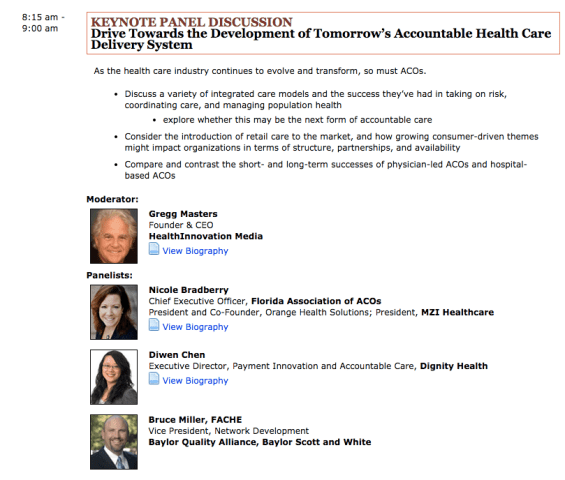
I am pleased to say that I will be moderating the Keynote Panel Discussion:
Drive Towards the Development of Tomorrow’s Accountable Health Care Delivery System’ with some talented colleagues from different markets around the country.

Joining me in this deep dive are: Nicole Bradberry, Chief Executive Officer, Florida Association of ACOs, President and Co-Founder, Citra Health Solutions; President, MZI Healthcare, Diwen Chen, Executive Director, Payment Innovation and Accountable Care, Dignity Health, and Bruce Miller, FACHE, Vice President, Network Development, Baylor Quality Alliance, Baylor Scott and White.

This is a unique blend of talented thought leaders and host business models from three different domestic U.S. markets all with distinctly different geo-political healthcare footprints. Nicole sits atop a member based association of ACOs in Florida (in addition to her leadership role at MZI Healthcare a vendor, consultant and health IT infrastructure play), while Diwen hails from a progressive institutionally managed integrated delivery system with hospital DNA Dignity Health, and Bruce stewards Network and Quality Management issues for an integrated group medical practice/IDN Scott and White that recently merged with the flagship Baylor Health System to combine two trophy properties (with distinctly different cultures, imj) in the Lonestar state.

This will be a ‘roll up your sleeves’ exchange on lessons learned in ACO alignment as well insights into the ‘how do I navigate the white waters of clinical integration’ given the local market considerations I face?


Your Comment is in Moderation: ‘Why ACO Savings Aren’t About Location.’

By Gregg A. Masters, MPH

We’re having an interesting exchange over at The Healthcare Blog where Health Care Policy Lead at Aledade, Inc. Travis Broome posted a piece titled: ‘Why ACO Savings Aren’t About Location.’

I chimed in with some ‘contextually pro’ ACO thoughts with some significant push back by industry veteran, author, consultant, economist and President of HealthFutures, Jeff Goldsmith fka ‘tcoyote’.

Thanks Jeff… lovin’ the exchange! Just sayin’ metrics, metrics. depends on lens….
Bottom-line is we still live on a production driven healthcare ecosystem – ‘capitation’ (PMPM) still a fraction of total contract spend (even if you include ‘lite versions’ ie, bundled payment, DRGs, or ambulatory case rates, or OWA’s [other weird arrangements]).
Share of GDP has been and continues to disproportionately claim an obscene allocation of the U.S. (public, private) spend and growing; all while a grand COST SHIFTING CHARADE proceeds under the convenient ‘consumer directed/skin in the game’ brand play by payors/health plans/or more aptly put ‘benefits solutions providers’.
There are no more ‘health insurers’ per se. they’ve collectively failed to manage clinical risk. PERIOD. They are ‘transaction processors’ increasingly living off of ‘fees’ and investment returns as ‘banks’, with the great hope that ‘technology plays’ (mhealth, digital health, tech-enabled patient engagement), etc… can cure the beast.
So yes, today and in the near term, clever (and well paid) managers’ are subject to production incented growth or share objectives (even amidst declining units primarily due to the slowing (and cost shift) economy and reduced discretionary spending for elective services).
The handful of creative ‘comp plans’ that scaled the transformative shift from volume to value remain a fraction of total [see my piece ‘Eating Glass’ https://acowatch.me/2014/08/14/eating-glass-a-davita-healthcare-partners-hiccup-or-physician-integration-implosion/ about Craig Samitt’s abrupt departure from DaVita/Healthcare Partners ] are at least on the table given the ACO triple aim sustainability mission. If units decline, skilled managers find ways to drive UP price. Consolidations are precisely that, no?
I remember when per diems and case rates were first introduced back in the 80s. The CFO calculus was pretty simple: budget revenue requirements divided by projected units of service and voila, you got your case-mix adjusted average basis for both service tiered or global per diem contracting. Pretty simpleton, but true!
When shift to ambulatory from inpatient began, Outpatient surgery/procedure case rates were benchmarked to historical inpatient revenue yield. Only growth of physician owned ASC’s forced some competitive restraint to price [ and that theme remains alive today via OIG report: http://www.beckershospitalreview.com/finance/oig-says-bring-down-hopd-rates-for-surgery-to-asc-rates-cms-disagrees-11-things-to-know.html ]. That the aggregate trend UP is rather obvious, no? It has not abated from a total cost of care perspective – the only measure that really matters.
Thanks for sharing Jeff. I am not an economist, just a grunt in the c-suite who negotiated a fair amount for global (hospital, physician, ancillary and pharma) full risk downloads (from licensed entity to risk bearing delivery system) via multiple health plans in different states.
Things don’t seem to change much in the ‘healthcare borg.’

Please consider offering your thoughts as well! The original blog post is here.


Farzad Mostashari MD Unbundles the ‘Healthcare Borg’ at Engage

By Gregg A. Masters, MPH

I have been following the career of Dr. Mostshari since his tenure at ONC as Director of the Office of the National Coordinator for Health Information Technology.

Upon learning of his launch of the startup ACO management company Aledade, we posted some thoughts here and here.

Yesterday at MedCity Media’s ‘ENGAGE’ conference in Bethesda, Maryland he literally tutored the in-person audience as well as many others following the feed via Google Hangouts, or the twitter stream tagged #mcENGAGE. Mostashari illuminated both the burning platform nature of the ‘business as usual’ through a prism of ‘good for doc’, ‘good for patient’, ‘good for society’, as well as probable indicia of the likely solutions. This is a masterful performance by a physician executive turned entrepreneur worthy of widespread distribution. Apparently there’s quite a bit more to Mostshari than EHR adoption and the national e-connectivity backbone.

Enjoy!

ACO Onramp: Reading the Pioneer [Exit] Tea Leaves

By Gregg A. Masters, MPH

Whenever someone buys a stock for the most part they make a decision that weighs available public (and sometimes ‘non public’) information and concludes that the company’s value exceeds (currently or shortly will) that which is expressed in the bid/offer price points the day the purchase is executed. Yet, there is always a seller who may more often than not hold the opposite opinion. After all why is he/she selling if the stock price undervalues the company’s enterprise fundamentals?buy sell

Absent the expressed manipulation of a third party intermediary (broker dealer, hedge fund, etc.) this buy vs. sell ‘call’ can reasonably and accurately reflect the aggregate market based ‘tug of war’ between the public perception and actual fundamentals of a company – at least as reflected in it’s stock price or ‘market cap’.

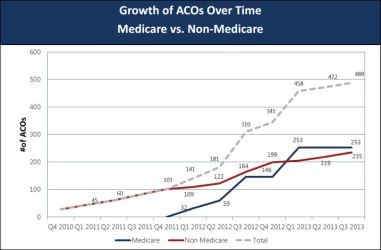
This same tug of war might equally apply to the battle for the ACO narrative at least as it relates to interpreting the reported ‘signals’ of movement inside the accountable care space.  However, instead of stock prices we’re looking at certain metrics including the number of players entering or conversely exiting the accountable care theatre as a proxy for the underlying health or efficacy of the Affordable Care Act – or at least that piece allocated to the provision in the Act specific to ‘accountable care’.ACO growth medicare vs non medicare

Of late the headlines have predictably served up a mixture of news for public consumption and therefore fodder for the talking heads to spin in the media and the ‘credible’ blogosphere writ large to explain to their audience.

If only healthcare where as simple as buy/sell equity transactions on public exchanges (lets not get into ‘dark pools’) mostly immune from ideological spin as to the broader significance of a move up or down in standing, valuation or growth vs. contraction. Unfortunately the health reform space is littered with agenda driven spin to drive an ideological outcome in one way or the other. And we know who the usual suspects are…

Meanwhile, several headline examples meriting interpretation including original source links are posted below. Further, since the launch of Aledade and several other entrepreneurial players (Privia Health) to bolster the vision, leadership, capacity and management infrastructure including the healthIT spine that supports independent physician led participation in the ACO initiatives, we include a recent Commonwealth Fund deep dive titled Profile: Rio Grande Valley ACO Health Providers’ exploring a physician led ACO effort in the Rio Grande Valley of Texas.

Context for the ACO pulse check narrative is perhaps best framed via a JAMA piece titled: The Pioneer Accountable Care Organization Model Improving Quality and Lowering Costs which is instructive on the significance of select Pioneer exits, while a deeper dive into the weeds of ‘Shared Savings in Accountable Care Organizations: How to Determine Fair Distributions (abstract only) addresses a problem most ACOs would aspire to have, i.e., a formula to distribute actual savings generated. 

The later abstract notes:

Accountable care organizations (ACOs) are playing a major role in health care reform. In the last 2 years alone, Medicare ACOs have proliferated to cover more than 5 million Medicare beneficiaries in more than 360 organizations nationwide.1 In ACOs, individual clinicians (including physicians, physician assistants, and nurse practitioners, among others), group practices, and, in some cases, hospitals contract with payers to be jointly accountable for the health outcomes and expenditures of a defined patient population. By meeting specified quality measures while keeping expenditures below defined benchmarks, ACOs share in the monetary savings generated.

Over at Modern Healthcare, Melanie Evans notes in ‘Medicare’s Pioneer program down to 19 ACOs after three more exit‘: 

Franciscan Alliance in Indianapolis, Genesys PHO in Flint, Mich., and Renaissance Health Network in Wayne, Pa., have exited the program, which is now in its third year.

For further discussion into quality performance measurements checkout ‘Medicare gives first glimpse of ACO quality performance’.

Perhaps the biggest piece of news was wrapped into the announcement of the launch of Vivity Health, see: ‘Reform Update: Will Anthem’s Vivity gain traction among large employers?‘.

This ambitious announcement by Wellpoint spawned the following two tweets today:

.’s ambitious ‘Vivity’ alliance [a response to ] will make merger look like a walk in the park!

Although saw light when it green-lighted as chassis to build out/express MA care delivery innovation.

Finally until job descriptions change reflecting better deployment of professionals working at the ‘top of their license’, as well as non clinical or administrative staff support re-engineered workflows, we’re probably not witnessing the movement of the needle towards the triple aim. In ‘ACOs, other delivery reforms shift job roles at hospitals’ we learn a little more about this continued labor pool tweaking.

IPA 2.0 the Preferred ACO Chassis?

By Gregg A. Masters, MPH

Earlier his morning I received an email from a colleague watching the ACO space for one of his clients. He wanted to draw my attention to an announcement by a Northern Virginia based company that supports physicians in independent practice. He also offered his client as commentator on the significance of this announcement for the emerging accountable care industry.

I promptly read and followed the hyperlink tree for backstory on the announcement and am now called to author this blog post.

Here is the seemingly superficially benign headline with considerably deeper dive significance grabbing the moment:

Arlington's Privia Health lands $400M to begin national expansion


Thus far the ACA rollout in general with all its misdirected and misinformed ideological representations in the media and ‘monkey courts’ in the Congress, and the ACO uptake chatter in particular has centered on major moves by nameplate operators in the space (hospitals, health systems and health insurers re-imagining their business models and market presence), with a smattering of regional or niche market players with interesting designs or claims on a novel path that might work.

Lost perhaps in the conversational exchange moving the health reform football forward is the net contribution to be realized via seasoned and risk savvy players who have demonstrated the value equation via their delivery systems albeit in the more familiar and perhaps safer turf of ‘Medicare Advantage’ and have chosen to sit on the sidelines or enter and exit the Pioneer program.

Simmering in the sea of competitive repositioning however in somewhat ‘semi-obscurity’ (perhaps stealth mode) are players who are emerging from the physician led, or preserving the independent practice of medicine model. Of late we’ve learned of the launch of Aledade, here and here, and today we witness the rather prominent bolstering via significant capital investment in Privia Health who’s ‘about’ content notes:

Privia builds and enables high-performance physician groups and clinically integrated provider networks – using technology, team-based care, and unique wellness programs to help leading doctors better manage the health of their populations.

So here we revisit the fundamentals of physician integration which is mission critical and the ultimate driver if the ACA is to work as envisioned. Physicians – traditionally averse to top down leadership especially when originated by health system or hospital executives – must aggregate into cohesive, seamless, coordinated nodes of care delivery to prudently purchase, deliver and thus restrain the ‘rapacious appetite’ of an institutionally driven healthcare [perhaps more aptly characterized as sick-care] industry drunk on a fee-for-volume paradigm.

When IPAs (independent practice associations) where first envisioned in the mid 70s and later amped up in the mid 80s to penetrate so-called mainstream medicine, the value prop was always to ‘preserve independent medicine’ while enabling participation in and thus positioning a ‘dog in the hunt’ for a market segment eagerly pursued by ‘bricks and sticks’ medical groups (primarily multi-specialty) who’s professional management correctly saw as a growing piece of the commercially insured (and later Medicare) pie.

The announcement by Privia Health today of a $400 million investment by ‘An investor group led by an affiliate of Goldman Sachs & Co.’ is in the words of an informed colleague aka @VinceKuraitis ‘could be a very BFD’.

As noted in the article above, Privia:

‘..markets itself as a platform for physicians to stay in private practice while becoming part of a larger network…’

Get to know these guys ASAP. We’ll be extending an invitation to their leadership to come tell the Privia Health story on ‘This Week in Accountable Care‘, and the details will be posted here upon confirmation.


Changing the Mythology of Hospital Led Value Based Purchasing

By William De Marco

William J. DeMarco | Pendulum HealthHospitals whose only product is acute care will have a difficult time managing in the post reform environment. Many hospitals have ventured into outpatient services competing with physicians. This has proven to be a mistake long term when seeking collaboration with physicians. Many hospitals do not understand how ACOs actually make money and have been so confused about managed care controlling their utilization and revenue that they believe this is the same strategy, yet it is not.

There are successful collaborations between hospitals and physicians such as Geisinger, Baylor (now Baylor Scott and White Heath) and Intermountain. There are also several new PHOs emerging as underlying structures to contract with the ACO. However, there are still traditional scenarios where the hospital runs it all and then the PHO becomes the HPO.

When starting an ACO there needs to be a separate corporation with physicians as major leaders, yet often times the hospital foots the bill for the startup and ends up feeling it is a disadvantaged partner because it is going to have its length of stay and admissions restricted. When the hospital pays for all the startup cost there is an expectation that these costs will be recovered when savings are created. This expectation can wipe out any bonus monies and if there is no bonus money earned the hospital is carrying this debt forward.

Both overspending a bonus or not earning a bonus will create major long lasting conflict for both parties and the finger pointing may last for years. This finger pointing is not just between the hospital and the physicians but sometimes between the physicians themselves, primary versus specialty, older doctor versus younger doctor, etc. If the hospital does not head this off immediately, the collaboration will be in trouble. Suddenly it is all about the bonus, but not really; it’s about how the physician feels he/she has been treated by the hospital. A fire begins burning that may never be quenched. Sometimes new managers being brought to hospitals report that the doctors do not trust them even though they never did anything to them.

The essential point being missed here is that when no one is held accountable, everyone can blame each other without consequence.

Using the joint venture organizational structure and a strategy that fits the marketplace there is a better chance to build a foundation for open cooperation and accountability and this does several things.

  1. Structure provides limits in terms of what powers or authority hospitals have over physicians in the relationship. This is reflected in the participation agreements and the board make up. There is an understanding that the hospitals will have the “physicians enforce physicians” rule and the hospital will run its own departments in accordance with the clinical guidelines that formulate part of the essential strategy to manage results that earn savings against the benchmark.
  2. Committees (several) hold the organization accountable for clinical guideline creation and enforcement. Non-compliant physicians may still practice at the hospital but they do not share the bonus unless they successfully correct their utilization issues. Several committees are required but we would add management, technology assessment, finance, and reimbursement committees to support the organization.
  3. While this list of committees can go on, I am constantly amazed when asking ACO executives what kind of bonus they are expecting under optimal conditions and I get a blank look.
  4. If no feasibility study has been done, two things will fall apart – the vision is tarnished because no one can articulate why they are doing this and the reimbursement sharing (if any) is left out until there is money on the table. And then the fight begins. Like a big family when a relative with money dies, it can be nasty. Those who put more money into the early investment (the hospital) want their cut.

If part of ownership by the physician included some money up front, with the hospital matching this amount with the understanding more dollars will come that, after expenses, can be divided in accordance with a schedule, this may be a start to fixing this problem. But nothing is simple here. It will get the physician’s attention to come to meetings if he/she want a return on investment and hospitals will reduce their risk by having to match what’s put up instead of putting all the money up. Perhaps a commercial loan for any additional money could be used to share the risk further. This may sound simple, but to not discuss the ins and outs of capital before getting started often leaves one partner holding the bag if the ACO should fail to produce savings.

Unifying the structure at the top and pushing down the accountability throughout the organization with delegated committee responsibilities and then supporting this with a capital plan to launch and divide rewards as earned avoids the PHO from becoming a HPO and unifies the medical and hospital staff around a common set of goals and vision that will likely lead to other joint ventures. Hospitals can form successful ACOs but must find that simple but effective way to form a true collaboration.

William DeMarco is President and CEO of DeMarco & Associates, Inc.  Mr. DeMarco created the firm based upon 20 years experience in health plan development and management, earning his credentials working with several community based health plans in the competitive St. Paul /Minneapolis marketplace. For more information see Pendulum Healthcare and follow on Twitter via @WJDeMarco