And ‘the Act’ is…

By Gregg A. Masters, MPH

Per the SCOTUS blog:

Amy Howe:

“We do not expect any additional opinions today, so NO health care today.

Few laws have and continue to stir up such emotion, political spin and both authentic and misinformed interest. Perhaps the mood [for some of us] is best captured in the following tweet:

@JeffreyYoung_HC: “The waiting is the hardest part.” – Justice Tom Petty

For an excellent compendium of resources both legal and otherwise, see: ACA Litigation Blog.

More later!

Early Returns: ACOs Improve Management of Patient Populations, Offer Short-Term Savings

by Bryn Nelson, PhD

Opportunities to be more efficient are largely under care of hospitalists, ACO director says

Several years ago, Presbyterian Medical Group in Albuquerque, N.M., decided to integrate three elements of its healthcare system: its health plan, the employed medical group, and the hospital delivery system. Knitting those parts into a cohesive whole helped the group realize that “lowering the cost of care by improving efficiency, by improving coordination, and by enhancing collaboration between payor and physicians made a lot of sense,” executive medical director David Arredondo, MD, says. When the accountable care organization (ACO) concept came along, Dr. Arredondo says, “it really was just a natural extension of what we were doing.”

The ACO model, championed as a way to prevent the fragmentation of care and rein in costs by getting providers to assume joint responsibility for specific patient populations, received a major boost through 2010’s Affordable Care Act. Last year’s ACO rule-making process by the Centers for Medicare & Medicaid Services (CMS), however, was anything but smooth. Cautious optimism by such organizations as SHM gave way to loud complaints over the initial rules for a voluntary initiative called the Shared Savings Program. Critics asserted that participants would be forced to assume too much financial risk while being swamped with paperwork requirements.

By year’s end, though, the final rules had assuaged many of the biggest concerns, and the April 10 announcement of 27 participants for the program’s first round—more than half of which are physician-led organizations—has rekindled much of the enthusiasm. According to CMS officials, the agency is reviewing more than 150 applications for the program’s next round, which will begin in July.

Keys to Success
In December, CMS selected 32 organizations to participate in an even more ambitious initiative called the Pioneer ACO Model. That separate but related experiment in shared accountability launched Jan. 1, and it may be months before enrolled organizations can say whether the rewards outweigh the risks. Interviews with Presbyterian’s Dr. Arredondo and two other Pioneer participants about why they took the plunge, however, have highlighted some potential keys to success.

All three agree that the ACO model offers a better match for their long-term, patient-centered goals and that the fee-for-service model is gradually becoming a thing of the past.

“In some ways, it was actually kind of a relief that the system was going this way because we, probably like many systems, were beginning to be caught between the budgeted model and a fee-for-service model,” Dr. Arredondo says. “When you’re heavily one way or heavily the other way, then it makes things a little easier to manage and understand. When you’re right in the middle, it becomes a little uncomfortable.”

Penny Wheeler, MD, chief clinical officer for Minneapolis-based Allina Hospitals & Clinics, says organizations in that precarious position need to carefully examine their capabilities and consider how best to pace their transition. Otherwise, they might prematurely give up too much revenue that could be used to reinvest in care improvements.

“We can tolerate it if we shoot ourselves in one foot, but we can’t tolerate it if we shoot ourselves in both feet, in this new world,” Dr. Wheeler says.

If caution is warranted, she says, the ACO model still aligns well with a strategy of building toward outcome-based healthcare. Despite the likelihood of “lumps and bumps and warts along the way,” Dr. Wheeler says, “we really wanted to be part of the shaping of that outcome-based delivery, and receive market rewards for what we were creating for our community.”

Austin, Texas-based Seton Health Alliance, a third Pioneer participant, is a collaborative effort between a hospital delivery system known as Seton Health Care Family and a multispecialty physician group called Austin Regional Clinic. Greg Sheff, MD, president and chief medical officer of the ACO, says the partnering organizations were separately moving toward more population health initiatives and more proactive, coordinated, and accountable care.

“The Pioneer ACO, for us, really provided an opportunity to light the fire and motivate the organizations to put the entity together and start doing the work,” he says, adding PCPs and hospitalists will be critical to his organization’s ongoing integration efforts.

“The areas where there are opportunities to be more efficient are largely under the care of the hospitalists,” he says, citing in-house utilization as well as care transitions, comprehensive post-acute placement, and readmission prevention efforts. To support those providers, Pioneer participants say well-designed electronic medical records are paramount, while separate efforts, such as patient-centered medical homes and unit-based rounding, might offer timely assists. (Click here to listen to more of The Hospitalist’s interview with Dr. Sheff.)

No one’s expecting the next few years to be seamless, but Dr. Sheff views his newly formed ACO as a long-term endeavor in which success isn’t necessarily defined by whether the group achieves shared cost savings.

“We define success by whether we are able to move our delivery system to a place where we’ll be much more adept at going forward, continuing to manage populations,” he says. “We really see this as a strategic organizational decision more than, ‘Boy, that contract looks like something that we can leverage in the short term.’”

Bryn Nelson is a freelance medical writer in Seattle.

This article originally appeared in The Hospitalist.
How Hospitals Can Test the Waters of Accountable Care

By Gregg A. Masters, MPH

Found on the Accountable Care Bulletin.

Hospitals considering accountable care strategies have plenty of options to choose from, but deciding where to begin can be confusing. Joseph Damore, Vice President of Engagement and Delivery for Premier, explores how hospitals can test the waters of accountable care, from engaging staff in wellness to partnering with local employers on population health.

ACOs, Patients, Consumers and the Dark Matter Glue that Makes it All Work

By Gregg A. Masters, MPH

It’s been a brutal pace and schedule of late and one of the pieces I’ve omitted from presenting here is titled: Building Patient-Centeredness in the Real World: The Engaged Patient and the Accountable Care Organization‘ proffered by colleague and friend Michael Millenson, aka @MLMillenson, President, Health Quality Advisors LLC.

I received a heads-up on the timely publication and further notice during the Third National ACO Summit, so better late than never Michael!

This is a great piece since it weaves many contemporary threads into the healthcare system redesign imperative. Inescapable synergies resonate from the e-patient movement, to the growing interest in the Society for Participatory Medicine, the continued explosive growth of engagement in social media, and the Final Rule relative to the implementation of both ‘shared governance’ and ‘patient centered-ness’ provisions of ACOs.

It is no secret that the patient’s (consumer’s) role in the ‘triple aim’ is as principal and partner. We are drowning under the weight of diseases of lifestyle choice. Before you even grant consideration to the cost shifting from plan-to-member that is permitting many of the group, individual, and even Medicare Advantage plans that are written and offered today, the handwriting is and has been on the wall that the burden for bending the cost curve has been squarely placed on the shoulders of the member/patient/consumer.

This piece is a must read, and welcome addition to the growing body of knowledge advancing the democratization of the healthcare experience!

Un-bundling the Act: Provisions for ACOs

By Gregg A. Masters, MPH

We heard a lot about the rough life of Federal legislators when one of the material objections aka ‘talking points’ to actually considering the thoughtful remedies borne via public/private discourse and years if not decades of health policy development and experience outlined in the Patient Protection and Affordable Care Act was it’s weight and the corresponding number of pages found therein. After all an industry which represents 1/7th of the US Economy, consuming approximately $2.7 trillion in 2010, when compared to most if not all other industries seems to posses characteristics somewhat unresponsive to traditional marketplace demand and supply equilibrium. After all, few other industries create their own demand inside a rather complex and opague theater for such an essential human service.

As we sit poised for the decision on the constitutionality of the individual mandate, if not the Act in it’s entirety, why not take a summary look at both the provisions specific to ACOs, the balance of the Act, as well as it’s staged implementation timeline.

Courtesy of the Kaiser Family Foundation:

Accountable Care Organizations
Section 3022 of the Affordable Care Act

Allows providers organized as accountable care organizations (ACOs) that voluntarily meet quality thresholds to share in the cost savings they achieve for the Medicare program.

Implementation: January 1, 2012

Implementation update: On April 7, 2011, the Department of Health and Human Services published a proposed rule in the Federal Register defining Accountable Care Organizations and set out requirements for governance, legal structure, transparency efforts and the incorporation of evidence-based medicine and quality efforts. HHS also released facts sheets for providers and consumers, as well as fact sheets on legal issues and quality scoring in ACOs. The Federal Trade Commission and Department of Justice issued a joint policy statement on antitrust issues related to ACOs. On May 20, 2011, CMS issued a request for applications for the Pioneer ACO Program, which is targeted at organizations that can demonstrate the improvements in quality and cost-savings of a mature ACO.

On December 19, 2011, CMS announced 32 health care organizations that will participate in the new Pioneer Accountable Care Organization project.

All Eyes on SCOTUS Decision Expected Later This Week?

By Gregg A. Masters, MPH

We’ve been in a quiet period since the Supreme Court of the United States (SCOTUS) accepted the series of challenges to the Patient Protection and Affordable Care Act, yet the buzz factor is up via the blogosphere, social media and both broadcast and cable news media outlets as some expect the decision of the court to be reported later this week.

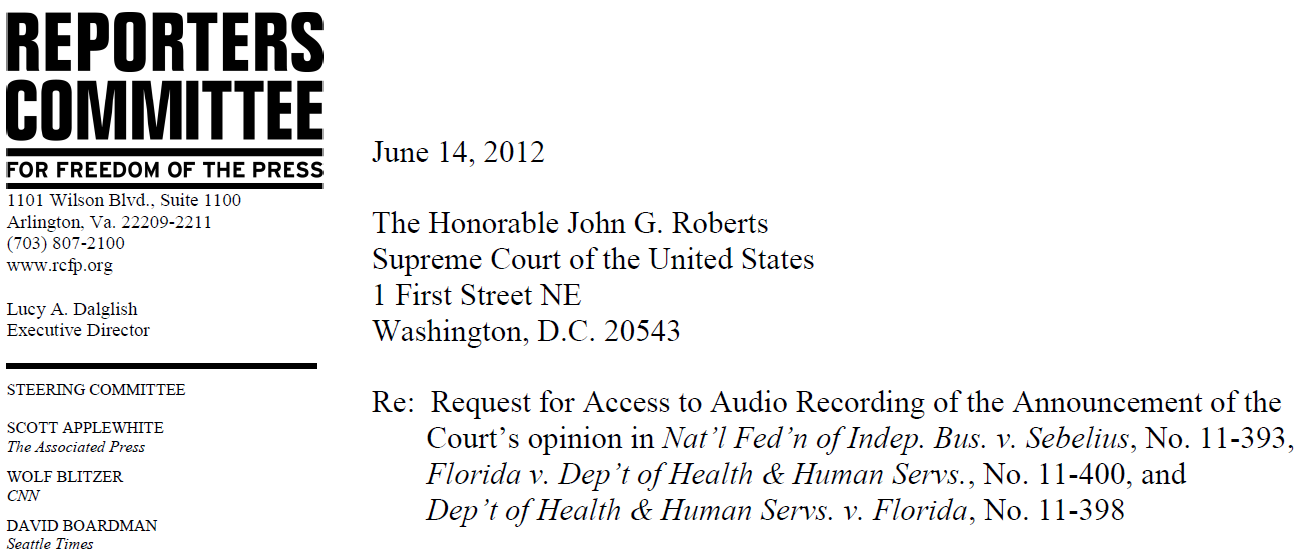
Of interest is the letter submitted via the The Reporters Committee for Freedom of the Press, representing major news outlets and a series of co-sponsoring entities have petitioned the Court as follows:

The Reporters Committee and media coalition are asking the Court to allow live audio and video coverage of the release of the opinion in the health care cases.  In the conclusion of the letter, we are asking that if the Court decides not to allow live audio and video, that it at least release the Court’s own audio recording of the hearing as soon as the hearing ends.

In the tea leave reading department, and via a mock if not proforma review of the outcome of the ruling David Dranove , writes on The Healthcare Blog: ‘ My Initial Reaction to the Supreme Court Decision:’

In ruling on the constitutionality of the purchase mandate, the Supreme Court has also decided the fate of the entire ACA. I thought that Justice Scalia makes a valid argument that health insurance exchanges would likely fail without the mandate, and that without exchanges, the entire ACA fails apart. His understanding of selection bias makes me believe he would have been a terrific economic theorist! But am I the only one who thinks it ironic that he appeals to economic theory here but ignored the equivalence of taxes and rebates? Justice Ginsberg also shows surprising economic depth, noting that the adverse selection “death spiral” is not a given and that exchanges would probably survive without the mandate. And when she cites my colleague Ben Handel’s paper on inertia in health insurance markets, I am truly awed. Thanks to the Supreme Court decision, we may never know if Justice Ginsberg is correct.

The impact of SCOTUS decision on accountable care and ACOs in particular is also the subject of widespread debate and active consideration. Some argue that the ‘It’s Too Late To Turn Back: A Transformation To Wellcare Has Already Begun‘, and that even if the Act we repealed in it’s entirety or effectively ‘gutted’ as a result of ruling the individual mandate as over-reach and therefore unconstitutional, the market place dynamics already in play are moving in the direction of the ‘spirit’ of the Act up to and including the pursuit of ACOs as primary market transformation vehicles.

We’re considering hosting a simulcast ‘Tweet-chat’ on ACOchat.org, using the hashtag #ACOchat with a live radio broadcast on ‘This Week in Accountable Care.’ We’ll be somewhat on call as to the timing, fulfillment of the undertaking, but be sure to follow us on Twitter via @ACOwatch and @2healthguru as the plans for the chat will be announced via these real time tools upon the release of the decision.

Update: Growth and Dispersion of Accountable Care Organizations – Leavitt Partners

By Gregg A. Masters, MPH

While Attending the Third National ACO Summit in Washington, DC last week I  had the opportunity to cross paths with Thomas Merrill my liaison with Leavitt Partners (LP) responsible for our interview on ‘This Week in Accountable Care‘ discussing LP’s initial release of their report ‘Growth and Dispersion of Accountable Care Organizations.’ Thomas informed me of an impending update to their landmark issue in November 2011. That update is now available via the Leavitt Partners website here.

In summary, the update reveals the following key metrics and contextual guidance:

The last eight months have seen considerable growth in the number of health care entities commencing accountable care payment arrangements. Despite large variation in models used, this growth is evidence of the increasingly common belief that health care should be more than simply providing and billing for services.

Leavitt Partners has utilized both public and private sources to track the activity of 221 accountable care organizations through the end of May 2012.

Growth is concentrated in larger population centers though it has expanded to 45 different states. Care coordination and payment models continue to vary depending on the organization leading the initiative, the organizations involved in the ACO and the region or market in which the entity serves. While the various Medicare ACO programs seem to be influencing the direction of accountable care models, the government’s role in leading the growth of accountable care is unclear.

Well said, though a clearly hedged future. I might add that irrespective of the outcome of the SCOTUS decision, the competitive ‘horse is out of the barn.’ As witnessed by United HealthGroup’s statement earlier this week of their intention to carry forward certain provisions of the Patient Protection and Affordable Care Act (ACA), if the decision is to deem the individual mandate (and perhaps more) unconstitutional. Irrespective of the legal shackles that may be placed on CMS, the commercial market is steaming forward implementing the very spirit of the Act via ACOs and derivative efforts to achieve the triple aim.

Dave Chase CEO of Avado at Health Datapalooza

By Gregg A. Masters, MPH

In the flurry of activities associated with the Health Data Forum III in Washington, DC aka (‘health datapalooza‘) I managed to corral  Dave Chase aka @ChaseDave in the Exhibition Hall at the DC Convention Center following his presentation at the ACO breakout session.

Amidst the background noise, we hear from Dave about his highlights from the event, a little about Avado and how they serve the interests of developing or operational ACOs.

During the ACO track at Health Datapalooza, there were four categories of software that have emerged as a result of ACOs. Chase argues that one of the new categories will be Patient Relationship Management (PRM) that is a superset of traditional proprietary patient portals tied to a single EHR. The PRM category does more to directly weave the patient into the process in a way that the Pioneer ACOs described.

Atul Gawande at Health Data Palooza Session on ACOs: A Keynote

By Gregg A. Masters, MPH


Since he authored ‘The [healthcare] Cost Conundrum‘ piece some three years ago, positing the question of who will emerge as the ‘anchor tenant’ business model in healthcare, I’ve been ‘waving’ at Atul Gawande via social media including Twitter and blog.

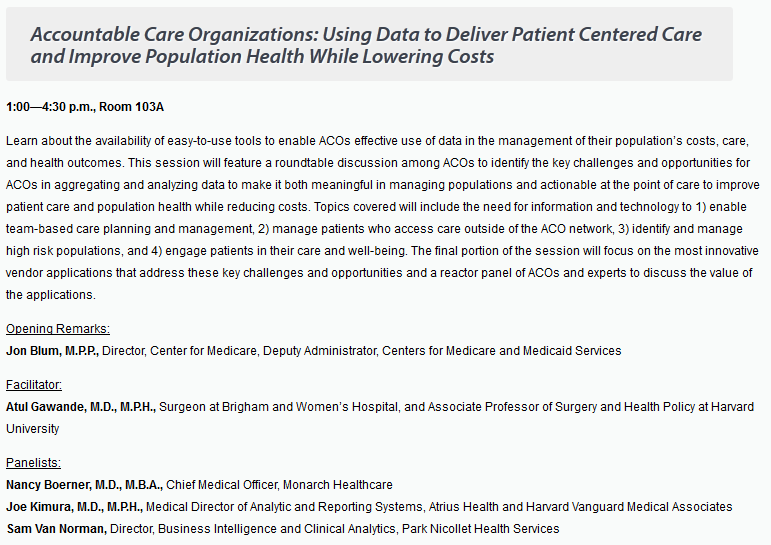
When I saw that he was faciliating a breakout session at ‘Health Datapalooza‘ aka HDI Forum III or as some would label it the ‘friends of Todd Park love in’, titled ‘Accountable Care Organizations: Using Data to Deliver Patient Centered Care and Improve Population Health While Lowering Costs‘ I thought I finally get to shake his hand and thank the public health colleague in person for his incredible work.

As a member of the digital media press corps at the event, I was also committed to covering both via Twitter, @ACOwatch and video of certain events. I was not about to let this one go undocumented, so I trained the video camera on Gawande and captured the entire session.

There are some memorable quotes in this piece (e.g., ‘from cowboys to pit crews’), as he draws poignant insights derived from two seemingly conflicting sides of the equation: ‘systems of killing’ and ‘systems of healing’.

Third National ACO Summit: Q & A McClellan, Dentzer & Fisher

By Gregg A. Masters, MPH


I had the pleasure of covering the Third National ACO Summit in Washington, DC on June 7th and remotely on the 8th, 2012.

This is the Q & A session from the opening panel featuring:

Elliott S. Fisher, MD, MPH
Director, Population Health and Policy; Director, Center for Population Health, The Dartmouth Institute for Health Policy, Lebanon, NH
Mark McClellan, MD, PhD
Director, Engelberg Center for Health Care Reform, Brookings Institution; Former CMS Administrator and FDA Commissioner, Washington, DC
Susan Dentzer
Editor-in-Chief, Health Affairs, Bethesda, MD; Health Policy Analyst, The News Hour with Jim Lehrer, Washington, DC (Moderator)

For detailed program information including webcast replay of the entire Summit, click here.