Update: Growth and Dispersion of Accountable Care Organizations – Leavitt Partners

By Gregg A. Masters, MPH

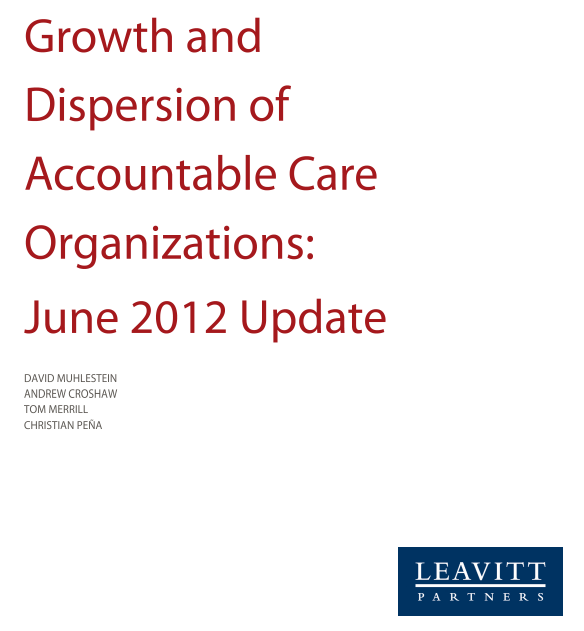
While Attending the Third National ACO Summit in Washington, DC last week I  had the opportunity to cross paths with Thomas Merrill my liaison with Leavitt Partners (LP) responsible for our interview on ‘This Week in Accountable Care‘ discussing LP’s initial release of their report ‘Growth and Dispersion of Accountable Care Organizations.’ Thomas informed me of an impending update to their landmark issue in November 2011. That update is now available via the Leavitt Partners website here.

In summary, the update reveals the following key metrics and contextual guidance:

The last eight months have seen considerable growth in the number of health care entities commencing accountable care payment arrangements. Despite large variation in models used, this growth is evidence of the increasingly common belief that health care should be more than simply providing and billing for services.

Leavitt Partners has utilized both public and private sources to track the activity of 221 accountable care organizations through the end of May 2012.

Growth is concentrated in larger population centers though it has expanded to 45 different states. Care coordination and payment models continue to vary depending on the organization leading the initiative, the organizations involved in the ACO and the region or market in which the entity serves. While the various Medicare ACO programs seem to be influencing the direction of accountable care models, the government’s role in leading the growth of accountable care is unclear.

Well said, though a clearly hedged future. I might add that irrespective of the outcome of the SCOTUS decision, the competitive ‘horse is out of the barn.’ As witnessed by United HealthGroup’s statement earlier this week of their intention to carry forward certain provisions of the Patient Protection and Affordable Care Act (ACA), if the decision is to deem the individual mandate (and perhaps more) unconstitutional. Irrespective of the legal shackles that may be placed on CMS, the commercial market is steaming forward implementing the very spirit of the Act via ACOs and derivative efforts to achieve the triple aim.

Dave Chase CEO of Avado at Health Datapalooza

By Gregg A. Masters, MPH

In the flurry of activities associated with the Health Data Forum III in Washington, DC aka (‘health datapalooza‘) I managed to corral  Dave Chase aka @ChaseDave in the Exhibition Hall at the DC Convention Center following his presentation at the ACO breakout session.

Amidst the background noise, we hear from Dave about his highlights from the event, a little about Avado and how they serve the interests of developing or operational ACOs.

During the ACO track at Health Datapalooza, there were four categories of software that have emerged as a result of ACOs. Chase argues that one of the new categories will be Patient Relationship Management (PRM) that is a superset of traditional proprietary patient portals tied to a single EHR. The PRM category does more to directly weave the patient into the process in a way that the Pioneer ACOs described.

Atul Gawande at Health Data Palooza Session on ACOs: A Keynote

By Gregg A. Masters, MPH


Since he authored ‘The [healthcare] Cost Conundrum‘ piece some three years ago, positing the question of who will emerge as the ‘anchor tenant’ business model in healthcare, I’ve been ‘waving’ at Atul Gawande via social media including Twitter and blog.

When I saw that he was faciliating a breakout session at ‘Health Datapalooza‘ aka HDI Forum III or as some would label it the ‘friends of Todd Park love in’, titled ‘Accountable Care Organizations: Using Data to Deliver Patient Centered Care and Improve Population Health While Lowering Costs‘ I thought I finally get to shake his hand and thank the public health colleague in person for his incredible work.

As a member of the digital media press corps at the event, I was also committed to covering both via Twitter, @ACOwatch and video of certain events. I was not about to let this one go undocumented, so I trained the video camera on Gawande and captured the entire session.

There are some memorable quotes in this piece (e.g., ‘from cowboys to pit crews’), as he draws poignant insights derived from two seemingly conflicting sides of the equation: ‘systems of killing’ and ‘systems of healing’.

Third National ACO Summit: Q & A McClellan, Dentzer & Fisher

By Gregg A. Masters, MPH


I had the pleasure of covering the Third National ACO Summit in Washington, DC on June 7th and remotely on the 8th, 2012.

This is the Q & A session from the opening panel featuring:

Elliott S. Fisher, MD, MPH
Director, Population Health and Policy; Director, Center for Population Health, The Dartmouth Institute for Health Policy, Lebanon, NH
Mark McClellan, MD, PhD
Director, Engelberg Center for Health Care Reform, Brookings Institution; Former CMS Administrator and FDA Commissioner, Washington, DC
Susan Dentzer
Editor-in-Chief, Health Affairs, Bethesda, MD; Health Policy Analyst, The News Hour with Jim Lehrer, Washington, DC (Moderator)

For detailed program information including webcast replay of the entire Summit, click here.

Recovering from DC Health Data and Innovation Week

By Gregg A. Masters, MPH

Whoa! What a week in DC. The events stacked back to back were fast, furious and content rich. I previewed the week here.

There is much to report, including my upcoming on ‘This Week in Accountable Care‘ interview with JD Kleinke, pioneering health care information entrepreneur, medical economist, author, and business strategist, this Wednesday at 12 Noon Pacific/3PM Eastern. We’ll discuss ACOs, health reform and more with one of the brightest thinkers in the health policy and consulting space.

Meanwhile, here is my summary of tweets associated with Day 1 of the Third National ACO Summit, Day 2 to follow shortly:

[View the story “Third Annual ACO Summit: Day 1” on Storify]

Towards a Framework of an ACO (Accountable Care) and Meaningful Use Crosswalk

By Gregg A. Masters, MPH

Lets begin with the core observation that both ACOs (or more broadly cast and therefore agile accountable care undertakings) and the Meaningful Use program are for the most part children of statute with intent to impact a less than optimal if not failing health care delivery and financing paradigm.

The former as a ‘modest’ component of the Affordable Care Act with a disproportionate share of the health reform consideration underway in many communities today. While the later is a ‘module’ if you will in the American Recovery and Reinvestment Act or more specifically via the provisions of the HITECH Act.

Lets first define an ACO

An Accountable Care Organization (ACO) is a network of physicians and other health care providers who are willing to work together and accept responsibility to improve quality and reduce the costs of health care services for a defined population.

According to CMS: ‘The goal of coordinated care is to ensure that patients, especially the chronically ill, get the right care at the right time, while avoiding unnecessary duplication of services and preventing medical errors.’

‘When an ACO succeeds both in both delivering high-quality care and spending health care dollars more wisely, it will share in the savings it achieves for the Medicare program.’

Meaningful use defined, per Search HealthIT:

Meaningful use (MU), in a health information technology (HIT) context, defines the use of electronic health records (EHR) and related technology within a healthcare organization. Achieving meaningful use also helps determine whether an organization will receive payments from the federal government under either the Medicare EHR Incentive Program or the Medicaid EHR Incentive Program.

It may be fair to describe the central intent of MU as follows: the focus on meaningful use is a recognition that better health care does not come solely from the adoption of technology itself, but through the exchange and use of health information to best inform clinical decisions at the point of care.

So let’s be mindful that: Information technology is a necessary (but insufficient) element in the creation of the actionable health information essential to inform and guide clinical decisions at the point of care.

To begin connecting the dots consider the following ACO/HIT needs as a minimum crosswalk framework:

• A hospital EHR (including CPOE)
• A physician office or medical group EHR
• Health Information Exchange (HIE) or ‘integration platform’ to connect disparate providers in the care continuum (both acute and sub-acute)
• Further supported by a population health data management system
• With robust business intelligence and predictive analytics or modeling platform
• And lets not forget a user friendly consumer health platform or portal

What ties all of this together? Minimally the quality, coordination, and seamless care more typical of integrated delivery systems with HIT central spines, and the population based focus goals of accountable care organization.

Today on MU Live Radio: ACOs & Meaningful Use Connecting the Dots

By Gregg A. Masters, MPH

ACOs, Meaningful Use (aka MU), the persistent ‘whitewater’ of health reform and the quest for the elusive ‘triple aim’ will be at the center of our chat today on Meaningful Use: MU Live Radio.

MU Live! is a 30 minute internet talk radio show hosted by our HITECH Answers experts. Our session experts discuss breaking news and issues on meaningful use as well as other health IT topics.

For more information including past guest segments, click here. To register to listen to today’s broadcast at 11AM Pacific/2PM Eastern, click here.

A Gentle Appeal to Healthcare Social Media Thought Leadership

By Gregg A. Masters, MPH

It takes courage to live a life of consistent integrity. Owning the occasional ‘wreckage of one’s presence’ (you know when things don’t go your way or as planned) can at times be an emotional and intellectual stretch. After all, we do live in a society that often embraces the transfer (vs. ownership) of one’s ‘guilt’ to another party. Whether you call it proactive risk management or ‘socio-pathetic’ behavior the common denominator is to distance oneself from the consequences of ‘failure’ or disappointment.

Let’s be real, we all have obligations including financial, professional, family, community, etc. Yet in our busy and challenging lives especially in a trying, somewhat unstable, and paradigm shifting digital economy honoring Sinclair’s challenge is a worthy reflection:

It is difficult to get a man to understand something, when his salary depends on his not understanding it.

More recently and perhaps best expressed by Steve Jobs’ legendary challenge to John Sculley, the then President/CEO of PepsiCo:

Do you want to sell sugar water for the rest of your life or do you want to come with me and change the world?

The same sensibilities if not value proposition choices remain with us today. If anything the stakes have gotten considerably higher.

Our ‘healthcare borg’ is failing many. It’s unrestrained appetite and unaccountable under-belly are no longer limited to internal esoteric debates among health policy wonks or healthcare leadership. The entire US economy is now at stake. So the question if not challenge I offer to the healthcare social media talent pool is:

what are you doing to advance the triple aim?

For those not necessarily tethered to the details of health policy, or transformational imperative debate, let me summarize the goal posts below, courtesy of Health Affairs:

Improving the U.S. health care system requires simultaneous pursuit of three aims: improving the experience of care, improving the health of populations, and reducing per capita costs of health care. Preconditions for this include the enrollment of an identified population, a commitment to universality for its members, and the existence of an organization (an “integrator”) that accepts responsibility for all three aims for that population. The integrator’s role includes at least five components: partnership with individuals and families, redesign of primary care, population health management, financial management, and macro system integration.

So with all due respect to your moral code, values and obligations (especially to those who sign your paycheck or who’s mouths you feed), ask yourself if your actions in social media advance the cause of the triple aim? If not, please re-evaluate how you are deploying these very powerful collaborative and engagement tools?

For example, is it in service of an unsustainable if not ‘value subtraction’ business model? If you have trouble connecting with ‘eligible entities’ or who might otherwise fit into this bucket, you might want to review Paul F. Levy’s recap of Clayton Christensen’s view of the health care world, as set forth in ‘The Innovator’s Prescription.’

So  be bold, use the power of these tools wisely. Just ask yourself: ‘what am I pretending not to know?’ Don’t be a vehicle that breaths life into failing or ‘net community negative’ institutions’ or interests. Take a stand! Make it about the ‘all in healthcare eco-system’.

More later on that one!

ACOs, PCMHs and Risk Contracting: A Primer

By Ben Miller, PsyD

Accountable Care Organizations (ACO), according to NPR, takes “up only seven pages of the massive new health law” yet has become one hot topic in healthcare circles. What are ACOs and what implications do they have on the community?

Well first, let’s define an ACO:

Accountable Care Organizations are partnerships between healthcare providers designed to be accountable for the quality and cost of the healthcare they provide in return for financial incentives. How these partnerships are implemented may vary, with some focused purely on primary care, while others include sub-specialists and hospitals. In all cases, primary care is expected to form the core of these organizations, the center of the wheel, and base for the ACO.

As we have discussed before on this website, primary care is so central to many health redesign efforts because it can help the system attain the triple aim (improve healthcare quality and patient experience, as well as reduce overall healthcare costs).

The promotion of ACOs is an exciting and innovative aspect of the Patient Protection and Affordable Care Act (PPACA). However, as with many things in healthcare, the devil is in the details. Much of the benefit and potential benefit for ACOs be found primarily through the Medicare Shared Savings Program (MSSP).  MSSP  is described in proposed regulations published by the Centers for Medicare & Medicaid Services (CMS) on April 7, 2011; however, the influence of the ACO regulations on the nation’s health system will extend beyond the MSSP.

ACOs are risk-bearing entities and require capitalization. To this end, hospitals and other healthcare professionals like physician groups are partnering with insurers to form these entities. The partnerships that participate in the MSSP will likely cross over into commercial plans, and Medicare will not be the only health insurer to benefit from the cost reductions realized by ACOs.

There appear to be some interesting opportunities within ACOs to deliver unique healthcare innovation. It is important, as with most healthcare initiatives, that the community be aware of what is happening at a macro level in order to be best informed on how to engage their healthcare community.  While ACOs can be confusing, the better we as a community understand the opportunities and implications, the more likely we are to have our voice heard. After all, someone outside of CMS is also going to need to say if this is working or not.

And of course, with any effort to change how healthcare is delivered, we must examine the payment mechanism.

There are three financial incentives models for ACOs: shared savings, savings bonus plus penalty, and capitation. Each of these tiers are characterized by increasing risk and benefit while decreasing the system and provider’s dependence on fee for service and with capitation, ultimately eliminated. This is a major step for healthcare as we can start to move away from fee for service (OH has written about FFS extensively here).

Shared savings allows for organizations to receive a portion of the amount saved compared to predicted costs in addition to regular fee for service payments. The savings bonus plus penalty model is similar to the shared savings model, with the addition that the organization must take responsibility for any excesses in spending, therefore increasing risk and potential reward.

What’s potentially very exciting is what happens when these savings are shared back into the community? Many interesting opportunities may unfold at this juncture, but how this will play out remains to be seen.

Since one of the goals of the triple aim is to enhance patient experience in healthcare, how do ACOs do this? Or do they? It’s a question that with every healthcare effort we should be asking.

  • How does an ACO make healthcare more patient-centered?
  • How does an ACO provide healthcare services that are more effective?
  • How does an ACO encourage providers to start to address health rather than just sickness?

The first step in helping answer these questions will come back to having a basic understanding of ACOs and their function in healthcare redesign. Have you seen ACO efforts emerge in your community? If so, what has your experience been? What thoughts do you have about this approach?

The ‘Looking at what’s to come: Accountable care organizations’ blog entry originally appeared in Occupy HealthCare.

Dr. Miller has his doctorate in clinical psychology and is an Assistant Professor in the Department of Family Medicine at the University of Colorado Denver School of Medicine where he is the Director of the Office of Integrated Healthcare Research and Policy. His core task is to integrate mental health across all three of the department’s core mission areas: clinical, education, and research. Opinions expressed here are his own and not those of his employer.
The Incidence of ACOs: The Leavitt Report

By Gregg A. Masters, MPH

We’re seeing a flurry of reports on ACOs quoting the Leavitt Partners report ‘Growth and Dispersion of Accountable Care Organizations‘ published last year, see previous post for access here.

Meanwhile we chatted with report authors Andrew Croshaw and Thomas Merrill who provided additional context and insight into their findings on ‘This Week in Accountable Care.’ To listen, click radio show image to the left.