A Bold Prediction by Tom Goldstein at SCOTUSblog

By Gregg A. Masters, MPH

News flash! we’re at 25 hours and counting for SCOTUS opinions on the trilogy of decisions they are set to rule on if the opinions are to book in this calendar year of the Court.

The following Tweet by @JoshGray_DC of the Advisory Board aka @TheAdvisoryBD caught my attention this morning:

Josh Gray ‏@JoshGray_dc

Tom Goldstein @SCOTUSBLOG goes out on limb: individual mandate will stand. Brave man!

And I must say, I agree with Tom. To wit my consideration tweets followed:

@JoshGray_dc I’m with Tom @SCOTUSblog ! http://bit.ly/LQqhJi

@JoshGray_dc always drawn to the ‘dark side’ or  more benignly put ‘contrarian’ view

@JoshGray_dc The truth is the only change since the preponderance of legal, wonk & even legislative views favored approach? = politics.

And that is ‘the truth’. This is not a case filtered through the individual or collective minds of a clear thinking American public, nor even a chorus of disinterested stakeholders, academics, policy wonks, or even politicians, but a 1984-esque ‘Newspeak’ series of progressively disingenuous filters.

Perhaps the original and ‘sober’ thinking on the subject is best reflected by former Reagan Administration Solicitor General, Charles Fried to ABC News in 2010, see: ‘SCOTUS, ACA & ‘Mis-informed’ Justices‘:

Anybody [who questions the constitutionality of the Affordable Care act] is either ignorant — I mean, deeply ignorant — or just grandstanding in a preposterous way.

We shall see, and will be chatting about the impact of the decisions shortly after the opinions are fed to us via our friends at @SCOTUSblog tomorrow, see: ‘SCOTUS and the ACA: Reflections on the Judgements of the Court‘.

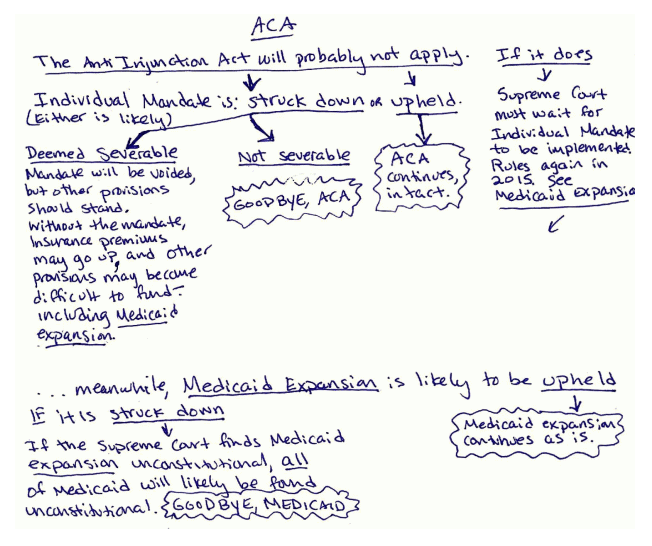
A ‘Back of the Napkin-esque’ Review of the SCOTUS ACA Decision Tree

By Gregg A. Masters, MPH

While trolling for interesting tidbits on the web, I came across what appears to be a simplified representation of the impact of the Court’s ruling. The original piece was offered by Emily Corwin and posted under the title ‘SCOTUS And The Affordable Care Act: An Overview.’

A deeper dive into the ‘WIFM’ department i.e., what’s at stake, Corwin frames the following source quotes:

Medicaid

If struck down, Medicaid itself could be deemed unconstitutional. This would create radical changes, since “medicaid is the workhourse of the nation’s health system, covering 30 percent of all children, 70 percent of nursing home residents and 40 percent of all deliveries,” reports Phil Galewitz.

If upheld, many more people would become eligible for Medicaid. The federal government would assume much of the additional costs initially, slowly transferring 10 percent of that burden to states by 2019.

Seniors

If struck down, “49 million Medicare beneficiaries could lose a variety of benefits that have already kicked in,” writes Marilyn Werber Serafini. These include prescription savings, preventative services, and wellness visits. However, if only the individual mandate is struck down, “nearly all of the health law’s Medicare changes will remain intact.”

Women

Even excluding maternity coverage, the National Women’s Law Center found that nearly one-third of the most commonly sold insurance plans charged women aged 25 to 40 at least 30 percent more than men for the same coverage,” writes Julie Appleby. The ACA would bar insurers from charging women higher premiums than men. Other provisions include requirements regarding maternity coverage, and removing copays for mammograms and contraceptives.

With additional source reference to ‘What’s at Stake for Patients‘ and A Consumer’s Guide to the Health Care Reform Law‘ as credible third party issue framing and explanation.

Thank you @EmilyCorwin!

SCOTUS and the ACA: Reflections on the Judgements of the Court

By Gregg A. Masters, MPH

On a special edition of ‘This Week in Accountable Care‘ we’re hosting a post ‘SCOTUS’ (Supreme Court of the United States) reflections session to consider the implications of their rulings.

We’re somewhat ‘on call’ in the scheduling department but SCOTUS must announce their opinion on Thursday, June 28th shortly after 10AM Eastern/7AM Pacific. So our show is slotted for 11AM Eastern/8AM Pacific.

The guest line-up is somewhat fluid but invites have been extended though not yet confirmed.

For context on the Affordable Care Act and reading the SCOTUS ‘tea leaves’ as well as some commentary see here, here and here.

As a point of clarification the innovation train under the broad framework of the accountable care movement as more specifically expressed via the pursuit of the ‘triple aim’ has been successfully introduced into the DNA and consciousness of the healthcare stakeholder community. Afterall, who can defend ‘un-accountable care’ (aka the status quo), anybody?  In a sense whatever SCOTUS ultimately decides is in part irrelevant, see: ‘ACOs are here to stay – Whatever the Court decides‘, ‘Life After the Supreme Court Ruling‘ and ‘ACOs not tied to health reform law’s fate, report finds‘ which suggest the ruling will not slow down the pace of delivery system and funding innovation the Act envisions both in the government as well as private sectors.

We will be tweeting and tagging to this broadcast via #ACOchat. For the tweet-stream see ACOchat.org.

To join us live or via archived replay, click here.

Un-bundling ‘the Act’: More Facts Amidst the Noise, Misinformation and Dumbed Down ‘Anger’

By Gregg A. Masters, MPH

It is past time to stand for clarity in the consideration process of the Patient Protection and Affordable Care Act aka ‘the Act.’

Even this far down the line, the benefits of the Act remain elusive to many both in and outside of the Beltway and the very limited attention span of the American public – from Joe Sixpack to so-called elites who spent some time in ‘kollege.’

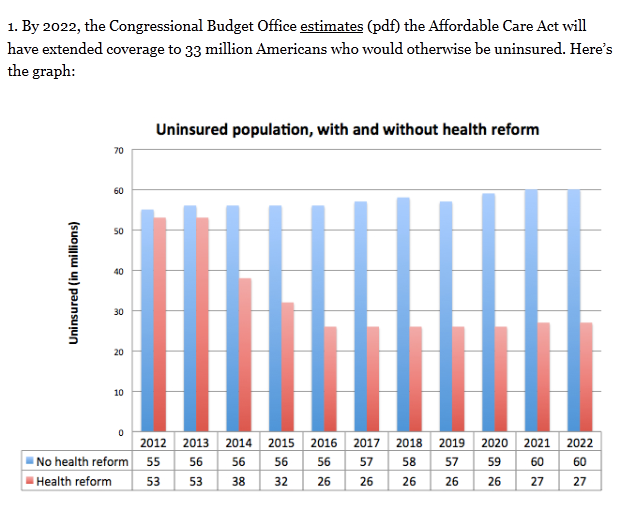
Thanks to one of the more disciplined and articulate health wonks in the space let me draw your attention to ‘11 Facts About the Affordable Care Act‘ by @EzraKlein.

As an uninsured self employed boomer with 3 plus decades in the belly of the beast, I am particularly interested in the narrative behind this graphic:

I find it amusing and somewhat troubling that my access to quality, affordable healthcare fate rests to a large degree in the hands of 9 insured Federal jurists [employees with lifetime appointments] perhaps mindful of the sentiment of a largely misinformed public, too often cheered on by special interests, who see their business model(s) at risk. Not to mention the claims by some that the enumerated list is NOT ‘factual’, even though the data-points are reported by credible sources with standing in the discourse in the public domain. Yet, one of the comments objected to the use of projections built upon decades of both public accounting and budget forecasting practice was challenged as ‘facts’, i.e., the project savings and costs of various initiatives, etc.

Beagle1
7:02 AM PDT

I’d hardly call estimates of what may happen in the future “facts”. More like wishful thinking. In that category, I’d put s 1, 9 &11. Remember that Medicare was supposed to be a bargain, and in the ensuing years its costs have ballooned beyond anyone’s wildest expectations. That prognosticators predcit the ACA to be any different astounds me

This argument merely underscores the opportunities for obfuscation if not diversion from the central conversation which is that lives are at stake.

None-the-less, it is imperative for the ‘skin in the game’ public and I am not limiting this pool to the uninsured or under-insured demographic sectors, e-patients and health activists, but all of us to get what this Act has already done, or positions via staged incremental progress (see the ‘What We’re Doing‘ series of initiatives led by the Center for Medicare and Medicaid Innovation, aka @cmsinnovates, not to mention the litany of private commercial market initiative witness @Aetna, @UHG, et al) into the future of a sustainable financing and delivery platform.

What was the message from Star Wars in ‘How Liberty Dies scene?’ Answer:

with thunderous applause…

usually via the ‘don’t confuse me with facts, my mind is already made up’ crowd.

And ‘the Act’ is…

By Gregg A. Masters, MPH

Per the SCOTUS blog:

Amy Howe:

“We do not expect any additional opinions today, so NO health care today.

Few laws have and continue to stir up such emotion, political spin and both authentic and misinformed interest. Perhaps the mood [for some of us] is best captured in the following tweet:

@JeffreyYoung_HC: “The waiting is the hardest part.” – Justice Tom Petty

For an excellent compendium of resources both legal and otherwise, see: ACA Litigation Blog.

More later!

Early Returns: ACOs Improve Management of Patient Populations, Offer Short-Term Savings

by Bryn Nelson, PhD

Opportunities to be more efficient are largely under care of hospitalists, ACO director says

Several years ago, Presbyterian Medical Group in Albuquerque, N.M., decided to integrate three elements of its healthcare system: its health plan, the employed medical group, and the hospital delivery system. Knitting those parts into a cohesive whole helped the group realize that “lowering the cost of care by improving efficiency, by improving coordination, and by enhancing collaboration between payor and physicians made a lot of sense,” executive medical director David Arredondo, MD, says. When the accountable care organization (ACO) concept came along, Dr. Arredondo says, “it really was just a natural extension of what we were doing.”

The ACO model, championed as a way to prevent the fragmentation of care and rein in costs by getting providers to assume joint responsibility for specific patient populations, received a major boost through 2010’s Affordable Care Act. Last year’s ACO rule-making process by the Centers for Medicare & Medicaid Services (CMS), however, was anything but smooth. Cautious optimism by such organizations as SHM gave way to loud complaints over the initial rules for a voluntary initiative called the Shared Savings Program. Critics asserted that participants would be forced to assume too much financial risk while being swamped with paperwork requirements.

By year’s end, though, the final rules had assuaged many of the biggest concerns, and the April 10 announcement of 27 participants for the program’s first round—more than half of which are physician-led organizations—has rekindled much of the enthusiasm. According to CMS officials, the agency is reviewing more than 150 applications for the program’s next round, which will begin in July.

Keys to Success
In December, CMS selected 32 organizations to participate in an even more ambitious initiative called the Pioneer ACO Model. That separate but related experiment in shared accountability launched Jan. 1, and it may be months before enrolled organizations can say whether the rewards outweigh the risks. Interviews with Presbyterian’s Dr. Arredondo and two other Pioneer participants about why they took the plunge, however, have highlighted some potential keys to success.

All three agree that the ACO model offers a better match for their long-term, patient-centered goals and that the fee-for-service model is gradually becoming a thing of the past.

“In some ways, it was actually kind of a relief that the system was going this way because we, probably like many systems, were beginning to be caught between the budgeted model and a fee-for-service model,” Dr. Arredondo says. “When you’re heavily one way or heavily the other way, then it makes things a little easier to manage and understand. When you’re right in the middle, it becomes a little uncomfortable.”

Penny Wheeler, MD, chief clinical officer for Minneapolis-based Allina Hospitals & Clinics, says organizations in that precarious position need to carefully examine their capabilities and consider how best to pace their transition. Otherwise, they might prematurely give up too much revenue that could be used to reinvest in care improvements.

“We can tolerate it if we shoot ourselves in one foot, but we can’t tolerate it if we shoot ourselves in both feet, in this new world,” Dr. Wheeler says.

If caution is warranted, she says, the ACO model still aligns well with a strategy of building toward outcome-based healthcare. Despite the likelihood of “lumps and bumps and warts along the way,” Dr. Wheeler says, “we really wanted to be part of the shaping of that outcome-based delivery, and receive market rewards for what we were creating for our community.”

Austin, Texas-based Seton Health Alliance, a third Pioneer participant, is a collaborative effort between a hospital delivery system known as Seton Health Care Family and a multispecialty physician group called Austin Regional Clinic. Greg Sheff, MD, president and chief medical officer of the ACO, says the partnering organizations were separately moving toward more population health initiatives and more proactive, coordinated, and accountable care.

“The Pioneer ACO, for us, really provided an opportunity to light the fire and motivate the organizations to put the entity together and start doing the work,” he says, adding PCPs and hospitalists will be critical to his organization’s ongoing integration efforts.

“The areas where there are opportunities to be more efficient are largely under the care of the hospitalists,” he says, citing in-house utilization as well as care transitions, comprehensive post-acute placement, and readmission prevention efforts. To support those providers, Pioneer participants say well-designed electronic medical records are paramount, while separate efforts, such as patient-centered medical homes and unit-based rounding, might offer timely assists. (Click here to listen to more of The Hospitalist’s interview with Dr. Sheff.)

No one’s expecting the next few years to be seamless, but Dr. Sheff views his newly formed ACO as a long-term endeavor in which success isn’t necessarily defined by whether the group achieves shared cost savings.

“We define success by whether we are able to move our delivery system to a place where we’ll be much more adept at going forward, continuing to manage populations,” he says. “We really see this as a strategic organizational decision more than, ‘Boy, that contract looks like something that we can leverage in the short term.’”

Bryn Nelson is a freelance medical writer in Seattle.

This article originally appeared in The Hospitalist.

How Hospitals Can Test the Waters of Accountable Care

By Gregg A. Masters, MPH

Found on the Accountable Care Bulletin.

Hospitals considering accountable care strategies have plenty of options to choose from, but deciding where to begin can be confusing. Joseph Damore, Vice President of Engagement and Delivery for Premier, explores how hospitals can test the waters of accountable care, from engaging staff in wellness to partnering with local employers on population health.

ACOs, Patients, Consumers and the Dark Matter Glue that Makes it All Work

By Gregg A. Masters, MPH

It’s been a brutal pace and schedule of late and one of the pieces I’ve omitted from presenting here is titled: Building Patient-Centeredness in the Real World: The Engaged Patient and the Accountable Care Organization‘ proffered by colleague and friend Michael Millenson, aka @MLMillenson, President, Health Quality Advisors LLC.

I received a heads-up on the timely publication and further notice during the Third National ACO Summit, so better late than never Michael!

This is a great piece since it weaves many contemporary threads into the healthcare system redesign imperative. Inescapable synergies resonate from the e-patient movement, to the growing interest in the Society for Participatory Medicine, the continued explosive growth of engagement in social media, and the Final Rule relative to the implementation of both ‘shared governance’ and ‘patient centered-ness’ provisions of ACOs.

It is no secret that the patient’s (consumer’s) role in the ‘triple aim’ is as principal and partner. We are drowning under the weight of diseases of lifestyle choice. Before you even grant consideration to the cost shifting from plan-to-member that is permitting many of the group, individual, and even Medicare Advantage plans that are written and offered today, the handwriting is and has been on the wall that the burden for bending the cost curve has been squarely placed on the shoulders of the member/patient/consumer.

This piece is a must read, and welcome addition to the growing body of knowledge advancing the democratization of the healthcare experience!

Un-bundling the Act: Provisions for ACOs

By Gregg A. Masters, MPH

We heard a lot about the rough life of Federal legislators when one of the material objections aka ‘talking points’ to actually considering the thoughtful remedies borne via public/private discourse and years if not decades of health policy development and experience outlined in the Patient Protection and Affordable Care Act was it’s weight and the corresponding number of pages found therein. After all an industry which represents 1/7th of the US Economy, consuming approximately $2.7 trillion in 2010, when compared to most if not all other industries seems to posses characteristics somewhat unresponsive to traditional marketplace demand and supply equilibrium. After all, few other industries create their own demand inside a rather complex and opague theater for such an essential human service.

As we sit poised for the decision on the constitutionality of the individual mandate, if not the Act in it’s entirety, why not take a summary look at both the provisions specific to ACOs, the balance of the Act, as well as it’s staged implementation timeline.

Courtesy of the Kaiser Family Foundation:

Accountable Care Organizations
Section 3022 of the Affordable Care Act

Allows providers organized as accountable care organizations (ACOs) that voluntarily meet quality thresholds to share in the cost savings they achieve for the Medicare program.

Implementation: January 1, 2012

Implementation update: On April 7, 2011, the Department of Health and Human Services published a proposed rule in the Federal Register defining Accountable Care Organizations and set out requirements for governance, legal structure, transparency efforts and the incorporation of evidence-based medicine and quality efforts. HHS also released facts sheets for providers and consumers, as well as fact sheets on legal issues and quality scoring in ACOs. The Federal Trade Commission and Department of Justice issued a joint policy statement on antitrust issues related to ACOs. On May 20, 2011, CMS issued a request for applications for the Pioneer ACO Program, which is targeted at organizations that can demonstrate the improvements in quality and cost-savings of a mature ACO.

On December 19, 2011, CMS announced 32 health care organizations that will participate in the new Pioneer Accountable Care Organization project.

All Eyes on SCOTUS Decision Expected Later This Week?

By Gregg A. Masters, MPH

We’ve been in a quiet period since the Supreme Court of the United States (SCOTUS) accepted the series of challenges to the Patient Protection and Affordable Care Act, yet the buzz factor is up via the blogosphere, social media and both broadcast and cable news media outlets as some expect the decision of the court to be reported later this week.

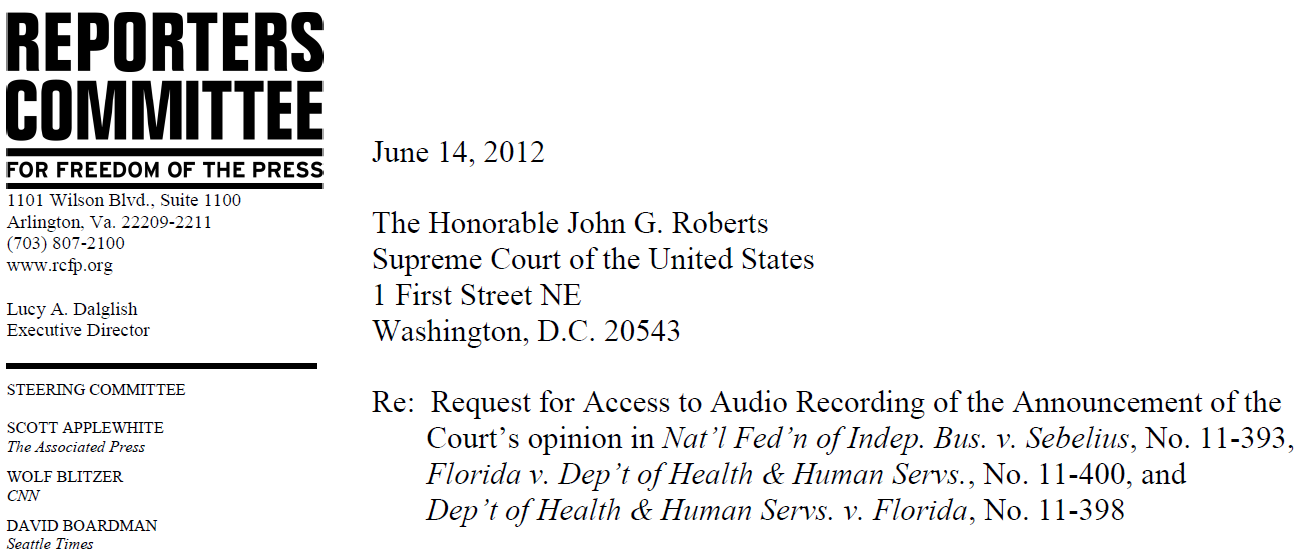
Of interest is the letter submitted via the The Reporters Committee for Freedom of the Press, representing major news outlets and a series of co-sponsoring entities have petitioned the Court as follows:

The Reporters Committee and media coalition are asking the Court to allow live audio and video coverage of the release of the opinion in the health care cases.  In the conclusion of the letter, we are asking that if the Court decides not to allow live audio and video, that it at least release the Court’s own audio recording of the hearing as soon as the hearing ends.

In the tea leave reading department, and via a mock if not proforma review of the outcome of the ruling David Dranove , writes on The Healthcare Blog: ‘ My Initial Reaction to the Supreme Court Decision:’

In ruling on the constitutionality of the purchase mandate, the Supreme Court has also decided the fate of the entire ACA. I thought that Justice Scalia makes a valid argument that health insurance exchanges would likely fail without the mandate, and that without exchanges, the entire ACA fails apart. His understanding of selection bias makes me believe he would have been a terrific economic theorist! But am I the only one who thinks it ironic that he appeals to economic theory here but ignored the equivalence of taxes and rebates? Justice Ginsberg also shows surprising economic depth, noting that the adverse selection “death spiral” is not a given and that exchanges would probably survive without the mandate. And when she cites my colleague Ben Handel’s paper on inertia in health insurance markets, I am truly awed. Thanks to the Supreme Court decision, we may never know if Justice Ginsberg is correct.

The impact of SCOTUS decision on accountable care and ACOs in particular is also the subject of widespread debate and active consideration. Some argue that the ‘It’s Too Late To Turn Back: A Transformation To Wellcare Has Already Begun‘, and that even if the Act we repealed in it’s entirety or effectively ‘gutted’ as a result of ruling the individual mandate as over-reach and therefore unconstitutional, the market place dynamics already in play are moving in the direction of the ‘spirit’ of the Act up to and including the pursuit of ACOs as primary market transformation vehicles.

We’re considering hosting a simulcast ‘Tweet-chat’ on ACOchat.org, using the hashtag #ACOchat with a live radio broadcast on ‘This Week in Accountable Care.’ We’ll be somewhat on call as to the timing, fulfillment of the undertaking, but be sure to follow us on Twitter via @ACOwatch and @2healthguru as the plans for the chat will be announced via these real time tools upon the release of the decision.