ACO train has left station SCOTUS decision irrelevant to market innovation?

By Karen M. Cheung

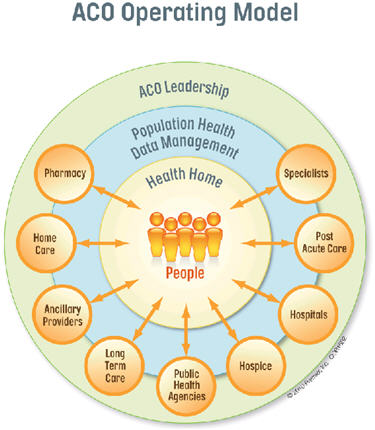
Regardless of how the U.S. Supreme Court will rule on the healthcare law, accountable care organizations are moving forward in coordinating patient care, improving quality and cutting costs. With yesterday’s announcement from the Centers for Medicare & Medicaid Services, 27 providers will be embarking on the Medicare Shared Savings Program, effective April 1.
The Medicare Shared Savings ACOs will follow the first 32 Pioneer ACOs, announced in December and launched Jan. 1.

“It’s not changing anything for us,” Atrius Health Executive Director Emily Brower, a Pioneer ACO in Massachusetts, told Kaiser Health News. “This is a model of care we’ve been trying to evolve into since before the Pioneer program existed.”
“We’ll continue making investments, and if the law is overturned, we’ll be asking where the return on investment is for us, if not in shared savings,” Brower continued. The return on investment “might be in patient growth because our patients become increasingly satisfied with the quality of care we provide.”

Although experts predicted hospitals would be leading the charge on the new payment models, the bulk of the ACOs announced yesterday are made up of physician-led organizations, CMS Deputy Administrator Jonathan Blum told Kaiser Health News. The selected ACOs include more than 10,000 physicians, 10 hospitals and 13 smaller physician-driven organizations, according to CMS.

The move toward ACOs, by CMS’ count, will..

Read complete article on FierceHealth, here.

Inside ‘accountable care’, challenges to the ACO

By Gregg A. Masters, MPH

We hear considerable chatter on both sides of the ACO or ‘AC/e’ for accountable care focused enterprise absent the organizational drama of fielding an entity per se with the right structural roots or cultural ‘DNA’.
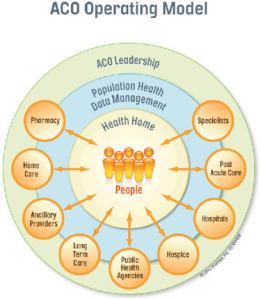
Yet, as someone with principal leadership immersion both setting up and managing the ACO ancestry down line if you will, I am mindful of the continuing granular nature of the challenge from the patient’s point of view.

When one considers the ‘faith based’ trust voucher like programs place on seniors becoming prudent (empowered) purchasers if not negotiators on their own behalf, the following experience raises some fundamental challenges in re-engineering a patient-centric healthcare eco-system.

In March of 2011 my 80 year old mother embarked on the labored journey of being ‘diagnosed’ and subsequently treated for breast cancer. The patient, an otherwise ‘age appropriate healthy’ and vibrant woman, took the parsed delivery and serial but strained confirmation of the diagnosis as an attraction into women’s health advocacy – I will explain shortly, and thus attempt to illustrate the accountable care challenge in this ‘n of 1’ experience.

I emphasize diagnosis with a mild dose of intentional sarcasm, as while the process played out it revealed multiple systemic flaws within our overpriced, discontinuous, and increasingly from a value proposition perspective ‘diminishing returns’ sick care ‘confederation’. Which according to Wikepedia is defined as:

A confederation in modern political terms is a permanent union of political units for common action in relation to other units. Usually created by treaty but often later adopting a common constitution, confederations tend to be established for dealing with critical issues such as defense, foreign affairs or a common currency, with the central government being required to provide support for all members.

But wait, this is offered in the context of a political situation. Precisely! Our healthcare, ah hem, metastasizing, commission based sick care fulfillment industry is very much a confederation of political sub-divisions defending their ‘turf’ if you will. Unfortunately in healthcare we lack the central unifying governmental role. Yet, in the typical hospital setting simply look at the political subdivisions of medical staff organization vs. an administration generally supported by a ‘paramilitary’ nursing organization, with more often than not a challenged Board of overseers given their stewardship agenda. Need another metaphor, check the myriad of medical specialty societies and watch them define and defend their interests, i.e., distribution of the cognitive vs. procedural income pie. Case closed?

Now back to the story, but first additional context to color the emerging irony. The source of my mother’s care is a indisputably a ‘best in class’ academic medical center (AMC) recognized by many third party authorities including HiMSS (the Health Information and Management Services Society) as a ‘level 7‘ (the best) facility in terms of it’s adoption and implementation of EHR technology as mission critical infrastructure.

One minor issue though is the ‘cancer center’ as a service line aggregating entity for the primary oncology specialties (e.g., hem/onc, radio therapy, etc.), is not online with the medical center’s EHR hub aka EPIC.

Yet the patient has been in a long term relationship with her primary care physician of at least seven years duration and who’s department, internal medicine, was the first service to go live with EHR implementation. Yet the primary care physician (and the entire department for that matter) was unaware of any of the patients experience or care process in the cancer center.

Thus a bit of a ‘data liquidity’ and patient care coordination challenge when it comes to a seamless patient experience relative to coordination and scheduling over certain legacy departmental silos. Remember the mantra of ‘patient centricity?’

Thus even in a top performing academic medical center that represents itself as a ‘health system’ in advertising and branding copy, the gaps in patient care are real and many. As a result, ‘accountability’ for the essential care coordination and broader navigation interests to obtain high quality and responsive care is in many instances deferred to the patient and his or her family as principal advocate.

Now back to the diagnosis issue. In March of 2011 an annual ‘routine’ screening mammogram created some diagnostic concern, as it was immediately followed by a (non routine) same day ultrasound. Shortly thereafter the departmental chair approached the patient with the following representation:

We see something we think is nothing but ask you to return in 6 months for a recheck [vs. the annual checkup interval]

The patient complies. Six months later a notice was dutifully received to return for the scheduled follow-up. This re-engagement interval began a series of progressively up-leveled and hierarchical interactions between an ultrasound tech, staff radiologist and ultimately the service or department chief with the following recommendation:

We still think it’s nothing but, I want a single fine needle aspiration biopsy done immediately

This call for ‘immediacy’ of the needle biopsy caused some genuine ‘terror’ in that moment for the patient. Unfortunately (perhaps at the time, though in retrospect a ‘good thing’), the procedure could not be scheduled until several days later.

Meanwhile in an alarmed state of an uncertain health status the patient called a women’s health activist for support. She recounted the facts of her encounters and AMC recommendations for follow-up. Upon hearing what played out, an appointment was immediately scheduled with a whole breast imaging (WBI) specialist outside the AMC’s medical staff. Prior to the appointment the whole breast imaging radiologist requested access to AMC’s mammogram and ultrasound imaging to date. The patient then journeyed back into the AMC requesting and obtaining same.

At the WBI center and post scanning the patient was told that of the two suspicious lesions identified by the AMC, neither where malignant. However, the whole breast imaging radiologist made a definitive call that another, deeper lesion not seen on the AMC mammograms or ultrasounds to date, was in fact ‘ductile invasive’ carcinoma.

Patient’s note:

Had I gone through with the recommended needle biopsies of the two suspect lesions, the likely results may have produced a ‘false negative’, with perhaps a return to the routine yearly screening schedule.

Needless to say this is not in the patient’s interest when an undetected malignancy goes untreated for another six or twelve months. [Editors’ Note: Clearly an incorrect diagnosis and resulting delay in appropriate care management can not be considered quality nor accountable care].

Now presented with conflicting diagnostic reads of her condition, patient returns to AMC for biopsies ordered by breast surgeon and presents WBI report to invasive radiologist who read it and says:

let’s go do the double core excavation biopsies.

Patient complies.

First lesion is ‘clean’ per radiologist. Second lesion caused some interactions between interventional radiologists centering on location and positional considerations of both breast and shoulder to correctly locate suspect lesion. Patient was not clear, i.e., she trusted the interventional process, as to whether AMC concerned themselves with ‘invasive ductile carcinoma’ call by the non AMC whole breast imaging radiologist.

To fast track forward, post multiple biopsies, and another MRI, the definitive diagnostic decision is delivered ‘you have cancer’ (some eleven days after WBI radiologist delivered the news).

This is one patient’s experience that raise issues on multiple levels, and may not be unique. Here are just some of the operational and system questions the experience raises on the path to accountable care:

  • Who is advocating for the patient when even in enlightened health systems too many of the constituent players remain domiciled in legacy departmental silos?
  • Why is the burden of delivering competent medical opinion outside of a network or health system solely on the patient to ‘make happen?’ Why such ‘data illiquidity?’
  • Who are the parties in interest to remedy systemic failures, i.e., departmental silos not communicating internally in an otherwise reasonably advanced health information technology savvy culture?
  • What role, if any, does the health plan have to re-mediate if not resolve systemic problems adversely impacting care coordination if not quality and outcomes of their ‘members’?
  • Can systems of care and academic systems in particular legitimately discount if not ignore ‘inputs’ provided by out of system participants? For instance, if a department of radiology dismisses whole breast imaging as a valid diagnostic tool, can they toss it aside and leave it solely to the patient to make it part of the diagnostic and treatment consideration process?

There is considerably more to this story. This includes only the breast cancer diagnostic and initial treatment process portion. The next phase will drill into the after treatment continuum and the many gaps in care that currently exist outside of tightly managed integrated delivery systems, and the real world impact this ‘black hole’ has on the patient both from a psycho-social as well as physical health status perspective.

The next blog post will focus on the role of the health plan to acknowledge and remedy apparent gaps in the downstream continuum of care once disclosed. We’ll attempt to frame the concern from both a population management and total health perspective under the triple aim umbrella. Considering the ACOs will assume broad systemic liability for the health status of the members assigned to the ACO all consequential gaps in care will need be remedied if the entity is to reduce readmission risk, and well as minimize the quality and cost consequences of delayed care due to incorrect or misdiagnosis of underlying disease, while restraining the growth rate of healthcare expenditures in an ‘at risk’ and aging population.


Medicaid and HITECH Conference: Fourth Annual

By Gregg A. Masters, MPH

From the CMS. Originally posted here.

To view the live conference video streaming feed, including accessing the agenda and related conference materials and handouts, click here.

Please join the Centers for Medicare & Medicaid Services (CMS) as we host a three-day conference for State Medicaid agencies, and other Federal and State partners.  The conference will focus on the Medicaid EHR Incentive Program and Health Information Technology.

Conference attendees will have an opportunity to:

  • Participate in dynamic workshops with CMS, Federal partners, State Medicaid colleagues, and industry leaders;
  • Share best practices and lessons learned on issues related to implementation, financing, operations, and other areas that will help demonstrate the value and impact of health information technology and health information exchange;
  • Collaborate with agencies such as the Office of the National Coordinator for Health Information Technology (ONC), the Health Resources and Services Administration (HRSA), the Agency for Healthcare Research and Quality (AHRQ), Indian Health Service (IHS), and the Centers for Disease Control and Prevention (CDC).

Dates: April 10-12, 2012

CMS will host a three-day conference beginning on the afternoon of Tuesday, April 10 through the afternoon of Thursday, April 12.

Daily Registration and Session Schedule
Tuesday, April 10, 2012:
Registration 8:00 a.m. – 6:30 p.m.
Sessions 12:00 p.m. – 6:30 p.m.
*New Medicaid HIT Staff Orientation 9:00 a.m – 11:00 a.m.
Wednesday, April 11, 2012:
Registration 7:00 a.m. – 6:00 p.m.
Sessions 8:30 a.m. – 6:00 p.m.
Thursday, April 12, 2012:
Registration 7:00 a.m. – 3:00 p.m.
Sessions 8:30 a.m. – 3:00 p.m
Location:  Hyatt Regency Baltimore on the Inner Harbor300 Light StreetBaltimore, MD 21202


ACOs: A promising report ‘from the front’ via IOM

By Gregg A. Masters, MPH

The prevailing sentiment towards ACOs in the market today can be grossly divided somewhere between the skeptic camp perhaps most gently represented by the oft quoted ‘unicorn’ attribution, credited to Mark Smith, MD, MBA, President and CEO of the California Healthcare Foundation:

The accountable care organization is like a unicorn, a fantastic creature that is vested with mythical powers. But no one has actually seen one.

And the ‘bullish’ camp, aka ACO evangelistas, more often than not associated with the proponent think tanks of ACOs including Don Berwick, MD, both at IHI (and a brief but productive tenure as Administrator at CMS), and Elliott Fisher, MD, et al, perhaps best framed as ‘faith based’ expectations to tame the beast, though ‘on the come’. This cautious optimism was tempered in part by decades of failure and the mixed results reported in 2011 by the Physician Group Practice demonstration project, see: “Lessons from the Physician Group Practice Demonstration — A Sobering Reflections.”

Which is why the recent IOM Report, titled: ‘A Path to Accountable Care‘ a report from the front if you will, is so welcome and timely. It puts meat on the faith based bone of whether ACOs can actually deliver on the promise of the ‘triple aim.’

What’s critical here is the level of stakeholder engagement to structure a proactive partnership from payor, to institutional provider, and participating medical groups. All of the principals are mature managed care players in their own right including Blue Shield of California, Dignity Health (formerly Catholic Healthcare West), and Hill Physicians Group.

According to Bodaken: ‘Dignity Health, Hill Physicians Group, and Blue Shield launched the pilot with the California Public Employees’ Retirement System (CalPERS) in January 2010. The pilot covered more than 40,000 Blue Shield members assigned to Hill in the greater Sacramento region. This represented about 75 percent of the CalPERS member population and accounted for about 75 percent of all dollars being spent for hospital services in the Sacramento area.’

To quote key summary metrics from the study:

By the end of the year, the collaboration achieved $15.5 millionin savings, which translated to no premium increase for CalPERS members in 2010. The savings largely resulted from a 15 percent reduction in inpatient readmissions and a 15 percent reduction in inpatient days utilized. Further, inpatient stays of 20 or more days were reduced by 50 percent. These, of course, tended to be catastrophic cases and often the most expensive hospital costs per day.

The foundation for these results is a three-way risk arrangement that plays a key role in keeping the parties aligned. The arrangement puts each party at financial risk for meeting per-member, per-month (PMPM) cost targets spanning institutional, professional, pharmacy, and ancillary services. Since each party has both upside and downside potential for health care expenditures, each is incentivized to cooperate rather than compete for revenue.

Ok folks, so we’ve spotted one (ah hem, a unicorn), and go figure it’s not Kaiser, Geisinger, nor Mayo – the usual suspects. Perhaps more striking is that fact that the arrangement is of all things a community based ‘network model’ of accountable care with rather impressive metrics and real world impact. The caveat then is that all healthcare is local, and it just so happens that all of the principals in this conversation are proactive, seasoned, and risk savvy players, not necessarily ingredients that you will find in Atlanta, Austin or Anchorage per se.

None-the-less, a hat tip to Bruce Bodaken, President and CEO of Blue Shield of California (@blueshieldca), Darryl Cardoza, CEO and Steve McDermott (former CEO), of Hill Physicians , and Lloyd Dean, President & CEO, and the good sisters at Dignity Health (@dignityhealth), fka Catholic Healthcare West, for their steady hands, vision and demonstrated leadership. You collectively represent:

a force of nature, vs. the feverish clod of grievances and ailments complaining that the world will not devote itself to making you happy.

FTC v. OSF Healthcare

By Gregg A. Masters, MPH

One of the more popular downsides associated with the growth and dispersion of ACOs in provider [primarily of the ‘institutional variety’ aka hospital/health system] consolidation and asset concentration, is the risk of anti-competitive pricing leverage. You know, the ‘my way or the highway’ approach of certain providers with near or actual ‘sole source’ standing in their markets.

Concurrent with the release of the final rule for ACOs were a series of enabling related agency rulings on the treatment of ACOs from tax, and anti-trust perspectives.

Just today, the FTC released a statement on the U.S. District Court’s ruling granting a preliminary injunction in the OSF/Rockford Hospital Matter:

The Court’s ruling today temporarily blocking OSF’s proposed acquisition of Rockford Health System is a victory for both competition and consumers. We continue to believe in the merits of our case, and that if this deal is ultimately allowed to proceed, the result will be less competition and higher health care prices in the Rockford area. We look forward to presenting our case before the Administrative Law Judge later this month.

Clearly this is one in a continuing series of actions FTC will take when the perceived scale is deemed tipped in favor of excess provider consolidation, and thus adding to an anti-competitive market.

ACOs [or the strategic positioning of same] are causing the DOJ and FTC to reconsider their thresholds and indicia of ‘equilibrium’ between acceptable payor/provider marketplace balance. Certainly there is more to come as we progress.

It may be completely coincidental timing, but OSF Healthcare appears in a write up at FierceHealth, titled ‘OSF Healthcare Exec on the Pioneer ACO journey‘.

Yes, we do live in [very] interesting times!

Accountable Care and Social Media: Can it connect the silo’s?

By Gregg A. Masters, MPH

In an article posted on KevinMD by the always learned and insightful George Lundberg, MD*, the question was posed:

can ACO’s re-invent the American Health Care System?

A rather compelling and timely question given the fragmentation and vertical silo’s characteristic of American health care finance and delivery, and the ‘patient-centric’ enhancements the ‘social media tool set’ seems to afford. Yet, there was a limited and in my view somewhat ‘unbalanced’ response. As someone familiar with the thought leadership ‘gene pool’ of social media, and healthcare social media sub-set in particular, I was struck by the absence of their voices [including yours truly] in the comment section.

Yet, the substance of the question is on point to a Health Information Technology Social Media TweetChat I will moderate this Friday, April 6th, 2012 at 9AM Pacific via the hashtag #HITsm. For the most recent tweets tagged with #HITsm, click here.

The flaws in our imploding house of cards ‘sick-care [non] system’ are recounted seemingly everywhere these days. And the recent preoccupation of the Supreme Court of the United States with the constitutional challenges of the Patient Protection and Affordable Care Act, places the question of what are the best practices to restrain and re-orient an overly paternalistic, too costly, unsafe and increasingly inaccessible industry that many would say has lost it’s way.

While Dr. Lundberg is hopeful:

We can build a new medical world based less upon process, quantity, volume, and lucre, and more on quality, safety, speed, outcomes, and patient-centered efficiency.

That sentiment is not shared by those called to comment on the piece. Some representative thoughts include:

Come on Dr. Lundberg, take the blinders off.

If grand platitudes can save our system, then ACO’s are a surefire success.

The ONE goal of an ACO: to maximize market share.

ACOs represent an enormous step forward in the corporatization (profit motivation) of American medicine.

Where do you come down? Does any of this negativity fanned by considerable skepticism if not sarcasm of ACOs to pull off what many of its predecessors, i.e., HMOs, PPOs, EPOs, DPOs, etc., have not – at least in the aggregate?

Is it wishful thinking? And what role, if any, does technology play in the remediation – or the ‘this time it’s different’ department? Might social media and the democratization of the patient/provider value proposition change the balance of power and thus drive ‘accountability’?

Here are my suggested topics for the #HITsm TweetChat:

  1. What does ‘Accountable Care’ mean to you?
  2. Can ‘social media’ (broadly cast) enable accountable care or ACOs in particular?
  3. Will physician’s ever play ball, and why? Why not?
  4. If you ran the zoo, where would you start? What tools are essential to build the conversation and enable the transformation?

We should have some fun on Friday. If I omitted any questions more on point for this conversation, please list them in the comments section.

* George Lundberg is a MedPage Today Editor-at-Large and former editor of the Journal of the American Medical Association.

SCOTUS, ACA & ‘Mis-informed’ Justices

By Gregg A. Masters, MPH

As suggested yesterday while ‘the case has been submitted’ per Chief Justice Roberts upon conclusion of Day 3 oral arguments over the constitutional challenges to the Patient Protection and Affordable Care Act, the war to shape the national narrative is well underway.

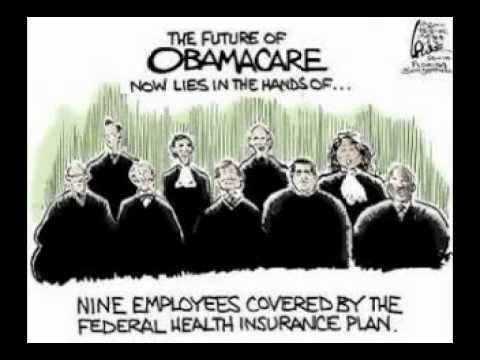
The blogosphere is ripe with buzz over the manner in which the Court conducted itself particularly with respect to the admission of erroneous information aka the ‘broccoli analogy’, and ‘the Cornhusker Kickback‘, the failure to read the actual law under dispute (by at least Justice Scalia), and the apparent echolalia of anti ‘ObamaCare’ right wing talking points, proferred as ‘facts’ in the Supreme Court of the United States.

As contextually offered by former Reagan Administration Solicitor General, Charles Fried to ABC News in 2010:

Anybody [who questions the constitutionality of the Affordable Care act] is either ignorant — I mean, deeply ignorant — or just grandstanding in a preposterous way.

Not much room for doubt here….and might I add the overwhelming weight of informed healthcare policy wonks and legal thinkers side with Fried’s view.

Fast forward via a recent interview with Ezra Klein of the Washington Post, where former SG Fried further opines given the Court’s current process:

 I’ve never understood why regulating by making people go buy something is somehow more intrusive than regulating by making them pay taxes and then giving it to them. I don’t get it. It was comical to read the Heritage Foundation’s brief attempting to explain why they were changing their position on this. Something needed to be done about this problem. Everyone understood that. So, the Heritage Foundation said let’s do an individual mandate because it keeps it within free enterprise. The alternative was single payer.

I find it fascinating for the capacity of some of us to rationalize anything, as if there is no institutional memory of any kind. That what’s real for some is only within the last 24 hours news cycle or is otherwise in alignment with their more often than not emotionally built ‘world view’. We are indeed living in the ‘United States of Amnesia‘ (or the Studs Terkel re-brand:  ‘the United States of Alzheimer’s) with a portion of the general public apparently unwilling to tether themselves to context and facts vs. purpose driven ideological spin.

Incidentally, this drama has everything to do with ACOs and the accountable care industry. To some degree this movement will advance regardless of SCOTUS for market and structural reasons, yet if nothing else, SCOTUS will impact the ambient background noise if not the direct context in which the competitive drama plays out.

SCOTUS Consideration A ‘Pyrrhic Victory’ Regardless of Ruling

By Gregg A. Masters, MPH

Ladies and Gentlemen, start your engines!

A P/Y/R/R/H/I/C victory is defined by Wikipedia as:

(/ˈpɪrɪk/) is a victory with such a devastating cost to the victor that it carries the implication that another such victory will ultimately cause defeat.

An army of professional, neo-professional and outright ‘amateur’, including skin in the game patients and consumers, healthcare insiders, ‘pigs at the trough’ (of $2.8 trillion ‘healthcare market’) channel partners, and a vast stakeholder constituency with ‘interests’ in the outcome of the SCOTUS decision, are minimally scrambling to position themselves for what’s to come, if not attempt to influence the Court’s ultimate ruling.

As noted in a previous post, 75% of Americans believe the SCOTUS process will be influenced by ‘politics’ vs. the ‘legal merits’ of the arguments submitted to the Court. Ergo, the battle has now entered a new phase to shape the national narrative and ultimately position the consumer friendly public perception of ‘the Act’, or as pejoratively tagged, ‘ObamaCare’ by those less inclined to read vs. deploy cute sound bytes for public consumption.

In an updated post, I will supply some credible contextual pieces to support the following claim:

The President has already won the narrative regardless of the Court’s ruling. We are where we are perceptually for political not legal reasons. Yet, the nature of the malady is apolitical, it is fundamental and structural.

Any attempt to rule in whole or in part the Act as ‘unconstitutional’ will face severe narrative “head winds” and political fallout as very popular line item provisions of ACA are repealed or otherwise diluted.

Meanwhile, a tasty morsel of consumption is offered here c/o Chas Roades, Chief Research Officer of The Advisory Board, titled: ‘Five Quick Reactions to the Supreme Court Hearings.’

SCOTUS and ACA Day 3 Part Deux: Medicaid Expansion

By Gregg A. Masters, MPH

Here is the audio for ‘Florida vs. The Department of Health and Human Services’.

Here is the transcript.

We are actively searching out the submitted briefs and will post them once found. [Editor’s Note: I invite anyone who may have direct access to post them here in the comments section; it will be much appreciated. I do NOT have Nexis/Lexis access].

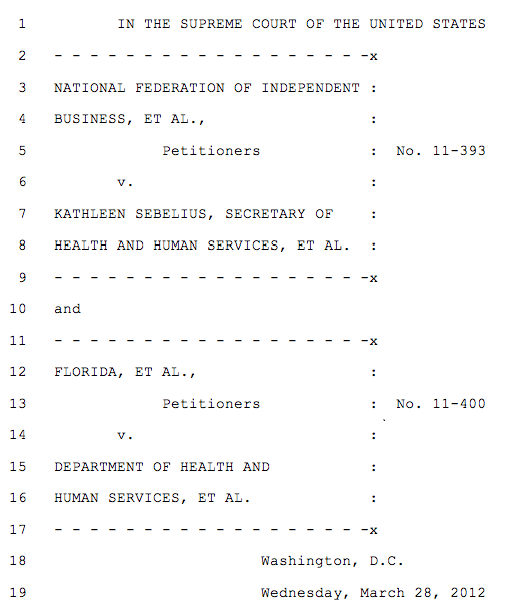
SCOTUS Audio and Transcript: National Federation of Independent Business v. Sebelius

By Gregg A. Masters, MPH

Day 3 is no disappointment. The core argument by Florida AG Clement is that if the  individual mandate is ruled unconstitutional, the entire Patient Protection and Affordable Care Act, absent the severability clause, must fall.

Judging from the robust engagement of AG Clement, including an interesting line of questioning from Justice Kagan, (peppered with periodic audience laughter), his argument was enjoined by a somewhat skeptical Court.

P.S. It wasn’t a ‘cakewalk’ for Deputy SG Kneedler either. The Court is engaged on both sides of the arguments presented. A must listen event!

For the audio proceedings of Day 3, click here.

The transcript is accessible here.

[Editor’s Note: Later today, the Court hears the arguments over states’ rights and the expansion of Medicaid under the Act].