Three Days in Scottsdale: Unbundling the Triple Aim?

By Gregg A. Masters, MPH

With the simultaneous running of the 6th Annual mHealth Summit (follow #mhealth14), Population Health Alliance [PHA] Forum (follow #PHAforum) and Institute for Healthcare Improvement [IHI] (follow #IHI26Forum) I am reminded of the oft quoted Don Berwick, the then Administrator for CMS channeling from his tenure in healthcare both as a clinician and ‘truth to power’ health wonk, of the ‘all hands on deck’ and ‘full court press’ nature of the challenge before the health[care] ecosystem stakeholder ‘leaderbody’ – if you will.PHA Forum 2014 via @ACOwatch

I have chosen to express his challenge more broadly as the mandate to pursue and enable a sustainable healthcare economy, since ‘business as usual’ is no longer even a remote option placed before any credible healthcare leadership whether inside, aligned with or otherwise tethered to the healthcare ecosystem sporting either traditional provider, recipient (patient/consumer) or payor stripes.

The HealthInnovation Media team is on site (me and my co-host colleague Douglas Goldstein aka @efuturist) In Scottsdale at the PHA Forum to interview keynote speakers, session leaders and interested parties to the arguably ‘nascent’ [or minimally rebranded] population health industry.

Just what is ‘population health’ you might ask? Is it ‘Disease Management 2.0’ rebranded and extended into the lifestyle or health side of the equation? Or is it some other programmatic expression yet to be fully defined and operationalized based on local provider/payor geo-political footprints?

The PHA Forum program committee has assembled a thoughtful line-up of talented folk at the PHA Forum 2014 who will address that subject. In particular, I am looking forward to hearing the perspectives (and data) from the founding Dean of the only School of Population Health Management (follow via @JeffersonJSPH), The Jefferson School of Population Health, David Nash, MD, MBA.

For the complete program agenda, click here. You can follow the twitter stream for this event via #PHAforum.

Vetting the ACA’s Impact on Health Insurance Operators

by Gregg A. Masters, MPH

Milliman Health 2013 Briefing Paper ACA ResultsIn contrast to the comprehensive ‘go live’ implementation of ‘RomeyCare’ in the Commonwealth of Massachusetts, the phased (and some would say diluted if not ‘fatally’ compromised) implementation of the Affordable Care Act (ACA) has been muted via a staggered on-boarding schedule of its various component parts and further selectively waived or delayed provisions primarily for political considerations.

Yet, we’re now some 3 1/2 years since enactment of the spirit of the ACA in March of 2010. One of the arguably principal accountability players to advise, measure, and report on the success or failure of the Act’s specific provisions are the good folks at Milliman Health – principal ‘actuaries to the stars’ of sorts.

Milliman often consults on the front end of risk assumption, mitigation – if not avoidance – in the shift from volume-to-value. They also measure and monitor the aggregate performance of the law based on their access to propriety client derived data sets, those residing in the public domain as well as tapping secondary sources in the market place as proxies.

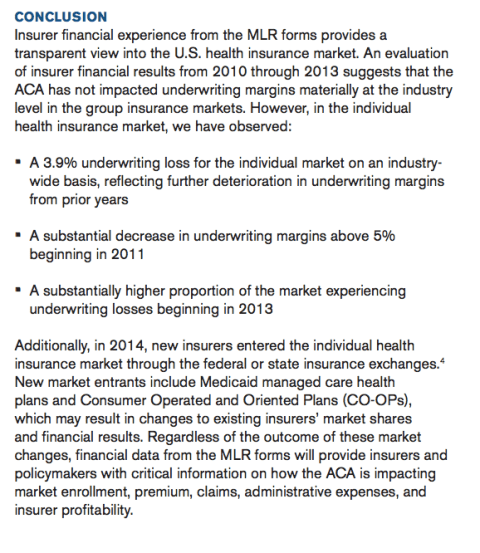
Recently Milliman issued the Briefing Paper: ‘2013 Commercial Health Insurance – Overview of Financial Results’ wherein the report notes:

‘With the Patient Protection and Affordable Care Act (ACA) enactment in March of 2010, health insurers have had to comply with minimum loss ratio requirements, more stringent rate reviews, removal of annual benefit limits, first dollar coverage of preventive care, and other requirements. The insurer experience for 2013 reflects the third year insurers have been required to comply with minimum loss ratio requirements. Additionally, 2013 marks the final year that medical underwriting was not prohibited for new business in the individual and small group comprehensive health insurance markets in many states. Therefore, 2013 commercial health insurance can be used to both evaluate the impact of ACA reforms that were implemented prior to 2013, as well as serve as a benchmark to evaluate insurer financial results moving forward’.

Suffice it to say, there is more meat in the report sourced from various indicia of market performance, but witness the Milliman general conclusion noting:

Milliman  Health Breifing Paper on ACA Results 2010 - 2013

The report provides ‘an overview of health insurer financial results in 2013 and evaluated changes in the health insurance industry’s expense structure and profitability from 2010 to 2013, including changes in the medical loss ratio.’ 

The report’s conclusions are rather instructive and a testimonial of how imposing ‘order’ (or some degree of plan standards and thus comparability to an arguably cowboy market – primarily the individual insurance domain) – has impacted the operations of market participants.

Basically, Milliman is saying some patterns can be more clearly discerned (in group market) while in truth there are too many moving parts and it’s perhaps to early to tell at least in the individual market.

For complete report access click here.

Comment

It remains to be seen how the political theater if not continuing litigious climate will impact the future performance of this initially proffered conservative health policy ideology muscled only into law via straight party line voting. The complexity of our healthcare system is such that any material effort to arrest, mitigate and redirect its underlying healthcare economics will be met with special interest agenda driven resistance if not outright mass public deception.

So in the spirit of the 70s rock band Kansas viaCarry on my wayward son‘, lets be mindful of the timeless advice of Mr. Rogers offered during times of deep national tragedy:

Look for the helpers. You will always find people who are helping.’ ~ Frederick “Fred” McFeely Rogers


ACO Alignment Summit

by Gregg A. Masters, MPH

Day one of the ACO Alignment Summit kicked off in Alexandria, Virginia with excellent presentations from Diwen Chen, Executive Director, Payment Innovation and Accountable Care, Dignity Health, and Michael Donahue, MBA, Vice President, Network Development and ACO Activities for Eastern Maine Healthcare System (EMHS).Dignity Health

Dignity Health a hospital system founded in 1986 with 38 hospitals is the fifth (5) largest hospital provider in the nation and the largest non-profit health system in California. Dignity Health operates 32 facilities in California, with three (3) in Arizona and three (3) in Nevada. The Dignity Health system medical staff boasts 9,000 affiliated physicians, and 500,000 members via four sponsored health plans.

EMHS Eastern Main Healthcare System (EMHS) is a regional integrated delivery system serving all of central, eastern, and northern Maine. Beacon Health, LLC is the organizational model which supports EMHS’ designation as a Pioneer Accountable Care Organization.

Beacon Health, LLC is one of the remaining 19 Pioneer ACOs piloting a program designed to improve the coordination, efficiency, effectiveness, quality, and cost of healthcare.

[NOTE: For more information see: EMHS Beacon Health Pioneer Accountable Care Organization.]

ACOs are key drivers implementing the ‘triple aim’ vision of the Affordable Care Act.  At core the intention is to improve the care delivered to Medicare patients, while transforming the overall healthcare delivery system from volume to value. EMHS deploys approximately 8,000 people in this transformative commitment to accountable care.

According to CMS Beacon Health, LLC experienced the following since admission to the program:

Performance Year 1 (2012): Gross Savings  5.0%

Performance Year 1 (2012): Gross Savings $4.05 Mil

Performance Year 1 (2012): Earned Shared Savings Payments $2.03 Mil

Performance Year 2 (2013): Gross Savings 5.6%

Performance Year 2 (2013): Gross Losses  $-6.26 Mil 

Performance Year 2 (2013): Earned Shared Savings Losses3 $-2.89 Mil 

A limited recap of the day’s presentation highlights is below:

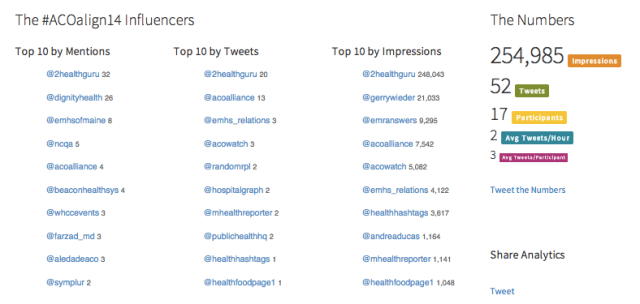
The twitter transcript is herethe updated analytics report here and dashboard here. Reach analytics for Day 1 are pasted below:

Analytics Day 1 ACO Alignment Summit

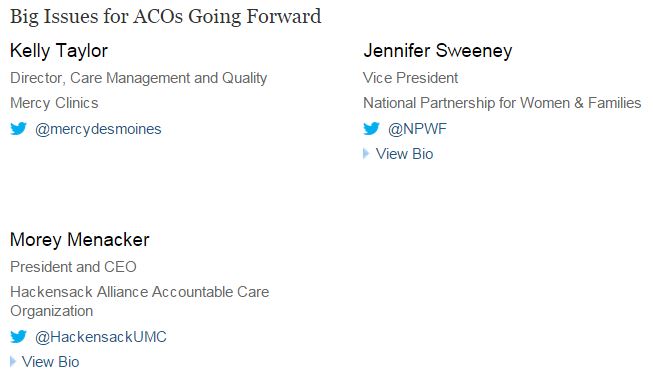
Brookings: ‘Big Issues for ACOs Going Forward’

On October 20, 2014 the Engelberg Center for Health Care Reform hosted a half day forum to assess the latest evidence on accountable care, discuss strategies to overcome unique ACO challenges, and provide an overview of accountable care reforms.

Panel participants included:

brookings aco's big issues going forward

Population Health, Social Determinants & the ‘All Hands on Deck’ Race to Matter

by Gregg A. Masters, MPH

Population Health Alliance (PHA) Executive Director and current Board Chair Fred Goldstein and I just finished chatting with Rain Henderson, the CEO of the Clinton Health Matters Initiative (CHMI) a project of the Clinton Global Foundation.

Rain covered quite a bit of ground from the mission of the Foundation to it’s current relevance and impact given recent signs of less than optimal hand offs between the public health community and umbrella acute care American Medicine infrastructure. We also learn more about CHMI and the broader goals of the Clinton Global Foundation.

To access this timely exchange click here.  pha keynotes2

Rain will provide the introductory remarks at the PHA member session in advance of Esther Dyson’s keynote presentation on ‘The Way to Wellville’, an initiative of HiCCUp.

This will be a powerful gathering of data driven and best practices supported participants in the general pursuit of a sustainable U.S. health care ecosystem and economy aka ‘the triple aim’.

For more information on the PHA Forum see full agenda and schedule.

The State of Accountable Care: Evidence to Date and Next Steps

by Gregg A. Masters, MPH

Brookings Med: ACOfuture

So I registered for the webcast version of this Brookings event titled: ‘The State of Accountable Care: Evidence to Date and Next Steps‘ which noted at 9AM start time. My assumption was Pacific time, so when I dialed in (really logged onto twitter to monitor the webcast hashtag #ACOfuture), the first tweet I saw was thanking everyone for a great program. Yup, the start time was 9AM Eastern, so I missed the live stream. The good news is this event was recorded and is now available for archived replay.

The full program agenda is here and principal deck here.

The line up is impressive and well worth watching for continuing insights into the accountable care theater. What’s working, what’s not, and why?

Enjoy this timely event!

Ebola: What’s Accountable Care Got To Do With It?

by Gregg A. Masters, MPH

I proudly display the ‘MPH” (master of public health) tag awarded by the School of Public Health from UCLA (a long time ago) and have both tweeted and blogged about the ‘we need more MPH’s and less MBA’s’ to solve America’s pressing healthcare challenges (access, affordability and quality imperative or ‘triple aim’) to which we now need to apparently add more robust ‘communicable disease control’ to the ‘value prop’ calculus.

Earlier today I tweeted:

Rick Santelli et al

I meant it…. minimally it’s about your lens, but more importantly ‘values’ in this scramble for purposeful behavior.

It use to be career minded and service oriented professionals where drawn into clinical medicine, the allied health professions (collectively ‘the helping professions’) and healthcare administrative services (their enablers) out of a sense of mission and giving back. So when I enrolled at UCLA in the School of Public Health the ‘route’ into hospital or health services administration was principally via the ‘MHA’ (Master of Health Administration), the ‘MPH’ (Master of Public Health) or even ‘MPA’ (Master of Public Administration) graduate degree programs.

The ‘MBA psychology’ had yet to infect the career progression glidepath, albeit that fire was in part stoked by the emergence of the proprietary hospital management industry (where I spent a fair amount of my time) intent on driving both revenue and share gains, but principally by deploying ‘secret sauce’ (superior management chops) operating efficiencies in exchange for quarterly earnings growth. Yet, since those early days the MBA strain seems to have dominated the current cultural pool of professionals entering the ‘admin’ or professional manager theater. Unfortunately, and while I generalize, most MBA students/graduates are really good at the profitability thing (sometimes squeezing out the last bit of profit from failing business models or burning platforms) and usually from an investor exit frame of reference. Rarely do we see a ‘community benefit’ or ‘sustainability of the healthcare delivery ecosystem’ sit on top of the MBA cultural indoctrination.

So as we watch the systemic exposure of the operational and worse yet horrific cultural gaps on display between the acute care health system and the ‘clean up crew’ as represented by ‘public health types’ i.e., both state departments of health or public health and their federal overlords at CDC, one must wonder about the viability of these apparently ‘parallel worlds’ with different incentives, values and cheerleaders.

Perhaps via this historically rationalized ‘financial class’ disconnect we’ve reached a teachable moment? Might we actually think about how public health and acute care medicine can work together for the greater good?

I think so! Will you join me?

Originally posted at PublicHealthHQ


ACO Alignment: The Holy Grail?

By Gregg A. Masters, MPH

So one view holds, ‘the more things change, the more they stay the same’ (i.e., it’s deja vu all over again), while the present day, ‘enlightened’ [or perhaps event horizon naive] view suggests, ‘no this time, things really are/can be different’. Just enter the key enabler: [ _________ ] e.g, technology, ubiquitous internet/device access, healthcare costs are now threatening countries, not just industries, patient empowerment, better ‘skin-in-the-game’ plan design, pure desperation, you name it, etc.

ACO Alignment Summit MastheadEven at this late stage in the early implementation of the Patient Protection and Affordable Care Act (ACA) we still find ourselves in a muddled and often confusing if not selectively implemented [or waived] regulatory market with respect to the ability of the Act to achieve its ends via the proscribed means. Yet, ACA is the law and most of us ‘on the ground’ [or closely following the action] are either muddling though and/or boldly going forward amidst a vague and ambitious yet mandatory journey – enabling the ‘triple aim‘.

One large moving part of the ACA that disproportionately bears the burden of the Act’s efficacy, that is mission critical and must be interstitially infused inside delivery system [and financing/risk sharing if not assumption] transformational efforts is ‘the ACO’ – including it’s many non Federal derivatives operating in the commercial space.

Unfortunately once you’ve seen an ACO, well, you’ve seen one ACO

[NOTE: For some context see More or Less Confusion in ACO World: Who Really ‘Certifies’ ACOs?‘Accountable Care: In Search of Anchor Business Model(s) for the ‘All In’ Healthcare Eco-system’, and ‘IPA 2.0 the Preferred ACO Chassis?’].

Other then some broad brush guidance in the ACA and the regulatory follow-up via rules implementation, there is much room for variation on how the ‘Ark’ is to be built, governed and operated. Ergo the continuing conversation around one key pillar in the launch of a viable ACO, i.e., physician alignment with enterprise and market goals, or by proxy achieving the underlying clinical integration essential to seamless, coordinated, efficient and appropriate delivery of evidenced based care.

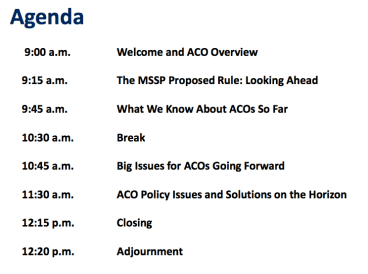
While there is much to learn, there are principles in evidence on which to build, i.e., successes in the market. If you want to learn more from an eclectic mix of players in the space, consider attending the ACO Alignment Summit.

Details of the panel session on alignment are here:ACO Alignment Summit
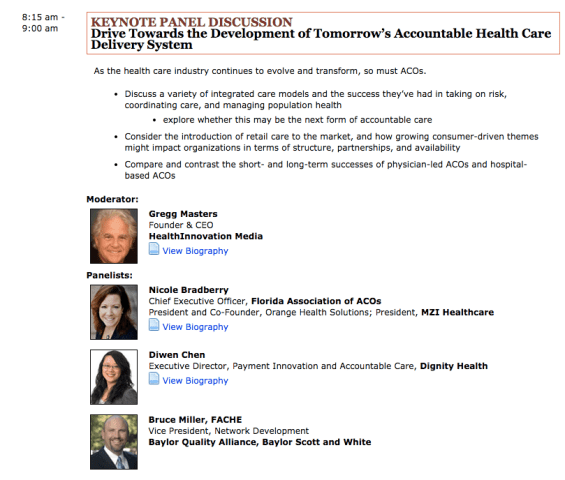
I am pleased to say that I will be moderating the Keynote Panel Discussion:
Drive Towards the Development of Tomorrow’s Accountable Health Care Delivery System’ with some talented colleagues from different markets around the country.

Joining me in this deep dive are: Nicole Bradberry, Chief Executive Officer, Florida Association of ACOs, President and Co-Founder, Citra Health Solutions; President, MZI Healthcare, Diwen Chen, Executive Director, Payment Innovation and Accountable Care, Dignity Health, and Bruce Miller, FACHE, Vice President, Network Development, Baylor Quality Alliance, Baylor Scott and White.

This is a unique blend of talented thought leaders and host business models from three different domestic U.S. markets all with distinctly different geo-political healthcare footprints. Nicole sits atop a member based association of ACOs in Florida (in addition to her leadership role at MZI Healthcare a vendor, consultant and health IT infrastructure play), while Diwen hails from a progressive institutionally managed integrated delivery system with hospital DNA Dignity Health, and Bruce stewards Network and Quality Management issues for an integrated group medical practice/IDN Scott and White that recently merged with the flagship Baylor Health System to combine two trophy properties (with distinctly different cultures, imj) in the Lonestar state.

This will be a ‘roll up your sleeves’ exchange on lessons learned in ACO alignment as well insights into the ‘how do I navigate the white waters of clinical integration’ given the local market considerations I face?


Your Comment is in Moderation: ‘Why ACO Savings Aren’t About Location.’

By Gregg A. Masters, MPH

We’re having an interesting exchange over at The Healthcare Blog where Health Care Policy Lead at Aledade, Inc. Travis Broome posted a piece titled: ‘Why ACO Savings Aren’t About Location.’

I chimed in with some ‘contextually pro’ ACO thoughts with some significant push back by industry veteran, author, consultant, economist and President of HealthFutures, Jeff Goldsmith fka ‘tcoyote’.

Thanks Jeff… lovin’ the exchange! Just sayin’ metrics, metrics. depends on lens….
Bottom-line is we still live on a production driven healthcare ecosystem – ‘capitation’ (PMPM) still a fraction of total contract spend (even if you include ‘lite versions’ ie, bundled payment, DRGs, or ambulatory case rates, or OWA’s [other weird arrangements]).
Share of GDP has been and continues to disproportionately claim an obscene allocation of the U.S. (public, private) spend and growing; all while a grand COST SHIFTING CHARADE proceeds under the convenient ‘consumer directed/skin in the game’ brand play by payors/health plans/or more aptly put ‘benefits solutions providers’.
There are no more ‘health insurers’ per se. they’ve collectively failed to manage clinical risk. PERIOD. They are ‘transaction processors’ increasingly living off of ‘fees’ and investment returns as ‘banks’, with the great hope that ‘technology plays’ (mhealth, digital health, tech-enabled patient engagement), etc… can cure the beast.
So yes, today and in the near term, clever (and well paid) managers’ are subject to production incented growth or share objectives (even amidst declining units primarily due to the slowing (and cost shift) economy and reduced discretionary spending for elective services).
The handful of creative ‘comp plans’ that scaled the transformative shift from volume to value remain a fraction of total [see my piece ‘Eating Glass’ https://acowatch.me/2014/08/14/eating-glass-a-davita-healthcare-partners-hiccup-or-physician-integration-implosion/ about Craig Samitt’s abrupt departure from DaVita/Healthcare Partners ] are at least on the table given the ACO triple aim sustainability mission. If units decline, skilled managers find ways to drive UP price. Consolidations are precisely that, no?
I remember when per diems and case rates were first introduced back in the 80s. The CFO calculus was pretty simple: budget revenue requirements divided by projected units of service and voila, you got your case-mix adjusted average basis for both service tiered or global per diem contracting. Pretty simpleton, but true!
When shift to ambulatory from inpatient began, Outpatient surgery/procedure case rates were benchmarked to historical inpatient revenue yield. Only growth of physician owned ASC’s forced some competitive restraint to price [ and that theme remains alive today via OIG report: http://www.beckershospitalreview.com/finance/oig-says-bring-down-hopd-rates-for-surgery-to-asc-rates-cms-disagrees-11-things-to-know.html ]. That the aggregate trend UP is rather obvious, no? It has not abated from a total cost of care perspective – the only measure that really matters.
Thanks for sharing Jeff. I am not an economist, just a grunt in the c-suite who negotiated a fair amount for global (hospital, physician, ancillary and pharma) full risk downloads (from licensed entity to risk bearing delivery system) via multiple health plans in different states.
Things don’t seem to change much in the ‘healthcare borg.’

Please consider offering your thoughts as well! The original blog post is here.