From “Unicorns to Multicorns” ACOs Morphing Below Radar

By Gregg A. Masters, MPH

This is a continuing long tail series following the content rich and strategy insight generous experiences reported by the ‘risk savvy braintrust’ at the 3rd National ACO Congress aka the ‘walking the talk of innovation’ crowd.

From sound-bytes to sensibilities?

Via UC Berkeley Professor Steven Shortell, Ph.D., MPH, Professor, School of Public Health, and Blue Cross of California Distinguished Professor Health Policy and Management, and Professor of Organizational Behavior, Haas Management of Organizations Group, we get the ‘multicorns’ observation, which is informative beyond cute:


This evolutionary market shift tracks back to the humorous ‘unicorn’ observation variably attributed to Rober Margolis, MD of Healthcare Partners, or Mark Smith, MD, of California Healthcare Foundation, depending on your source, to characterize the inflated hopes of ACOs to cure all that ails our over-engineered network of ‘sick-care’ silos.

Yet, there is meaning inside the whimsical observation.

More than Just the MSSP or the Pioneers

To many keeping a pulse on the growth and dispersion, to coin an epidemiological headline from our friends at Leavitt Partners, you are likely following the reported certified entities as announced via CMS or its innovation group at CMMI. Yet, there is much more market activity brewing beneath the surface. The engagement picture, if you will, is both wider and deeper than the official view on ACO penetration as seen through the lens of a CMS certification prism. In addition to CMS Medicare, dual eligible and Medicaid activities, major health plans (Aetna, United HealthGroup, WellPoint, are ‘queued up’ [i.e., where demand is exceeding supply] with requests to joint venture accountable care or ‘ACO collaborations’ (ranging from medical homes to straight commercial versions of both single and multi-payer ACOs).

So when one thinks about innovation, and the role of ACOs in particular as well as the  ‘Federales’ (as recently tagged by Dan Munro aka @danmunro) as an untrustworthy overlord [my words] , don’t limit your thinking to the official list published by CMS. There is considerably more, and this doesn’t even begin to address the ‘direct practice’ or ‘membership medicine’ market as potentially qualified primary care medical homes for listing on State or Federally administered health insurance exchanges. There is order in the seeming discrete chaos and inherent range of ACA initiatives. So as mentioned to my friend Dan:

go deeper and ‘trust the [market] force[s]’, [of innovation], Luke!

The Anatomy of a Patient Centered Medical Home: the Physiology of an ACO?

By Margalit Gur-Arie

Obamacare is here to stay, and with it a host of initiatives small and large, some intended and some not so much so, targeting massive transformation of the health care delivery system. One of those initiatives involves the adoption of the principles of a Patient Centered Medical Home (PCMH) for primary care as formulated by the primary care medical associations, and to a large extent, as translated into operational processes by the National Committee for Quality Assurance (NCQA). There are other implementations of the PCMH put forward by public and private organizations, but NCQA’s Medical Home recognition program is considered the gold standard for PCMH. The PCMH concept is also here to stay, and as is the case with Obamacare, the Medical Home model has its supporters, its detractors and all sorts of misconceptions and implementation missteps.
If you randomly ask a primary care physician about his/her opinion on the Patient Centered Medical Home model of primary care, you will most likely get one of the answers listed below in order of increasing prevalence:

  1. Absolutely fantastic way to practice medicine. We’ve been doing this for a while and are a Level III recognized Medical Home.
  2. The idea is good and we are currently making the transition and working on obtaining NCQA recognition. It’s not easy, but we are hopeful.
  3. We are part of a PCMH pilot in our state. It’s a lot of work and I am not convinced that it will have any benefits for my practice.
  4. I read about it, but I can’t afford to hire dieticians and social workers and spend time on all the paper work.
  5. I don’t have time for this.  Just a bunch of government regulations that do nothing for patient care.
  6. This is the final nail in the coffin of primary care. It’s going to drive all remaining independent physicians out of practice, which is what the government wants anyway.
  7. My mother-in-law is in an assisted living facility, but other than that I don’t have any patients in nursing homes….. I don’t take Medicaid.
  8. Say that again…?

Just like Obamacare is not something invented by overzealous socialists, but the brainchild of extremely conservative thinking, the PCMH is not a government invention, but instead it is based on a statement made by physician associations attempting to define good primary care and the need for insurers to pay more for such excellence. The devil of course is in the details. It’s been said that the “official” NCQA PCMH requirements consist of too many details, and that some of those details are bureaucratic in nature, burdensome, expensive and contribute little to patient care. It’s been said that true quality of care and practice transformation, whatever that may be, is largely independent of counting points, formal testing, certifications and recognition’s   Granted, all these contentions seem reasonable, but before deciding to walk away, how about a quick bird’s eye tour of what NCQA PCMH recognition really is?

The six parts of formal NCQA 2011 PCMH recognition are called Standards. Let’s take a critical look at each one and note the order in which they are arranged.

Standard #1 – Enhance Access and Continuity – Continuity here refers to people having a personal physician instead of seeing whoever happens to have time that day. I don’t know many practices where this is not the case anyway, but it’s hard to argue against the need to build a long term relationship between patients and their doctors, and it’s even harder to argue against this being the #1 foundational requirement of delivering high quality longitudinal patient care. Note that by definition solo practices are automatically set up to care for patients this way (just saying…). The second part of this Standard is a bit more problematic from a physician’s point of view, because it does require availability after hours and seeing patients the same day as much as possible. It is not an easy task to start tinkering with your schedule, if you are not currently offering same-day appointments, and done haphazardly, it may have serious financial implications to your practice. How about being available after hours, particularly for a solo or very small practice? How about your family and personal life? If you are one of the new concierge docs with a tiny panel of well-behaved patients, this is obviously not an issue. If you have 2500 patients, or so, on your panel, some creative thinking may be required. How would your patients react if, say, every Tuesday you’d start seeing patients from 12 pm to 8 pm? Or if you closed early on Wednesdays and twice a month you saw patients on Saturday mornings? Or if you had an arrangement with a couple of other practices to provide urgent care at odd hours on a rotating basis?

A recent study in the Annals of Family Medicine found that total health care expenditures were 10.4% lower for patients who had access to extended hours of care. This is great news for the “system”, but how about benefits to you and your practice? Whether you like it or not, you are now competing against business models with extremely low overhead, such as grocery store clinics and virtual tele-medicine clinics, offering pseudo-primary-care to your rushed and hurried patients for simple needs, leaving you to deal with complex visits that cost you a lot to deliver, but pay as much (or as little) as the simple ones. Unless you start thinking outside the box, your model of business is destined to become obsolete. Offering some electronic visits, providing hours for urgent care needs and collaborating with others on extended coverage may very well be a matter of survival. Interestingly enough, another recent JAMA study, although limited to community health centers, finds measurable correlation between access and continuity and lower operational costs per unit of service. There should be very little doubt at this point that Standard #1 is the place to start work on the viability of any practice, or ignored at significant peril.

Standard #2 – Identify and Manage Patient Populations – This one sounds onerous and a departure from individualized patient care, but is it really so? The “populations” term notwithstanding, all this Standard requires is that you document patient demographics and clinical information in the chart (seriously?), that you take good histories and that you send reminders to your patients to mind their chronic and/or preventive care needs. There is really nothing here that a good primary care physician doesn’t already do, and probably to a much greater extent than the NCQA standards specify. The one thing that may be different is that this Standard talks about proactive reminders to patients that don’t come in to see you on their own. Good for business and definitely good for patient care on an individual level.

Standard #3 – Plan and Manage Care – Another statement of the obvious, but this standard uses terminology that may raise some eyebrows. For example, it asks that your care is evidence-based. Is your care not evidence-based? Surely you decide how to treat patients based on your education, what you learned along the years, books, articles and latest research, instead of throwing darts at a random treatments list hanging in your office. And this is really all there is to this Standard, other than practicing medicine, i.e. seeing patients, evaluating conditions, planning care, talking to patients, and generally speaking, being their doctor.

Standard #4 – Provide Self-Care Support and Community Resources – This may sound like the new age fluff of patients taking care of themselves, and granted, there is some of that here, but the details are again pretty straightforward in their intent to have patients understand their conditions and do something about it. Primary care docs don’t usually fit the much publicized portrait of aloof and paternalistic doctors who won’t give you the time of day. It is the time constraints in fully loaded practices that may prevent some from fully engaging with their patients, and no certification process will change that without proper shift in reimbursement, or a change to a more direct practice model with smaller patient panels. This Standard’s feasibility is also highly dependent on patients themselves, but there are simple things you and your staff can do to better enable patients to take some responsibility for their own health (most of which you are probably doing already), and this is all this Standard is about.

Standard #5 – Track and Coordinate Care – Do you send patients to specialists and then forget all about them? Do you order lab tests and don’t care if the results come in or not or if they are normal or not? Do you get calls from the hospital notifying you that one of your patients was admitted, and you hang up thinking that this is not your problem? No? Then you are tracking and coordinating care. Can you do more? Probably, but here you are largely at the mercy of specialists and hospitals in particular. You most likely already have tickler lists to help remind your staff about getting specialists notes and test results, but it is extremely difficult to have the hospital contact you if you are not admitting your own patients (and sometimes even if you do). There is effort (and costs) involved in better tracking and better coordination and payers are starting to take notice as evidenced by the latest care coordination CPTs added to the Medicare physician fee schedule.

Standard #6 – Measure and Improve Performance – Here it is. This is the measuring, reporting and all administrating bag of requirements, complete with patient satisfaction surveys, sending data to payers and using electronic medical records. While most items here are optional, a medical home is required to set some improvement goals for clinical measures (just goal setting, not necessarily outcomes). So after doing everything outlined in previous Standards, this is where the assumption is implicitly made that a medical home should be able to continuously improve the care it provides. Perhaps you believe that you are already providing excellent care, and no doubt most of you do, but is there anything more you can do? This Standard is asking you to consider this question, and if you have an answer, begin acting on it. And yes, this too may take more time and more effort on your part, and thus be dependent on payments to support these efforts.

Did I leave anything out? If your opinion of the PCMH was something along the lines of #6 above, you are probably wondering about some “strategic” omissions. How about all that “team care” and nurse practitioners? How about those case managers and dieticians? What of the need to buy, implement and use an expensive EMR? Well, for starters these things are optional in nature. Unless you are a team of one, you already have people helping you out with patient care and administration, and you are not required to use or augment your staff more than you are comfortable with. A good EMR should help, but it is not mandatory either. And yes, NCQA will recognize nurse practitioner led practices as medical homes, but this is reflective of legislation at State levels, and it should be appropriately addressed at a policy and legislative level as well. As to the infamous amounts of paperwork involved, yes, there is plenty of that, but there is also plenty of help out there and you just need to find it.
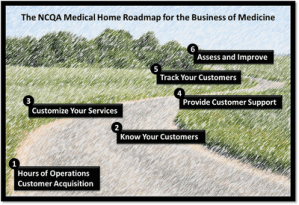
On the surface the NCQA PCMH recognition process is an administrative test for primary care, but if you look at it carefully, you can see that it is also a logically ordered roadmap for quality primary care and a tool for you to take a fresh look at your practice and position it to change with the times without having to sacrifice your ethics and your principles. Some things in this roadmap are at the heart of what you do every day, others are things that you may want to do if time and finances allowed, and few are in the realm of “forget it”. Unlike Meaningful Use, the NCQA PCMH “test” is not an all-or-nothing proposition and there is reasonable freedom for you to discard those “forget it” items, or postpone the wishful thinking for a better day. There should be financial benefits accruing from just doing some of the things on this roadmap (such as Standard #1), and there are financial incentives from payers for doing other things or from just “passing the test”.

The medical home is a timeless model of care, repackaged for these troubled and technology driven times, and as such, it is also a business model for the future of primary care. You could approach the entire exercise as yet another payer and government mandated intrusion, or you could make this roadmap your own, and look at it as a means by which to refine and sustain an already excellent practice. It is ultimately all up to you.

Margalit Gur-Arie is a partner at BizMed, and formerly Sr. Vice President Operations at Physician Advantage (GenesysMD). She publishes ‘On Healthcare Technology‘ and tweets via @margalitgurarie.

ACOs, ‘HMO lite’ or ‘DNA of the Transformation’?

By Gregg A. Masters, MPH

I am regularly amused by some in the popular press as well as guerrilla social media theater (myself included in that bucket) by the continued doubt if not outright dismissal of ACOs as the central spine if not fulfillment DNA of ‘the new, new thing/imperative’, i.e., to manifest the ‘triple aim’ as the sustainable healthcare ecosystem.

In the last 24 hours I interacted with one of those credible voices following a heads-up to the blog post: ‘Smart Money, ACOs and Risk Savvy Medical Managers’, where I argue that ‘smart money’ is betting on (and walking the talk) of ACO implementation, to wit the following tweets were then exchanged (Note: Dan had sent me the ‘eye porn’ headline titled ‘Are ACOs Doomed to Fail’ which was in part the impetus for the smart money post). After reading the post Dan offers:

Dan Munro @danmunro: Solid points – but endorsements “aren’t the droids we’re looking for.” Think Tom Cruise and “SHOW ME THE MONEY!” 😉

Gregg Masters @2healthguru: @danmunro See: http://content.healthaffairs.org/content/31/9/2074.abstract… AND bit.ly/ShTka4 Huge impact. Only beginning. #ACOchat

Dan Munro @danmunro: @2healthguru … but the underlying payment mechanism is still FFS – and “shared savings” will vary widely & be small: hc4.us/ACOsFFS

Dan Munro @danmunro: @2healthguru It’s a debate we all need. I just feel like we’re still playing around the edges. Any form of capitation only goes so far.

Well I’m not sure what metric my friend used to judge something as ‘varied’ and ‘small’, but for those of us previously operationally tasked with managing bed day utilization, admit rates, and by definition readmission, consistent with quality measures, these are not small numbers reported by the collaboration between Aetna and NovaHealth, an independent physician association based in Portland, Maine:

The patient population in the pilot program had 50 percent fewer hospital days per 1,000 patients, 45 percent fewer admissions, and 56 percent fewer readmissions than statewide unmanaged Medicare populations.

You don’t have to be a math whiz to grasp the economic significance of 50%, 45% and 56% reductions in major indices of hospital utilization. Whether per case or per diem calculations we’re talking serious savings to the payor [Medicare, or the Medicare Advantage risk contractor]. Such impact via ACO pilots dwarf the soft savings assumptions embedded in the Medicare Shared Savings Program since most projections are leaning on the modest results produced to date via the Physician Group Practice Demonstration Project which notes:

in Program Year 2, the cost per Medicare beneficiary were reduced by only $120 (1.2 percent) as compared with the base year. Whereas the groups earning bonuses reduced expenditures an average of $334 per person in Program Year 2.

So to the Dan’s of the world, up your sights as to the possibilities here! It’s time to be the change we seek, and stop looking for reasons to fail, up to and including finding empirical reasons to manage to mediocrity vs. the achieve the win within the reach of like minded, passionate and collaborative people.

Editors note: I will be interviewing Charles Kennedy, MD, CEO of Aetna’s Accountable Care Solutions Group, on Wednesday, November 14th, 2012 at 3:30PM Pacific time, listen here.

‘ObamaCare’ Lives: Ladies and Gentlemen Start Your ACO and HIE Engines

By David Harlow, Esq.

Much has been written and said about the effect of the election on the implementation of federal health reform initiatives. The commentariat, including the blogerati and twitterati wings, have focused on the budget battles of the future to come from Capitol Hill, the flurry of regulations to come from HHS, and the last stand of the boys in red in certain state capitals around the country against implementation of health insurance exchanges and Medicaid expansion under the ACA.


I spoke recently about the importance of the Accountable Care Organization law and regulations, and related initiatives being undertaken by the Center for Medicare and Medicaid Innovation (CMMI) at CMS, and the ways in which these initiatives are likely to affect the next phase in the development of the health care system in this country. I thought I’d share a few of the highlights here.

We have built a system of sick care in the USA, not health care, and the disruptive forces contained in the Affordable Care Act, including the ACO provisions, have the potential power to change our system to a system of health care – by changing the focus, by changing the incentives, by changing the behaviors of both patients and providers.

The goal for all of us in health care these days is to be better integrated with other parts of the system, so that we can do more with less in the future. We all know — or should know by now — that we will have to do more with less. The key to future success will be managing patients’ care and its attendant costs over the long term, managing an episode of care that extends beyond an inpatient surgery to encompass pre-admission and post-discharge services, managing a chronic condition with a multidisciplinary approach using medicine, nursing and even social media and game theory to motivate patient behavior modification. We need to move from reimbursement-based medicine to evidence-based medicine.

When the ACA was enacted, folks likened the ACO to the unicorn: Nobody’s ever seen one, but everyone knows exactly what it looks like. Once the ACO regulations were finalized, I called it as I saw it: the ACO is a camel — a horse designed by committee. And now I see the ACO and related initiatives under the ACA as a camel with its nose in the tent: a disruptive force beginning to change the world as we know it.

When the final ACO rules came out about a year ago, CMS actuaries predicted that there would eventually be about 270 Medicare ACOs — including large and small organizations and urban and rural organizations — by the end of three years (we are less than one year in at this point), providing care to up to 2 million Medicare beneficiaries. We’re on track to get there and beyond, with over 150 Medicare ACOs already approved and several hundred more applications queued up for the future. (Keep in mind there are approximately 150 commercial ACOs out there as well – according to an inventory updated this spring by Leavitt Partners.)

In addition to the estimated 270 Medicare ACOs, HHS estimates up to $1 billion in savings to Medicare over four years, and the Congressional Budget Office estimates $5 billion in savings over eight years. At first blush, these look like impressive figures, until we recall that there are 6000 hospitals in the US, nearly 50 million Medicare beneficiaries, and that Medicare is a $500 billion line item in FFY 2013 alone. The ACO initiative is a drop in the bucket.

The ACO initiative is generating a lot more interest than perhaps they should, based on these numbers – but this is legitimate, for a couple of reasons. ACOs really form the conceptual building blocks for a new approach to achieving the Triple Aim – which is now the mission of CMMI: Better Healthcare, Better Health and Lower Costs Through Improvement. CMMI seeks to: “Encourage better health for entire populations by addressing underlying causes of poor health, such as physical inactivity, behavioral risk factors, lack of preventive care and poor nutrition.” It is using the levers of the ACO program to enlist ACOs in the execution of this element of its mission.

So, the camel’s nose Is In the tent – we’re at the leading edge of a significant disruption built around the Affordable Care Act’s provisions on ACOs and related initiatives: a sea change in the way health care is conceptualized, and radical change in delivery and payment systems. We’re ahead of the curve on these issues in Massachusetts, with a law passed this summer that will move us into ACOs for all — not just Medicare beneficiaries — and away from fee-for-service medicine, and a local Blue Cross-Blue Shield plan known as the Alternative Quality Contract that has been working on this basis — budgeted caps with quality kickers — for several years already. It’s the latest form of pay for performance, or value-based payment.

An ACO has to have at least 5000 Medicare beneficiaries attributed to it, but the beneficiaries cannot be forced to enroll in a closed network. Because Congress sees elimination of choice of provider as a third rail of health care, ACOs do not know for certain which patients will have more than 50% of their primary care encounters with an ACO PCP in any given year and thereby be attributed to the ACO, Thus, in order to succeed, ACOs must be focused on population health, on prevention and wellness in a population, not just on individual encounters with patients.

CMMI is also using the power of the purse — its $10 billion budget, to be spent over ten years on experiments with the health care system. Nearly two dozen experiments are already under way, including three flavors of ACOs. While CMMI is experimenting with a wide variety of methods to incentivize health care providers to change the way they provide care (check out the CMMI “What We’re Doing” page), the health care providers participating in these innovations should be laser-focused on the 10% of chronically ill Medicare beneficiaries whose health care expenses consume 50% of the Medicare dollar. If they change their approach to managing these patients’ care through patient-centered medical homes or otherwise, there are great opportunities to achieve significant savings through avoiding preventable hospitalizations and the like.

The keys to success will be clinical integration — not just in word but in deed — and turning data into actionable intelligence. Health care systems that can achieve these two interim goals will be well-positioned to achieve the broader goals of improving population health and quality of care while bending the cost curve — and not just for Medicare beneficiaries attributed to Accountable Care Organizations.

David Harlow is a seasoned health care attorney and consultant recognized as an accomplished, innovative and resourceful thought leader in health care law, strategy and policy. He is the Principal of The Harlow Group LLC, a health care law and consulting firm based in Boston, MA. David publishes the popular ‘Healthblawg‘ and tweets under the handle @healthblawg.

Smart Money, ACOs and Risk Savvy Medical Managers

By Gregg A. Masters, MPH

I’ve been pondering the ‘where is the ACO smart money’ question for a while as in its answer lies greater clarity than the current high ‘noise to signal’ ratio experienced by many. Since we witness a range of opinion on whether the healthcare industry can self correct via proactive conscious choice, or whether a solution (increasingly of the draconian variety) will be externally imposed, seeing more clearly is a worthwhile objective to pursue.

The centerpiece of much of the innovation to operationally manifest the ‘triple aim’, and thereby tame an otherwise insatiable provider appetite relies heavily on ACOs or their many accountable care derivatives, including coordinated care initiatives and patient centered medical homes, et al.

Yet according to some, ACOs aka ‘HMO lite’ will suffer the same fate as their more tightly managed brethren spawned during the 80s and 90s amidst a massive rollout of managed care organizations (MCOs) into mainstream medicine. The argument goes, ACOs are perhaps too little, too late, too weak, and therefore destined to recreate the same ‘disappointment’ of managed care v1.0.

Put this pessimism into the popular view circa 2010/11 that mocked ACOs as ‘unicorns’ into which powers have been imbued with qualities and competencies only seen in myth since they do not exist in the real world. Then add to the conversational mix the litany of comments submitted to CMS when the ‘notice of proposed rule’ was released for public comment, which promptly drew the ire of many via 1,300+ comments objecting from everything to disproportionate risk assumption, for too little upside, to widely variant costs bases to stand up an ACO, and you get the context picture.

But wait there’s more, even post issuance of the final rule, there was additional commentary about the low relative degree of expected participation of many of the name plate players who for one reason or another were choosing to stay on the sidelines – at least for now.

Within this range of sentiment, I set about answering the question of where is the ‘smart money’ in ‘ACO-dom’, and felt the most qualified audiences to query would include the likes of ‘risk savvy’ medical groups, integrated delivery systems or their trade group representatives.

The American Medical Group Association (AMGA) held their annual meeting here in San Diego and I attended some of their proceedings, though they have expressed their opinions formally to then CMS Administrator Don Berwick here, I put the above question to them via a proxy recently and obtained the following response:

American Medical Group Association members continue to provide patients with high quality medical care and many of our members are operating in arrangements that reward physicians for value, rather than for volume. In fact, of the 106 Medicare Shared Savings Program participants, 35 are, or are affiliated with, AMGA members. And we know that more of our members will be signing up in the next phase of MSSP beginning on January 1, 2013. Additionally, of the 32 Pioneer ACO Program Participants, 22 are AMGA members. And we are aware that dozens of our members are involved in commercial ACO arrangements.

AMGA’s recently held our Institute for Quality Leadership (IQL) which explored these successful models of accountable care. Leaders from these innovative groups presented successful routes they have taken to transition from volume-based care to value-based, accountable care models. These groups are committed to reforming our healthcare delivery system and this meeting reveals the way many groups are forging ahead to create a health system that delivers real quality and value to patients. These groups are redefining what it means to be a high-performing health system and showing that coordination of care improves quality, bends the cost curve, and delivers value.


More recently, I posed the same question to Donald Crane, representing a large and sophisticated assembly of group medical practices from the state of California. Donald Crane is the CEO of the California Association of Physician Groups (CAPG), who I met  at the recently concluded 3rd National ACO Congress in association with the Integrated Healthcare Association (IHA). What follows are a series of his statements in response to the basic question of where CAPG stands in relation to the emerging ACO industry:

CAPG regards itself as a group of ACO providers….with a mixture of both global risk as well as professional only risk. We are ‘they’….AND we’re bullish on the [ACO] model.

Though the bottom-line, at least for purists to be considered an ACO you need to be built upon a fee-for-services vs. an HMO chasis. What we’re really talking about is the movement of FFS to fee for value.

An ACO can be characterized as HMO lite, but need be seen as a stepping stone to greater risk assumption.

[As evidence of CAPG’s bullishness on ACO model, members participating in CMS’s ACO Pioneer program include]:

Sharp Healthcare system (both Rees Stealy & Sharp Community Medical Group), Heritage ACO, Monarch Healthcare, Healthcare Partners, PrimeCare (also known as North American Medical Management), and Brown & Toland Physicians. So 6 of the 32 Pioneers [ACOs] are California based.

This is the cradle of managed care, where the know how resides, so it isn’t any surprise that we have 6 Pioneers here.

If we had our druthers we’d probably convert [these beneficiareis] to Medicare Advantage as the tried and true way to make [ACOs] work. It seems to me the world is moving towards defined contribution. We need to basically make money on savings, that’s our model. And the tipping point is the dual eligibles.

So there you have it. From two in the know ‘smart money’ sources. The future while still rather uncertain overall (i.e, all healthcare is local), remains bullish at least for those with experience in the world of physician led clinical risk and network management.

More on some of the individual member footprints and structural initiatives in subsequent blog posts.

If the ACO Idea Fails, What’s Next?

By Gregg A. Masters, MPH

In the sea of collective opinion via both pundit and ‘boots on the ground do’ers’ reported in trade group, popular and growing insights proffered via social media, one of the narratives centers on can ACOs really make a difference? In other words, is meaningful reform of the failing volume driven finance and delivery system paradigm possible, i.e., can ‘they’ enable the real time fulfillment of the triple aim? Further, are these growing, variably expressed and evolving ‘ACO vehicles’ [of the regulated government variety, as well as its many private/commercial mutations] both necessary and sufficient to achieve what has been an historically elusive goal?

For some reflection, in today’s conversation alone via Kaiser Health News, I am struck by the title ‘Are ACOs Doomed To Fail?‘ as somewhat of an headline ‘eye porn’ invitation to engage one’s cerebral matter in the question.

This is a timely and reasonable question, so do read the article and judge for yourself. See if you agree with the professors’ call:

ACOs in the end are going to end up costing more money and not necessarily deliver on the quality either.

For an abstract of the Health Affairs article, click here.

My take is this sound-byte headline and associated conclusion represent the school of narrow thinking too often derived from academics’ and health policy wonks typically fueled with a graduate school of business ‘market’ orientation vs. a sustainable public health ‘ecosystem’ perspective.

Yet, perhaps a better dialectic is witnessed in the observation, question and subsequent answer offered by [Kaiser] Permanente’s Federation founding Chief Executive, Jay Crosson, MD at the 3rd National ACO Congress:


To wit, Dr. Crosson suggests a future not unlike the looming dramatic reduction approaching 27% to the Medicare fee schedule via ‘sequestration’:


Bottomline, the days of containing ‘solution-speak’ to internal squabbling among healthcare leadership (both provider and payor communities) are over. The collective industry failure, exceptions notwithstanding, to re-engineer our costly and to many inaccessible healthcare assets and coverage is now a macro economic issue that threatens the U.S. if not entire global economies.

So is it different this time? Or are we just ruminating on ‘much to do about nothing’ one more time? I say no. It is different. We all have skin in this game. ACOs and their ‘accountable care’ derivatives are here to stay. If they fail, ‘game-over’ and the government steps in with a with single payor solution [the good, the bad, and the ugly et sequelae]. No more private/public partnership ‘bites at the apple’ so to speak, so let’s ‘get er done.’

3rd National ACO Congress Video Mashup

By Gregg A. Masters, MPH

For a taste of the proceedings, check out the video mashup below:

Overview of the ACO Congress

Since the Second National Accountable Care Organization Congress in November 2011, the ACO trend has demonstrated great momentum. As of June 2012, there are more than 200 ACOs identified in the U.S., a 38% increase in only six months (see: Update: Growth and Dispersion of Accountable Care Organizations – Leavitt Partners). The number and variety of organizations adopting accountable care demonstrates providers’ strong belief that the accountable care model is a crucial component of the future of American healthcare.

The Third National ACO Congress held on October 30-November 1, 2012 in Los Angeles brought together leading policymakers, deal-makers, experts, and those who have been working on the frontline of ACO implementation and operations to provide unique, in-depth insights and hands-on experience on what has been done so far and what’s in the planning stage in every sector.

The three-day conference featured compelling keynote presentations, including “Inside the Deal” sessions with the principals in the Monarch/Optum and HealthCare Partners/DaVita transactions, political forecasts from leading healthcare advisers, updates from CMS, and insights from private sector ACO developers. There will be three content-rich pre-conferences and twenty-two concurrent sessions that offer participants a chance to learn more about the Medicare Shared Savings and Pioneer ACO programs, private sector ACO partnerships, Medicaid, Dual Eligible and safety net-focused ACOs. We will also hear from experts on ACO legal issues, quality measurement and HIT implementation. Please join us for this exciting agenda as ACO implementation continues to roll out across the nation.

The 3rd National ACO Congress

By Gregg A. Masters, MPH

Just concluded at the Beverly Hilton Hotel, a stone’s throw away from my high school, ‘Beverly’ (yup, the real 90210), I attended the 3rd National ACO Congress. Co-produced by the the California Association of Physician Groups, CAPG, and the Integrated Healthcare Association, IHA. This truly represented a gathering of the best and brightest health policy wonks, entrepreneurs and innovators in the accountable care industry. Both CAPG and IHA include many of the integrated delivery systems and risk savvy medical groups who have ‘walked the talk’ and done most of the heavy lifting in making managed competition actually work.

There is so much to compile and reflect upon, for now I merely want to make notice of this recap to be available shortly. Perhaps the best visual representation that captures the key take away (if not warning to the collective industry) was proffered by this question in Kaiser Permanente’s Jay Crosson, MD’s keynote.

This is somewhat reminiscent of actor Ed Harris’ noteworthy cinematic ‘channeling’ of Gene Kranz’s energy (though Kranz did not actually say this during the heat of the crisis) and leadership to his team of engineers on Apollo 13:

Failure is not an option…

I seriously doubt the private sector has another legitimate, ‘hey we can do this…’ bite at the apple, before Government steps in and puts an end to our collective public/private failure to remedy the root cause of the ‘dis-ease’.

Bricks and Sticks or Vision and Values? Building the ACO

By Jim Frederick, Senior Editor/Pharmacy, Drug Store News

New, holistic models for integrated, patient-centered care are emerging from the fog of health reform almost as fast as you can say “accountable care organization.” But pharmacy and retail clinic operators aren’t waiting for ACOs to fully ripen; they’re forging new alliances with hospital-based health systems and building the kind of continuity-of-care networks that could be a template for the new era of evidence-based medicine and improved patient outcomes.

If anything going on in health care traces the changes that are transforming the health system — attacking the unsustainable cost curve and dramatically improving patients’ access to care — it’s the accelerating growth of partnerships between hospital-based health systems and retail pharmacies and pharmacy-centered clinics.

It makes perfect sense. Both community pharmacies and the roughly 1,400 in-store clinics now open are evolving quickly beyond their traditional practice models with a broader menu of health-and-wellness services.

That makes them ideal extensions of hospital-based care, providing cheaper and more accessible points of entry into a local or regional health system for patients in need of basic diagnostic services and front-line care.

Boehringer Ingelheim Pharmaceuticals noted in a report on retail clinics: “The demand for health care is steadily growing as the population ages and increases, creating some strain on often overworked hospitals and physician practices.”

Retail clinics, BI noted, provide “a way of addressing this issue.”

Community pharmacists can play an equally critical role. With more and more chains and independents giving pharmacists the tools and training to practice “at the top of their license,” pharmacies allied with hospitals provide a slew of services that improve patients’ long-term health and reduce readmission rates — including preventive health services, disease management and monitoring, screenings, medication therapy management, counseling and adherence programs.

In a report in the online publication Payers & Providers, Jim Lott, EVP of the Hospital Association of Southern California, called such alliances…

Read complete article here.

Transformational Potential of Medicare ACOs – Part 1


Dr. David Ballard, Chief Quality Officer and Senior Vice President at the Baylor Health Care System in Dallas, TX and Executive Director of its Institute for Health Care Research and Improvement, introduces a series of articles appearing in the August 2012 issue of Mayo Clinic Proceedings where he shares a 3-part interview with 3 leading health care experts, Drs Shulkin, Couch, and Haydar, who are involved with Accountable Care Organizations (ACOs). They discuss how and why the Medicare ACO funding options work or don’t work for their respective institutions. For ‘The Potential of Medicare Accountable Care Organizations to Transform the American Health Care Marketplace: Rhetoric and Reality‘, click here.