Universal American: A ‘Healthy Collaboration?’

By Gregg A. Masters, MPH

JP Morgan Healthcare Conference | Universal AmericanI intended to post updates from Aetna and Cigna next in this series, yet today I received a tweet by Vince Kuraitis, aka @VinceKuraitis, calling attention to Universal American a managed care player I’ve not spent much time on. Yet they present a rather interesting profile and operating footprint some of which I will highlight below.

According to their website Universal American (UAM):

…provides health benefits to people with Medicare. We are dedicated to a Healthy Collaboration, working together with healthcare professionals in order to improve the health and well-being of our members.

The JPMorgan Healthcare conference deck is here, and webcast here (you may need to register). Of note is with the recent release of CMS certified ACOs, UAM now operates ’31 ACOs approved for participation in the Shared Savings Program which include more than 2,000 participating physicians covering an estimated 300,000 Original Medicare beneficiaries in 13 states.’ So not only are they a player in Medicare Advantage (the end game for risk bearing ACOs), they have a presence in the gateway market as well. For complete details, click here.

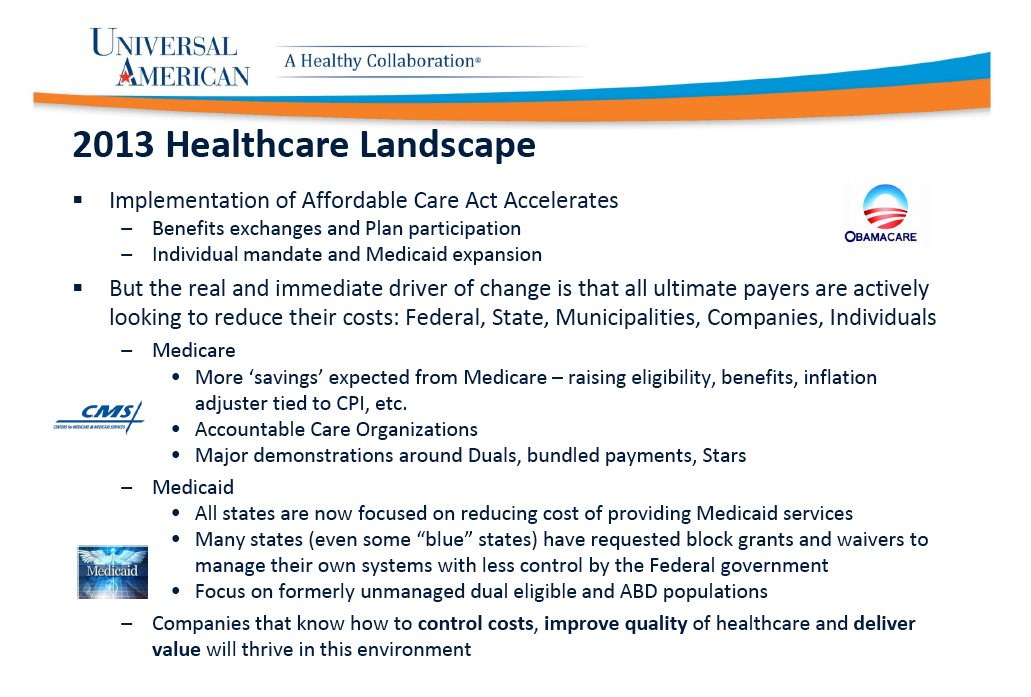
Two pieces from their narrative tell the story, 1) the ‘healthcare landscape’:

Universal American Healthcare Landscape
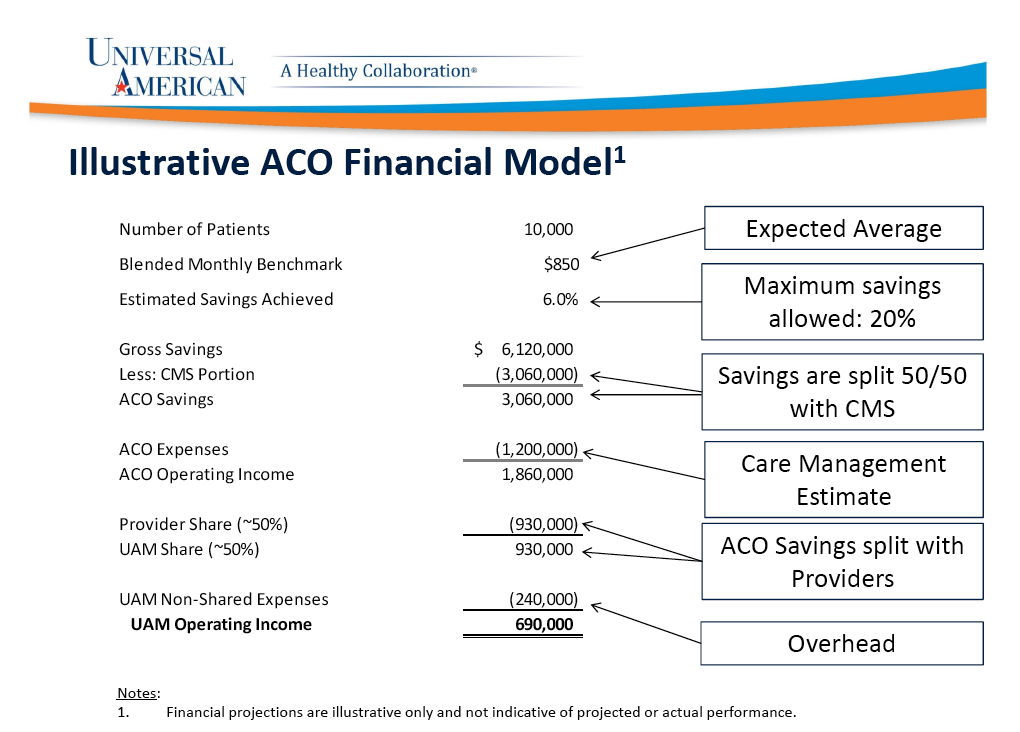
And, 2) a proforma ACO funds flow in their 50/50% ‘healthy collaboration’ provider/healthplan partnership benchmarked to actuals driving a bottom-line:
Picture 5

Strategic Market Tea Leaves: The Health Plan Perspective

By Gregg A. Masters, MPH

JPMorgan Healthcare Conference 2013 HealthNet PresoWhether you love em (anyone love their health insurance company?) or hate em, major health plans are in a reasonable position to lead if not steward the needed healthcare transformation. While physicians aka ‘disorganized medicine’ too often circle the wagons and shoot in, and whereas hospital systems present too much baggage and institutional inefficiencies, health plans with a ‘utility company’ mindset and access to local, regional and national market ‘big data’ footprints are likely candidates to support if not direct and brand local innovation.

In a continuing series to sample and curate narrative from the rich content at JP Morgan Healthcare conference 2013 here are some highlights as well as the audio webcast and deck proffered by industry veteran Jay Gellert, CEO and President of HealthNet.

Setting context for his remarks and visualizing the future he stipulates:

We think that whatever happens over the next 3-4-5 years [in our business] is going to be an increasingly Government driven market (‘B to G’).’

“…historically at this conference until very recently the vast majority of presenter’s talks has been about how to increase revenue….we think that’s kind of the past as we move to budget driven system…a much more radical change than people have come to grips with…

Gellert’s strategic thesis for HealthNet is offered upfront:

Gellert HealthNet Thesis: JPMorgan Healthcare Conference

Meanwhile some of the other market worthy observations include:

One of the benefits of being in California is that you’ve seen this [risk migration/management] movie before…”

“We’ve really never had an experience in the history of this country where we’ve moved from medical underwriting to community rating without intense disruption…

“…whether successful or not…one of the key challenges for all of us to remember is the individual market is only 5% of the [total]..

Key themes included positioning for the health insurance exchanges, ‘scrubbing the [commercial] book’, positioning for membership growth in Medicaid (MediCal), dual eligibles’, Medicare Advantage and continued uncertainties associated with specific provisions of the Affordable Care Act.

Up next @Aetna, then @Cigna.

JP Morgan Healthcare Conference Unbundled: Something for Everyone?

By Gregg A. Masters, MPH

The 31st annual get together of biotech, pharma and an eclectic litany of publically held healthcare company and many impressive tax exempt health system peeps was my first albeit from a somewhat disadvantaged, i.e., ‘crasher’, status. Yet, in the overall program mix there seemed to be something for everybody from payor to provider, to device manufacturer and distributor, clinical research organizations, academia, it’s primary audience the investment community and even the maturing health technology start-up world, i.e., AliveCor, et al.

For a compete agenda including archived webcasts of select presos, decks, etc., click here. Access is public and free, but registration is required. There is enough information to keep a blogger, journalist or consultant busy parsing out market relevant information for weeks if not more depending upon your level of interest and willingness to search and retrieve content available elsewhere on the web. Yet, I will drill into portions of the overall program and petition any of you who have access to content shared elsewhere that may complete or amplify the narrative.

The $4.42 billion (‘I think we overpaid..’) acquisition of Healthcare Partners by DaVita in May 2012 sheds unique insights on the developing operational and business model footprints emerging inside the accountable care industry. Denver, Colorado based specialty healthcare provider DaVita is a market leader in renal dialysis, and Torrance, California domiciled Healthcare Partners are defacto thought leaders and best practice innovator’s in the risk savvy medical group or physician led integrated delivery space.Picture 2

Many questioned the synergy when DaVita tendered their offer for Healthcare Partners wondering why in the world would a specialty care provider go after a California based medical group with risk contracts with HMOs (there are considerably more contracting and other assets, but this was the oversimplified characterization of what was on the table). Yet, the diversification from renal care into general acute if not the entire care continuum given the move into accountable care or otherwise stated as the shift from volume to value paradigm, the acquisition made perfect sense.

So consider the reporting by Kent Thiry, DaVita’s CEO/Chairman and co-chair Robert Margolis, MD, as peeling back the curtain of accountable care strategy under the emerging incentives and rule changes provisioned under the staged implementation of the Affordable Care Act.

The webcast is here, and the deck is here.

Enjoy!

And the Circle Grows! CMS Announces Another Round of ACOs

By Gregg A. Masters, MPH

Industry watchers have to be impressed by the announcement from CMS today that effectively doubles the ACO count from prior reported totals.

CMS App Clipped

Is it just me, or can you can sense the subtle shift in market sentiment from skepticism to loss of first mover opportunity in one’s market.

For the list of newly anointed ACO’s with a start date of January 1, 2013, click here.

We’ll digest the details and un-bundle its significance for you shortly. i.e., ‘Columbus gets its first Obamacare Accountable Care Organization’ market by market, and model by model.

Take note: the filing application deadline for January 2014 go live date is Summer 2013! Get those apps in process!

JP Morgan Healthcare Conference 2013

By Gregg A. Masters, MPH

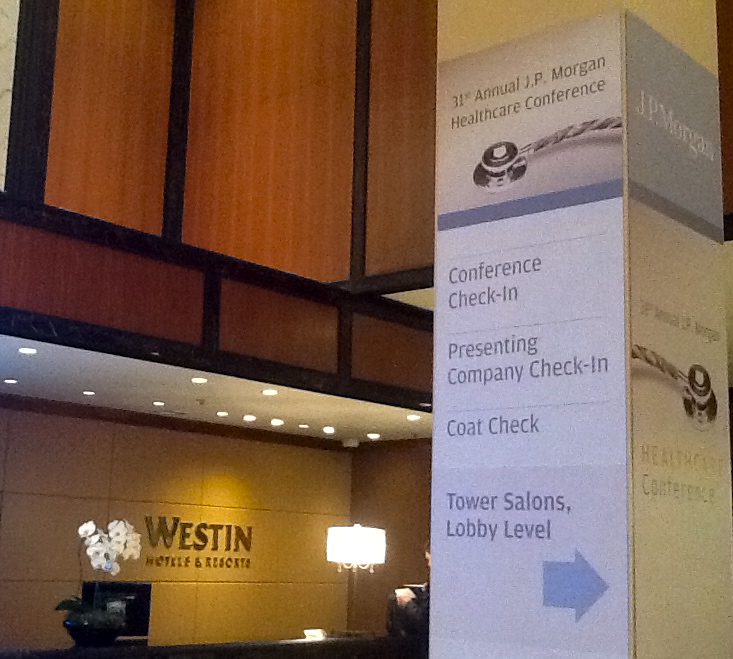
We’re here in the ‘city by the bay’ for the 31st annual assembly of biotech and pharma peeps and the money they seek from the venture capital world. Not exactly my tribe, but my interest was sparked by the generous ‘non profit track’ with many nameplate integrated delivery systems in the strategy and market management conversation.JP Morgan Healthcare Conference

For details, links and some humor on the event including ‘twit’ offered by conference attendees see: JP Morgan Healthcare Conference TweetUp or JP Morgan 31st Annual Healthcare Conference.

Major kudos as JP Morgan is livestreaming portions of the event. This is public but you will need to register on their site.

More later….

More or Less Confusion in ACO World: Who Really ‘Certifies’ ACOs?

By Gregg A. Masters, MPH

The ‘signal to noise’ discernment premium went up a notch recently with the following tweet:

@NCQA Read more about newly recognized ACO @KelseySeybold and their commitment to quality and value in the Houston Chronicle http://ow.ly/g6vzl 7:39 AM – 14 Dec 12

NCQAlogo And with that breaking news announcement (Kelsey Seybold is the first ACO to be recognized by NCQA) another piece of the ACO puzzle has been laid before American public as well as industry stakeholders. Unfortunately one cannot simply graft the information on top of an expanding but orderly base of journalistic reporting and therefore public assimilation of how their healthcare experience can be expected to cKSC-logohange. The fast developing (i.e., ‘bottoms up’, vs. alleged ‘top down’ dictates of an overreaching Federal overlord) world of ACOs are just not that simple to grasp due to the underlying absence of operating standards, the best intentions of Government and the private sector notwithstanding.

A closer look reveals some of the unintentional misdirect or potential for market confusion. The referenced Houston Chronicle article (aka @HoustonChron) erroneously identifies the NCQA as:

…the entity that certifies ACOs.

Yet, NCQA (the National Committee on Quality Assurance) is a ‘private non-profit healthcare measurement group’ based in Washington, D.C. that has organized a voluntary, fee based ‘ACO accreditation program.’ NCQA’s ‘ACO standards’ focus on the following seven core competencies:

  • ACO Structure and Operations
  • Access to Needed Providers
  • Patient-Centered Primary Care
  • Care Management
  • Care Coordination and Transitions
  • Patient Rights and Responsibilities
  • Performance Reporting and Quality Improvement

For context, private, nongovernmental entities typically recognize submitting applicants via a certification or ‘accreditation’ consideration process that approximates a ‘good housekeeping’ or ‘JD Power’ like ‘seal of approval’. They do not license nor legally certify ACOs per se, unless that authority is delegated to them by some governmental entity.

The authority that officially ‘certifies’ ACOs as legal entities for participation in the Medicare Shared Saving Program (MSSP) is the Center for Medicare and Medicaid Services (CMS), aka @CMSgov. ACOs are codified in Section 3022 of the Affordable Care Act and serve as the principal market based vehicles to fulfill the goals of the Medicare Shared Savings Program.

Even here though, the story is not that straightforward, as CMS certifies entities for participation in the MSSP, while its innovation arm, a division within CMS, the Center for Medicare and Medicaid Innovation (CMMI) aka @CMSinnovates, both admits and ‘certifies’ participation in the ‘Pioneer Program’.

Splitting hairs? Maybe. But there are structural differences of what constitutes an ACO to the Feds vs. NCQA vs. those effectively deemed an ACO via contractual agreements with one of more payers under the terms of an ‘accountable care collaboration’ or derivative arrangement.

So perhaps the correct narrative is that NCQA is ‘an’ entity that certifies some ACOs, not ‘the’ entity per se. More accurately though and per terms of their program, NCQA ‘accredits’ ACOs (as defined by NCQA) via a seal that signifies:

Organizations that earn accreditation may have extra credibility and first-mover advantages in their local markets. Being an early adopter of ACO accreditation may also help an organization become eligible to participate in demonstration projects or pilot programs that public and private health plans sponsor.

Finally, it’s interesting to note, that Kelsey Seybold Clinic though now recognized by NCQA is neither participating in MSSP, nor as a risk savvy medical group, perhaps even integrated delivery system, in the Pioneer Program designed and administered by CMMI for more advanced risk bearing participants.

So you be the judge. The slog continues?

Standing Up the ACO: Lessons from South Park?

By Gregg A. Masters, MPH

On Sunday I was chatting with a friend in the biz and the conversation turned to ACOs, wherein he whimsically laughed and then relayed a story from a recent California Medical Association (CMA) sponsored event on health reform, the future of medicine and Accountable Care Organizations, wherein one of the keynote speaker’s (I suspect Mark Smith, MD, of California Health Care Foundation), queried the audience asking for a show of hands:

How many of you watch South Park?

To wit, an estimated 350 out of 500 hands went in the air (South Park is apparently popular with many physicians). The speaker then recounted the gist of the ‘Gnomes underpants’ episode, analogizing their ‘business plan’ to the current state of the art in the accountable care industry at large (for detailed plot, click here).

The apparent resonance of the narrative is the fitting metaphor of a three phased business strategy [absent the mission critical second phase] to effectively profit from the ill gotten underpants gains’. Some say the ‘accountable care’ development and management glide-path is equally clouded by the absence of a similar mission critical body of knowledge and practice bridging theory with mission fulfillment. Clearly the humor lay in the leap of faith (or invisible hand(s) of the market) required, i.e., now that we formed this ACO thing, what is it we need do to make it profitable? Or in South Park terms, that thing in between acquiring stolen property, and projected assumed profit. Perhaps the context or challenge to organizers of ACOs is best reflected in the oft repeated (and variably credited) refrain:

The accountable care organization is like a unicorn, a fantastic creature that is vested with mythical powers. But no one has actually seen one. – Ian Morrison

Does this accurately reflect the state of ‘accountable care’? While the jury may be out, the empirical data is starting to accumulate. We shall see, and starting in Q1 2013 @ACOwatch will present examples from the broad tapestry of the ACO industry including representatives from the Pioneer class, independent physician led ACOs, their hospital centric alternatives, and hybrid ‘accountable care collaborations’ typically associated if not led by a single or multi payor partner(s).

New England Healthcare Institute (NEHI) ACO Innovation Summit

November 27th, 2012 [Editor’s note: portions of broadcast present with low audio].

NEHI Summit Explores Innovations In the Emerging ACO Landscape

The opportunities – and the challenges – presented by the rapid movement towards Accountable Care Organizations were the subject of a recent NEHI summit that drew perspectives from across health care:

“I think ACOs have a whole lot of opportunity to improve the patient experience.” Amy Whitcomb Slemmer, Executive Director, Health Care for All

“This new model has changed the conversation. We now have information that lets us understand total medical expense.” Dr. Justine Carr, CMO, Steward Health Care System

“The ACO model has promise in terms of providing better feedback data along the whole continuum of care.”
Kathleen Buto, VP Global Health Policy, Johnson & Johnson

“In an ACO environment, how you use resources is something that people need to be held accountable for.”
Dr. Gene Lindsey, President and CEO, Atrius Health

NEHI is a Massachusetts based nonprofit, member based national health policy institute focused on enabling innovation that will improve health care quality and lower health care costs. Working in partnership with members from across the health care system, NEHI brings an objective, collaborative and fresh voice to health policy. We combine the collective vision of our diverse membership and our independent, evidence-based research to move ideas into action.

For recent NEHI insights into health reform, click here.

Accountable Care: It’s Growth, Complexity, Prevalence and Promise?

By Gregg A. Masters, MPH

From Leavitt Partners. a webinar held on November 8th, 2012. The focus is on ACOs, and represents an update post elections from their previous reporting here.

A/C/O: ‘Another Compromised Organization’ or ‘A Coordinated Orchestra?’

By Gregg A. Masters, MPH

Last Friday I moderated the HealthIT social media focused tweetchat tagged ‘#HITsm’, see context piece here, and transcript here. The theme centered on the value or centrality of HealthIT to ACO success. The conversation was lively (for additional context, ACO surprise provides metrics on dispersion and penetration into Medicare and commercial markets), and in part reflective of popular notions of whether these rapidly emerging ‘multicorns’ can succeed but more specifically served by social media.

Screen shot 2012-12-03 at 9.29.42 AM

One tweet in particular caught my eye. While specific to a question on the role of social media to ACO development, it resonates with the bearish camp on ACOs in general (a view I challenge on a regular basis). I paused since the tweet was proffered by one of the brighter bulbs in the tool shed of EHR and HealthIT thought leadsership. It was in response to the following tweetchat question:

@HealthStandards #HITsm T5: Can social media ‘detect and amplify’ (preconfigure) preferred community referral interactions to grease the skids of an #ACO? Fri Nov 30 9:48:06 PST 2012

@ehrandhit Hard to see social media doing much to bring together ACOs. Within ACO’s social connections can really help though. #HITsm Fri Nov 30 9:52:28 PST 2012

I centered on this tweet as I engage with John Lynn (@techguy) in health reform and transformation exchanges now and then. In this case, I could not disagree more with his take. To wit the following exchange ensued:

@2healthguru really? Surprised to hear this especially from you!! #HITsm Fri Nov 30 9:52:40 PST 2012

@ehrandhit Not enough providers on it and discussing patient care. Maybe one day. Social principles, yes. Social media, no. #HITsm Fri Nov 30 9:55:44 PST 2012

@ACOwatch T5 I know of no other accelerator to connect like minded docs (i.e, culture) than #hcsm. A virtual ACO tribe preconfigured. #HITsm Fri Nov 30 9:55:49 PST 2012

I then wondered: what am I not seeing here? Is John correct by distinguishing between ‘social media principles, yes’ and ‘social media, no’? Does the low relative participation/utilization of social media limit it’s potential to inform ACO network development? Good questions! What are social media principles vs. the application of social media? Can they be separated? How? Why? How are we measuring physician involvement in social media?

If social media leverages the wisdom of the crowd, reveals, extends and informs conversations, enables collaboration or otherwise energizes social learning (both personal and professional), might the technology serve the interests of an ACO (a de-facto social network), or any series of structured activities designed to advance the triple aim? Intuitively I answer yes, but want to use this line of thinking to vet the reasoning process.

Finally, a broader sensitivity ties to the larger question of the value proposition of ACOs to enable the triple aim or build the sustainable healthcare ecosystem. So discerning the larger sentiment (bullish v. bearish) question might be whimsically framed in the search for wisdom by comedian/actor Steve Martin in the movie classic ‘the jerk’ wherein he was mentored in the less than nuanced discrimination of ‘sh*t from the shine-ola’.

This bearish attribution to ACOs, is a matter near and dear to my heart, since its camp includes some very smart people including the likes of Jeff Goldsmith, Regina Herzlinger, among some of the top in the pyramid of health-wonk thought leadership, while their suspect upside is more than offset by the likes of Elliott Fisher, Don Berwick, and more recently Don Crane to name a few.

Yet, the question remains amidst the market narrative, as most recently evidenced at Not Running a Hospital by Paul F Levy, in a blog post titled ‘Neither accountable nor caring nor organized’, which offers more thought fueling the bearish camp. (NOTE: A thank you to Dan Munro for the heads-up).

The net result” of ACOs, says Federal Trade Commissioner J. Thomas Rosch, “may therefore be higher costs and lower quality health care—precisely the opposite of its goal….

So back to the original question and the title of this blog post. Can social media connect like minded dots and pre-configure if you will an ACO? You betcha! Just look at its growing traction, and measure the social capital and utility created by connecting tweeps via this simple and corny to some medium. It is powerful, tribal, additive, collaborative, chaotic and democratic. Ideas surface and float on the basis of relevance and merit, not personalities nor politics.

From a gravity and use case point of view, applications are being demonstrated daily. For one measure, just look at the constantly expanding database of the healthcare hashtags project hosted by @Symplur. Take a measure of conferences, tweetchats and ‘regular’ hashtags added to their repository on a daily basis.

If the medium is the message, what we’re learning from the explosion of social media, is there are lots of voices/ideas looking for ways to make a difference. Some of those voices concern themselves with important healthcare considerations and need be collaboratively tapped and channeled in service of worthwhile societal needs. One of those consensus needs is the pursuit of the triple aim or creation of a patient centric, sustainable healthcare ecosystem. Why not use social media to reveal underlying referral patterns? Or to screen physicians for their values toward coordinated, seamless care? Or the willingness to be part of a team – the bottom line definition of an ACO?