3rd National ACO Congress Video Mashup

By Gregg A. Masters, MPH

For a taste of the proceedings, check out the video mashup below:

Overview of the ACO Congress

Since the Second National Accountable Care Organization Congress in November 2011, the ACO trend has demonstrated great momentum. As of June 2012, there are more than 200 ACOs identified in the U.S., a 38% increase in only six months (see: Update: Growth and Dispersion of Accountable Care Organizations – Leavitt Partners). The number and variety of organizations adopting accountable care demonstrates providers’ strong belief that the accountable care model is a crucial component of the future of American healthcare.

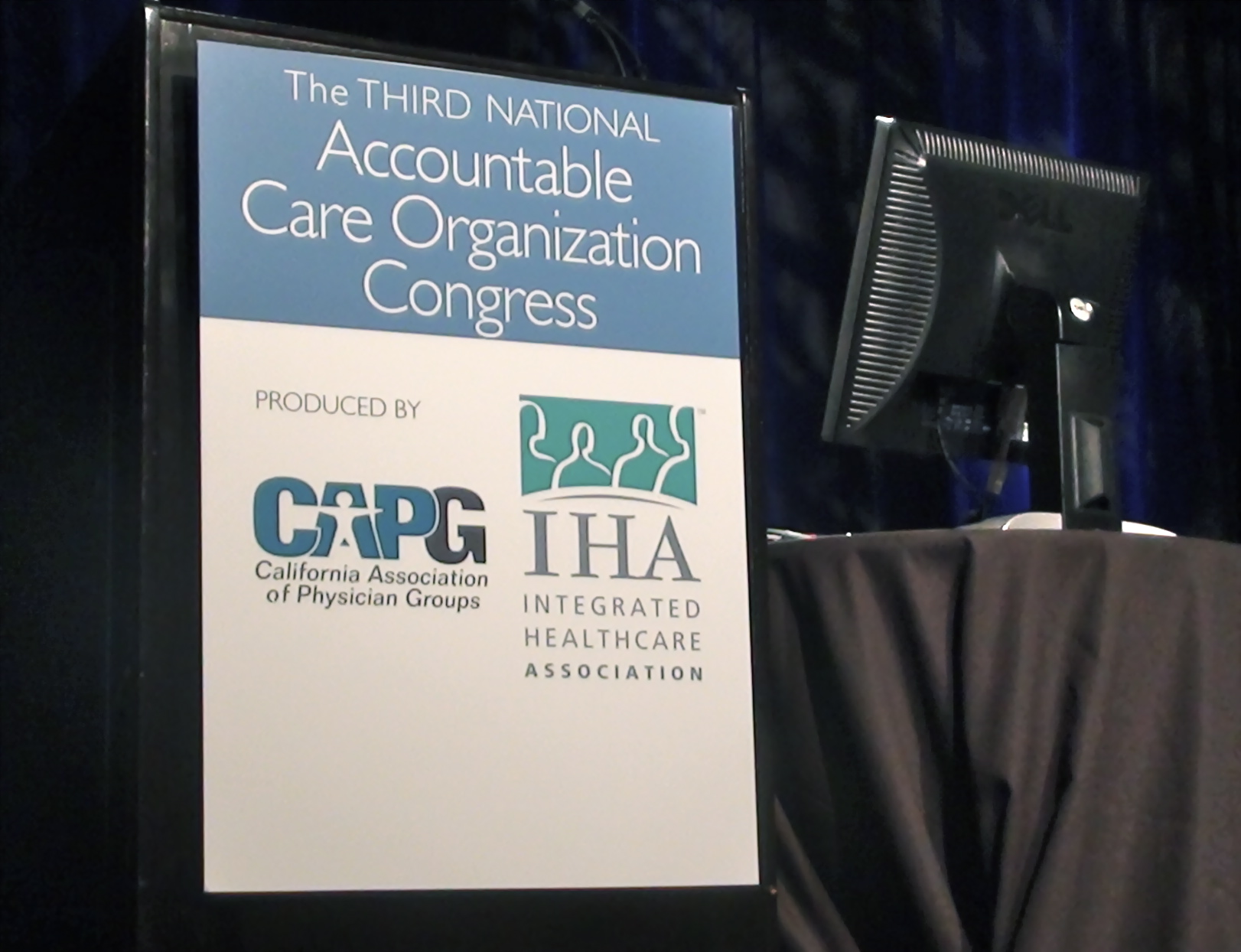
The Third National ACO Congress held on October 30-November 1, 2012 in Los Angeles brought together leading policymakers, deal-makers, experts, and those who have been working on the frontline of ACO implementation and operations to provide unique, in-depth insights and hands-on experience on what has been done so far and what’s in the planning stage in every sector.

The three-day conference featured compelling keynote presentations, including “Inside the Deal” sessions with the principals in the Monarch/Optum and HealthCare Partners/DaVita transactions, political forecasts from leading healthcare advisers, updates from CMS, and insights from private sector ACO developers. There will be three content-rich pre-conferences and twenty-two concurrent sessions that offer participants a chance to learn more about the Medicare Shared Savings and Pioneer ACO programs, private sector ACO partnerships, Medicaid, Dual Eligible and safety net-focused ACOs. We will also hear from experts on ACO legal issues, quality measurement and HIT implementation. Please join us for this exciting agenda as ACO implementation continues to roll out across the nation.
The 3rd National ACO Congress

By Gregg A. Masters, MPH

Just concluded at the Beverly Hilton Hotel, a stone’s throw away from my high school, ‘Beverly’ (yup, the real 90210), I attended the 3rd National ACO Congress. Co-produced by the the California Association of Physician Groups, CAPG, and the Integrated Healthcare Association, IHA. This truly represented a gathering of the best and brightest health policy wonks, entrepreneurs and innovators in the accountable care industry. Both CAPG and IHA include many of the integrated delivery systems and risk savvy medical groups who have ‘walked the talk’ and done most of the heavy lifting in making managed competition actually work.

There is so much to compile and reflect upon, for now I merely want to make notice of this recap to be available shortly. Perhaps the best visual representation that captures the key take away (if not warning to the collective industry) was proffered by this question in Kaiser Permanente’s Jay Crosson, MD’s keynote.

This is somewhat reminiscent of actor Ed Harris’ noteworthy cinematic ‘channeling’ of Gene Kranz’s energy (though Kranz did not actually say this during the heat of the crisis) and leadership to his team of engineers on Apollo 13:

Failure is not an option…

I seriously doubt the private sector has another legitimate, ‘hey we can do this…’ bite at the apple, before Government steps in and puts an end to our collective public/private failure to remedy the root cause of the ‘dis-ease’.

Bricks and Sticks or Vision and Values? Building the ACO

By Jim Frederick, Senior Editor/Pharmacy, Drug Store News

New, holistic models for integrated, patient-centered care are emerging from the fog of health reform almost as fast as you can say “accountable care organization.” But pharmacy and retail clinic operators aren’t waiting for ACOs to fully ripen; they’re forging new alliances with hospital-based health systems and building the kind of continuity-of-care networks that could be a template for the new era of evidence-based medicine and improved patient outcomes.

If anything going on in health care traces the changes that are transforming the health system — attacking the unsustainable cost curve and dramatically improving patients’ access to care — it’s the accelerating growth of partnerships between hospital-based health systems and retail pharmacies and pharmacy-centered clinics.

It makes perfect sense. Both community pharmacies and the roughly 1,400 in-store clinics now open are evolving quickly beyond their traditional practice models with a broader menu of health-and-wellness services.

That makes them ideal extensions of hospital-based care, providing cheaper and more accessible points of entry into a local or regional health system for patients in need of basic diagnostic services and front-line care.

Boehringer Ingelheim Pharmaceuticals noted in a report on retail clinics: “The demand for health care is steadily growing as the population ages and increases, creating some strain on often overworked hospitals and physician practices.”

Retail clinics, BI noted, provide “a way of addressing this issue.”

Community pharmacists can play an equally critical role. With more and more chains and independents giving pharmacists the tools and training to practice “at the top of their license,” pharmacies allied with hospitals provide a slew of services that improve patients’ long-term health and reduce readmission rates — including preventive health services, disease management and monitoring, screenings, medication therapy management, counseling and adherence programs.

In a report in the online publication Payers & Providers, Jim Lott, EVP of the Hospital Association of Southern California, called such alliances…

Read complete article here.

Transformational Potential of Medicare ACOs – Part 1


Dr. David Ballard, Chief Quality Officer and Senior Vice President at the Baylor Health Care System in Dallas, TX and Executive Director of its Institute for Health Care Research and Improvement, introduces a series of articles appearing in the August 2012 issue of Mayo Clinic Proceedings where he shares a 3-part interview with 3 leading health care experts, Drs Shulkin, Couch, and Haydar, who are involved with Accountable Care Organizations (ACOs). They discuss how and why the Medicare ACO funding options work or don’t work for their respective institutions. For ‘The Potential of Medicare Accountable Care Organizations to Transform the American Health Care Marketplace: Rhetoric and Reality‘, click here.

Yes We Can? No, He [POTUS] Didn’t. Not Tonight.

Note: An Opinion Piece By Gregg A. Masters, MPH

If you were not dialed into the first presidential debate tonight, you missed a rather tortured, poorly moderated, POTUS failed series of opportunities to credibly discredit his health reform ‘etch-a-sketch’ opponent. In the post debate punditry, and fact checking, this one is likely to ascend to the Romney ‘distortion zone’ hall of fame collection.

Going into the debate, odds makers favored POTUS to win the match, while most assumed his challenger would benefit though not land anything remotely resembling exchange parity if not the ‘out of the money’ and long shot knock out punch. In fact many saw this debate as an opportunity for POTUS to land just such a fatal blow to this master of health policy obfuscation.

Yet the results are in, and the sentiment is perhaps best be summarized by a series of tweets proffered by Atul Gawande, MD, aka @atul_gawande:

@Atul_Gawande 1. Obama was meandering and confusing.

@Atul_Gawande 2. Romney made a shockingly better case for government being a protector of the weak and vulnerable than Obama.

@Atul_Gawande 3. Romney’s stated policies—cutting coverage for the uninsured, Wall St regulations, and top tax bracket—weaken those protections.

@Atul_Gawande 4. That Obama could not convincingly explain this is utterly depressing.

@Atul_Gawande 5. The key policy Q: did Romney’s promise to leave the tax share of the rich the same walk back his promise to cut top tax bracket?

No doubt a wake-up call to the Obama camp.

In the attribution department, the title for this post ‘ Yes we can? No, he didn’t. Not tonight.‘ was sourced from: Warren Kinsella, aka @kinsellawarren, who described himself as ‘…a raconteur, bon vivant, and – occasionally – a Toronto-based lawyer, author and consultant. He is not profound, but he enjoys a good scrap.’

William J. DeMarco on Provider Contracting, ACOs, Value Based Purchasing, and Practice Acquisition

By Gregg A. Masters, MPH

Courtesy of Clive Riddle and MCOL aka @M_C_O_L, author, consultant and long term managed care industry verteran reflects on the ACO environment, unbundles and expounds on the range of entrants in the ACO space and reports on the status of the playing field as of the May 2012 data point.

For a recent chat with DeMarco, on ‘This Week in Accountable Care’ click here.

ACOs in the ‘Good Ole US of A’

By Gregg A. Masters, MPH

David Blumenthal, M.D., MPP, Former National Coordinator (2009-2011) Office of the National Coordinator for Health Information Technology and seasoned health policy wonk opines on ACOs. Further details and balance of Dr. Blumenthal’s credentials below:

In this video, Dr David Blumenthal, Samuel O. Thier Professor of Medicine and Professor of Health Care Policy at Massachusetts General Hospital/Partners HealthCare System and Harvard Medical School, talks to Nuffield Trust Director Dr Jennifer Dixon about one aspect of health care reform in the United States — the development of accountable care organisations (ACOs).

Dr Blumenthal provides an overview of this core part of the US health reform legislation which will see ACOs — networks of providers — assume responsibility for the quality and cost of care for their patients. He explains how financial incentives and accountability mechanisms will be introduced to help increase the efficiency of care and improve quality, and outlines the measures being taken to ensure that the amount of risk ACOs take on will be calculated appropriately.

Dr Blumenthal presented at the Commonwealth Fund and Nuffield Trust 12th international meeting on the quality of health care in July 2011.

Video and description originally posted by http://www.nuffieldtrust.org.uk

J.D. Kleinke Makes It Perfectly Clear!

By Gregg A. Masters, MPH

Amidst the relentless noise, fear mongering, hand wringing and incessant misrepresentation of both the legislative history as well as decades of development of sensible health policy context for competing models of managed competition or healthcare market reform, J.D. Kleinke in a recent New York Times Opinion piece titled ‘The Conservative Case for Obamacare‘ essentially clears the air once and for all.

If you have not read his piece, I strongly encourage you to do so!

For those of you without the time to scan right now, let me cite two key observations. But first, please be mindful that J.D. Kleinke is a resident fellow at the American Enterprise Institute, a former health care executive and the author of the novel “Catching Babies”, and not some fringe liberal dwelling in a pseudo think tank pumping ideological fuel into the health reform disinformation rant. J.D. notes:

The core drivers of the health care act are market principles formulated by conservative economists, designed to correct structural flaws in our health insurance system — principles originally embraced by Republicans as a market alternative to the Clinton plan in the early 1990s. The president’s program extends the current health care system — mostly employer-based coverage, administered by commercial health insurers, with care delivered by fee-for-service doctors and hospitals — by removing the biggest obstacles to that system’s functioning like a competitive marketplace.

So much for the ‘Government takeover’ enshrined in Republican town hall talking points designed to to stir the pot and focus grandma’s attention on the inevitable death panels in her future.

J.D. further observes the likely source of the vigorous opposition to the Heritage Foundation inspired ‘individual mandate’ included in the Patient Protection and Affordable Care Act aka ‘Obamacare’, as a market driven alternative to the Clinton administration’s ‘American Health Security Act of 1993, aka ‘HillaryCare’:

In the partisan war sparked by the 2008 election, Republicans conveniently forgot that this was something many of them had supported for years. The only thing wrong with the mandate? Mr. Obama also thought it was a good idea.

All I can say is ‘thanks J.D.’. I now wonder whether Matt Holt was projecting on your future when he tweeted:

Matthew Holt ‏@boltyboy
JD Kleinke’s resignation letter from AEI

Physicians, ACOs and Those ‘Boiler Plate’ Participation Agreements: Buyer Beware!

By Jeffrey L. Cohen, Esq.

There continues to be terrific interest in accountable care organizations (ACOs), which are of course a financially risk-based model of providing healthcare to patients who choose to enroll in the Medicare Shared Risk Program. ACO organizations are often led by hospitals and hospital systems, though occasionally by physician organizations. One of the key common threads among these provider led ACOs is the fear of being left out of “the game,” the fear of losing out financially. This fear, however, can lead physicians to run headlong into danger if and when they sign ACO documents.

One of the key ways ACOs get formed involves a stack of contracts being created, then shoved under physicians’ noses. Doctors afraid to lose out tend to just sign. The organizations are really to blame here, when the documents fail to contain material terms to deal with things like: credentialing criteria, disciplinary procedures, financial provisions, how the financial up side or down side can affect physician compensation. The documents are simply slid under their noses and, in fear of being left out, they get signed! Or, as my buddy Rodger says “Ready, shoot, aim.”

Regardless of a doctor’s view of ACOs, no document ought to be signed unless all the questions raised by them are addressed, very clearly and in writing. Be at the table with ACO organizers and do your best to design a good system, but don’t be naïve to think that the unaddressed portions will magically get filled in somehow in a way that benefits you or that even makes sense. At the very least, wait until the document is complete, then consider if you want to sign it.

Jeffrey L. Cohen, Esq. is the founder of the Florida Healthcare Law Firm. Follow him on Twitter via @FLhealthlawfirm. This article originally appeared here.

I’m Absolutely Bullish on the Future of Healthcare!

By Gregg A. Masters, MPH

In the walk and perhaps some instances trot towards forming and launching an ACO you have prominent voices on both sides of the debate. The bearish camp is perhaps best represented by the likes Jeff Goldsmith in ‘Can Accountable-Care Organizations Improve Health Care While Reducing Costs?’ or Virgina Herzlinger in ‘Herzlinger Predicts ACOs, PCMHs Will Fail‘.

While the bullish camp advocates include Donald Berwick, MD in ‘Making Good on ACOs’ Promise — The Final Rule for the Medicare Shared Savings Program‘, Drs. Elliott Fisher and Mark McCllelan, see ‘Fostering Accountable Health Care: Moving Forward In Medicare‘. Now add to the bullish view and in no uncertain terms, that of Charles Saunders, MD, President of Strategic Diversification for Aetna.

I had the good fortune to chat (to listen, click on show image to the right) with Dr. Saunders today to gain additional insight into how one rather progressive and forward thinking ‘payor’ views their interest in the ACO and Patient Centered Medical Home market, while actively re-tooling its traditional health plan business model.

Healthcare consultant and author Joe Flower recently opined ‘Even Aetna CEO admits: We’re toast‘ while noting Mark T. Bertolini aka @mtbert, proffered the following sober reckoning on the demise of the traditional health insurance business model:

The system doesn’t work, it’s broke today. The end of insurance companies, the way we’ve run the business in the past, is here.

What Bertolini sees under the auspices of the Affordable Care Act and the ACO provisions specifically are minimally transitional if not replacement vehicles to the health plan business model. A reinvented Aetna (if not entire AHIP membership) will have a lot to do with technology and a range of value added roles Aetna can play in building and supporting the drivers of sustainable healthcare ecosystems. We’ve got to get beyond simplistic notions of ‘my revenues are your expenses’, and see our collective interests in a collaborative vs. competitive future.

The visionary on point to assemble, configure if not birth the moving parts of this future is Dr. Charles Saunders. We got some of his worldview today on ‘This Week in Accountable Care.’

In the words of a very smart man, from many years ago:

No one is big enough to be independent of others – Dr. William Worrall Mayo

Perhaps we’ll pay attention this time?