So What’s with the [ACO] Bundled Payment Thing?

By Gregg A. Masters, MPH

It’s interesting to note the more ‘things change’, the more they ‘[seem] to stay the same?’ Let me explain….

In a recent observation by Rob Lazerow featured in the post ‘How Are ACOs Doing‘ the Advisory Board Senior Consultant dubs 2013 as the ‘year of accountable care’. He then goes on to highlight the ‘bundled payment’ program as the center of gravity in ACO market movement since:

It has nearly twice as many provider organizations compared to those participating in the shared savings program. It represents a big spike in experimentation.

Yet, Rob’s newfound gestalt may seem like a bit of back tracking from his previous sentiment as noted earlier via ‘Bundled Payment: A Gateway to Accountable Care? where I engaged him on the subject and value proposition of bundled payment to the ACO movement and holy grail of the triple aim.

So the ‘stay the same’ angle here is more about the herd movement into or out of popular thinking (perhaps even superficial) around ACO strategic issues vs. the granular basing of what we know works, and their real world impediments to local market implementation.

For instance, quite some time ago I penned the following provocative title: ‘Bundled Payment? Lets Start with the ‘RAPERs!’ Unfortunately, I was dead serious then and remain so today, however this bit of granular insight was a tad more than the market wanted to consider then. It received little if any attention and/or discussion, yet it goes to the fundamentals of our ‘healthcare cost conundrum‘. Might it’s reception be different today? Are we really ready to tackle the issues, or will we be content to just keep talking and meeting, with little to nothing changing? We shall see.

Some Context and Perspective on Standing Up the ACO

By Gregg A. Masters, MPH

I am passionate and write a fair amount about health reform, innovation in business models and the pursuit of a ‘sustainable healthcare ecosystem’ as I’ve been intimately involved in serial efforts to restrain the appetite of a change resistant industry that Shannon Brownlee aptly frames in Escape Fire the hard hitting documentary that recently aired on CNN, that:

…we’re in the grip of a very big industry and it doesn’t want to stop making money.

For more context on the nature of that ‘grip’ and it’s persistent hold see: Mayo v. McAllen – The Battle for the Soul of American Medicine?

Most of the readers of this blog don’t know me personally, so let me offer some historical perspective that may shed light on my standing in the conversation, and why you might want to heed or discount some of the warnings and arguments I have been making since it’s launch in 2010.

First up, I am a founding member of what was the disruptive innovator in the PPO space in California back in the mid to late 80s. We were a start-up joint venture (JV) between Los Angeles and Orange County flagship hospitals and their medical staffs.  As a condition for participation in the contracting network, member hospitals formed ‘PPGs’ (professional practice groups) which later morphed into IPAs as we expanded our book from discounted fee for services (FFS) contracting to at-risk contracting under the forerunner of Medicare Advantage, i.e., Medicare Choice, program and later Maxicare’s commercial IPA ‘Window Project’.

More on point though, we were organized as a payor agnostic ‘3rd generation PPO’ since we repriced claims to contracted amounts (both hospital and physician) and cut a contract sensitive ‘expected EOB’ for the payor to process (later we were extended check writing privileges for selet payors); AND we had ‘attorney-in-fact authority’ on behalf of member hospitals and PPG physicians to enter into contracts vs. shuttle them back and forth as was customary for prevailing ‘messenger model’ PPOs then and even to some degree now.

So posit the ‘payor neutral’ or ‘agnostic’ frame of reference coupled with a claims repricing engine and attorney-in-fact standing as an optimally positioned contracting entity or management services organization (MSO) in the managed care value chain.

Second, during the run up where the major commercial insurers and payors (i.e., Aetna, Blue Cross, Blue Shield, the Equitable, Prudential, et al), and then market leading hospital management companies (i.e., Hospital Corporation of America/HCA, National Medical Enterprises/NME, and American Medical International/AMI – the latter two merged to form Tenet) strategized their entry into the managed care space by creating their own or JV’d ‘insurance vehicles’ I actively counseled (initially via back channels and later direct) principals at AMI to not invest in AMICARE, but to position a payor neutral contracting vehicle, much like the one referenced above, to contract with any and all payors that made portfolio sense in their respective markets, given net revenue and physician alignment goals. The guidance was shunned, and approximately 36 months later, AMI discontinued AMICARE taking a charge in the neighborhood of $350 million.

Incidentally the collective proprietary entry of hospital systems into the ‘business of health insurance’ met with a similar unwinding at various points in time including the respective charges to balance sheets and income statements. In addition there followed an extended period wherein a residual culture war between those with integrated delivery system DNA, and the traditional dye in the wool ACHE types, played out for the hearts and minds of the prevailing paradigm of hospital leadership and forward vision.

Then in the mid 90s I was retained by a major hospital system, an HCA spinoff dubbed ‘HealthTrust’ to propose and implement a managed care strategy for 12 hospitals in its Houston Region. Shortly after my arrival in the Lonestar state, my best strategic counsel was to leverage the creation of a super MSO that contracted on behalf of the region’s hospitals, and their associated physicians once again tethering to the principal of a payor agnostic solution, partnered with independent physicians via IPAs, participating medical groups or direct. Unfortunately, the then prevailing ‘corporate wisdom’ and business model was to create the capacity for staff model like HMO delivery capabilities via the outright acquisition of certain primary care physician practices. In Texas that vehicle is known as a ‘501.a’ entity where the hospital (or other non physician sponsor) can be the sole member and acquire the assets of a physician’s practice and in turn employ him or her even though Texas is a corporate practice of medicine state.

Over time, that commitment unwound much like the previous iterations noted above as the model was untenable and did not produce the revenues, physician loyalty nor productivity assumed in the buyouts, let alone contracting objectives the hospital system had for it’s local market and associated physicians.

Finally, and the last seasoning experience since this sheds fair amount of insight into present day ACO challenges. Two major hospital systems merged in the Dallas Fort Worth market during the mid to late 90s. At it’s core, it was a strategic merger of two fundamentally oppositional cultures.

Party A, though a hospital system none-the-less made a commitment to the health insurance [or perhaps more accurately characterized integrated delivery system paradigm] fielded the largest provider sponsored HMO, including some innovative spinoffs up to and including a parallel ‘payor agnostic’ contracting platform that dealt with other payors, in addition to operating flagship hospitals in their north Texas service areas.

Party B was a more traditional hospital system with the usual inpatient, outpatient and niche services folded into an institutional assets portfolio with geographic distribution that engaged in managed care via downstream relationships with health plans across successive iterations of PHO configurations. Risk contracting was part of the mix, but the hospital system was not a top line sponsor of an HMO nor other insurance product strategy deferring to downstream participation.

Post merger of the two hospital systems Party B’s physician partner in the PHO asserted ‘a change in ownership’ and demanded the provisioned ‘mandatory redemption’ ie., share buyout option to effectively eliminate the ‘H’ from the P/H/O. In other words, the PHO would become a PO (physician organization).

As a senior player in the conversation, I advised the leadership of Party B to not take the ‘divorce’ personally, but stand down and focus on ways to play into a value added partner relationship to the PO, primarily via contractual arrangements and a coordinated contracting game-plan. This was not to be the chosen strategy and there developed a considerable tension and back tracking on established goodwill between the hospital system parent and it’s engaged physician leadership.

As it turned out, there were much bigger issues on the table, and while forging new relationships between Party B’s PO and hospital leadership was a priority, what took center stage was what would be the ‘successor culture’ amidst an insurance vs. traditional hospital operations mindset in the newly minted merged organization? In the former scenario (Party A’s culture), hospitals are cost centers, not the traditional nor familiar ground of operating them as revenue centers. Bottom line, the hospital culture prevailed, and shortly witnessed a sequential ‘return to core business operations’ where non core assets were shopped to strategic suitors, i.e., the HMO was sold to a publically traded entity looking for a commercial market share gains in the North Texas communities. Physician Standing Up the ACO

So believe it or not, we’ve been here before. There is institutional memory to tap, and leverage from direct if not indirect lessons forged from a combination of serial strategic misfires as well as purposeful vertical integration plays. The hospital scenario mentioned above is timely as it plays out against the downside of provider consolidation disproportionately favoring pricing discrimination against patients or their health plan proxies to restrain price hikes associated with undue asset concentrations. Hospital operators have quite rationally simplified their operating strategies, perfecting the unit production driven revenue formula, and have managed to their benefit in the North Texas market as well as elsewhere as a by product of risk push-back and a return to their core strengths, i.e., maximizing the unit performance of their hospital operations. A modest tweak in the formula is re-admission risk, shared savings targets, and meeting quality metrics.

Can independent ACOs reverse if not control for the downsides of hospital asset concentrations? Perhaps, but only with proper vision, management, infrastructure and capital to weather the unavoidable transitional storm. It is not a level playing field, nor are the financial incentives harmonized with the end game. Until hospitals are seen as cost centers in a reconfigured population health or community based context, they will remain responsive to volume driven (vs. value oriented) sick-care assets in the health and wellness continuum. The hope is ACOs properly equipped the the authority, standing and scale may able to align healthcare assets into the sustainable healthcare ecosystem that works for all of us – a rather ambitious undertaking by any measure.

The jury is out, the chatter is intense and no resolution in sight anytime soon. Stay tuned!

Are Institutionally Led ACOs ‘DOA’? I Say Heck Yah!

By Gregg A. Masters, MPH

At the end of the [business model and strategic positioning] day, it’s all about the intangible but mission critical ‘C’ word, i.e., culture, and whether two traditionally oppositional styles (physician v. hospital) can mash-up and ‘meaningfully integrate’ (clinically, legally & workflow wise) where previous attempts during the 80s and 90s failed.Are Hospital Led ACOs DOA?

Truth be told, fast forward a couple of decades and that cultural divide has yet to be reconciled a least on average. Granted there are some exceptions (most notably progressive integrated delivery systems who’ve aligned financial incentives but more importantly ‘vision’), and many of the oppositional dinosaurs (physician ‘free agency’ and solo practice are on an accelerated decline) are retiring or otherwise stepping aside. Yet even with the emerging digital natives sporting MD degrees, the cultural divide between clinicians and administrative types (or latter day suits of all stripes), remains a geopolitical land grab just beyond the reach of the individual ‘P’, “H’ and thus ‘O’. Yet, all healthcare is local right, so clearly there are differences based on locality and market considerations.

What’s different today?

Most will say that the difference between PHO 1.0 (for the casual reader or those with a professional event horizon shorter than a decade plus, PHO = a physician/hospital/organization), and the ACO movement spawned by the Affordable Care Act and most visibly iterated as PHO 2.0 roll-ups (since many of the more visible and publically tagged ACO efforts include an ‘H’) nets out to an accessible if not the ‘new and improved’ ubiquitous technology edge, coupled with smarter ‘productivity’ systems to hold docs accountable post acquisition (risk transfer) of practice assets or hiring.

Back when the internet was just getting going circa the 1990s and Jim Clark was pushing the Healtheon vision – an ambitious agenda to virtualize if not harmonize the complex healthcare ecosystem, we did not have the ubiquitous connectivity and prevalence of user friendly devices including mobile and tablets or the enabling bandwidth let alone national coverage.

Reading the ‘tea Leaves’

Yet even in the face of ‘smarter people’, ‘better systems’ and increasingly accessible, ‘robust cloud based services infrastructure’ (IT and otherwise) with attractive price points, is the people challenge any different today? At least two data-points suggest otherwise evidencing the underlying ‘dis-ease’ associated with the implementation complexity of a ‘soft sell’ re-engineering of American healthcare via the aggregate market uptake of ARRA, HITECH and key ACA (ACO) provisions.

According to a Athena Health’s 2012 ‘Physician Sentiment Index‘:

  • 69% believe EHRs can improve patient care, down from 75% the year before.
  • 75% believe achieving Meaningful Use is a burden.
  • 53% believe the Affordable Care Act will be detrimental to patient care, up from 50% the year before.
  • 58% believe most or all of the Affordable Care Act should be repealed, and 26% believe that some elements should be repealed. Only 16% said to keep it as is.
  • 63% believe the shift to Accountable Care Organizations (ACO) will have a negative impact on profitability, up from 48% last year.
  • 54% believe the quality of care will decrease over the next five years.

Add to the mix the following headline: ‘Physician Turnover Hits New High as Demand for Primary Care Increases’, which reveals:

physician turnover reaches the highest rate since the first year data was collected in 2005, and exceeds pre-recession levels. Medical groups reported an average turnover rate of 6.8 percent in 2012, according to the 8th annual Physician Retention Survey from Cejka Search and the American Medical Group Association (AMGA).

The survey also reported turnover of 11.5 percent among advanced practice clinicians (APCs), which includes physician assistants and nurse practitioners.

Also noteworthy is from the report’s ‘Other Key Findings’:

‘Culture is the Top Controllable Turnover Factor: Lack of cultural fit was the third most common reason given for voluntary departures, and the most common factor within the control of a medical practice.’

‘Demand for Care Teams Intensifies: More than three-quarters (76%) of respondents plan to hire more primary care physicians in the next 12 months, 67 percent plan to hire more nurse practitioners and 61 percent plan to hire more physician assistants. Strong teamwork skills will be vital to successful coordinated care.’

Bottom Line

So that ‘primary care sucking sound’ (remember Ross Perot’s NAFTA warning?) mostly to build out and staff ACOs, medical homes and their derivative ‘high value’ networks, are creating an environment where the natives are clearly restless, while the disconnect between industry rhetoric and the on the ground reality of the transformational imperative has never been more acute, nor the stakes so high.

ACOs were purposefully visioned as physician led enterprises, yet as is often the case in healthcare innovation amidst a change resistent ‘just say no’ culture the capital partner steps in to steward if not direct the initiative’s vision of organization, governance and equity (fairness if not capital) issues. Moreover, hospitals (or their parent systems) are the likely source of ‘capital’ – financial, managerial and infrastructure, ergo they step into the void of physician leadership to move the needle albeit in their narrow view of self interest.

Most institutionally led ACOs therefore are dead on arrival unless there are compensating factors which infuse [group practice] physician culture at the center of the enterprise in pursuit of the triple aim, or hedges where hospital executives clearly see their role as transitional enablers and not drivers of a physician seeded transformational process amidst a sea of conflicting incentives, values and workflows.

This Week in Accountable Care with Aetna Strategist Charles Saunders MD

By Gregg A. Masters, MPH

On the broadcast I chat with Charles Saunders MD, CEO of Emerging Businesses at Aetna. Dr. Saunder’s seat in the house of healthcare innovation is a unique perch and his tenure in the business brings both depth and breadth to fundamental questions we face as a collective industry.

A fountain of information and insight we discuss the emergence of all strains of ACO’s from the Medicare Shared Savings Program to accountable care collaborations and their public/private hybrids and derivative strains. There is strong demand from the provider community to work with Aetna as an infrastructure and strategic partner.

We originally broadcast this episode on September 18th 2012 under the blog post: ‘I’m Absolutely Bullish on the Future of Healthcare!‘ The story remains an important one and if anything, the momentum has only accelerated since up to and including the recent announcement of the launch of the National Association of ACOs earlier this month. Do yourself a favor and spend some time with Dr. Saunders, it is well worth the listen.

HiMSS 2013 Accountable Care Organization RoundUp: Monday March 3rd

By Gregg A. Masters, MPH

Himss 13 LFTF Masthead

We’re only 8 days out from the HiMSS bash in the ‘big easy’ aka ‘NOLA’. We’ve been so engaged in planning the Health Innovation Broadcast Consortium aka @HIBCtv coverage it’s been a challenge to stay on top and share the more worthwhile developments in the ACO space.

So lets detail some of the events that have caught my eye and we’re likely to cover in some fashion. First up and from the ‘specialty program’ department from the Delivering on Value – The Handshake Between Cost & Quality  I’m intrigued by the following trilogy as all address fundamental issues in standing up a viable ACO:

The ‘ACO Encounter: Physician-Lead Perspective

Description: The fastest growth in accountable care organizations is in physician-led ACOs. Gain insights from the experiences of knowledgeable physician-led accountable care initiatives who work with multiple small and medium size practices. **Each ACO Encounter presentation will be provided three times between 1:45 p.m. and 4:45 p.m. Attendees will have the opportunity to rotate though all three encounters during that time frame. Please refer to the attached PDF program for more details.

Speaker: Michael Griffis

Obtaining Quality through New Care Models: Challenge and Promise of ACOs

Description: Hear how to identify and better manage high-risk, high-cost patients, while exploring different care models, such as accountable care organizations, and incentive programs, such as value-based purchasing, to optimize patient care management.

Speaker: Blair Childs

ACO Encounter: Payer Perspective 

Description: Commercial health plans are partnering with providers to build successful accountable care collaborations with their expertise and analytic capabilities. Hear from leading health plans about innovations and strategies around reporting, care coordination, payment models, and analytic tools including risk identification and predictive modeling.

Speaker: Charles D. Kennedy, MD

Note: While much of the attention in ‘ACO-dom’ has rightfully centered around CMS certification of participating entities in the Medicare Shared Savings Program (MSSP), and via the Centers for Medicare and Medicaid Innovation (CMMI) the Pioneer and Advanced Payment model programs, there is a frenetic pace of activity in the commercial markets stoked in part by Aetna, Cigna, United et al, under the banner of ‘accountable care collaborations’ et sequelae. Dr. Kennedy is a principal architect of Aetna’s accountable care solutions group.

We spoke with in ever so briefly here, and look forward to spending some time with him up close and personal in NOLA.

The National Association of ACOs Emerges

By Gregg A. Masters, MPH

We’re only 8 days out from the HiMSS bash in the ‘big easy’ aka ‘NOLA’. We’ve been so engaged in planning the Health Innovation Broadcast Consortium aka @HIBCtv it’s been a challenge to stay on top and share the more worthwhile developments in the ACO space.

naacosPerhaps of most immediate interest is the somewhat predictable announcement of the formation of the National Association of Accountable Care Organizations aka ‘NAACO’S’.  I quote in part from the February 8th, 2013 PR below:

Over 60 Accountable Care Organizations (ACO) from more than 15 States have come together to form the National Association of ACOs. NAACOS is a 501 (c) 6 non-profit organization that allows ACOs to work together to increase quality of care, lower costs and improve the health of their communities. The Centers for Medicare and Medicaid (CMS) has recognized 258 organizations as ACOs, and private insurance plans are working with numerous other ACOs in cities across the US.

“It is phenomenal that this many ACOs could come together in a matter of 8 weeks to form such an important organization,” said Clif Gaus, NAACOS President.

“While rapid, this is a natural evolution of what was an informal network of ACO executives recognizing the need for the ACO industry to have its voice clearly and consistently at the table as regulations and program rules are developed by CMS and the States. Equally important is providing a forum for a peer to peer exchange of effective and efficient solutions to the myriad of operational challenges,” explains Mike Barrett, the Chair of the NAACOS. 

Membership is expected to exceed 100 ACOs by April, representing over 2.0 million Medicare assigned beneficiaries.

The announcement continues to define the NAACOS mission as:

  • Fostering growth of accountable care models of care;
  • Promoting industry-wide uniformity on quality and performance measures;
  • Providing Peer-to-Peer learning experiences
  • Highlighting clinical and operational best practices;
  • Constructively engaging the vendor community, and
  • Educating the public about the value of accountable care.

Further NAACOs is sponsoring its first national conference and membership
meeting in Baltimore, MD. Attendees will hear from key CMS leadership on the ACO programs and Medicare’s Quality Reporting and Improvement Programs and have the opportunity to learn from one and other in peer-to-peer exchanges and breakout sessions. 

NAACOS is governed by an Interim Board of Directors until the permanent Board
will be elected in June. The Interim Board includes:

Interim Board of Directors and General Counsel

Mike Barrett, NAACOS Chairman
Heritage California ACO
Northridge, CA

Ted Carpenter
President

For more information on the National Association of Accountable Care Organizations, click here.

Signal to Noise Challenges in ACO Actuarial Data: Who’s ‘At Greater Risk?’

This post originally appeared at HealthHombre.

HealthHombre.com | BlogThe national health expenditure data released last week showed relatively modest 2011 growth, which promptly provoked a back-and-forth about what the figures truly say and what they portend for holding spending in check going forward.  Amid considerable mental gear gnashing, the data have been assessed in light of such potential cost influencers as lingering recessionary effects, clinical v. administrative drivers, and imminent arrival of the full-bore ACA.  Occupying several nodes along the public-opinion continuum, headlines ranged from “Spending Growth at 52-Year Low” to “Americans Boost Spending” to (out on the far edge of the limb) “Future is Not Clear.”

More clear is the sharp relief into which the expenditure data cast other data, detailed in a new analysis that suggests a greater risk of Medicare Shared Savings Program underpayment of ACOs in precisely this type of environment — i.e., when no one’s altogether sure about the ups and downs of health care spending.  As a CMS summary put it:

[T]he role of random fluctuations in year-to-year healthcare spending may play a larger role in savings measurement than previously anticipated. Although CMS is fairly well protected from the chance that an Accountable Care Organization (ACO) would be rewarded inappropriately for savings that did not truly occur, ACOs are much less protected from the analogous chance that they are inappropriately denied rewards for savings that do occur.  (emphasis supplied)

And so as CMS moves forward with the latest wave of ACOs, the agency seems to have its own bets pretty well covered.  ACOs themselves, however, could face “denied rewards,” with the risk that genuine savings will go unshared particularly acute for smaller ACOs.  The analysis mused that the new data may mean ACO participation will be skewed toward groups of larger providers better able to buffer themselves against the vicissitudes of future health spending patterns.

In a risky world, ACOs, perceived by some as potentially “fragile” to begin with, seem little strengthened by this latest confluence of data.

A Tale of Two Cities: The Worst of Times or the Best of Times? L.A. v. San Diego

By Gregg A. Masters, MPH

Comparing and contrasting healthcare markets or their essential component parts can be a perilous board room exercise if the intent is to make sense of strategy options, that inform enterprise or entity choice, and meaningfully benchmark forward progress.

In pursuit of the ‘triple aim’: better experience of care, improved population level outcomes, and lower per capita costs, the quest to gage forward progress into the broad brush ‘new, new accountable care’ paradigm, it’s vitally important to understand the granular nature of markets, its constituent players, and the relative balance of power therein.

Los Angeles Study: California Healthcare Foundation ACO

In the run-up and consideration process of the rule set to articulate and map the glide path for the formation and launch of accountable care organizations (ACOs) and derivative – i.e., ‘off balance sheet equivalent’ – commercial or privately negotiated versions, much concern was directed to the potential complications of incentivizing such ‘wholesale’ provider integration. Many warned that disproportionate pricing leverage would result as modern day versions of Paul Ellwood’s ‘SuperMeds’ would rule their respective turfs. The net effect being the continued power shift away from purchasers or their health plan agents’ assumed ability to restrain the ‘rapacious apetite’ of an often expansionist, capital starved (you know the crane as mascot) and yet margin (contract restrained) challenged provider marketplace – not exactly the ‘shift’ outcome intended by either the ACA or subparts specific to ACOs.
San Diego Study | California Healthcare Foundation ACO
So courtesy of recent updates to previous market studies funded by the California Healthcare Foundation and fielded by the The Center for Studying Health System Change, we have insights into two emerging ‘accountable care’ Southern California strategy footprints. For details see: ‘Los Angeles: Fragmented Healthcare Market Shows Signs of Coelescing’, and ‘San Diego: Healthcare Providers Expand Capacity as Competition Increases for Well Insured Patients’

For prior tea leave interpretations, see: IPA + HIT (aka technology stack) x MSO = ACO, and California Association of Physician Group (CAPG) CEO Don Crane’s take in Smart Money, ACOs and Risk Savvy Medical Managers. So which footprint is more in alignment with the intent of the ACA’s triple aim, you be the judge? I say, what up San Diego?

And the beat goes on….

National ACO Patient Engagement Benchmarking Survey

By Gregg A Masters, MPH

Earlier today Avado released a National ACO Benchmark Survey directed to select ACO avadoand accountable care industry executives. A core component of ACO success from both a financial and outcomes perspective, and critical to the fulfillment of the triple aim, ‘patient engagement’ is a broadly cast, locally flavored and otherwise rather ambitious undertaking. In an industry that typically did not have to think in such aggregate (population level or shared governance) nor granular (patient centric, beneficiary engaged) terms, this is no walk in the park. For an itemization of CMS indicia of patient centered-ness see:‘The ACO Must…’ Towards an Operational Definition of ‘Patient Engagement.’

Avado’s CEO Dave Chase introduces the survey as follows:

We invite you to participate in a benchmarking study on readiness for patient engagement. This survey is being sent to hundreds of ACO executives to elevate the importance of Patient Relationship Management (PRM) and the role they can play to positively impact the health and financial outcomes for ACO risk assumption.

The results from all participating ACO executives across the country will be compiled and sent back to you, along with an invitation to view a webinar about the top ten things to know about PRM with at least one of the authors of the forthcoming HIMSS book on patient engagement: “Engage! Transforming Healthcare through Digital Patient Engagement”, as a thank you for participating.

To access the survey, click here. The Deadline for completion is Monday, February 4th, 2013.

Chase continues:

Those who’ve studied patient portals have made the analogy that legacy patient portals are akin to pre-Google web search i.e., low-value and a “marketing checkbox”. Google demonstrated that there was value that could be unlocked. The organizations that understood this early such as Amazon and Expedia gained a massive advantage over their competition that their competitors never recovered from. Likewise, the organizations that recognize the value of PRM will gain a major advantage over their competition while better serving their patients.

‘The ACO Must…’ Towards an Operational Definition of ‘Patient Engagement’

By Gregg A. Masters, MPHaco patient engagement

In the realm of stuff we need to do and sometimes clouded by either ad copy or less than straightforward guru guidance cutting through the clutter can sometimes be confused by the words ‘may’, ‘should’ or other less obligatory statements. For instance:

M/U/S/T | a verb |to:

be commanded or requested to…
be urged to…
be compelled by physical necessity to…

You fill in the blank.

So it’s pretty clear that ‘must’ leaves little wiggle room or cause for doubt when it comes to meeting a certain legal or regulatory threshold or standard. In this case, we’re addressing certain global provisions in the Patient Protection and Affordable Care Act specific to Accountable Care Organizations (ACOs).

CMS previously described ‘patient engagement‘ via the rule making process as:

the active participation of patients and their families in the process of making medical decisions….

[and that] measures for promoting patient engagement may include, but are not limited to, the use of decision support tools and shared decision making methods with which the patient can assess the merits of various treatment options in the context of his or her values and convictions. Patient engagement also includes methods for fostering ‘‘health literacy’’ in patients and their families.

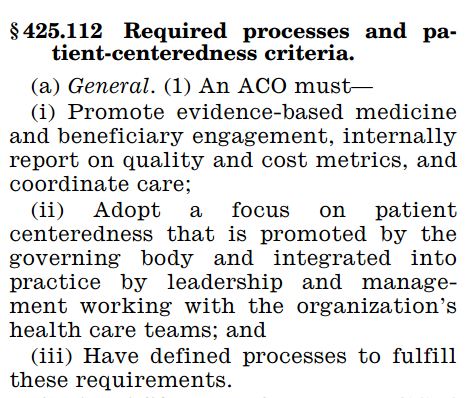
Also consider the balance of criteria or so-called CMS ‘indicia’ of patient centered-ness via Section 425.112: Required processes and patient-centeredness criteria:

“(b) Required processes.

The ACO must define, establish, implement, evaluate, and periodically update processes to accomplish the following:

(2) Promote patient engagement.

These processes must address the following areas:
(i) Compliance with patient experience of care survey requirements in § 425.500.
(ii) Compliance with beneficiary representative requirements in § 425.106.
(iii) A process for evaluating the health needs of the ACO’s population, including consideration of diversity in its patient populations, and a plan to address the needs of its population.
(A) In its plan to address the needs of its population, the ACO must describe how it intends to partner with community stakeholders to improve the health of its population.
(B) An ACO that has a stakeholder organization serving on its governing body will be deemed to have satisfied the requirement to partner with community stakeholders.
(iv) Communication of clinical knowledge/evidence-based medicine to beneficiaries in a way that is understandable to them.
(v) Beneficiary engagement and shared decision-making that takes into account the beneficiaries’ unique needs, preferences, values, and priorities;
(vi) Written standards in place for beneficiary access and communication, and a process in place for beneficiaries to access their medical record.

(3) Develop an infrastructure for its ACO participants and ACO providers/suppliers to internally report on quality and cost metrics that enables the ACO to monitor, provide feedback, and evaluate its ACO participants and ACO provider(s)/supplier(s) performance and to use these results to improve care over time.

(4) Coordinate care across and among primary care physicians, specialists, and acute and post-acute providers and suppliers.

The ACO must—
(i) Define its methods and processes established to coordinate care throughout an episode of care and during its transitions, such as discharge from a hospital or transfer of care from a primary care physician to a specialist (both inside and outside the ACO);”

The pathways to achieve these indicia of patient engagement are perfectly clear, right? Perhaps in the world of mature integrated delivery systems infused with a patient centric mission and committed physician group practice embracing a team based, seamless care culture. But the average ACO tethered to one or more community hospitals via ‘in name only’ cowboy medical groups, I think not.

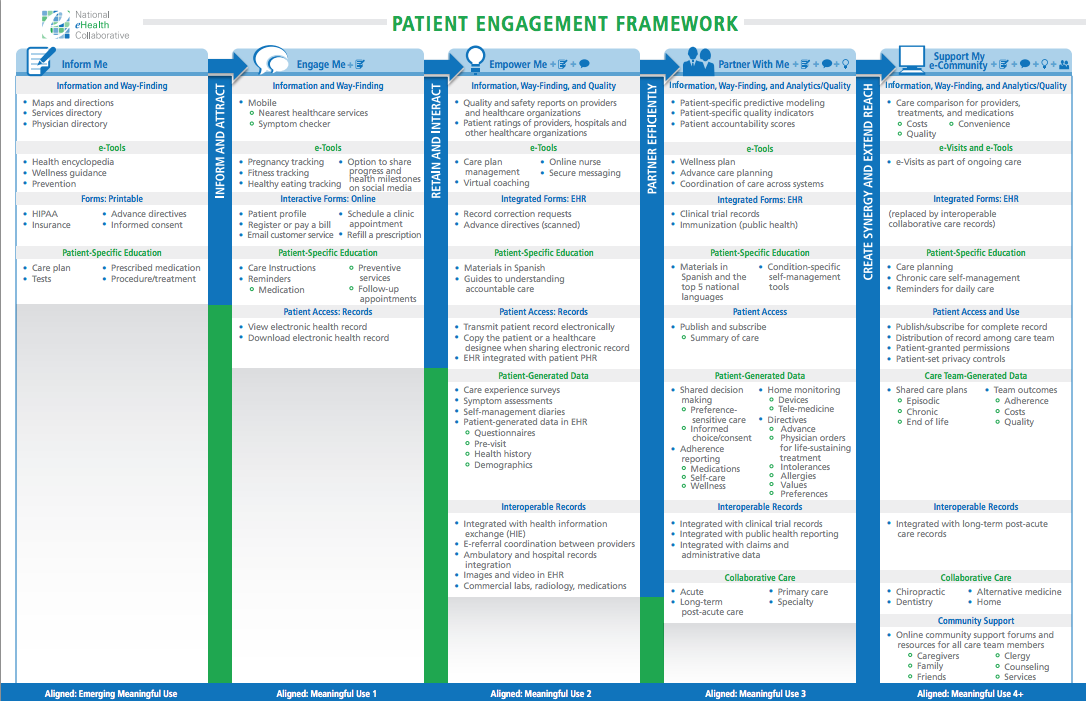
Now consider the crosswalk and ‘best case(?)’ staged implementation timeline perhaps most accurately reflected in the National eHealth Collaborative’s ‘Patient Engagement Framework’.

Patient Engagement Framework | NeHC

Truth be told we have a way to go before the proverbial ‘rubber meets the road’, both in terms of the technical fulfillment or health information technology side as well as the ‘fit’ inside an ACO given our national state of ‘readiness’ or maturity if you will.

One bit of news likely to add some clarity to the muddy state of affairs that we’ve learned of recently, and is due to be released shortly by Dave Chase et al at Avado, is a survey of ‘Patient Engagement Readiness’ directed to the ACO industry at large including CEO, CMOs, CIOs, CMIOs and others at the center of this ACO/technology/patient interface. We’ll preview this timely and relevant industry survey and will post the results here as well.

Stay tuned, more to follow shortly!