
Summary of SCOTUS Affordable Care Act Rulings

By Gregg A. Masters, MPH

This provided courtesy of Deloitte’s ‘Special Edition Health Care Reform Memo: June 29, 2012’ where long term healthcare industry advisor and wonk Paul Keckly opines:

The decision was a bit of a surprise: I expected the law to be upheld; I did not suspect the mandate would be upheld, nor its legal standing as a “tax” the foundational justification for the ruling.

On the questions before the court:
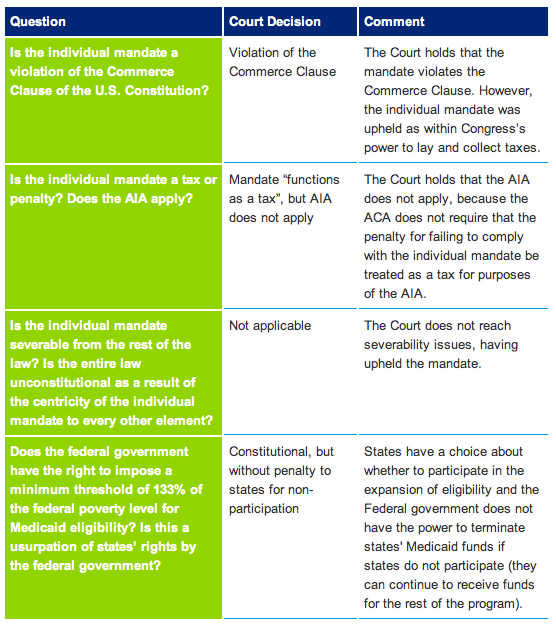
To read complete Deloitte letter, click here.

Meanwhile, in the Day +1 of the post SCOTUS ACA ruling, I opined somewhat on ‘This Week in Accountable Care‘ discussing my take as well as the near term plans for the radio show. Suffice it to say there is an impressive line-up of some top talent who are slated to make guest appearances on the show. From health plans to medical groups, ACOs and even the consulting domain we have some informative sessions in store for you!
Maggie Mahar, Robert Reich, Michael Cannon and Grace Marie Turner on SCOTUS ACA Ruling

By Gregg A. Masters, MPH

Courtesy of a tweet via Gary Levin aka @glevin1 we note the following  @Google+ Hangout post SCOTUS ruling discussion. NOTE: there is a slight delay in the clip.

The chat is facilitated by David Firestone aka @fstonenyt and includes an eclectic mix of the academic, think tank and ideological spectrum including Maggie Mahar, aka @Maggie Mahar, @UCBerkeley Professor Robert Reich, aka @RBReich, Michael F. Cannon, aka @MFcannon of @CatoInstitute, and Grace Marie Turner of @GalenInstitute aka @GraceMarieTweet!

Considering all the noise from peeps who know little to nothing about healthcare, it’s oh so ‘tender underbelly’ and fundamentally flawed if not schizophrenic financial incentives and resulting business models, but are none-the-less convinced that anything Obama puts his name to must be bad, this is a breath of fresh air in the thoughtful exchange about the realities of the Act and it’s challenge to be more broadly embraced by a confused American public.

SCOTUS and the ACA: Livestreaming via @TakeActionNews

By Gregg A. Masters, MPH

It’s here! Watch as we get the historic decision of SCOTUS on the Affordable Care Act. David Shuster aka @DavidShuster, and Mark Levine aka @MarkLevineTalk report from the plaza of the Supreme Court of the United States. Watch as social media delivers the decision, first and accurately via a historic live streamed video feed from two veteran legal observers, reporters and social media aficiandos David and Mark. That’s more than can be said for CNN and Fox News.


Live feed is courtesy of Take Action News.

SCOTUS ACA Tea Leaves: Justice Ruth Bader Ginsburg Keynote to ACS National Convention

By Gregg A. Masters, MPH

For the I can’t get enough of the SCOTUS speculation crowd who are scouring the Internet and consuming every bit of credible reporting or musings for insight on where they will come down on the constitutionality of the individual mandate or the Patient Protection and Affordable Care Act in part or it’s entirety, here is a gem by Justice Ruth Bader Ginsburg at the 2012 ACS National Convention: “Democracy at Stake.”

In her words, Justice Ginsburg offers ‘an impressionistic view of life’ in the 2011-12 Court. At 27:35 mark, she comments on ‘the Affordable Care Act cases’ remarking with some levity if not temperance:

Some have described the controversy [surrounding the cases] as unprecedented and they may be right if they mean the number of press conferences, prayer circles, protests, counter-protests, going on outside the Court while oral argument was underway inside the Court.

What might she know and possibly be telegraphing if anything given her chosen contextual markers and historical comparisons?

Volokh Conspiracy: Final Thoughts on the Eve of the Individual Mandate Decision

By Gregg A. Masters, MPH

In the interest of balance and reflecting the range of thoughtful and credible legal thinking on the ACA in general and the individual mandate in particular, I followed the link attached to this post via @EzraKlein this afternoon:

@ezraklein  If the mandate falls and this proves a key moment in Court history, this post will be very useful to future scholars

To wit the following extract is pasted. The complete blog post appears at the Volokh Conspiracy:

Ilya Somin • June 27, 2012 5:05 pm

Over the last year, I have written an academic article, several amicus briefs, and countless blog posts and op eds about the individual mandate case. Whether I said anything useful or not is for others to judge. But, as a constitutional federalism scholar and one who had long argued for the need to enforce constraints on the scope of federal power, I felt I could not simply sit out what will surely be one of the most important federalism cases of my lifetime.

If the Court ends up striking down the mandate (which I continue to believe is a 50-50 proposition), it will be because the federal government failed to come up with a good explanation of how the law can be upheld without giving Congress nearly unlimited power to impose other mandates. Although both sides in the litigation have come up with numerous interesting points, I continue to think that this is the central issue, and the biggest flaw in the federal government’s position.

I would like to thank Eugene Volokh for inviting me to join the Volokh Conspiracy, without which I might not have been able to be involved in this debate to anything like the same extent. I would also like to thank the Washington Legal Foundation, several members of Congress (at the lower court level), and many of my academic colleagues (including several of my co-bloggers) for giving me the opportunity to represent them by writing amicus briefs on their behalf, including one at the Supreme Court level. It was a great honor to be your advocate in this important case.

Many have commented on the role of the Volokh Conspiracy in promoting the viability of this challenge. Co-blogger Randy Barnett deserves great credit for developing several of the most important arguments underlying the challenge, and especially for his December 2009 paper with Todd Gaziano, which gave an excellent and very influential early explanation of why the individual mandate was unconstitutional, and how it was not authorized by previous precedent. Co-bloggers Jonathan Adler, David Kopel, and David Bernstein also played an important role in developing legal arguments and participating in the resulting public debate.

In my view, the VC was just one of many factors that made this challenge more viable than the mandate’s defenders initially expected. Perhaps our most important role was in challenging the oft-made claim that there was an expert consensus in favor of the constitutionality of the mandate. This helped undermine the emerging narrative that this case was a frivolous no-brainer that only people ignorant of constitutional law could support. But it is important to add that we were not the only legal academics who helped develop the case against the mandate, and discredit the myth of a consensus. Non-VCers who made important contributions include Steve Calabresi (Northwestern), Richard Epstein (NYU), Gary Lawson (BU), Steve Presser (Northwestern), Steve Willis (Florida), and others whom I apologize for omitting.

Outside the academy, enormous credit goes… (click here for original post).

Paul Gigot, SCOTUS and the Affordable Care Act

By Gregg A. Masters, MPH

WSJ Editorial Page Editor Paul Gigot handicaps the highly anticipated SCOTUS ruling following the disgusting ‘silenced majority’ ad copy piece fronting an otherwise informative clip (shame on the WSJ, they know better!). This is more evidence of the real world impact via the triumph of Citizens United and the more recent ‘we know better than you Montana folk’ over-reach of the ‘small government [when it’s convenient] crowd’ via the recent American Tradition Partnership, Inc. v. Bullock ruling.

Yet I digress, as Gigot opines:

My ideal outcome would be to overturn the whole law

Inside the Murdoch empire, I’m sure the executive compensation and benefits package from which Mr. Gigot proffers his lofty opinion is a rather attractive and well funded set of tax advanaged [read subsidy] healthcare benefits. Perhaps if he were one of the 50 million plus uninsured, his perspective might be a little different.

SCOTUS Decision: ‘It’s Affirmed’, No It’s a ‘Divided Court’, Nope It’s Bye, Bye ‘Obamacare’

By Gregg A. Masters, MPH

Holey rusted metal, Batman! The ground. It’s all metal. It’s full of holes. You know, holey. – Robin

In ‘Mourdock Prepares for all SCOTUS Outcomes‘ we witness the elasticity and ‘whatever it takes’ determination to position the election-ering agenda of one aspiring Congressman.

Watch as Indiana’s Treasurer Richard Mourdock covers his ‘ass’ in anticipation of the soon to be announced rulings. Gotta give him credit for the ‘strategic thinking’, yet question the wisdom of the social media guru who uploaded all ‘holey‘ contingencies to Youtube.

A Bold Prediction by Tom Goldstein at SCOTUSblog

By Gregg A. Masters, MPH

News flash! we’re at 25 hours and counting for SCOTUS opinions on the trilogy of decisions they are set to rule on if the opinions are to book in this calendar year of the Court.

The following Tweet by @JoshGray_DC of the Advisory Board aka @TheAdvisoryBD caught my attention this morning:

Josh Gray ‏@JoshGray_dc

Tom Goldstein @SCOTUSBLOG goes out on limb: individual mandate will stand. Brave man!

And I must say, I agree with Tom. To wit my consideration tweets followed:

@JoshGray_dc I’m with Tom @SCOTUSblog ! http://bit.ly/LQqhJi

@JoshGray_dc always drawn to the ‘dark side’ or  more benignly put ‘contrarian’ view

@JoshGray_dc The truth is the only change since the preponderance of legal, wonk & even legislative views favored approach? = politics.

And that is ‘the truth’. This is not a case filtered through the individual or collective minds of a clear thinking American public, nor even a chorus of disinterested stakeholders, academics, policy wonks, or even politicians, but a 1984-esque ‘Newspeak’ series of progressively disingenuous filters.

Perhaps the original and ‘sober’ thinking on the subject is best reflected by former Reagan Administration Solicitor General, Charles Fried to ABC News in 2010, see: ‘SCOTUS, ACA & ‘Mis-informed’ Justices‘:

Anybody [who questions the constitutionality of the Affordable Care act] is either ignorant — I mean, deeply ignorant — or just grandstanding in a preposterous way.

We shall see, and will be chatting about the impact of the decisions shortly after the opinions are fed to us via our friends at @SCOTUSblog tomorrow, see: ‘SCOTUS and the ACA: Reflections on the Judgements of the Court‘.

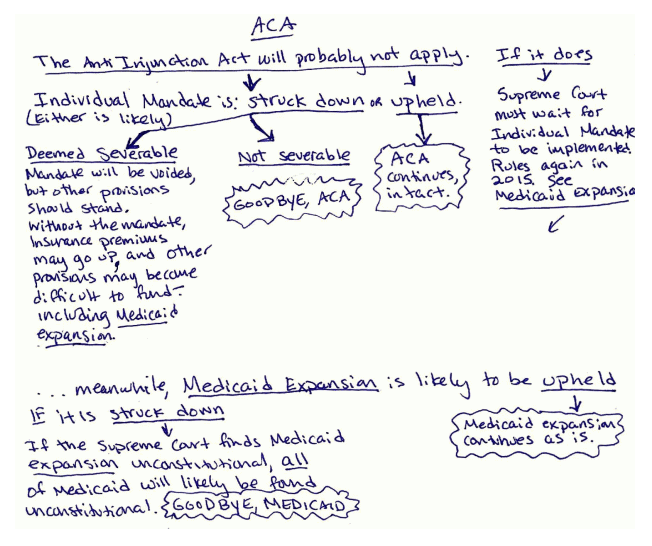
A ‘Back of the Napkin-esque’ Review of the SCOTUS ACA Decision Tree

By Gregg A. Masters, MPH

While trolling for interesting tidbits on the web, I came across what appears to be a simplified representation of the impact of the Court’s ruling. The original piece was offered by Emily Corwin and posted under the title ‘SCOTUS And The Affordable Care Act: An Overview.’

A deeper dive into the ‘WIFM’ department i.e., what’s at stake, Corwin frames the following source quotes:

Medicaid

If struck down, Medicaid itself could be deemed unconstitutional. This would create radical changes, since “medicaid is the workhourse of the nation’s health system, covering 30 percent of all children, 70 percent of nursing home residents and 40 percent of all deliveries,” reports Phil Galewitz.

If upheld, many more people would become eligible for Medicaid. The federal government would assume much of the additional costs initially, slowly transferring 10 percent of that burden to states by 2019.

Seniors

If struck down, “49 million Medicare beneficiaries could lose a variety of benefits that have already kicked in,” writes Marilyn Werber Serafini. These include prescription savings, preventative services, and wellness visits. However, if only the individual mandate is struck down, “nearly all of the health law’s Medicare changes will remain intact.”

Women

Even excluding maternity coverage, the National Women’s Law Center found that nearly one-third of the most commonly sold insurance plans charged women aged 25 to 40 at least 30 percent more than men for the same coverage,” writes Julie Appleby. The ACA would bar insurers from charging women higher premiums than men. Other provisions include requirements regarding maternity coverage, and removing copays for mammograms and contraceptives.

With additional source reference to ‘What’s at Stake for Patients‘ and A Consumer’s Guide to the Health Care Reform Law‘ as credible third party issue framing and explanation.

Thank you @EmilyCorwin!

SCOTUS and the ACA: Reflections on the Judgements of the Court

By Gregg A. Masters, MPH

On a special edition of ‘This Week in Accountable Care‘ we’re hosting a post ‘SCOTUS’ (Supreme Court of the United States) reflections session to consider the implications of their rulings.

We’re somewhat ‘on call’ in the scheduling department but SCOTUS must announce their opinion on Thursday, June 28th shortly after 10AM Eastern/7AM Pacific. So our show is slotted for 11AM Eastern/8AM Pacific.

The guest line-up is somewhat fluid but invites have been extended though not yet confirmed.

For context on the Affordable Care Act and reading the SCOTUS ‘tea leaves’ as well as some commentary see here, here and here.

As a point of clarification the innovation train under the broad framework of the accountable care movement as more specifically expressed via the pursuit of the ‘triple aim’ has been successfully introduced into the DNA and consciousness of the healthcare stakeholder community. Afterall, who can defend ‘un-accountable care’ (aka the status quo), anybody?  In a sense whatever SCOTUS ultimately decides is in part irrelevant, see: ‘ACOs are here to stay – Whatever the Court decides‘, ‘Life After the Supreme Court Ruling‘ and ‘ACOs not tied to health reform law’s fate, report finds‘ which suggest the ruling will not slow down the pace of delivery system and funding innovation the Act envisions both in the government as well as private sectors.

We will be tweeting and tagging to this broadcast via #ACOchat. For the tweet-stream see ACOchat.org.

To join us live or via archived replay, click here.