Dr. Don Berwick on ACO’s: From Volume to Value

By Donald Berwick, MD

Editors Note: Thanks to a tweet today via @AxSys_Health

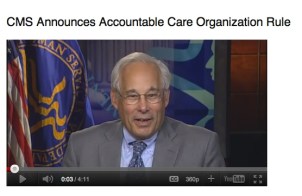
CMS Administrator Don Berwick, M.D., explains ACO’s in plain language.

Hi, I’m Don Berwick, CMS administrator. Today’s a kind of red letter day, October 20th 2011. That’s the day in which we launch the Accountable Care Organization final rule and I just want to spend a minute describing this to you a bit.

This is one of the most exciting and important elements the Affordable Care Act. When we think about the goal of transforming American medicine into the kind of care that we all want for ourselves and our loved ones. American medicine is fragmented right now.

You get lost between the slats because we built the system that way, we pay for it that way, we train for it that way and institutions manage themselves separately. That’s not what patients need. That’s not what you want and I want. We want continuity and seamlessness and most of all we want to stay home and healthy instead of being in hospital beds or sick if we can avoid it.

We are trying now through all the policies in the Affordable Care Act to change the structures of incentive in support for the American health care system, so we can better support that seamless care. Right now in a fragmented payment system hospitals get rewarded, for example, for keeping their beds full. Doctors get rewarded for doing as much as they can. We’re, shifting that game. It now becomes not how much you do but how well you do, that determines the rewards you get and the support you get from us at CMS.

That’s really what doctors and nurses and hospitals want to do anyway. What’s the idea behind an Accountable Care Organization, is to set up a structure, in which doctors and hospitals and others can join together and take responsibility for a group of patients, Medicare beneficiaries, who are attributed to them.

We watch the beneficiaries, we watch where they get their care and if they get the majority of their care from a group of doctors who want to form an ACO then those patients are attributed to the ACO. They still can go anywhere they want, it’s still a Medicare fee for services to the patient lost no choices. But now that ACO conformance say we want to take responsibility for these people that come to us for care, as the ACO then begins to better coordinate care for those people building more cooperation, investing in care coordination, adopting electronic records, working in such a way that people can stay out of the hospital and stay healthy.

What will happen is cost will fall and quality will go up and now in the Accountable Care Organization world they can share in the savings. We split the savings with them. Medicare keeps some, some goes back to the providers of care We don’t want them skimping on care and so we watch quality very closely. The ACO rule has in it 33 measures of quality that we’re going to track really closely, and all of the normal functions of anti-trust regulations and others are watching for good behaviors.

I think the provider community will rise to that. In the ACO rule we’re offering a range of options about how you can get into this shared savings environment all the way from the track one of the rule in which you’re allowed to share savings but you don’t have any downside risk if costs go too high, way over to the pioneer program, offered now by the center for Medicare and Medicaid innovation which you can actually share more savings but take more risk if costs go too high. In all cases we’re protecting the beneficiary but watching care very, very closely to make sure that it’s improvements that’s generating the savings that we can now share.

There’s lots of interest in this all over the country. We’re going to see ACOs of many forms develop and I’m pretty excited about getting this rule into final form. I’ve got to thank, literally hundreds of your colleagues, people all over CMS, all over HHS indeed, and other government agencies have been getting together to help shape this rule to download and read the over 1200 comments we got to travel all over the United States getting feedback so that the final rule can be much better than the proposed rule as indeed it is.

I think we have a really exciting program on our hands. Many of you will be called upon to explain this rule to beneficiaries, to your friends and neighbors and your family. Now I’d like to make sure you have all the information you want about this. So log on to cms.gov/aco or find other ways to get information, inform yourselves and we’ll be reaching out with information to CMS employees so you can understand this wonderful, wonderful new program.

It’s part of the transition to the American health care system we want, which is really supporting care, to keep people healthy and which the whole structure of care shifts from volume to value from how much you do to how well the patient does and that’s what the ACO is intended to do. It’s a pretty exciting day. Thanks.

For the complete video and original transcript posted, click here.

Proposed v. Final ACO Rule

By Gregg A. Masters, MPH

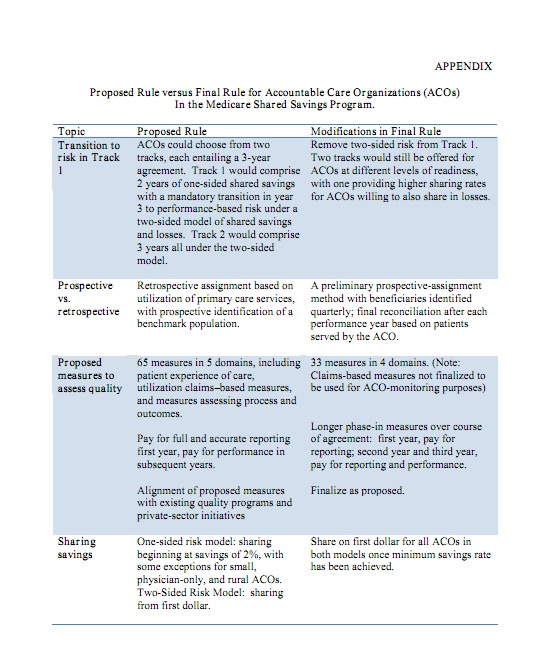
Deep in the 690+ pages of the document filed with the OFR, is a nifty little matrix that compares key provisions of the ‘notice of proposed rule making’ to the final rule which theoretically incorporated the best and brightest suggestions pro-offered in 1,300+ comments supplied to CMS.

That pre/post matrix can be accessed here. It is a good cheat sheet to follow along with some of the key provisions providing a fair amount of ‘stakeholder heartburn’.

In the end, and in the hard to please everyone department, AMA acknowledges CMS for reducing the number of quality measures, while ASCO expresses it concern over their reduction and failure to reflect the QM measures specific to oncology.

ACOs: It’s Not Just About Medicare [shared savings]

By Gregg A. Masters, MPH

A recent report attached to a Tweet posted by Brian Ahier caught my attention in the blitzkreig of ACOs postings this past week.

 @ahier Building #ACO‘s & OUtcome Based Contracting in the Commercial Market

The complete title of the attached report is ‘Building ACOs and Outcome Based Contracting in the Commercial Market: Provider and Payor Perspectives‘.

This immediately caught my attention as for the better part of 30 years in the healthcare industry I spent a considerable amount of time in the managed care contracting business negotiating and signing my share of upstream (payor) as well as (downstream) hospital, physician and network agreements. From full risk, global capitated network deals to discounted fee for services to specialty care subcontracting and essential re-insurance backstops, I lived and breathed c/o/n/t/r/a/c/t/i/n/g.

Since the release of the proposed rule to implement the ACO provisions in the Affordable Care Act, most of the mainstream discussion has been about the ‘Medicare Shared Savings Program’, and considerably less attention has been paid to the activities delegated to the Center for Medicare and Medicaid Innovation (CMMI).

This report may change that singular focus since it broadens the loop and recognizes the market shift which is and has been rather active since the passage of the Act in March of 2010.

Call it ‘managed care 2.0, or 3.0’ or whatever you choose, the fix in healthcare, i.e., bending the cost curve. demonstrating the value proposition and improving access while reducing the rate medical inflation, if not lowering the cost of care, is rather well known: integration (legal, financial and operational) of medical practices under a banner of patient centered and coordinated (v. solo-ed or fragmented) care, enabled by information networks linked and seamlessly integrated across the continuum of care.

This was the same mission in the 70s and 80s when primarily HMO’s and to a lesser degree PPO’s were the mantra, yet the pain points did not exist as they do today, nor did the enabling technologies. The difference today is our house of cards sick care system is in the ICU on life support, and no one is defending the more is better, fee for services paradigm that drove our ‘healthcare borg’ to these heights of inefficiency and diminishing returns. Yet technology along with a determined shift in consciousness if not the sober recognition that ‘business as usual’ is not an option, gives us a materially different palette on which to collaborate towards a changed paradigm.

Check out this report and see what is already happening below the radar. You might be surprised. There is enough here to parse out over several posts and perhaps even invite the authors into a conversation on ‘ACO Watch: A Mid-Week Review’.

ACO Final Rule: A Round Up of Early Opinion and ‘Go To’ Resources

By Gregg A. Masters, MPH

Like some of you, I woke up the morning of Friday, October 21st, 2011 to a literal ‘blitzkrieg’ of tweets flooding two TweetDeck columns tagged ‘ACOchat’ and ‘ACO’. Everyone it seems has a dog in the hunt to make known their standing or interest in Accountable Care Organizations (ACOs), the Medicare Shared Savings Program and related stuff, i.e., the Pioneer Program, Advanced Payment Model, etc.

Shortly after the final rule was published in the Federal Register, CMS conducted a ‘background’ stakeholder conference call. If you missed, you can listen via ACO Watch: A Mid-Week Review re-broadcast (note: we had some audio glitches, but got the entire call plus questions in).

Meanwhile for a list of some notable write ups and contributions, checkout:

As always first out of the box via @KHNewsHHS Releases Final Regulations for ACOs.

As well as the excellent contextual and opinion piece by Dr. Don Berwick in the New England Journal of Medicine, ‘Making Good on ACO’s Promise – The Final Rule for the Medicare Shared Savings Program‘.

My friend Michael L. Millenson and occasional guest poster on this blog chimes in with an insightful and witty Forbes piece titled: CMS Wants Docs to Ante Up to ACO Poker Game.

Meanwhile, the American Medical Association, one of several professional medical associations to back the Patient Protection and Afforable Care Act (bravo!), opines the net gain for docs via: Final ACO Rule Offers Promise to Improve Care Delivery, and CMS spotlights physician-friendly changes in final ACO rule.

The health plan and payor community checks in with AHIP’s, their trade association, posting: AHIP Statement on ACO Regulation.

While Esptein Becker’s Douglas A. Hastings posted on Health Affairs BlogValue-Based Payment, Accountable Care, and the ACO Final Rule: Are We Making Progress?

Also from the legal domain, McDermott Will Emery published: Medicare Shared Savings Program Final Rules  complete with comments and historical markup of key provisions in the PPACA the ACO final rule implements.

Of course the reference final rule summary from CMS is here, as well as the ‘fact sheets‘ previously posted to this blog, here.

From the ‘connect the dots’ health IT side of the conversation, i.e., hey you want an ACO…..gotta have the infrastructure, check out HealthData Management: ‘ACO Barriers‘ by Gary Baldwin.

And one of my favorites is from CMS in the Appendix titled: Proposed Rule versus Final Rule for Accountable Care Organizations (ACOs) In the Medicare Shared Savings Program.

There is more to come as we’re building the ‘go to’ resource portal for everything ACO.

p.s. Thursday, October 27th at 1PM Eastern there’s a FREE webinar that we’ll be following and tweeting from organized by @HCPlive and featuring fellow healthtweep David Harlow, aka @healthblawg, titled: Accountable Care Organizations, Bundled Payments, and the Future of Health Care. 

You can register here.

More later!

HHS/CMS ‘Fact Sheets’ Per PR Issued Today on HealthCare.gov

EDITOR’S NOTE! Re: The press release ‘fact sheet’ for the ACO and Medicare Shared Savings Programs provisions as codified in today’s FINAL RULE, is published in it’s entirety below:

People with Medicare will be able to benefit from a new program designed to encourage primary care doctors, specialists, hospitals, and other care providers to coordinate their care under a final regulation on Accountable Care Organizations issued today by the Department of Health and Human Services (HHS). 

On October 20, 2011, HHS announced final rules and a new opportunity for financial support to help doctors, hospitals, and other health care providers work together to improve the care for Medicare patients.  By choosing to become Accountable Care Organizations, providers will be able to share in savings by better coordinating patient care, providing high quality care, and using health care dollars more wisely.

These new final rules, which were made final after an extensive review of comments and additional stakeholder input on the proposed rule, add a new option for providers looking for support in coordinating patient care. The Accountable Care Organization model of delivering care may not be right for every doctor, practice, clinic, or hospital, but it adds to the extensive menu of options offered through the Affordable Care Act to provide better health, better care and lower costs not only for Medicare beneficiaries, but for all Americans.

The new rules establish a new voluntary Medicare Shared Savings Program that helps doctors, hospitals, and other providers improve their ability to coordinate care across all health care settings. Providers who meet certain quality standards can share in any resulting savings.

The quality measures are organized into four domains:

  • Patient experience
  • Care coordination and patient safety
  • Preventive health
  • Caring for at-risk populations

The higher the quality of care providers deliver and the greater the effectiveness of their care coordination, the more savings they may keep.  Federal savings could be up to $940 million over four years.

In a complementary program announced today, HHS is accepting applications from providers to help test the Advance Payment model. This model will test whether pre-paying a portion of future shared savings will increase participation of physician-owned and rural Accountable Care Organizations in the Medicare Shared Savings Program, and whether advance payments will allow teams of providers to improve care for beneficiaries and generate Medicare savings more quickly.  The advance payments would be recovered from any future shared savings achieved by the team of providers.

These two new opportunities create incentives for health care providers to work together to treat an individual patient across care settings – including doctors’ offices, hospitals, and long-term care facilities.  Providers are not required to participate in Accountable Care Organizations, and patients of providers who participate continue to have control over which doctors they see and what care they receive.

Improving Care for Patients

Any patient who sees multiple doctors understands the frustration of fragmented and disconnected care: lost or unavailable medical charts, duplicated medical procedures, or having to provide the same information over and over to different health care providers.  This lack of coordination is even worse for patients with multiple chronic conditions who receive care from multiple health care providers.

Improved care coordination supported by these programs will lift this burden from patients, while improving the partnership between patients and doctors in making health care decisions.  People with Medicare will have better control over their health care, and their doctors can provide better care because they will communicate with the patient’s other care providers.

Patients choosing to receive care from providers participating in an Accountable Care Organization will have access to information about how well the organization is meeting the quality standards.

People with Medicare who receive care from a provider participating in an Accountable Care Organization will retain their rights to see any physician or hospital that participates in the Medicare program.  In other words, an Accountable Care Organization cannot restrict care or limit a Medicare beneficiary’s access to a physician or other health care professional. Medical decision making remains the responsibility of the patient and his or her doctor.

Helping Providers Coordinate Care

The two programs announced on October 20, 2011 are part of a broader effort by the Obama Administration to improve the quality of health care not only for Medicare beneficiaries, but for all Americans.  The Affordable Care Act supports several programs that help health care providers coordinate care.

  • Through the Partnership for Patients, more than 6,000 organizations including hospitals, doctors, and others have pledged to reduce hospital-acquired conditions and improve transitions in care.
  • The Bundled Payments initiative gives providers flexibility to work together to coordinate care for patients over the course of a single episode of an illness.
  • The Comprehensive Primary Care Initiative will allow Medicare to join with other health care payers such as employer-based health plans and/or Medicaid programs to invest in strengthening primary care.
  • The testing of the Pioneer Accountable Care Organization Model is designed for organizations with experience providing integrated care across settings.
  • The Federally Qualified Health Center (FQHC) Advanced Primary Care Practice Demonstration program is helping FQHCs provide more coordinated care and better access to primary care for Medicare patients.

Medicare Shared Savings Program

The new Medicare Shared Savings Program is intended to give Medicare fee-for-service beneficiaries the advantages of better coordination of care whether they get care in the hospital, a nursing facility, their doctor’s office, or their home.  The goal is to deliver seamless, high quality care for Medicare beneficiaries, and to make patients and providers true partners in care decisions.

Providers Eligible to Participate

Under the final rule, a group of providers and suppliers of services agree to work together with the goal that patients get the right care at the right time in the right setting.  The final rule requires that each group of providers be held accountable for at least 5,000 beneficiaries annually for a period of three years.  Each group must include health care providers and Medicare beneficiaries on its governing board.

All Medicare providers can participate in an Accountable Care Organization to coordinate care, but only certain types of providers are able to sponsor one.  Those providers include physicians in group practice arrangements, networks of individual practitioners, and hospitals that are partnering with or employ eligible physicians, nurse practitioners, physician assistants, and specialists.  To help providers serving rural and other underserved areas, the final rule allows Rural Health Clinics (RHCs) and Federally Qualified Health Centers to work together to coordinate care for patients.  In addition, in the final rule, certain critical access hospitals are also eligible.

Measuring Quality Improvement

The final rule links the amount of shared savings an Accountable Care Organization may receive, and in certain instances shared losses it may be accountable for, to its performance on: 1) quality standards on patient experience; 2) care coordination and patient safety; 3) preventive health; and 4) at-risk populations.  These standards will be measured in a way that accounts for providers who treat patients with more complex conditions.

To earn shared savings the first performance year, providers must fully and accurately report across all four domains of quality.  Providers will begin to share in savings based on how they perform in some of those 33 quality measures in the second and third performance years.

Sharing Savings and Sharing Losses

CMS is implementing two models: a one-sided shared savings model, in which providers only share in savings; and a two-sided shared savings and losses model, in which providers also share in losses if growth in costs go up.  The proposed rule had required Accountable Care Organizations in the one-sided shared savings model to share losses in the third year of the agreement period.  In response to comments, CMS has modified the proposal, and the final rule allows Accountable Care Organizations to participate under the one-sided shared savings-only model for the entire length of their first agreement period.  This will help organizations with less experience coordinating care, such as some physician organizations or small or rural providers, to gain experience before taking on the responsibility of sharing losses. It also allows more experienced providers to take on the responsibility of losses in exchange for greater potential rewards.  Accountable Care Organizations may share up to 50% of the savings under the one-sided model and up to 60% of the savings under the two-sided model, depending on their quality performance.

For each year, CMS will develop a target level of spending for each ACO to determine its financial performance. Because health care spending for any group of patients normally varies from year to year, CMS will also establish a minimum savings and minimum loss rate that would account for these variations.  This protects the Medicare Trust Funds from sharing savings, and providers against sharing in losses, due to normal variation in Medicare spending.  Both shared savings and shared losses will be calculated on the total savings or losses, not just the amount by which the savings or losses exceed the minimum savings or loss rate.  In addition, the amount of shared savings would depend on how well the team of providers performs on the quality measures specified in the rule.

To view a chart highlighting some of the key differences between the proposed and final rules visit:http://www.cms.gov/aco/downloads/Appendix-ACO-Table.pdf (PDF- 106 KB)

Advance Payment Model

The Advance Payment Model tests whether advancing a portion of an Accountable Care Organization’s future shared savings will increase participation from physician-owned and rural providers in the Medicare Shared Savings Program, and whether advance payments will allow those teams of providers more quickly improve care for beneficiaries and generate Medicare savings.  The Advance Payment Model was designed to support physician-owned and rural ACOs with upfront infrastructure investments.  These providers will receive payments in advance that will be recouped as they achieve savings.

There are three ways provider groups may receive these payments:

  • Upfront fixed payment
  • Upfront payment based on the number of Medicare patients served
  • Monthly payment based on the number of Medicare patients

This model is open only to physician-owned organizations, critical access hospitals, and rural providers participating in the Shared Savings Program, helping them become Accountable Care Organizations to improve care for their patients.  Application deadlines will match the Shared Savings Program.  For more details, visit http://innovations.cms.gov/areas-of-focus/seamless-and-coordinated-care-models/advance-payment/.

Antitrust Guidance for Providers

CMS has worked closely with the Department of Justice (DOJ) and the Federal Trade Commission (FTC) to facilitate the creation of Accountable Care Organizations by giving providers clear and practical guidance to form innovative, integrated health care delivery systems without raising antitrust issues.

Along with the final rule for the Shared Savings Program, DOJ and FTC have issued a joint Statement of Enforcement Policy Regarding Accountable Care Organizations Participating in the Medicare Shared Savings Program (“Antitrust Policy Statement”).  Under the Antitrust Policy Statement, the agencies will give rule of reason treatment to an Accountable Care Organization if they use the same governance and leadership structure and the same clinical and administrative processes in the commercial market as it uses to qualify for and participate in the Shared Savings Program.

In addition, the Antitrust Policy Statement outlines an expedited process that Accountable Care Organizations can use to obtain further guidance about their antitrust concerns.  For more details, visit www.ftc.gov/opp/aco/ andhttp://www.justice.gov/atr/public/health_care/aco.html.

For More Information

The Shared Savings Program final rule is posted at: www.ofr.gov/inspection.aspx.

The Advanced Payment solicitation is posted at: http://innovations.cms.gov/areas-of-focus/seamless-and-coordinated-care-models/advance-payment/.

For more information on these two topics, fact sheets are posted at http://www.cms.gov/center/press.asp.

The joint CMS and Department of Health and Human Services Office of Inspector General (OIG) Interim Final Rule with Comment Period addressing waivers of certain fraud and abuse laws in connection with the Shared Savings Program is posted at:  www.ofr.gov/inspection.aspx.

The Antitrust Policy Statement is posted at: www.ftc.gov/opp/aco/ andhttp://www.justice.gov/atr/public/health_care/aco.html.

The Internal Revenue Service (IRS) Fact Sheet, Tax-Exempt Organizations Participating in the Medicare Shared Savings Program Through Accountable Care (FS-2001-11), will be posted at: http://www.irs.gov (PDF 52 KB).

Posted on: October 20, 2011

They’re Here!!

CMS releases final rule today on ACO and Medicare Shared Services Program!

For complete text of final rule submitted to the Office of the Feferal Registrer today, click here.

More details to follow including a TweetChat via hashtag #ACOchat.

There will be a conference call and Press conference today with Dr. Don Berwick et al most likely discussing the release of today’s rule. ACO Watch a Mid Week Review will record the conference call, for archival replay, click here.

Detlails here:

Stakeholder Call: Thursday, October 2oth, 2011: 2PM EDT: 888-946-4721, Passcode: HEALTHCARE 

CO-OPs The Stealth ‘Accountable Care’ Opportunity

Co-Ops, no not the apartment kind, are entities somewhat buried in the Patient Protection and Affordable Care Act that may hold some hiddlen promise on the innovation front. New wine in the same old bottle, or  incremental innovation at the margins?

Consumer Operated and Oriented Plan (CO-OP) program to foster the creation of non-profit, member-run health insurance companies in all 50 states and District of Columbia to offer qualified health plans. To be eligible to receive funds, an organization must not be an existing health insurer or sponsored by a state or local government, substantially all of its activities must consist of the issuance of qualified health benefit plans in each state in which it is licensed, governance of the organization must be subject to a majority vote of its members, must operate with a strong consumer focus, and any profits must be used to lower premiums, improve benefits, or improve the quality of health care delivered to

its members. (Appropriate $6 billion to finance the program and award loans and grants to establish CO-OPs by July 1, 2013)

The Patient Protection and Affordable Care Act (Full Text) – Section 1322 is below the fold :

SEC. 1322. FEDERAL PROGRAM TO ASSIST ESTABLISHMENT AND OPERATION OF NONPROFIT, MEMBER-RUN HEALTH INSURANCE ISSUERS.

(a) Establishment of Program-

(1) IN GENERAL- The Secretary shall establish a program to carry out the purposes of this section to be known as the Consumer Operated and Oriented Plan (CO-OP) program.

(2) PURPOSE- It is the purpose of the CO-OP program to foster the creation of qualified nonprofit health insurance issuers to offer qualified health plans in the individual and small group markets in the States in which the issuers are licensed to offer such plans.

(b) Loans and Grants Under the CO-OP Program-

(1) IN GENERAL- The Secretary shall provide through the CO-OP program for the awarding to persons applying to become qualified nonprofit health insurance issuers of–

(A) loans to provide assistance to such person in meeting its start-up costs; and

(B) grants to provide assistance to such person in meeting any solvency requirements of States in which the person seeks to be licensed to issue qualified health plans.

(2) REQUIREMENTS FOR AWARDING LOANS AND GRANTS-

(A) IN GENERAL- In awarding loans and grants under the CO-OP program, the Secretary shall–

(i) take into account the recommendations of the advisory board established under paragraph (3);

(ii) give priority to applicants that will offer qualified health plans on a Statewide basis, will utilize integrated care models, and have significant private support; and

(iii) ensure that there is sufficient funding to establish at least 1 qualified nonprofit health insurance issuer in each State, except that nothing in this clause shall prohibit the Secretary from funding the establishment of multiple qualified nonprofit health insurance issuers in any State if the funding is sufficient to do so.

(B) STATES WITHOUT ISSUERS IN PROGRAM- If no health insurance issuer applies to be a qualified nonprofit health insurance issuer within a State, the Secretary may use amounts appropriated under this section for the awarding of grants to encourage the establishment of a qualified nonprofit health insurance issuer within the State or the expansion of a qualified nonprofit health insurance issuer from another State to the State.

(C) AGREEMENT-

(i) IN GENERAL- The Secretary shall require any person receiving a loan or grant under the CO-OP program to enter into an agreement with the Secretary which requires such person to meet (and to continue to meet)–

(I) any requirement under this section for such person to be treated as a qualified nonprofit health insurance issuer; and

(II) any requirements contained in the agreement for such person to receive such loan or grant.

(ii) RESTRICTIONS ON USE OF FEDERAL FUNDS- The agreement shall include a requirement that no portion of the funds made available by any loan or grant under this section may be used–

(I) for carrying on propaganda, or otherwise attempting, to influence legislation; or

(II) for marketing.

Nothing in this clause shall be construed to allow a person to take any action prohibited by section 501(c)(29) of the Internal Revenue Code of 1986.

(iii) FAILURE TO MEET REQUIREMENTS- If the Secretary determines that a person has failed to meet any requirement described in clause (i) or (ii) and has failed to correct such failure within a reasonable period of time of when the person first knows (or reasonably should have known) of such failure, such person shall repay to the Secretary an amount equal to the sum of–

(I) 110 percent of the aggregate amount of loans and grants received under this section; plus

(II) interest on the aggregate amount of loans and grants received under this section for the period the loans or grants were outstanding.

The Secretary shall notify the Secretary of the Treasury of any determination under this section of a failure that results in the termination of an issuer’s tax-exempt status under section 501(c)(29) of such Code.

(D) TIME FOR AWARDING LOANS AND GRANTS- The Secretary shall not later than July 1, 2013, award the loans and grants under the CO-OP program and begin the distribution of amounts awarded under such loans and grants.

(3) ADVISORY BOARD-

(A) IN GENERAL- The advisory board under this paragraph shall consist of 15 members appointed by the Comptroller General of the United States from among individuals with qualifications described in section 1805(c)(2) of the Social Security Act.

(B) RULES RELATING TO APPOINTMENTS-

(i) STANDARDS- Any individual appointed under subparagraph (A) shall meet ethics and conflict of interest standards protecting against insurance industry involvement and interference.

(ii) ORIGINAL APPOINTMENTS- The original appointment of board members under subparagraph (A)(ii) shall be made no later than 3 months after the date of enactment of this Act.

(C) VACANCY- Any vacancy on the advisory board shall be filled in the same manner as the original appointment.

(D) PAY AND REIMBURSEMENT-

(i) NO COMPENSATION FOR MEMBERS OF ADVISORY BOARD- Except as provided in clause (ii), a member of the advisory board may not receive pay, allowances, or benefits by reason of their service on the board.

(ii) TRAVEL EXPENSES- Each member shall receive travel expenses, including per diem in lieu of subsistence under subchapter I of chapter 57 of title 5, United States Code.

(E) APPLICATION OF FACA- The Federal Advisory Committee Act (5 U.S.C. App.) shall apply to the advisory board, except that section 14 of such Act shall not apply.

(F) TERMINATION- The advisory board shall terminate on the earlier of the date that it completes its duties under this section or December 31, 2015.

(c) Qualified Nonprofit Health Insurance Issuer- For purposes of this section–

(1) IN GENERAL- The term `qualified nonprofit health insurance issuer’ means a health insurance issuer that is an organization–

(A) that is organized under State law as a nonprofit, member corporation;

(B) substantially all of the activities of which consist of the issuance of qualified health plans in the individual and small group markets in each State in which it is licensed to issue such plans; and

(C) that meets the other requirements of this subsection.

(2) CERTAIN ORGANIZATIONS PROHIBITED- An organization shall not be treated as a qualified nonprofit health insurance issuer if–

(A) the organization or a related entity (or any predecessor of either) was a health insurance issuer on July 16, 2009; or

(B) the organization is sponsored by a State or local government, any political subdivision thereof, or any instrumentality of such government or political subdivision.

(3) GOVERNANCE REQUIREMENTS- An organization shall not be treated as a qualified nonprofit health insurance issuer unless–

(A) the governance of the organization is subject to a majority vote of its members;

(B) its governing documents incorporate ethics and conflict of interest standards protecting against insurance industry involvement and interference; and

(C) as provided in regulations promulgated by the Secretary, the organization is required to operate with a strong consumer focus, including timeliness, responsiveness, and accountability to members.

(4) PROFITS INURE TO BENEFIT OF MEMBERS- An organization shall not be treated as a qualified nonprofit health insurance issuer unless any profits made by the organization are required to be used to lower premiums, to improve benefits, or for other programs intended to improve the quality of health care delivered to its members.

(5) COMPLIANCE WITH STATE INSURANCE LAWS- An organization shall not be treated as a qualified nonprofit health insurance issuer unless the organization meets all the requirements that other issuers of qualified health plans are required to meet in any State where the issuer offers a qualified health plan, including solvency and licensure requirements, rules on payments to providers, and compliance with network adequacy rules, rate and form filing rules, any applicable State premium assessments and any other State law described in section 1324(b).

(6) COORDINATION WITH STATE INSURANCE REFORMS- An organization shall not be treated as a qualified nonprofit health insurance issuer unless the organization does not offer a health plan in a State until that State has in effect (or the Secretary has implemented for the State) the market reforms required by part A of title XXVII of the Public Health Service Act (as amended by subtitles A and C of this Act).

(d) Establishment of Private Purchasing Council-

(1) IN GENERAL- Qualified nonprofit health insurance issuers participating in the CO-OP program under this section may establish a private purchasing council to enter into collective purchasing arrangements for items and services that increase administrative and other cost efficiencies, including claims administration, administrative services, health information technology, and actuarial services.

(2) COUNCIL MAY NOT SET PAYMENT RATES- The private purchasing council established under paragraph (1) shall not set payment rates for health care facilities or providers participating in health insurance coverage provided by qualified nonprofit health insurance issuers.

(3) CONTINUED APPLICATION OF ANTITRUST LAWS-

(A) IN GENERAL- Nothing in this section shall be construed to limit the application of the antitrust laws to any private purchasing council (whether or not established under this subsection) or to any qualified nonprofit health insurance issuer participating in such a council.

(B) ANTITRUST LAWS- For purposes of this subparagraph, the term `antitrust laws’ has the meaning given the term in subsection (a) of the first section of the Clayton Act (15 U.S.C. 12(a)). Such term also includes section 5 of the Federal Trade Commission Act (15 U.S.C. 45) to the extent that such section 5 applies to unfair methods of competition.

(e) Limitation on Participation- No representative of any Federal, State, or local government (or of any political subdivision or instrumentality thereof), and no representative of a person described in subsection (c)(2)(A), may serve on the board of directors of a qualified nonprofit health insurance issuer or with a private purchasing council established under subsection (d).

(f) Limitations on Secretary-

(1) IN GENERAL- The Secretary shall not–

(A) participate in any negotiations between 1 or more qualified nonprofit health insurance issuers (or a private purchasing council established under subsection (d)) and any health care facilities or providers, including any drug manufacturer, pharmacy, or hospital; and

(B) establish or maintain a price structure for reimbursement of any health benefits covered by such issuers.

(2) COMPETITION- Nothing in this section shall be construed as authorizing the Secretary to interfere with the competitive nature of providing health benefits through qualified nonprofit health insurance issuers.

(g) Appropriations- There are hereby appropriated, out of any funds in the Treasury not otherwise appropriated, $6,000,000,000 to carry out this section.

(h) Tax Exemption for Qualified Nonprofit Health Insurance Issuer-

(1) IN GENERAL- Section 501(c) of the Internal Revenue Code of 1986 (relating to list of exempt organizations) is amended by adding at the end the following:

`(29) CO-OP HEALTH INSURANCE ISSUERS-

`(A) IN GENERAL- A qualified nonprofit health insurance issuer (within the meaning of section 1322 of the Patient Protection and Affordable Care Act) which has received a loan or grant under the CO-OP program under such section, but only with respect to periods for which the issuer is in compliance with the requirements of such section and any agreement with respect to the loan or grant.

`(B) CONDITIONS FOR EXEMPTION- Subparagraph (A) shall apply to an organization only if–

`(i) the organization has given notice to the Secretary, in such manner as the Secretary may by regulations prescribe, that it is applying for recognition of its status under this paragraph,

`(ii) except as provided in section 1322(c)(4) of the Patient Protection and Affordable Care Act, no part of the net earnings of which inures to the benefit of any private shareholder or individual,

`(iii) no substantial part of the activities of which is carrying on propaganda, or otherwise attempting, to influence legislation, and

`(iv) the organization does not participate in, or intervene in (including the publishing or distributing of statements), any political campaign on behalf of (or in opposition to) any candidate for public office.’.

(2) ADDITIONAL REPORTING REQUIREMENT- Section 6033 of such Code (relating to returns by exempt organizations) is amended by redesignating subsection (m) as subsection (n) and by inserting after subsection (l) the following:

`(m) Additional Information Required From CO-OP Insurers- An organization described in section 501(c)(29) shall include on the return required under subsection (a) the following information:

`(1) The amount of the reserves required by each State in which the organization is licensed to issue qualified health plans.

`(2) The amount of reserves on hand.’.

(3) APPLICATION OF TAX ON EXCESS BENEFIT TRANSACTIONS- Section 4958(e)(1) of such Code (defining applicable tax-exempt organization) is amended by striking `paragraph (3) or (4)’ and inserting `paragraph (3), (4), or (29)’.

(i) GAO Study and Report-

(1) STUDY- The Comptroller General of the General Accountability Office shall conduct an ongoing study on competition and market concentration in the health insurance market in the United States after the implementation of the reforms in such market under the provisions of, and the amendments made by, this Act. Such study shall include an analysis of new issuers of health insurance in such market.

(2) REPORT- The Comptroller General shall, not later than December 31 of each even-numbered year (beginning with 2014), report to the appropriate committees of the Congress the results of the study conducted under paragraph (1), including any recommendations for administrative or legislative changes the Comptroller General determines necessary or appropriate to increase competition in the health insurance market.

Physician Hospital Co-Management Arrangements

By Marshall R. Burack, Akerman Senterfitt

In recent years, a number of regulatory and economic factors have driven hospitals and physicians to find ways to work together in a more coordinated manner in order to improve the quality and reduce the cost of patient care. Factors causing hospitals and physicians to work together include, among other things, bundled payments for services, the imminent introduction of Accountable Care Organizations and other shared savings arrangements, and reduced reimbursements from both private and governmental payers.

Direct employment of physicians is one means by which hospitals can assure a cooperative relationship with physicians. An ever-increasing number of physicians are becoming employed by hospital-owned practices.1 Many hospitals, however, either do not wish to employ physicians directly, or do not have the financial resources necessary to acquire and operate medical practices. Moreover, although more physicians are electing to become employed by hospitals, many physicians do not want to become employees of a hospital or other institutional provider and wish to continue to provide patient services through an independent, physician-owned practice.

Co-Management Arrangements

For those hospitals which do not wish to establish and operate a hospital-owned medical practice, and for those physicians who wish to practice independently rather than as a hospital employee, the physician-hospital co-management arrangement offers an alternative arrangement for aligning financial incentives and encouraging physicians to work cooperatively with the hospital to which they admit patients to improve the quality and reduce the cost of hospital care.

A co-management arrangement typically involves the formation of a management company which is jointly owned by a hospital and independent physician members of the medical staff.

The purpose of the jointly-owned company is to manage one or more service lines offered by the hospital. The management company may be formed to manage a specific, narrowly defined service line (e.g., the cardiac cath lab) and include only a limited number of specialist physicians. Alternatively, the management company could be formed to manage a broadly defined service line (e.g., surgical services, or inpatient medical services) and include a substantial portion of the hospital’s medical staff. In either event, the general objective of the management company in managing a particular service offered by the hospital is to improve the quality of that service, while reducing the cost of providing the service to patients.

In order to achieve this objective, the management company and the hospital would enter into…..

To read or download complete article, click  here.

Akerman Senterfitt serves clients throughout the United States and overseas from Florida, New York, Washington, D.C., California, Colorado, Virginia, Nevada, Utah, and Texas. We are ranked among the top 100 law firms in the U.S. by The National Law Journal NLJ 250 (2011) in number of lawyers and we are the largest firm in Florida.

ACO reimbursement, bundled payments, clinical quality measures and public profiles will be based on ICD-10 data

By Lynne Thomas Gordon

Healthcare leaders are juggling multiple pressures, including the consistent delivery of high-quality patient care, evaluation and development of accountable care organizations, the careful management of sensitive patient data, achieving meaningful-use criteria, making the most efficient use of the newest technology and stretching revenue to maintain end-to-end coverage of their bottom lines.

With so many priorities, it’s easy to become distracted from managing important changes such as the International Classification of Diseases, 10th Revision, or ICD-10. But there’s an urgent date on our calendars: the HHS’ final implementation date of Oct. 1, 2013, is a hard deadline that will trigger dramatic, though different, consequences for both those who will be prepared for the change and those who won’t. ACO reimbursement, bundled payments, clinical quality measures and public profiles will be based on ICD-10 data.

Given the high stakes, it is imperative that healthcare leaders avoid getting so caught up in the day-to-day that we fail to prepare properly for the many important changes that the ICD-10 conversion will demand from us.

The change to ICD-10 provides the U.S. the chance to discard the technologically outdated, medically inferior ICD-9 coding system and join all other World Health Organization member nations that have been successfully using ICD-10 to manage patient data for more than 15 years. Healthcare leaders will find that the more granular ICD-10 codes will provide opportunities to improve workflows, dive into quality improvement initiatives, demonstrate the severity of conditions being treated and participate with the rest of the developed world in the meaningful exchange of patient data for matters related to public health, scholarly research and the overall advancement of global health information management.

While multiple surveys conducted by AHIMA over the past year-and-a-half show promising signs that healthcare organizations are now making progress in planning for the ICD-10 conversion (85% of respondents recently indicated that they had begun work on ICD-10 planning and implementation), much work still remains if we’re to continue meeting implementation milestones. There is very little time for any industry providers or professional communities involved in data set management to lag behind or experience untimely (cont’d).

Read complete Modern Healthcare Article, click here.

Lynne Thomas Gordon is CEO of the American Health Information Management Association.

Massmed Releases 10th Annual Physician Workforce Study

Physician Shortages Found in 8 Specialties, Continued Primary Care Shortages, and Physician Concerns About Global Payments and Accountable Care Organizations:

Waltham, Mass. — September 28, 2011 — The Massachusetts Medical Society today released its 2011 Physician Workforce Study showing critical and severe physician shortages in eight specialties, a sixth consecutive year of shortages of primary care physicians, and physicians’ concerns about participating in global payments and accountable care organizations.

The study also confirmed once again that the state faces difficulty in recruiting and retaining physicians and that the fear of being sued has a pervasive, negative influence on the practice of medicine by causing physicians to alter or limit their practice.

The 2011 study is the Society’s 10th annual comprehensive look at the physician workforce in Massachusetts and includes responses from 1,071 practicing physicians. Among the topics surveyed were the labor supply of physicians by specialties; physician recruitment and retention; satisfaction with the profession and practice environment; willingness to participate in global payment programs and accountable care organizations; opinions of the U.S. health care system; and the impact of professional liability concerns on the practice of medicine.

To download complete ‘2011 Patient Access to Health Care Study’, click here.