AHIP: It’s Not Cost Shifting, We’re ‘Unleashing Patients’

By Gregg A. Masters, MPH
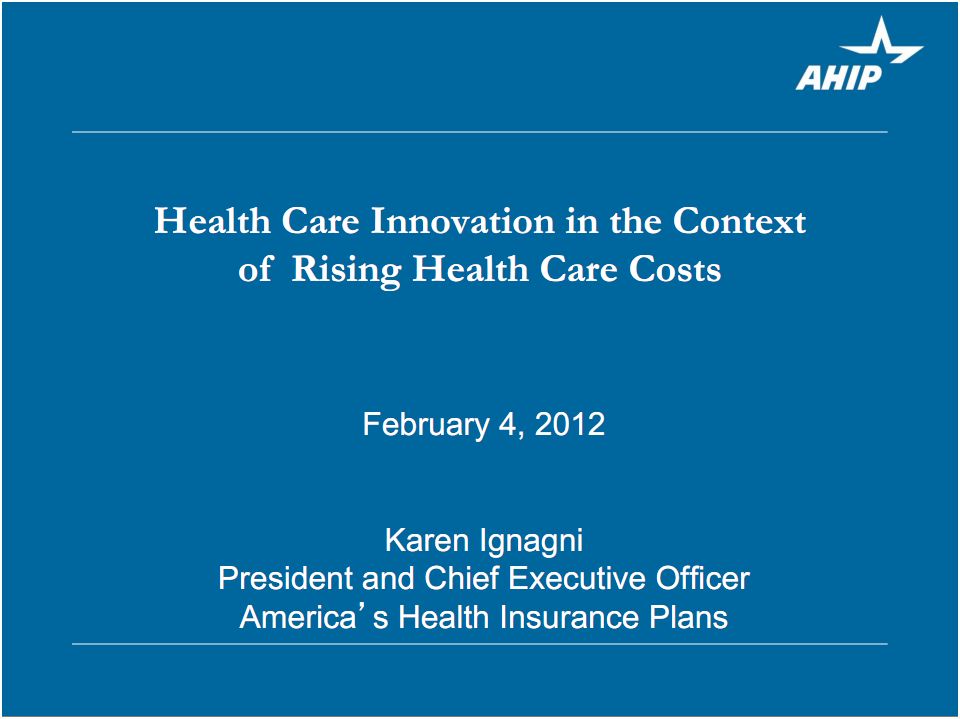
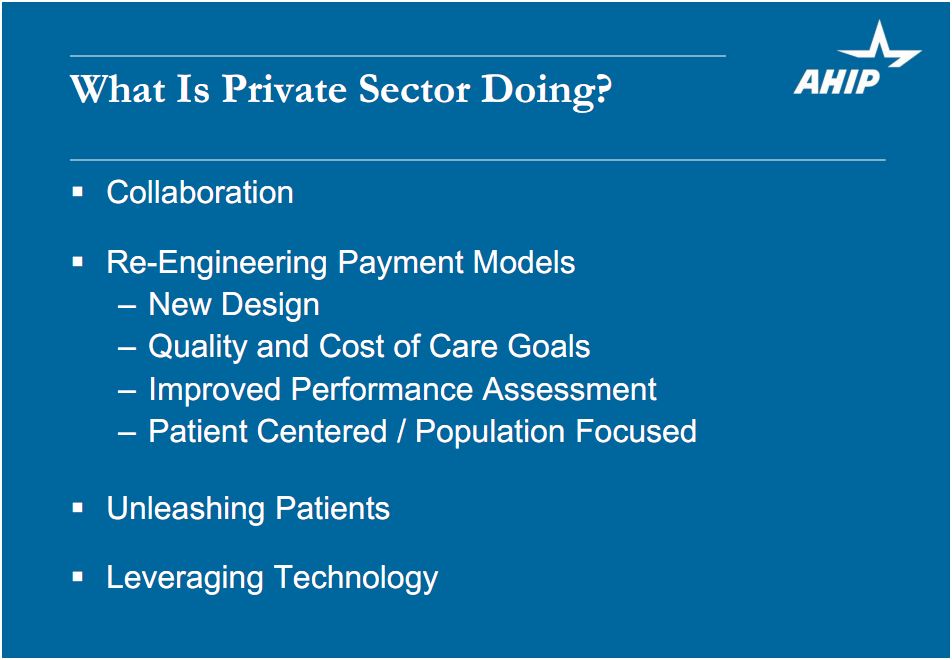
Seriously folks, you’ve got to hand it to the PR firm supplying the American Health Insurance Plans (AHIP) with the brilliant, timely and thematically near argument resistant messaging copy just revealed via a .PPT preso titled ‘Health Care Innovation in the Context of Rising Health Care Costs‘ and delivered by Karen Ignani, aka to some as ‘Darth Vader’.

Perhaps brilliant does not capture the pure genius of the campaign, but lets pull back the cover a bit. Stay with me as I walk you through some thought process and history.

The practice of cost shifting has been a fact of life in American health care since the birth of the Medicare and Medicaid programs. Shortly after passage the ratcheting down of very generous third party reimbursement programs built on cost plus, and ‘you tell us what’s a reasonable charge’ for this procedure systems, the prospective payment system was introduced and the Government started to clamp down on their payment liability, thereby pushing onto the private payor market (mostly an indemnity, charge based liability system). Seeing the obvious writing on the wall, and enabled by both state and federal legislation payers re-branded themselves as ‘managed care plans’ and began to ‘cap’ the full burden of this cost shifting via selective contracting (both HMO and PPO), deploying a series of professional and institutional pricing tactics including case rates, per diems (both tiered and global), conversion factors, resource based relative value system (RBRVS), prepayment, capitation, percent of premium and other forms of limiting payments to providers, globally speaking.
The net effect of this ‘dance’ though modulated by a series of disabling public backlashes to the premise of the success in the managed care formula, essentially watered down the primary model that seemed to produce results for a brief period of time in the mid 90s, i.e., medical cost inflation dipped to zero and below.

Fast forward two decades, and the pace of healthcare consumption of GDP has more than resumed it’s upward march, and the rapacious appetite of the health care borg remains as unquenched as ever.

Yet this time, we’re entering an era with a mantra of ‘patient empowerment’ aided via the exploding and enabling series of platforms, devices, sensors, applications and mega availability of connectivity to the cloud as a service provider to perhaps once and for all enable informed choice, and thereby modulate the healthcare borg’s appetite.

The timing could not be more exquisite. The move by health plans on their own right into the high deductible (or consumer directed) health plan market has been received by a large ‘yawn’ for the most part. The scant research available to suggest that HDHP’s do not compromise access and quality and thereby contribute to poorer overall population health status are mostly sponsored by the industry and questioned by some as to their credibility.

But add to that the appeal of the mhealth, quantified self, personal responsibility for one’s health ethic, etc., and throw in the wellness and prevention agenda sensibilities, and voila, you have a compelling formula to appeal to a growing subset of the health care consumer and provider marketplace (from @Qliance to @CarePractice).

Brilliant? You betcha! Will it work, well that jury is still out. To get some context on the question, check out a recent webinar titled: ‘How Social Media is Revolutionizing the Healthcare Industry‘. You might want to pay particular attention to the exchange between Adam Bosworth, aka @adambosworth, of Keas and James Kean, aka @JamesRKean of @wellnessFX.

What’s this got to do with ACOs you say? More on that one in the next post.
Rebuttal and Comment to ‘NYT Op Ed: Emanuel Editorial is Irresponsible and Naive’

By Vince Kuraitis

Zeke Emanuel’s editorial in the New York Times — The End of Health Insurance Companies — really got my blood boiling. It’s irresponsible and naive. Former Obama advisor Emanuel “predicts”:

By 2020, the American health insurance industry will be extinct. Insurance companies will be replaced by accountable care organizations — groups of doctors, hospitals and other health care providers who come together to provide the full range of medical care for patients.

Irresponsible

Provoking and demonizing health plans might have had populist appeal and political value in 2009, but in 2012 it’s an unnecessary attack on a constituency that has potential to be one of the administration’s best allies in advancing accountable care.

Prior to ACA reform legislation, health plans had the wrong economic incentives — the rules of the game were not consistent with good public policy:

  • Health plans had incentives to AVOID risk, not manage risk. They were economically incentivized to avoid high risk patients (with preexisting conditions) and to get rid of patients that became sick
  • Health plans had minimal incentives to CONTROL systemic costs — they could pass them on in the form of premium increases.

ACA changed incentives and disrupted the payer business model:

  • Health plans will longer be allowed to avoid high risk patients; they must accept all comers
  • Health plans must MANAGE, not avoid costs. Health plans are abandoning their old business models.
  • What are we seeing in the marketplace? Almost all health plans are embracing the vision of accountable care and need to shift the system from Volume to Value. Health plans could be administration’s biggest friend in revamping the health care delivery non-system.

Naive

Emanual mislabels the trend that is occurring. It’s not about Accountable Care Organizations (ACOs), it’s about incentivizing and promoting “accountable care.” ACOs are one experimental model toward achieving accountable care; varied collaborations among private payers, hospitals and doctors are other experimental models.

Emanuel seems also not to have noticed that care providers have a lot of hesitations about the ACO model — at best we have some early adopters trying them out. There is no stampede.

Provocation as a tactic might have some political value when stakeholders are dragging their feet and resisting change. Provocation as a tactic when industry stakeholders are lining up to help you achieve administration objectives — well, that’s just plain dumb. Emanuel would be much wiser to take credit and praise health plans, not to bury them.

Comments
1. On February 2nd, 2012 at 1:22 pm, Gregg Masters (@2healthguru)said:

Go Vince…

I will take the counter point position, though I suspect at some level this may be a semantic argument at core.

I agree with Emanuel’s basic argument. Health plans are dinosaurs, not just from a populist perspective. Once upon a time the GHAA was a group or revolutionaries committed to making a difference. Today, it’s a ‘meet the new boss, same as the old boss…’ experience.

Health plans remain the weakest link in the value proposition of healthcare financing and delivery food chain.

Nice to see you recognize the contributions of the Act as some of its provisions do indeed level a playing field that was impossible to discern between self funded health plans, state regulated health insurance practices, and that slice of Federalism which standardized at least the HMO sector.

Yet, health plans today resemble little if any of their prior selves as ‘risk managers’ or delivery system architects and co-managers, i.e., an indemnity carrier acquiring an HMO book if business if you will. Remember Aetna’s acquisition of US Healthcare? #epicfail…

Other than the individual market, health plans have morphed into risk avoidant transaction processors, with an underwriting churn of 2 – 3 years of recycling commercial accounts. They insure precious little.

If health plans are to survive and add value, if not enable, the emerging ‘accountable care’ industry, it will be as defacto ‘utility companies’ partnering with local and regional delivery systems. They do have their core skills sets (including underwriting, marketing, member/provider administration, and private label product development) that can add value to the healthcare delivery proposition. Yet it remains to be seen if the vision exists to enable this purposeful transformation. There is some evidence to warrant optimism.

Irresponsible, I don’t think so. Also, the ACO industry need be unbundled to understand it’s components. This is not a homogeneous effort.

As a historically reform resistant industry, who’s maximized returns under a fee for services paradigm, you seem to cut a considerable degree of slack for an industry-wide culpability to NOT heal a long failing, and unsustainable business model with precious little community benefit.

2. On February 2nd, 2012 at 1:59 pm, Vince Kuraitis said:

Gregg, Thanks for your comment. Agree, our differences might be more semantic than real.

I’ll go so far as to acknowledge that Zeke’s scenario of health plan demise is “plausible”, but he loses me when he “predicts” this will happen. When there is uncertainty in the marketplace, it’s far more constructive to develop plausible scenarios rather than try to be a fortune teller.

Prior to ACA, health plans had the wrong policy and economic incentives. You can choose to call them “evil”, or you can change the rules of the game. ACA does the right thing in changing the rules of the game.

Agree that health plans have a long way to go, but in my talks with health plan execs, the “get it” – they understand the need for change and that the old business model is not viable.

Cutting health plans slack? As a consultant I work across industry segments, so I’m not writing as an spokesperson. I agree health plans have a lot of morphing to do.

Fundamentally though, I think we would agree that we need to build a more collaborative health care system. Zeke’s editorial throws rocks at a time we need to be throwing flowers.

Vince Kuraits is the publisher of the e-caremanagement.com blog where this post originally appeared. For Vince’s bio, click here.

Monarch HealthCare: Leveraging Expertise in Population Health Management

A Case Study in the Brookings–Dartmouth ACO Pilot Program

This case study examines the progress that Monarch HealthCare, a physician led independent practice association in Orange County, California, has made in
its efforts to become accountable for the quality and overall cost of care for its
patient population. Monarch HealthCare is one of the provider groups participating in the Brookings–Dartmouth ACO Pilot Program that are profiled in the Commonwealth Fund case study series Toward Accountable Care.
Accountable care organizations (ACOs) have been proposed as a new
delivery model to encourage clinicians, hospitals, and other health care organizations to work together to improve the quality of care and slow spending growth.

The Affordable Care Act’s ACO program is intended to promote better management and coordination of care for Medicare beneficiaries by enabling providers
working in ACOs to share in any savings they achieve. However, there is little evidence from the field on how health care organizations progress from traditional payment models toward the ACO model. To better understand this process, this case study documents Monarch HealthCare’s journey to develop an ACO.

To read the complete study, click here. Follow Monarch Healthcare via Twitter, here.

Miss Commonwealth Fund Webinar on ACOs?

By Gregg A. Masters, MPH

If you did, do yourself a favor and watch the recorded broadcast ‘ACO Formation: Leading the Transition to New Models of Care‘, here.

My net take away from the event is total optimism that the clearer thinking brain trust who understand, ‘failure is not an option’ for a healthcare conundrum stakeholder community which has resisted serial attempts (both in the private and public sectors) dating back to the passage of the HMO Act in the 70s, are deep into the conversation in a ‘walking the talk’ way.

What a contrast to the serial whiners and hand wringers who rarely resist the anti-thinking pejourative slam of ‘ObamaCare’, perhaps raised to a different level of fear mongering only last night by candidate Gingrich who associated the Patient Protection and Affordable Care Act with the ‘greatest threat to American liberty!’ Geesh, but I digress…..

This on the ground reporting shows that the parallel track of public, private initiative stimulated directly by the Act is well underway, and abetted not only by some of the brightest health wonk minds in the converation but a wide range of stakeholder community engagement from Hospital sponsored to payor enabled ACO models.

Do yourself a favor and watch the FREE rebroadcast of ‘ACO Formation: Leading the Transition to New Models of Care‘ (registration required)!

For complete program details, including the speaker presentations, click here.

Tweet Transcript of Commonwealth Fund ACO Formation: Leading the Transition to New Models of Care

By Gregg A. Masters, MPH

TweetReach for #ACOchat – Demonstrating the ‘digital footprint’ of a real time healthcare focused social media ‘conversation….

Reached 20,760 peeps via the last 50 tweets….Exposure: 180,892 Impressions

Tweet Types

Each pie slice shows how many people saw how many tweets
and the impressions generated via the 8 Tweeps participating below…. for real time tweet scroller tagged #ACOchat, click here.

DellHealth

DellHealth: RT @pjmachado: Culture change is HARD work and takes leadership, time, commitment & a plan #aco #acochat

pjmachado

pjmachado#PCMH & #ACO are highly complimentary! Must have strong primary care docs in order for #aco to succeed #acochat #mdchat

2healthguru

2healthguru: Next question set: ‘how to engage consumers?’ #epatients take note #aco #acochat

pjmachado

pjmachado: RT @2healthguru: another reason to perfect the accountable care model = many payers aren’t paying too well. Fisher. #aco #acochat

2healthguru

2healthguru: Follow #acochat tweetsteam via http://t.co/RJTZZGcz We’re tweeting the @commonwealthfnd #ACO webinar today.

2healthguru

2healthguru: another reason to perfect the accountable care model = many payers aren’t paying too well. Fisher. #aco #acochat

commonwealthfnd

commonwealthfnd: RT @pjmachado: @Norton_Health need actionable info not just data & remember ‘it is about the patient!’ #ACO #acochat

2healthguru

2healthguru: RT @pjmachado: last 50 #acochat tweets reached >15k people!http://t.co/uCAC06EG #ACO

KThomtweets

KThomtweets: RT @pjmachado: RT @2healthguru: Superb context and #ACOresource set from @commonwealthfnd | http://t.co/8veEZ8z4 #acochat

2healthguru

2healthguru: Best quote or accountable care mantra? ‘marry yourself to transparency’ via Friend, TMC #aco #acochat

pjmachado

pjmachado: RT @2healthguru: Superb context and #ACO resource set from @commonwealthfnd | http://t.co/8veEZ8z4 #acochat

pjmachado

pjmachado: Keys to success keep it simple, transparency, equitable distribution, hospital facilitated – time will tell if it works #aco #acochat

2healthguru

2healthguru: Superb context and #ACO resource set from @commonwealthfndhttp://t.co/MBCY0F4G #acochat

pjmachado

pjmachado: last 50 #acochat tweets reached >15k people!http://t.co/QdARhk2g #ACO

pjmachado

pjmachado: absolutely! RT @2healthguru … payers to understand their ‘utility value’ that enables private labeling via local partners!! #acochat

KThomtweets

KThomtweets: RT @pjmachado: Transparency with #doctors & providers is required to create an atmosphere of trust #ACO #ACOCHAT – you think?!

2healthguru

2healthguru: RT @Docweighsin: Q&A on Commonwealth #ACO webinar-how 2 build trust with various partners? Answer: complete transparency w/ docs#acochat

2healthguru

2healthguru: @pjmachado what better role than for payers to understand their ‘utility value’ that enables private labeling via local partners!! #acochat

pjmachado

pjmachado: Transparency with #doctors & providers is required to create an atmosphere of trust #ACO #ACOCHAT – you think?!

pjmachado

pjmachado#healthcare must shift from win/lose to win/win approach in order to acheive better health outcomes at reasonable cost #aco #acochat

2healthguru

2healthguru: @pjmachado Creating a ‘trust agency’ in a too often trust averse context is, well, challeging. #aco #acochat

2healthguru

2healthguru: RT @pjmachado: Culture change is HARD work and takes leadership, time, commitment & a plan #aco #acochat

pjmachado

pjmachado: Make lots of profit w/as is RT @2healthguru Interesting when TMC started down this path,very few payers where interested in talking #acochat

2healthguru

2healthguru: oh yeah, and Anthem. #acochat

2healthguru

2healthguru: Kudos to United, Humana! #acochat

clintonbon

clintonbon: RT @pjmachado: Culture change is HARD work and takes leadership, time, commitment & a plan #aco #acochat

2healthguru

2healthguru: Interesting when TMC started down this path, very few payers where interested in talking. Go figure! #acochat

pjmachado

pjmachado: Culture change is HARD work and takes leadership, time, commitment & a plan #aco #acochat

2healthguru

2healthguru: Interesting that #ACOs profiled today were not risk savvy players per se. #acochat

2healthguru

2healthguru: ‘Never underestimate the value of data’ and ‘it’s about the patient’ @Norton_Health #acochat

pjmachado

pjmachado: @norton_health need actionable info not just data & remember ‘it is about the patient!’ #ACO #acochat

2healthguru

2healthguru: Be patient with ‘infrastructure assessment..’ @Norton_Health#acochat

pjmachado

pjmachado: Norton has had to find local providers that support patient needs that they did not have-had to share data to coordinate care #ACO #acochat

2healthguru

2healthguru: Working w/docs: 1 build understanding of new model, 2 balance hosp/phys relationships 3 inform & educate per @Norton_Health #acochat

pjmachado

pjmachado: RT @Docweighsin: @Norton_Health work w/ clinicians 2 understand bldg accountable care in2 org, not just #ACO http://t.co/OqfYrIuJ#acochat

2healthguru

2healthguru: RT @Docweighsin: @Norton_Health work w/ clinicians 2 understand bldg accountable care in2 org, not just #ACO http://t.co/7yYrsVG4#acochat

pjmachado

pjmachado: Several investments ( #HealthIT , people educ) happened earlier in order to support #aco – not required but made changes easier… #acochat

petewendel

petewendel: RT @2healthguru: RT @pjmachado: Norton #ACO not about the contract… MUST focus on culture change & having a process to manage it#ACOCHAT

eCollab12

eCollab12: RT @pjmachado: Norton #ACO not about the contract… MUST focus on culture change & having a process to manage it #ACOCHAT

2healthguru

2healthguru: RT @pjmachado: Norton #ACO not about the contract… MUST focus on culture change & having a process to manage it #ACOCHAT

2healthguru

2healthguru: ‘..can’t overstate the importance of the change in mindset [culture]’ on the journey to accountable care. @norton_health #aco #acochat

pjmachado

pjmachado: Norton #ACO not about the contract… MUST focus on culture change & having a process to manage it #ACOCHAT

pjmachado

pjmachado: Norton leveraged payors’ capabilities RT @2healthguru: @Norton_Health up now, #Humana their payor partner. #aco #acochat

2healthguru

2healthguru: @Norton_Health up now, Humana their payor partner. #aco#acochat

pjmachado

pjmachado: RT @2healthguru ‘we had right #EMR in our #hospital…but a different story with our docs…’ #aco #acochat ‘challenging’ #HealthIT #hitsm

2healthguru

2healthguru: ‘we had the right EMR in our hospital…but a different story with our docs…’ #aco #acochat ‘challenging’

pjmachado

pjmachado: # of lives! MT @2healthguru on @commonwealthfnd webinar: Sparse ‘ACO map’ for 2009 vs. 2011 with possibly 180 dots on map! #aco#acochat

pjmachado

pjmachado: TMC is convinced that when they big hi quality low cost provider that PATIENTS will come #ACO #ACOCHAT

commonwealthfnd

commonwealthfnd: MT @2healthguru on @commonwealthfnd webinar: Sparse ‘ACO map’ for 2009 vs. 2011 with possibly 180 dots on map! #aco #acochat

pjmachado

pjmachado: TMC ANALYTICS is critical – IMO BIG DATA will support the transformation of #healthcare #ACO #ACOCHAT #hitsm #healthIT #HIMSS

ACO Formation: Leading the Transition to New Models of Care

Register here.

Faculty:

  • Elliott Fisher, M.D., M.P.H., Director, Population Health and Policy, The Dartmouth Institute for Health Policy and Clinical Practice
  • Bridget Larson, M.S., Director, Health Policy Implementation, The Dartmouth Institute for Health Policy and Clinical Practice
  • Judy Rich, R.N., President and Chief Executive Officer, Tucson Medical Center
  • Steve Hester, M.D., Senior Vice President and Chief Medical Officer, Norton Healthcare
  • Moderator: Anne-Marie J. Audet, M.D., M.Sc., S.M., Vice President, Health Care Quality and Efficiency, The Commonwealth Fund
Miss program? Watch recording, here.

Platforms, Accountable Care and Results

By Vince Kuraitis

What do Amazon, Apple, Facebook and Google have in common?

Eric Schmidt, Chairman (and former President) of Google, coined the term “Gang of Four” in referring to the similar platform/application technical architecture and business models of these companies. In the case of Apple iOS and Google Android OS, much of the value is created by the 500K+ applications built on these platforms, not just by the platform themselves.

So four of the largest, most successful companies in the world are built on platforms — what does this imply for health care? Are “platforms” in health care a “Nice to Have” or a “Must Have”?

Understanding that most folks have probably never even thought to ask the question, I believe that platforms will soon become a “Must Have” in health care.

You can view an initial strategic/high level webinar or slide deck in which I argue that platforms will be a “Must Have” in health care. My colleague Shahid Shah (The Healthcare IT Guy) and I will be writing more on this topic in the near future.

This webinar will be a part of next week’s Future Care Web Summit 2012, and is made available to you courtesy of MCOL. Please check out their event.

You can download the slides here

or view the webinar (synced slides with audio). The file is 75 MB, so it might take a while to download. The webinar is about 17 minutes long.

…and if the topic of platforms/applications piques your interest, plan to attend the eCollaboration Forum on February 23, a part of HIMSS12. Shahid and I will be presenting on the topic: “The Future of Collaborative Health Platforms.”

Vince Kuraitis publishes the informative blog ‘e-caremanagement.com‘ from which this post is drawn. For a bio on Vince, click here.

Markets, Metrics, Maturity and ACO Model: 6 Market Types

By Joseph F. Damore and Barbara Gray

As finance leaders consider whether to apply to the Medicare Shared Savings Program, they should evaluate the application of accountable care principles to six other markets for value-based contracting.

When the Centers for Medicare & Medicaid Services issued proposed regulations for Medicare accountable care organizations (ACOs), it refocused attention on the need to improve population health while slowing cost growth.

But as hospitals develop plans for accountable care, they would be wise to consider additional market segments. After all, the need for higher value health care doesn’t start and end with Medicare. You can find accountable care principles at play in many places as providers and payers drive toward new, value-driven models of care in lieu of traditional fee-for-service. These providers are meeting quality metrics, implementing improved care processes (such as transitions of care and patient activation), assuming risk, forming partnerships with payers and other providers, offering incentives for population health and wellness, and deploying health IT.

Six Markets Beyond Medicare

Based on our work assessing “ACO readiness” in nearly 90 markets, it is clear that there are at least six additional partners or populations to target beyond Medicare.

Your own employee health plan. The first place to look is….

To read the complete ‘Building Accountable Care, Block by Block’ article, click here.

ACO Blueprint?

By Joe Damore

In 2010, the Charlotte, N.C.-based Premier Health Alliance created two working groups to assist its hospital and health system member organizations to prepare to participate in the Medicare Shared Savings Program for accountable care organizations (ACOs), one of the voluntary programs created by the Affordable Care Act (healthcare reform) in 2010. As Premier’s website explains, the ACO Implementation Collaborative is designed to help Premier member organizations “pursue ACOs for patients today, leveraging existing payer partnerships and a tightly aligned, engaged physician network.” Meanwhile, “The ACO Readiness Collaborative is designed for health systems that must first develop the organization, skills, team and operational capabilities necessary to become ACOs and ultimately joint the Implementation Collaborative. Altogether, nearly two dozen health systems, representing several dozen hospitals, are already actively participating in the collaborative.

One of the key Premier executives involved in helping the organization’s hospital and health system member organizations to prepare for ACO development has been Joe Damore, whose title is vice president for the implementation collaborative. Damore, who spent about 30 years in healthcare management, as a senior executive in numerous hospitals and health systems nationwide, joined Premier in January 2011, and has been deeply involved in ACO development support there ever since. Damore will be addressing these issues in an educational session at HIMSS12 in Las Vegas on Feb. 20 (“A Capability Framework For Accountable Care”).

Damore spoke recently with HCI Editor-in-Chief Mark Hagland regarding his leadership in this area and the lessons being learned about accountable care work in the collaborative and across Premier to date. Below are excerpts from that interview.

Tell us a bit about how your professional background dovetailed with the needs you are now addressing at Premier?

I’ve spent about 30 years in management, first, with several different hospitals and health systems, and including about 20 years as a CEO. My philosophy was, I tried to build integrated health systems. The model that I thought was the most logical model was creating regional integrated health systems, and I went to Greenville Hospital System in Greenville, South Carolina, because Bob Toomey was trying to build integrated care there; that’s what I did at several different organizations, in fact. Now at Premier, I get to work with really progressive organizations, to manage, measure, and improve the health of populations all across the country. I get to work with organizations like Fairview in Minneapolis, Presbyterian in Albuquerque, Banner Health in Phoenix, and AtlantiCare in Atlantic City, New Jersey, WellStar [Health System] in Atlanta, and Baystate Health in Springfield, Mass. Those are members of our collaborative, and I would rank those among the most progressive organizations in the country. I visited at least 40 organizations across the country the last year.

Read complete Healthcare Informatics article, here.

Healthcare Industry Expert Joe Damore of Premier Is Helping Hospitals and Health Systems Move Forward on ACO Development

Wednesday Update

By Gregg A. Masters, MPH

I just finished listening to a webinar led by Justin T. Barnes, VP at Greenway Medical Technologies, aka @HITadvisor.

While a blend of strategic and granular takeaways from the final ACO rule, the webinar provided a useful overview of the broader implications of health reform and innovation both from the point of view of Medicare as well as the private market.

During the webinar Justin links ARRA to PPACA and the somewhat lesser known ‘stealth plays’ stimulated by CMS’ Center for Medicare and Medicaid Innovation.

Once the links are available, I will post them here.

Also, we are pulling together a ‘Pioneer ACO deep dive’ from A to Z, where we will profile the enterprise, market conditions, risk maturity level, and business model of each of the candidate ACOs. Details to follow.