How to Finance and Build Your ACO

David A. Lips, for HealthLeaders Media

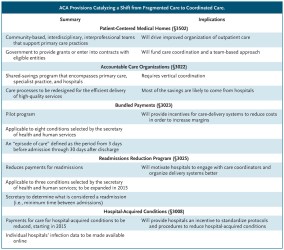
Section 3022 of the Patient Protection and Affordable Care Act is has the innocuous name, “Medicare Shared Savings Program.” Accountable care organizations are at the heart of this program, which is intended to coordinate healthcare providers serving patient populations of at least 5,000. Unlike many other parts of PPACA, this section does not establish a pilot program. Instead, it creates a fully active program with its own reimbursement structure.

The opening sentence of new Section 1899 of the Social Security Act indicates that there are significant financial dimensions to creating and running ACOs. To wit:

Not later than Jan. 1, 2012, the Secretary [of the Department of Health and Human Services (HHS)] shall establish a shared savings program … that promotes accountability for a patient population and coordinates items and services under [Medicare] parts A and B, and encourages investment in infrastructure and redesigned care processes for high quality and efficient service delivery (emphasis added). Indeed, the incentive for establishing an ACO is financial. If an ACO provider network manages costs and meets quality targets on patient care, Medicare will pay it a portion of its savings to the Medicare program.

ACOs may be modeled in various ways. Section 1899(b)(1) lists several possible configurations: professionals (physicians, physician assistants, nurse practitioners, and clinical nurse specialists) in group practices, networks of individual practitioners, joint ventures between hospitals and professionals, and hospitals employing professionals. ACOs do not have to include hospitals, although hospitals would be helpful partners because they would probably already have good infrastructure for reporting the information that HHS will require.

Read complete HealthLeaders article, here.


ACO 101: A Physician Primer with Mark Browne, MD

On the Wednesday, December 29th 2010 program ACO 101: A Physician Primer at 11AM Pacific and 2PM Eastern, my guest commentator and co-host is consultant, health innovation thought leader, and blogger, Mark Browne, MD of Pershing Yoakley & Associates, aka @consultdoc on Twitter.

While on the front end of the Centers for Medicare and Medicaid rule making process, we’ll focus on the known fundamentals of Accountable Care Organizations (ACO’s) of interest to physicians. Specifically we’ll address:

(1) What are ACO’s? Absent regulatory guidance, we have primarily a 30 thousand foot view with some pilot and demonstration exceptions. (2) What are the known or proximal models in operation to date? How are they structured? (3) How will ACO’s impact medicine and my practice in particular? Is this Medicare and Medicaid only? Or will its influence extend to the private or commercial (employer sponsored) market? (4) Why are ACO’s seen as a centerpiece in the Patient Protection and Affordable Care Act? Why the optimism? (5) What ‘go to’ resources are available, including related industry experience garnered from HMO’s, PPO’s and prior integrated delivery systems, to facilitate my education? (6) Why do ACO’s hold promise for taming the thirst of a seemingly insatiable health care financing and delivery ‘non’ system? (7) What does ‘physician leadership’ look like during the ACO consideration process?

Your advanced comments and questions are invited and welcome, and can be posted below via the comment section. In a prior post, we supplied links to 3 timely and informative reports well worth your review. Please join us.

ACO 101: ‘A Physician Primer’

Next week we take some time to get down to fundamentals for physicians on Accountable Care Organizations (ACO’s).

Specifically we’ll address:

  • What are they? Absent regulatory guidance, we have primarily a 30 thousand foot view with some pilot and demonstration exceptions.
  • What are the known or proximal models to date? How are they structured?
  • How will ACO’s impact medicine and my practice in particular? Is this Medicare and Medicaid only? Or will it impact the private market?
  • Why are ACO’s seen as a centerpiece in the Patient Protection and Affordable Care Act? Why the optimism?
  • What ‘go to’ resources are available, including related industry experience garnered from HMO’s, PPO’s and prior integrated delivery systems, to facilitate my education?
  • Why do ACO’s hold promise for taming the thirst of a seemingly insatiable health care financing and delivery ‘non’ system?
  • What does ‘physician leadership’ look like during the ACO consderation process?

Your advanced comments and questions are invited and welcome.

In a prior post, we supplied links to 3 timely and informative reports that are worth reviewing, click here for access.

ACO Watch: A Mid Week Review

On the Wednesday, December 22nd 2010 program at 11AM Pacific and 2PM Eastern, thought leader, blogger, lecturer and consultant Kent Bottles, MD, returns for an encore conversation. 

We’ll highlight key points in several of the recent reports issued, herehere and here, by the Center for American Progress, the California Healthcare Foundation, and Health Affairs, respectively on ACOs, and provide somewhat of a primer for physicians who may not be familiar with the PPACA’s (‘ACA’) provisions and the enabling language defining Accountable Care Organizations (ACOs) in the ACA.

To join us for a live or archived replay of this segment, click here.

A Model For Integrating Independent Physicians Into Accountable Care Organizations

Mark C. Shields, Pankaj H. Patel, Martin Manning and Lee Sacks in Health Affairs

Abstract

The Affordable Care Act encourages the formation of accountable care organizations as a new part of Medicare. Pending forthcoming federal regulations, though, it is unclear precisely how these ACOs will be structured. Although large integrated care systems that directly employ physicians may be most likely to evolve into ACOs, few such integrated systems exist in the United States. This paper demonstrates how Advocate Physician Partners in Illinois could serve as a model for a new kind of accountable care organization, by demonstrating how to organize physicians into partnerships with hospitals to improve care, cut costs, and be held accountable for the results. The partnership has signed its first commercial ACO contract effective January 1, 2011, with the largest insurer in Illinois, Blue Cross Blue Shield. Other commercial contracts are expected to follow. In a health care system still dominated by small, independent physician practices, this may constitute a more viable way to push the broader health care system toward accountable care.

Accountable Care Organizations Federal Trade Commission Physician-Hospital Organization Cost of Health Care Health Reform

The Affordable Care Act of 2010 included several delivery system reforms intended to address deficiencies in the way health care is delivered in the United States. Among these is the accountable care organization. The Centers for Medicare and Medicaid Services (CMS) defines an accountable care organization (ACO) as “an organization of health care providers that agrees to be accountable for the quality, cost, and overall care of Medicare beneficiaries who are enrolled in the traditional fee-for-service program who are assigned to [the organization].”1

The ACO model is not confined to public programs such as Medicare and Medicaid. Advocates of ACOs contend that these future care systems will strengthen US health care by improving care, controlling costs, and being held accountable for results. However, there are at least four major challenges to implementing accountable care organizations across the United States. First is the dominance of solo and small-group independent physician practices that provide care to the majority of the US population. Second is the voluntary medical staff structure within most hospitals, which fails to engage physicians in leading the system changes needed to deliver consistently safe, cost-effective, and high-quality care.2–4 A third challenge is the dominance of fee-for-service reimbursement, which makes moving to more performance-based payment systems difficult. Fourth is the need to spur ACOs in the private, commercial market and not just confine them to publicly financed programs in Medicare and Medicaid.

Challenges To Overcome

Adjusting To The Dominance Of Small Practices

The current focus for ACO development has been on finding ways to build more fully integrated systems that for the most part would employ their own staff physicians. However, few such organizations exist. Most parts of the country have no such integrated health care systems, and fewer than 15 percent of US physicians are believed to be affiliated with them.5

Other types of accountable care organizations focused on solo and small-group physician practices could give the concept broader reach. Several models that could bolster the spread of accountable care organizations include physician-hospital organizations, independent practice associations, virtual physician organizations, and health plan–provider networks.2

Nevertheless, there are numerous reasons why the ACO model is difficult to apply to solo and small-group practice.6 Solo practitioners and small groups rarely have the capital to invest in the kind of information technology (IT) or quality improvement training for staff that is necessary to achieve ACO status.7 Their small size makes it difficult to implement key quality tools such as disease registries or electronic health records.8 Management support and a culture of developing consistent processes can help larger groups outperform small groups.9–11

Traditional Hospital Voluntary Medical Staff

The weaknesses of the traditional hospital medical staff structure…(read complete Health Affairs article, here).

Copyrighted and published by Project HOPE/Health Affairs as A Model For Integrating Independent Physicians Into Accountable Care Organizations, Mark C. Shields, Pankaj H. Patel, Martin Manning and Lee Sacks, Health Affairs volume 29, issue number 12.


Sneak Peak at Upcoming ACO Risk Sharing, Quality Measure and Beneficiary Assignment Regulations?

Medicare Payment Advisory Commission (MedPAC) Chairman, Glen Hackbarth, recently submitted comments in response to the Center for Medicare & Medicaid Services’ (CMS) Request for Information regarding the much-anticipated Patient Protection and Affordable Care Act (PPACA) Accountable Care Organization (ACO) regulations, to be published early next year.  MedPAC’s comments were outlined in a letter dated November 22, 2010, from Mr. Hackbarth to CMS.  MedPAC’s comments were focused on three primary areas that it believes will be crucial to the success of ACOs and the Shared Savings Program:

  1. A two-sided (upside and downside) risk sharing model for ACOs;
  2. Pre-notification to Medicare beneficiaries of assignment to an ACO; and
  3. Development of a meaningful set of quality measures for ACO patient outcomes.

I. Two-Sided Risk Corridors.

MedPAC has expressed concerns over the shared-savings model under PPACA because, MedPAC contends, it places 100 percent of the risk for losses on Medicare.  As currently contemplated under PPACA, if an ACO exceeds the spending target for the Medicare beneficiaries enrolled in the ACO, and/or the ACO fails to meet designated quality targets, ACO providers still receive 100 percent of the normal Medicare fee-for-service reimbursement.  MedPAC refers to this as the “bonus-only” model and contends that the bonus-only model does not create sufficient incentives for cost reduction or quality improvement.

In addition, the Commission argues that under the bonus-only model, some ACO providers would receive bonuses not based on quality of care or reduction of costs, but simply by virtue of random variations in the health status of beneficiaries enrolled in the ACO.  As such, MedPAC is recommending the inclusion of some type of minimum threshold of cost savings before the ACO would be eligible for any bonus distributions.  The threshold would be higher for ACOs with smaller member enrollment (because of the greater variation in health status), and smaller for ACOs with higher enrollment.  MedPAC points..

Read complete client alert, here.

With nearly 700 lawyers in 12 offices, Drinker Biddle represent clients that consist primarily of substantial businesses, healthcare providers, money and asset managers and investors, ranging from mid-sized enterprises to Fortune 50 companies.

Health Industry Stakeholders to CMS on ACO’s: Published Comment Letters

In response to the request for comment proferred by CMS on November 17th, 2010 ‘Medicare Program; Request for Information Regarding Accountable Care Organizations and the Medicare Shared Saving Program’ the industry has spoken.

Below are select links to the respective submitting entities, and the issues they have called to the attention of CMS Chief, Donald Berwick, MD:

Charles N. Kahn III, on behalf of the Federation of American Hospitals.

Glenn M. Hackbarth, on behalf of MedPac.

Linda E. FIshman, on behalf of the American Hospital Association.

Fred Ralston, Jr. MD, FACP, on behalf of the American Collge of Physicians.

Karen S. Fisher, J.D., on behalf of the Association of American Medical Colleges.

Carmella Bocchino, on behalf of the American Health Insurance Plans.

Donald Crane, on behalf of the California Association of Physician Groups.

Michael D. Maves, MD, MBA on behalf of the American Medical Association.

This a limited selection. More will be added shortly; meanwhile feel free to add any omitted to date.

CMS To Hold Series of Regional ‘Listening Sessions’

During these sessions, CMS  intends to highlight health reform efforts while also gaining continuing input from community stakeholders. CMS’s purpose in organizing the regional sessions is to clarify that the Patient Protection and Affordable Care Act (PPACA) has given it new opportunities to improve the care delivery and payment system, including Accountable Care Organizations (ACOs) under the ACA’s Shared Savings Program.

Each listening session will minimally focus on:

  • The ‘Shared Savings Program’ (MSSP) for ACOs
  • The new Center for Medicare and Medicaid Innovation (CMMI); and
  • The Federal Coordinated Health Care Office (FCHCO)

December 10, 2010: 9:00 – 11:00 AM Mountain Time

CMS Region 8 – Listening Session ‘Health Care Delivery System Reform’

Co-hosted by HHS Regional Director, Marguerite Salazar, CMS Regional Administrator Jeff Hinson And featuring Dr. Richard Gilfillan, M.D, Acting Director, CMS’ Centers for Medicare and Medicaid Innovation (CMI).

The purpose of this listening session is to highlight the important work CMS is undertaking around health care delivery system reform. We will spotlight three areas of interest: The Accountable Care Organization Shared Savings Program, The Center for Medicare and Medicaid Innovation and The Federal Coordinated Health Care Office.

Individuals will be provided with a registration confirmation. Attendees are instructed to bring their registration confirmation to the event as registration will be verified at the door.

Questions may be directed to the following voicemail box: 303-844-7130. We also note that a transcript of this session will be available at this website several weeks following the event. We appreciate your time and participation, and we thank you in advance.

The Children’s Hospital, Anschutz Medical Campus, 2nd Floor Conference Center, 13123 East 16th Avenue, Aurora, CO 80045

To attend, click here.

December 13, 2010: 12:00 – 2:00 PM

CMS Region 10 – Listening Session: Health Care Delivery System Reform

The Region 10 Department of Health and Human Services (HHS) and the Centers for Medicare & Medicaid Services (CMS) invites your participation to a Listening Session co-hosted by HHS Regional Director Susan Johnson and CMS Regional Administrator John Hammarlund.

Dr. Don Berwick, CMS Administrator, will provide opening remarks and Dr. Richard Gilfillan, Acting Director of the CMS Center for Medicare and Medicaid Innovation (CMMI), will be soliciting your ideas and feedback to help inform health care delivery reform and innovation efforts.

Hilton Seattle Airport and Conference Center, 17620 International Blvd, Seattle, WA 98188

To attend, click here.

December 16, 2010: 1:00 – 2:30 PM Eastern Time

CMS Region 4 – Listening Session ‘Health Care Delivery System Reform’

Hosted by CMS Regional Administrator, Dr. Renard Murray featuring Dr. Richard Gilfillan Acting Director, Centers for Medicare and Medicaid Innovation (CMI) and Sharon Donovan Federal Coordinated Health Care Office Also including The Department for Health and Human Services Regional Director, Anton Gunn.

The purpose of this listening session is to highlight the important work CMS is undertaking around health care delivery system reform. We will spotlight three areas of interest: The Accountable Care Organization Shared Savings Program, The Center for Medicare and Medicaid Innovation and The Federal Coordinated Health Care Office.

Call in information: 800-837-1935, use ID Code: 28950540

December 17, 2010: 9:30 – 11:30 AM

CMS  – Listening Session ‘Health Care Delivery System Reform’

Hosted by Dr. Renard Murray, Ph.D., CMS Regional Administrator and featuring Dr. Richard Gilfillan, M.D, Acting Director, CMS’ Centers for Medicare and Medicaid Innovation (CMI).

The purpose of this listening session is to highlight the important work CMS is undertaking around health care delivery system reform. The Affordable Care Act has given CMS new opportunities to improve the care delivery and payment system. We will spotlight three areas of interest: The Accountable Care Organization Shared Savings Program, The Center for Medicare and Medicaid Innovation, The Federal Coordinated Health Care Office.

In addition, we are eager to receive your input pertaining to these spotlight areas. Therefore, this session will provide a forum for interested parties to make oral statements. Because we would like to hear from as many people as possible, remarks should be kept to no more than 10 minutes.

Seating is limited and will be based on a first come, first served basis. Those interested in attending must register no later than close of business Wednesday, December 15. Individuals will be provided with a registration confirmation. Attendees are instructed to bring their registration confirmation to the event as registration will be verified at the door. Questions may be directed to the following voicemail box: 303-844-7130.

We also note that a transcript of this session will be available at this website several weeks following the event.

Richardson Civic Center, 411 W. Arapaho Road, Suite 102, Richardson, TX 75080

To attend, click here.

L. Gordon Moore, MD: Next on ACO Watch – A Mid-Week Review

On Wednesday, December 15th, at 11AM Pacific, and 2PM Eastern, my special guest commentator is l. Gordon Moore, MD, President of Ideal Medical Practices, former ‘chief evangelist’ of the HelloHealth University, and a participant on Twitter via @lgordonmooremd.

Dr. Moore is a thought leader in ‘exemplary primary care’, and a physician who is actively exploring the value proposition of new media tools, and digital health technologies to enable the more efficient organization of health care services to better meet the needs of consumers, payors and host primary and/or specialty care physicians.

On this third segment of ACO Watch: A Mid-Week Review we’ll explore the role of direct medical practices, aka primary care medical homes, in the unfolding ACO tapestry. While an unconventional dot to connect to a host (or ‘parent’) ACO, or even to extend traditional consideration to serve as a host ACO per se, a suitably configured (but yet to be defined in regulatory language) network of direct medical practices can indeed both qualify for ACO consideration, as well as earn eligibility to be included in emerging state Health Insurance Exchanges (HIE’s) as ‘qualified health plans’ under the Patient Protection and Affordable Care Act (PPACA).

Many believe the core innovation that will determine the granular success or failure of the PPACA to achieve it’s ‘triple aim’ goals as outlined by Don Berwick recently, will be served up via niche and/or so-called ‘marginal players’ in the conversation. The direct medical practice movement (collectively including: retainer or membership based medicine, as well as certain concierge or boutique medical practices) is one of the candidate horses in the race.

To join us live or for an archived replay of the broadcast with Dr. Gordon Moore, click here.

4 Ways to Think About ACO Strategy

Stephen Jenkins, for HealthLeaders Media

We are in the midst of a full-fledged frenzy of activity around accountable care organizations (ACOs). Be wary of a frenzy—these are the times when action becomes separated from thought and we lose track of why we are doing what we are doing. There are good reasons to pursue becoming an ACO, and some bad ones too. Over the past several months I have talked to dozens of organizations to understand the logic behind their strategy—why they want to be an ACO. The following mind-sets capture the four predominant ways that Sg2 sees healthcare organizations thinking about ACO strategy.

Strategic Logic #1: “I don’t understand ACOs, but I don’t want to be late to the party.”Many organizations have not yet wrapped their heads around what it means to be an accountable care organization—either the internal competencies needed to be successful or the external strategic considerations of pursuing this path. But they recognize a rising trend when they see it and are determined not to be left behind, just in case ACOs turn out to be something important. So they join a study collaborative, or engage a consultant to perform an ACO readiness assessment.

There is nothing wrong with this line of thinking, even if there is very little thinking behind it. In fact, the CEOs of these organizations are perhaps more honest than the rest of us in admitting that the strategic logic underpinning their ACO strategy is vague because ACOs are vague. It is a hedge-your-bets approach in the face of great uncertainty. The key caution for this group is:

How much time and money will you invest in an ACO strategy before you are certain about whether it makes sense for your organization? Be decisive about how many dollars and full-time employees you will dedicate, and the time frame for reopening the question about whether continuing that investment makes sense. If, in 6 or 12 months, you cannot articulate a clearer rationale for pursuing an ACO strategy, be ready to pull the plug.

Strategic Logic #2: “I will take advantage of this short-term opportunity to consolidate my position and seize market power.”Policy wonks talk about ACOs as vehicles to drive long-term improvement in clinical quality and cost reduction. But some health care organization CEOs view their ACO strategy through a lens that is much more short-term and slanted toward commercial considerations. These masters of the local market chessboard see ACOs as a way to lock in physician relationships and build their wallet share of health care services in the communities they serve. In this line of thought, ACOs very well may drive broader performance improvement and, if so, terrific! But that would be a happy by-product. The driver of these organizations’ ACO strategies—how leadership convinced their chief financial officers and their boards—is rooted in more prosaic market power considerations. Fair enough.

Read complete story, here.