HiMSS 2013 Accountable Care Organization RoundUp: Monday March 3rd

By Gregg A. Masters, MPH

Himss 13 LFTF Masthead

We’re only 8 days out from the HiMSS bash in the ‘big easy’ aka ‘NOLA’. We’ve been so engaged in planning the Health Innovation Broadcast Consortium aka @HIBCtv coverage it’s been a challenge to stay on top and share the more worthwhile developments in the ACO space.

So lets detail some of the events that have caught my eye and we’re likely to cover in some fashion. First up and from the ‘specialty program’ department from the Delivering on Value – The Handshake Between Cost & Quality  I’m intrigued by the following trilogy as all address fundamental issues in standing up a viable ACO:

The ‘ACO Encounter: Physician-Lead Perspective

Description: The fastest growth in accountable care organizations is in physician-led ACOs. Gain insights from the experiences of knowledgeable physician-led accountable care initiatives who work with multiple small and medium size practices. **Each ACO Encounter presentation will be provided three times between 1:45 p.m. and 4:45 p.m. Attendees will have the opportunity to rotate though all three encounters during that time frame. Please refer to the attached PDF program for more details.

Speaker: Michael Griffis

Obtaining Quality through New Care Models: Challenge and Promise of ACOs

Description: Hear how to identify and better manage high-risk, high-cost patients, while exploring different care models, such as accountable care organizations, and incentive programs, such as value-based purchasing, to optimize patient care management.

Speaker: Blair Childs

ACO Encounter: Payer Perspective 

Description: Commercial health plans are partnering with providers to build successful accountable care collaborations with their expertise and analytic capabilities. Hear from leading health plans about innovations and strategies around reporting, care coordination, payment models, and analytic tools including risk identification and predictive modeling.

Speaker: Charles D. Kennedy, MD

Note: While much of the attention in ‘ACO-dom’ has rightfully centered around CMS certification of participating entities in the Medicare Shared Savings Program (MSSP), and via the Centers for Medicare and Medicaid Innovation (CMMI) the Pioneer and Advanced Payment model programs, there is a frenetic pace of activity in the commercial markets stoked in part by Aetna, Cigna, United et al, under the banner of ‘accountable care collaborations’ et sequelae. Dr. Kennedy is a principal architect of Aetna’s accountable care solutions group.

We spoke with in ever so briefly here, and look forward to spending some time with him up close and personal in NOLA.

The National Association of ACOs Emerges

By Gregg A. Masters, MPH

We’re only 8 days out from the HiMSS bash in the ‘big easy’ aka ‘NOLA’. We’ve been so engaged in planning the Health Innovation Broadcast Consortium aka @HIBCtv it’s been a challenge to stay on top and share the more worthwhile developments in the ACO space.

naacosPerhaps of most immediate interest is the somewhat predictable announcement of the formation of the National Association of Accountable Care Organizations aka ‘NAACO’S’.  I quote in part from the February 8th, 2013 PR below:

Over 60 Accountable Care Organizations (ACO) from more than 15 States have come together to form the National Association of ACOs. NAACOS is a 501 (c) 6 non-profit organization that allows ACOs to work together to increase quality of care, lower costs and improve the health of their communities. The Centers for Medicare and Medicaid (CMS) has recognized 258 organizations as ACOs, and private insurance plans are working with numerous other ACOs in cities across the US.

“It is phenomenal that this many ACOs could come together in a matter of 8 weeks to form such an important organization,” said Clif Gaus, NAACOS President.

“While rapid, this is a natural evolution of what was an informal network of ACO executives recognizing the need for the ACO industry to have its voice clearly and consistently at the table as regulations and program rules are developed by CMS and the States. Equally important is providing a forum for a peer to peer exchange of effective and efficient solutions to the myriad of operational challenges,” explains Mike Barrett, the Chair of the NAACOS. 

Membership is expected to exceed 100 ACOs by April, representing over 2.0 million Medicare assigned beneficiaries.

The announcement continues to define the NAACOS mission as:

  • Fostering growth of accountable care models of care;
  • Promoting industry-wide uniformity on quality and performance measures;
  • Providing Peer-to-Peer learning experiences
  • Highlighting clinical and operational best practices;
  • Constructively engaging the vendor community, and
  • Educating the public about the value of accountable care.

Further NAACOs is sponsoring its first national conference and membership
meeting in Baltimore, MD. Attendees will hear from key CMS leadership on the ACO programs and Medicare’s Quality Reporting and Improvement Programs and have the opportunity to learn from one and other in peer-to-peer exchanges and breakout sessions. 

NAACOS is governed by an Interim Board of Directors until the permanent Board
will be elected in June. The Interim Board includes:

Interim Board of Directors and General Counsel

Mike Barrett, NAACOS Chairman
Heritage California ACO
Northridge, CA

Ted Carpenter
President

For more information on the National Association of Accountable Care Organizations, click here.

Signal to Noise Challenges in ACO Actuarial Data: Who’s ‘At Greater Risk?’

This post originally appeared at HealthHombre.

HealthHombre.com | BlogThe national health expenditure data released last week showed relatively modest 2011 growth, which promptly provoked a back-and-forth about what the figures truly say and what they portend for holding spending in check going forward.  Amid considerable mental gear gnashing, the data have been assessed in light of such potential cost influencers as lingering recessionary effects, clinical v. administrative drivers, and imminent arrival of the full-bore ACA.  Occupying several nodes along the public-opinion continuum, headlines ranged from “Spending Growth at 52-Year Low” to “Americans Boost Spending” to (out on the far edge of the limb) “Future is Not Clear.”

More clear is the sharp relief into which the expenditure data cast other data, detailed in a new analysis that suggests a greater risk of Medicare Shared Savings Program underpayment of ACOs in precisely this type of environment — i.e., when no one’s altogether sure about the ups and downs of health care spending.  As a CMS summary put it:

[T]he role of random fluctuations in year-to-year healthcare spending may play a larger role in savings measurement than previously anticipated. Although CMS is fairly well protected from the chance that an Accountable Care Organization (ACO) would be rewarded inappropriately for savings that did not truly occur, ACOs are much less protected from the analogous chance that they are inappropriately denied rewards for savings that do occur.  (emphasis supplied)

And so as CMS moves forward with the latest wave of ACOs, the agency seems to have its own bets pretty well covered.  ACOs themselves, however, could face “denied rewards,” with the risk that genuine savings will go unshared particularly acute for smaller ACOs.  The analysis mused that the new data may mean ACO participation will be skewed toward groups of larger providers better able to buffer themselves against the vicissitudes of future health spending patterns.

In a risky world, ACOs, perceived by some as potentially “fragile” to begin with, seem little strengthened by this latest confluence of data.

A Tale of Two Cities: The Worst of Times or the Best of Times? L.A. v. San Diego

By Gregg A. Masters, MPH

Comparing and contrasting healthcare markets or their essential component parts can be a perilous board room exercise if the intent is to make sense of strategy options, that inform enterprise or entity choice, and meaningfully benchmark forward progress.

In pursuit of the ‘triple aim’: better experience of care, improved population level outcomes, and lower per capita costs, the quest to gage forward progress into the broad brush ‘new, new accountable care’ paradigm, it’s vitally important to understand the granular nature of markets, its constituent players, and the relative balance of power therein.

Los Angeles Study: California Healthcare Foundation ACO

In the run-up and consideration process of the rule set to articulate and map the glide path for the formation and launch of accountable care organizations (ACOs) and derivative – i.e., ‘off balance sheet equivalent’ – commercial or privately negotiated versions, much concern was directed to the potential complications of incentivizing such ‘wholesale’ provider integration. Many warned that disproportionate pricing leverage would result as modern day versions of Paul Ellwood’s ‘SuperMeds’ would rule their respective turfs. The net effect being the continued power shift away from purchasers or their health plan agents’ assumed ability to restrain the ‘rapacious apetite’ of an often expansionist, capital starved (you know the crane as mascot) and yet margin (contract restrained) challenged provider marketplace – not exactly the ‘shift’ outcome intended by either the ACA or subparts specific to ACOs.
San Diego Study | California Healthcare Foundation ACO
So courtesy of recent updates to previous market studies funded by the California Healthcare Foundation and fielded by the The Center for Studying Health System Change, we have insights into two emerging ‘accountable care’ Southern California strategy footprints. For details see: ‘Los Angeles: Fragmented Healthcare Market Shows Signs of Coelescing’, and ‘San Diego: Healthcare Providers Expand Capacity as Competition Increases for Well Insured Patients’

For prior tea leave interpretations, see: IPA + HIT (aka technology stack) x MSO = ACO, and California Association of Physician Group (CAPG) CEO Don Crane’s take in Smart Money, ACOs and Risk Savvy Medical Managers. So which footprint is more in alignment with the intent of the ACA’s triple aim, you be the judge? I say, what up San Diego?

And the beat goes on….

National ACO Patient Engagement Benchmarking Survey

By Gregg A Masters, MPH

Earlier today Avado released a National ACO Benchmark Survey directed to select ACO avadoand accountable care industry executives. A core component of ACO success from both a financial and outcomes perspective, and critical to the fulfillment of the triple aim, ‘patient engagement’ is a broadly cast, locally flavored and otherwise rather ambitious undertaking. In an industry that typically did not have to think in such aggregate (population level or shared governance) nor granular (patient centric, beneficiary engaged) terms, this is no walk in the park. For an itemization of CMS indicia of patient centered-ness see:‘The ACO Must…’ Towards an Operational Definition of ‘Patient Engagement.’

Avado’s CEO Dave Chase introduces the survey as follows:

We invite you to participate in a benchmarking study on readiness for patient engagement. This survey is being sent to hundreds of ACO executives to elevate the importance of Patient Relationship Management (PRM) and the role they can play to positively impact the health and financial outcomes for ACO risk assumption.

The results from all participating ACO executives across the country will be compiled and sent back to you, along with an invitation to view a webinar about the top ten things to know about PRM with at least one of the authors of the forthcoming HIMSS book on patient engagement: “Engage! Transforming Healthcare through Digital Patient Engagement”, as a thank you for participating.

To access the survey, click here. The Deadline for completion is Monday, February 4th, 2013.

Chase continues:

Those who’ve studied patient portals have made the analogy that legacy patient portals are akin to pre-Google web search i.e., low-value and a “marketing checkbox”. Google demonstrated that there was value that could be unlocked. The organizations that understood this early such as Amazon and Expedia gained a massive advantage over their competition that their competitors never recovered from. Likewise, the organizations that recognize the value of PRM will gain a major advantage over their competition while better serving their patients.

‘The ACO Must…’ Towards an Operational Definition of ‘Patient Engagement’

By Gregg A. Masters, MPHaco patient engagement

In the realm of stuff we need to do and sometimes clouded by either ad copy or less than straightforward guru guidance cutting through the clutter can sometimes be confused by the words ‘may’, ‘should’ or other less obligatory statements. For instance:

M/U/S/T | a verb |to:

be commanded or requested to…
be urged to…
be compelled by physical necessity to…

You fill in the blank.

So it’s pretty clear that ‘must’ leaves little wiggle room or cause for doubt when it comes to meeting a certain legal or regulatory threshold or standard. In this case, we’re addressing certain global provisions in the Patient Protection and Affordable Care Act specific to Accountable Care Organizations (ACOs).

CMS previously described ‘patient engagement‘ via the rule making process as:

the active participation of patients and their families in the process of making medical decisions….

[and that] measures for promoting patient engagement may include, but are not limited to, the use of decision support tools and shared decision making methods with which the patient can assess the merits of various treatment options in the context of his or her values and convictions. Patient engagement also includes methods for fostering ‘‘health literacy’’ in patients and their families.

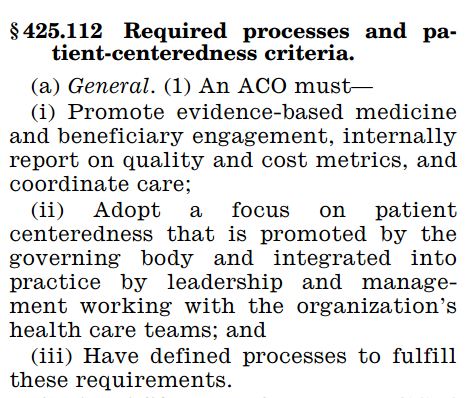
Also consider the balance of criteria or so-called CMS ‘indicia’ of patient centered-ness via Section 425.112: Required processes and patient-centeredness criteria:

“(b) Required processes.

The ACO must define, establish, implement, evaluate, and periodically update processes to accomplish the following:

(2) Promote patient engagement.

These processes must address the following areas:
(i) Compliance with patient experience of care survey requirements in § 425.500.
(ii) Compliance with beneficiary representative requirements in § 425.106.
(iii) A process for evaluating the health needs of the ACO’s population, including consideration of diversity in its patient populations, and a plan to address the needs of its population.
(A) In its plan to address the needs of its population, the ACO must describe how it intends to partner with community stakeholders to improve the health of its population.
(B) An ACO that has a stakeholder organization serving on its governing body will be deemed to have satisfied the requirement to partner with community stakeholders.
(iv) Communication of clinical knowledge/evidence-based medicine to beneficiaries in a way that is understandable to them.
(v) Beneficiary engagement and shared decision-making that takes into account the beneficiaries’ unique needs, preferences, values, and priorities;
(vi) Written standards in place for beneficiary access and communication, and a process in place for beneficiaries to access their medical record.

(3) Develop an infrastructure for its ACO participants and ACO providers/suppliers to internally report on quality and cost metrics that enables the ACO to monitor, provide feedback, and evaluate its ACO participants and ACO provider(s)/supplier(s) performance and to use these results to improve care over time.

(4) Coordinate care across and among primary care physicians, specialists, and acute and post-acute providers and suppliers.

The ACO must—
(i) Define its methods and processes established to coordinate care throughout an episode of care and during its transitions, such as discharge from a hospital or transfer of care from a primary care physician to a specialist (both inside and outside the ACO);”

The pathways to achieve these indicia of patient engagement are perfectly clear, right? Perhaps in the world of mature integrated delivery systems infused with a patient centric mission and committed physician group practice embracing a team based, seamless care culture. But the average ACO tethered to one or more community hospitals via ‘in name only’ cowboy medical groups, I think not.

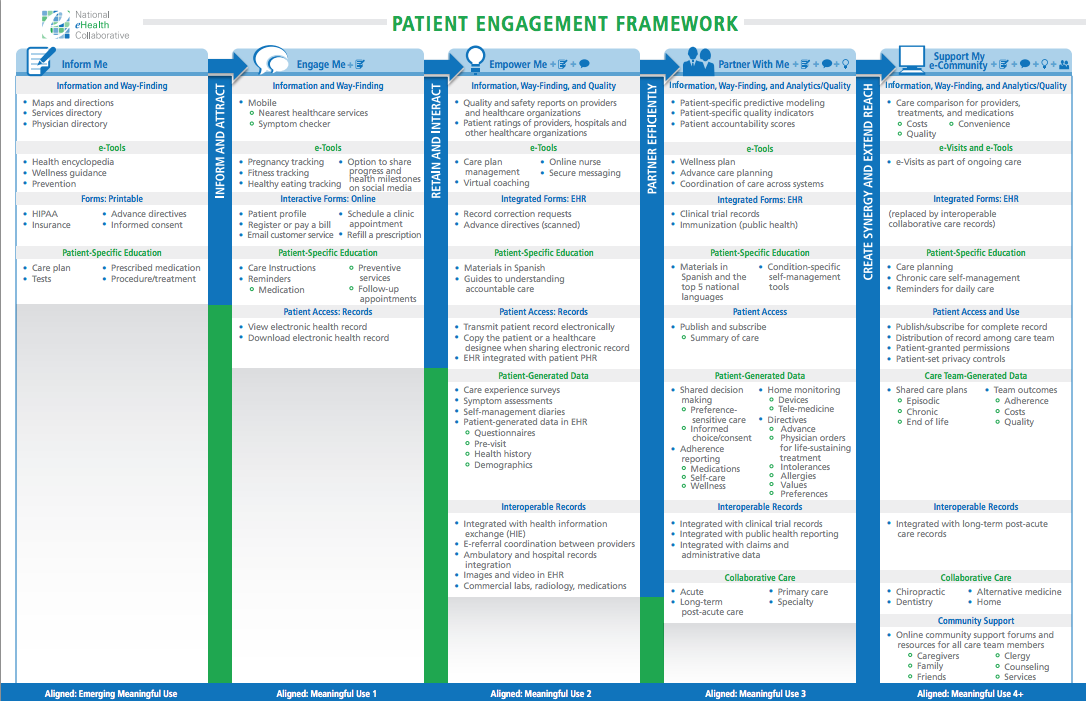
Now consider the crosswalk and ‘best case(?)’ staged implementation timeline perhaps most accurately reflected in the National eHealth Collaborative’s ‘Patient Engagement Framework’.
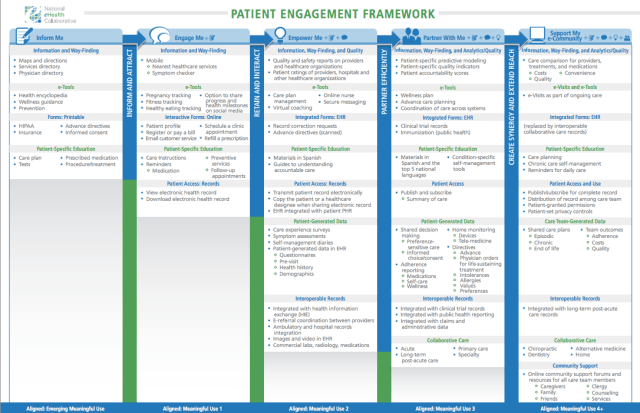
Patient Engagement Framework | NeHC

Truth be told we have a way to go before the proverbial ‘rubber meets the road’, both in terms of the technical fulfillment or health information technology side as well as the ‘fit’ inside an ACO given our national state of ‘readiness’ or maturity if you will.

One bit of news likely to add some clarity to the muddy state of affairs that we’ve learned of recently, and is due to be released shortly by Dave Chase et al at Avado, is a survey of ‘Patient Engagement Readiness’ directed to the ACO industry at large including CEO, CMOs, CIOs, CMIOs and others at the center of this ACO/technology/patient interface. We’ll preview this timely and relevant industry survey and will post the results here as well.

Stay tuned, more to follow shortly!
Universal American: A ‘Healthy Collaboration?’

By Gregg A. Masters, MPH

JP Morgan Healthcare Conference | Universal AmericanI intended to post updates from Aetna and Cigna next in this series, yet today I received a tweet by Vince Kuraitis, aka @VinceKuraitis, calling attention to Universal American a managed care player I’ve not spent much time on. Yet they present a rather interesting profile and operating footprint some of which I will highlight below.

According to their website Universal American (UAM):

…provides health benefits to people with Medicare. We are dedicated to a Healthy Collaboration, working together with healthcare professionals in order to improve the health and well-being of our members.

The JPMorgan Healthcare conference deck is here, and webcast here (you may need to register). Of note is with the recent release of CMS certified ACOs, UAM now operates ’31 ACOs approved for participation in the Shared Savings Program which include more than 2,000 participating physicians covering an estimated 300,000 Original Medicare beneficiaries in 13 states.’ So not only are they a player in Medicare Advantage (the end game for risk bearing ACOs), they have a presence in the gateway market as well. For complete details, click here.

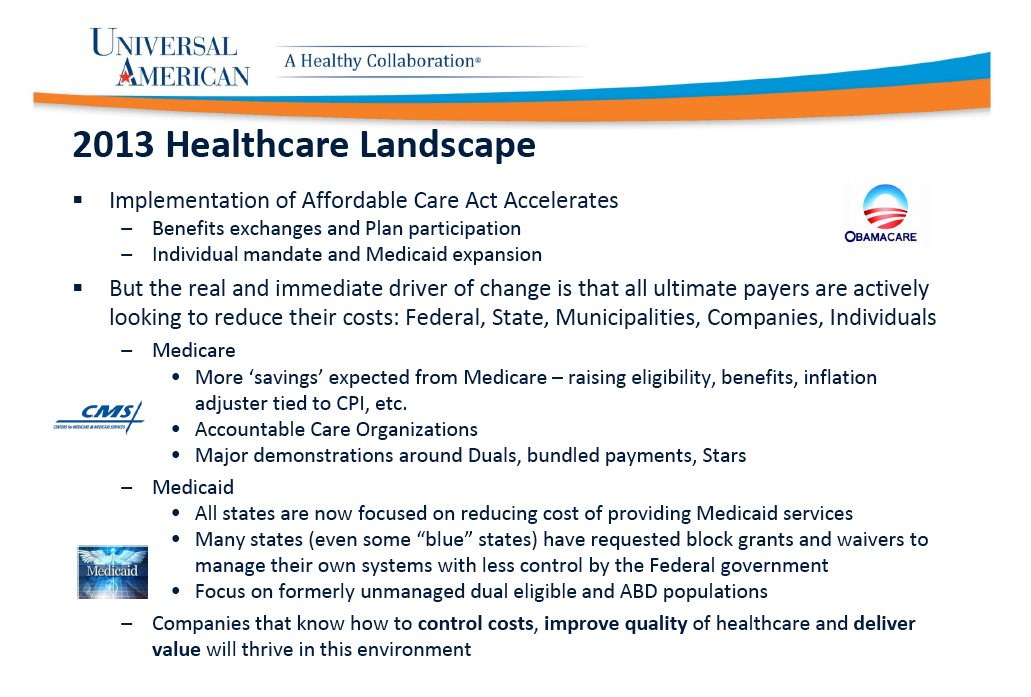
Two pieces from their narrative tell the story, 1) the ‘healthcare landscape’:

Universal American Healthcare Landscape
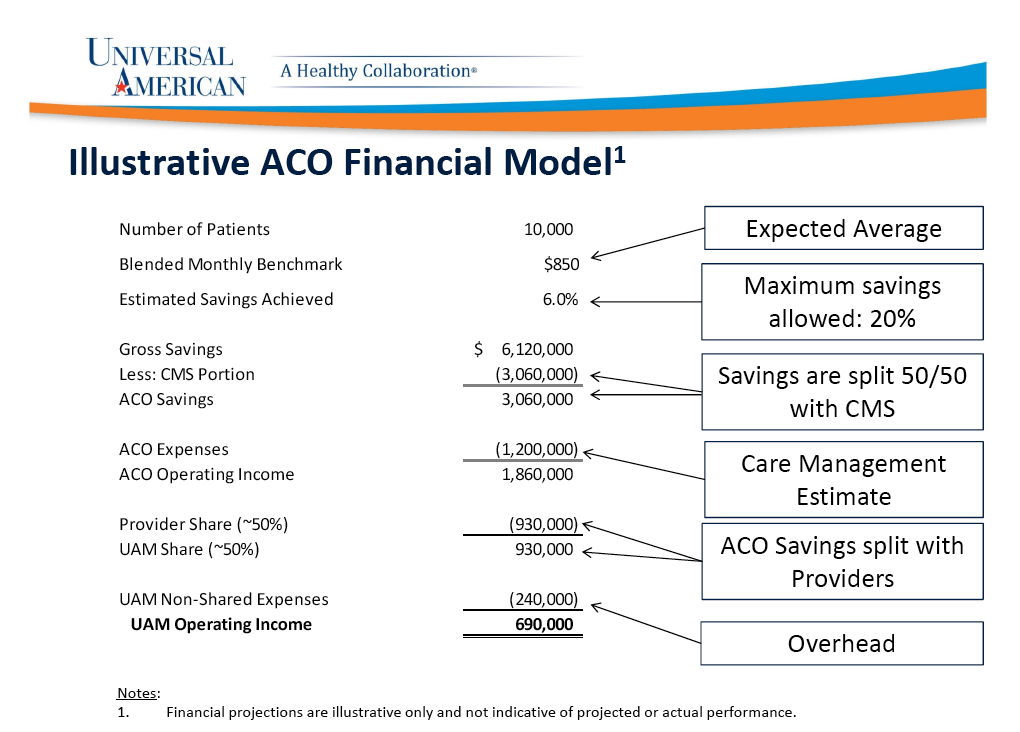
And, 2) a proforma ACO funds flow in their 50/50% ‘healthy collaboration’ provider/healthplan partnership benchmarked to actuals driving a bottom-line:
Picture 5

Strategic Market Tea Leaves: The Health Plan Perspective

By Gregg A. Masters, MPH

JPMorgan Healthcare Conference 2013 HealthNet PresoWhether you love em (anyone love their health insurance company?) or hate em, major health plans are in a reasonable position to lead if not steward the needed healthcare transformation. While physicians aka ‘disorganized medicine’ too often circle the wagons and shoot in, and whereas hospital systems present too much baggage and institutional inefficiencies, health plans with a ‘utility company’ mindset and access to local, regional and national market ‘big data’ footprints are likely candidates to support if not direct and brand local innovation.

In a continuing series to sample and curate narrative from the rich content at JP Morgan Healthcare conference 2013 here are some highlights as well as the audio webcast and deck proffered by industry veteran Jay Gellert, CEO and President of HealthNet.

Setting context for his remarks and visualizing the future he stipulates:

We think that whatever happens over the next 3-4-5 years [in our business] is going to be an increasingly Government driven market (‘B to G’).’

“…historically at this conference until very recently the vast majority of presenter’s talks has been about how to increase revenue….we think that’s kind of the past as we move to budget driven system…a much more radical change than people have come to grips with…

Gellert’s strategic thesis for HealthNet is offered upfront:

Gellert HealthNet Thesis: JPMorgan Healthcare Conference

Meanwhile some of the other market worthy observations include:

One of the benefits of being in California is that you’ve seen this [risk migration/management] movie before…”

“We’ve really never had an experience in the history of this country where we’ve moved from medical underwriting to community rating without intense disruption…

“…whether successful or not…one of the key challenges for all of us to remember is the individual market is only 5% of the [total]..

Key themes included positioning for the health insurance exchanges, ‘scrubbing the [commercial] book’, positioning for membership growth in Medicaid (MediCal), dual eligibles’, Medicare Advantage and continued uncertainties associated with specific provisions of the Affordable Care Act.

Up next @Aetna, then @Cigna.

JP Morgan Healthcare Conference Unbundled: Something for Everyone?

By Gregg A. Masters, MPH

The 31st annual get together of biotech, pharma and an eclectic litany of publically held healthcare company and many impressive tax exempt health system peeps was my first albeit from a somewhat disadvantaged, i.e., ‘crasher’, status. Yet, in the overall program mix there seemed to be something for everybody from payor to provider, to device manufacturer and distributor, clinical research organizations, academia, it’s primary audience the investment community and even the maturing health technology start-up world, i.e., AliveCor, et al.

For a compete agenda including archived webcasts of select presos, decks, etc., click here. Access is public and free, but registration is required. There is enough information to keep a blogger, journalist or consultant busy parsing out market relevant information for weeks if not more depending upon your level of interest and willingness to search and retrieve content available elsewhere on the web. Yet, I will drill into portions of the overall program and petition any of you who have access to content shared elsewhere that may complete or amplify the narrative.

The $4.42 billion (‘I think we overpaid..’) acquisition of Healthcare Partners by DaVita in May 2012 sheds unique insights on the developing operational and business model footprints emerging inside the accountable care industry. Denver, Colorado based specialty healthcare provider DaVita is a market leader in renal dialysis, and Torrance, California domiciled Healthcare Partners are defacto thought leaders and best practice innovator’s in the risk savvy medical group or physician led integrated delivery space.Picture 2

Many questioned the synergy when DaVita tendered their offer for Healthcare Partners wondering why in the world would a specialty care provider go after a California based medical group with risk contracts with HMOs (there are considerably more contracting and other assets, but this was the oversimplified characterization of what was on the table). Yet, the diversification from renal care into general acute if not the entire care continuum given the move into accountable care or otherwise stated as the shift from volume to value paradigm, the acquisition made perfect sense.

So consider the reporting by Kent Thiry, DaVita’s CEO/Chairman and co-chair Robert Margolis, MD, as peeling back the curtain of accountable care strategy under the emerging incentives and rule changes provisioned under the staged implementation of the Affordable Care Act.

The webcast is here, and the deck is here.

Enjoy!

And the Circle Grows! CMS Announces Another Round of ACOs

By Gregg A. Masters, MPH

Industry watchers have to be impressed by the announcement from CMS today that effectively doubles the ACO count from prior reported totals.

CMS App Clipped

Is it just me, or can you can sense the subtle shift in market sentiment from skepticism to loss of first mover opportunity in one’s market.

For the list of newly anointed ACO’s with a start date of January 1, 2013, click here.

We’ll digest the details and un-bundle its significance for you shortly. i.e., ‘Columbus gets its first Obamacare Accountable Care Organization’ market by market, and model by model.

Take note: the filing application deadline for January 2014 go live date is Summer 2013! Get those apps in process!