FTC v. OSF Healthcare

By Gregg A. Masters, MPH
One of the more popular downsides associated with the growth and dispersion of ACOs in provider [primarily of the ‘institutional variety’ aka hospital/health system] consolidation and asset concentration, is the risk of anti-competitive pricing leverage. You know, the ‘my way or the highway’ approach of certain providers with near or actual ‘sole source’ standing in their markets.

Concurrent with the release of the final rule for ACOs were a series of enabling related agency rulings on the treatment of ACOs from tax, and anti-trust perspectives.

Just today, the FTC released a statement on the U.S. District Court’s ruling granting a preliminary injunction in the OSF/Rockford Hospital Matter:

The Court’s ruling today temporarily blocking OSF’s proposed acquisition of Rockford Health System is a victory for both competition and consumers. We continue to believe in the merits of our case, and that if this deal is ultimately allowed to proceed, the result will be less competition and higher health care prices in the Rockford area. We look forward to presenting our case before the Administrative Law Judge later this month.

Clearly this is one in a continuing series of actions FTC will take when the perceived scale is deemed tipped in favor of excess provider consolidation, and thus adding to an anti-competitive market.

ACOs [or the strategic positioning of same] are causing the DOJ and FTC to reconsider their thresholds and indicia of ‘equilibrium’ between acceptable payor/provider marketplace balance. Certainly there is more to come as we progress.

It may be completely coincidental timing, but OSF Healthcare appears in a write up at FierceHealth, titled ‘OSF Healthcare Exec on the Pioneer ACO journey‘.

Yes, we do live in [very] interesting times!

Accountable Care and Social Media: Can it connect the silo’s?

By Gregg A. Masters, MPH

In an article posted on KevinMD by the always learned and insightful George Lundberg, MD*, the question was posed:

can ACO’s re-invent the American Health Care System?

A rather compelling and timely question given the fragmentation and vertical silo’s characteristic of American health care finance and delivery, and the ‘patient-centric’ enhancements the ‘social media tool set’ seems to afford. Yet, there was a limited and in my view somewhat ‘unbalanced’ response. As someone familiar with the thought leadership ‘gene pool’ of social media, and healthcare social media sub-set in particular, I was struck by the absence of their voices [including yours truly] in the comment section.

Yet, the substance of the question is on point to a Health Information Technology Social Media TweetChat I will moderate this Friday, April 6th, 2012 at 9AM Pacific via the hashtag #HITsm. For the most recent tweets tagged with #HITsm, click here.

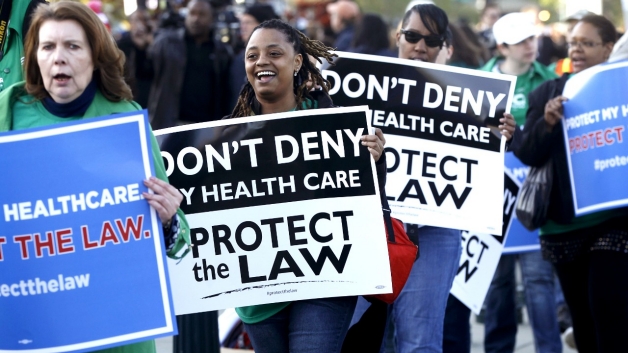
The flaws in our imploding house of cards ‘sick-care [non] system’ are recounted seemingly everywhere these days. And the recent preoccupation of the Supreme Court of the United States with the constitutional challenges of the Patient Protection and Affordable Care Act, places the question of what are the best practices to restrain and re-orient an overly paternalistic, too costly, unsafe and increasingly inaccessible industry that many would say has lost it’s way.

While Dr. Lundberg is hopeful:

We can build a new medical world based less upon process, quantity, volume, and lucre, and more on quality, safety, speed, outcomes, and patient-centered efficiency.

That sentiment is not shared by those called to comment on the piece. Some representative thoughts include:

Come on Dr. Lundberg, take the blinders off.

If grand platitudes can save our system, then ACO’s are a surefire success.

The ONE goal of an ACO: to maximize market share.

ACOs represent an enormous step forward in the corporatization (profit motivation) of American medicine.

Where do you come down? Does any of this negativity fanned by considerable skepticism if not sarcasm of ACOs to pull off what many of its predecessors, i.e., HMOs, PPOs, EPOs, DPOs, etc., have not – at least in the aggregate?

Is it wishful thinking? And what role, if any, does technology play in the remediation – or the ‘this time it’s different’ department? Might social media and the democratization of the patient/provider value proposition change the balance of power and thus drive ‘accountability’?

Here are my suggested topics for the #HITsm TweetChat:

  1. What does ‘Accountable Care’ mean to you?
  2. Can ‘social media’ (broadly cast) enable accountable care or ACOs in particular?
  3. Will physician’s ever play ball, and why? Why not?
  4. If you ran the zoo, where would you start? What tools are essential to build the conversation and enable the transformation?

We should have some fun on Friday. If I omitted any questions more on point for this conversation, please list them in the comments section.

* George Lundberg is a MedPage Today Editor-at-Large and former editor of the Journal of the American Medical Association.

SCOTUS, ACA & ‘Mis-informed’ Justices

By Gregg A. Masters, MPH

As suggested yesterday while ‘the case has been submitted’ per Chief Justice Roberts upon conclusion of Day 3 oral arguments over the constitutional challenges to the Patient Protection and Affordable Care Act, the war to shape the national narrative is well underway.

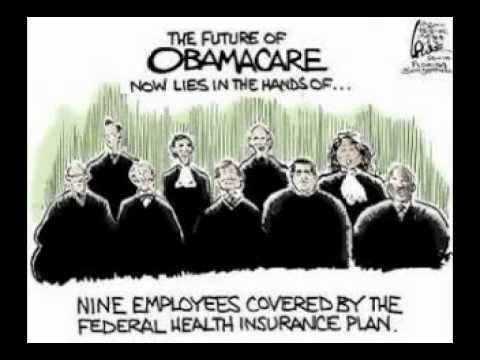
The blogosphere is ripe with buzz over the manner in which the Court conducted itself particularly with respect to the admission of erroneous information aka the ‘broccoli analogy’, and ‘the Cornhusker Kickback‘, the failure to read the actual law under dispute (by at least Justice Scalia), and the apparent echolalia of anti ‘ObamaCare’ right wing talking points, proferred as ‘facts’ in the Supreme Court of the United States.

As contextually offered by former Reagan Administration Solicitor General, Charles Fried to ABC News in 2010:

Anybody [who questions the constitutionality of the Affordable Care act] is either ignorant — I mean, deeply ignorant — or just grandstanding in a preposterous way.

Not much room for doubt here….and might I add the overwhelming weight of informed healthcare policy wonks and legal thinkers side with Fried’s view.

Fast forward via a recent interview with Ezra Klein of the Washington Post, where former SG Fried further opines given the Court’s current process:

 I’ve never understood why regulating by making people go buy something is somehow more intrusive than regulating by making them pay taxes and then giving it to them. I don’t get it. It was comical to read the Heritage Foundation’s brief attempting to explain why they were changing their position on this. Something needed to be done about this problem. Everyone understood that. So, the Heritage Foundation said let’s do an individual mandate because it keeps it within free enterprise. The alternative was single payer.

I find it fascinating for the capacity of some of us to rationalize anything, as if there is no institutional memory of any kind. That what’s real for some is only within the last 24 hours news cycle or is otherwise in alignment with their more often than not emotionally built ‘world view’. We are indeed living in the ‘United States of Amnesia‘ (or the Studs Terkel re-brand:  ‘the United States of Alzheimer’s) with a portion of the general public apparently unwilling to tether themselves to context and facts vs. purpose driven ideological spin.

Incidentally, this drama has everything to do with ACOs and the accountable care industry. To some degree this movement will advance regardless of SCOTUS for market and structural reasons, yet if nothing else, SCOTUS will impact the ambient background noise if not the direct context in which the competitive drama plays out.

SCOTUS Consideration A ‘Pyrrhic Victory’ Regardless of Ruling

By Gregg A. Masters, MPH

Ladies and Gentlemen, start your engines!

A P/Y/R/R/H/I/C victory is defined by Wikipedia as:

(/ˈpɪrɪk/) is a victory with such a devastating cost to the victor that it carries the implication that another such victory will ultimately cause defeat.

An army of professional, neo-professional and outright ‘amateur’, including skin in the game patients and consumers, healthcare insiders, ‘pigs at the trough’ (of $2.8 trillion ‘healthcare market’) channel partners, and a vast stakeholder constituency with ‘interests’ in the outcome of the SCOTUS decision, are minimally scrambling to position themselves for what’s to come, if not attempt to influence the Court’s ultimate ruling.

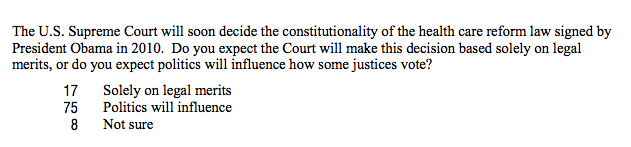
As noted in a previous post, 75% of Americans believe the SCOTUS process will be influenced by ‘politics’ vs. the ‘legal merits’ of the arguments submitted to the Court. Ergo, the battle has now entered a new phase to shape the national narrative and ultimately position the consumer friendly public perception of ‘the Act’, or as pejoratively tagged, ‘ObamaCare’ by those less inclined to read vs. deploy cute sound bytes for public consumption.

In an updated post, I will supply some credible contextual pieces to support the following claim:

The President has already won the narrative regardless of the Court’s ruling. We are where we are perceptually for political not legal reasons. Yet, the nature of the malady is apolitical, it is fundamental and structural.

Any attempt to rule in whole or in part the Act as ‘unconstitutional’ will face severe narrative “head winds” and political fallout as very popular line item provisions of ACA are repealed or otherwise diluted.

Meanwhile, a tasty morsel of consumption is offered here c/o Chas Roades, Chief Research Officer of The Advisory Board, titled: ‘Five Quick Reactions to the Supreme Court Hearings.’

SCOTUS and ACA Day 3 Part Deux: Medicaid Expansion

By Gregg A. Masters, MPH

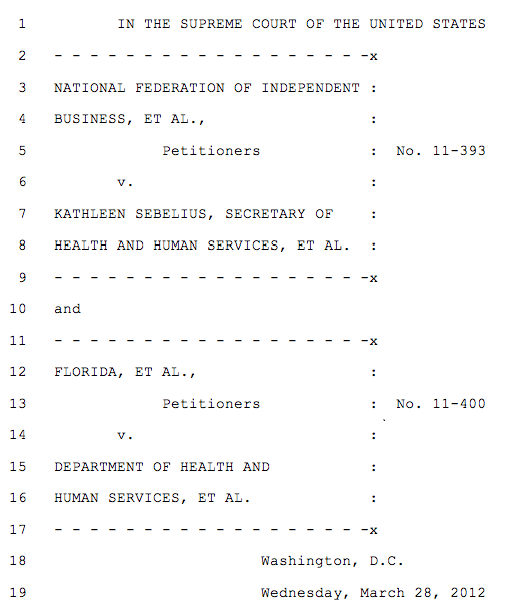
Here is the audio for ‘Florida vs. The Department of Health and Human Services’.

Here is the transcript.

We are actively searching out the submitted briefs and will post them once found. [Editor’s Note: I invite anyone who may have direct access to post them here in the comments section; it will be much appreciated. I do NOT have Nexis/Lexis access].

SCOTUS Audio and Transcript: National Federation of Independent Business v. Sebelius

By Gregg A. Masters, MPH

Day 3 is no disappointment. The core argument by Florida AG Clement is that if the  individual mandate is ruled unconstitutional, the entire Patient Protection and Affordable Care Act, absent the severability clause, must fall.

Judging from the robust engagement of AG Clement, including an interesting line of questioning from Justice Kagan, (peppered with periodic audience laughter), his argument was enjoined by a somewhat skeptical Court.

P.S. It wasn’t a ‘cakewalk’ for Deputy SG Kneedler either. The Court is engaged on both sides of the arguments presented. A must listen event!

For the audio proceedings of Day 3, click here.

The transcript is accessible here.

[Editor’s Note: Later today, the Court hears the arguments over states’ rights and the expansion of Medicaid under the Act].

The Affordable Care Act: Day 3 at SCOTUS

By Gregg A. Masters, MPH

It’s deja vu all over again!

The theater circa 2010 at the Senate Finance Committee via the reconciliation process that delivered unto us the Patient Protection and Affordable Care Act, the framework enabling the accountable care industry, is in play again this time at the Supreme Court of the United States (SCOTUS).

[Editor’s note: For a comprehensive and politically agnostic resource c/o @CSPAN, click here].

Day 1 dealt with the Anti Injunction Act (AIA), an arcane Federal law that would have deferred consideration of the constitutionality of ACA, was both interesting and curious in substance and contribution to ‘sentiment meter’ of the individual justices.

Day 2 took a rather problematic turn, at least for those who favor the Act (a long list of supporters) vs. Florida AG Clement, et al , who are determined to ‘restrain’ the relationship between the Federal Government and the people via at times simple minded bright lines of markets v. commerce inherent in the intent of the ‘commerce clause’. Many pundits concluded the Solicitor General arguing the Government’s position grossly mismanaged the message, and lost control of a compelling narrative during his argument and subsequent lively questioning by the court.

Now comes the finale, Day 3, with the focus on the question of ‘severability’ of the individual mandate. While a rather boiler plate clause typical of most contracts, the severability of the mandate alone (in whole or part) vs. the Act in it’s entirety, is the question before the court. The omission is a rather curious fact in it’s own right, and will no doubt be grist for the ‘Congressional intent mill’.

I’ve drawn a line between the process associated with the passage of the Act as it played out via the theater of the Senate Finance Committee hearing in 2010. Apparently, I am not alone as reported this week by Bloomberg 75% of the public believe politics vs. merits will drive the consideration process:

So yes, here we go again. This law has had a hard time in the public sphere, see Pew piece ‘Public Remains Split on Health Care Bill, Opposed to Mandate‘, mostly misunderstood in the aggregate due to its complexity, yet embraced when you consider it’s line item nature, i.e., eliminating benefit caps, pre-existing conditions, requiring a minimum of medical loss ratio of 80%, extending dependent care coverage up to the age of 26, the establishment of health insurance exchanges to assist in the standardization, evaluation and purchase of health insurance plans, an oversight role of the unrestrained nature of the individual insurance market and more.

Today’s proceedings will add content to the odds makers and pundits’ calls on which way the court will decide. For a setup piece, watch this clip from the Wall Street Journal:

For audio analysis of the proceedings to date, check out the higlights from SCOTUSblog here.

SCOTUS and the ACA: Day 1

By Gregg A. Masters, MPH

Perhaps the hearing of the new century thus far? The Supreme Court of the United States takes up the challenges submitted with respect to the Patient Protection and Affordable Care Act.

From the social media ‘journalism domain’, two hashtags received the predominant volume of tweets tagged to the event; they include: #SCOTUS, and #ACAhearings (both are partial digital footprints representing the last 50 tweets only, including the accounts reached and impressions generated).

For complete realtime coverage collapsing both #ACAhearings and #SCOTUS hashtags, click here.

Several blogs were tweeting contemporaneous commentary on the proceeding, two notable sources include:

The Wall Street Journal and the SCOTUSblog.

With some color and tea leaves interpretation, check out Dr. Jaan Sidorov’s blog for the bi-partisan common theme extraction on The Disease Management Blog via ‘Showdown at the SCOTUS Corral‘.

Useful context pieces include:

For those of you healthwonk junkies, C-Span is airing the replay of the event here (check for schedule).

Finally, the complete transcript from Day 1 is available here.

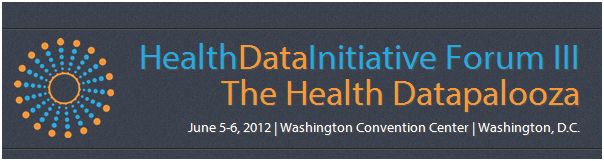
ACO Deep Dive Session at this Year’s Health Datapalooza

By Gregg A. Masters, MPH

This just in from the Centers for Medicare and Medicaid Innovation and HDI Forum III:

The CMS Innovation Center is helping plan one session of this two-day event. An ACO “deep dive” will demonstrate how Accountable Care Organizations can make effective use of claims data through innovative software services and analytics. Surgeon and author Atul Gwande will be leading a discussion between the audience and a diverse set of stakeholders from data analysts to a number of the Pioneer ACOs.

‘This year’s event will feature keynote addresses and panels, breakout sessions, apps demos and action beat announcements. Make sure you stop by the Data & Apps Expo to talk with data producers and the developers that use that data to create innovative tools and services to improve the health of individuals and communities. See an overview of the agenda below, and click through to find a detailed schedule of the events on Day 1 and Day 2.’

Thought leader and major disruptor of the health plan gene pool, Mark T. Bertolini, (aka @mtbert), Chairman, CEO & President, Aetna aka, @Aetna, to deliver Day 1 keynote address.

Welcome and opening remarks:

Matt Miller, aka @mattMillerNow, Host, “Left, Right & Center,” NPR (moderator)
Bob Kocher, aka @BobKocher Partner, Venrock (HDI Forum III Co-Chair)
Dick Foster, Venture Partner, Lux Capital (HDI Forum III Co-Chair)

For complete program details, click here.

Aetna teams with Hoag Orthopedic on bundled payment initiative

By Gregg A. Masters, MPH

Leveraging up from the Integrated Healthcare Association’s (IHA) work (and others) in the bundled payment domain, @Aetna announced yesterday that in association with partner health information technology vendor @McKesson_HIT, their work with Hoag Orthopedic Hospital (aka @HoagOrthopedic) in Newport Beach, California.

Bundled payment a child of the DRG payment system and long employed in service of managed care contracts for select high cost services including cardiovascular and orthopedic surgeries, holds promise to reduce costs, while promoting quality, patient safety and integrated care. Perhaps one of the least controversial elements of the Patient Protection and Affordable Care Act, an expanded bundled payment model is clearly in service of the Triple Aim (better care, better health, lower cost).

Per IHA:

according to one estimate [the bundled payment model], could reduce U.S. health expenditures as much as $300 billion between 2010 and 2020

For the complete announcement, click here.