They Shoot Horses’ Don’t They?

By Gregg A. Masters, MPH

Some may remember the movie ‘They Shoot Horses’ Don’t They‘ [caution: a rather graphic depiction of an exit]. The plot borrowing from the humane ‘taking them out of their misery’ [post injury] if you will, albeit in the context of certain determined dance partners ‘desperate to win a Depression-era dance marathon and the opportunistic MC who urges them on to victory’, strikes a contemporary cord.

Some might extend this desperation metaphor to our rather creatively change resistent healthcare industry, aka ‘healthcare conundrum‘, given decades of serial failure [or success depending upon your interest]. Yet, with Dr. Eric Topol’s recent publishing of ‘The Creative Destruction of Medicine‘ where among his many insights, he acknowledges with the weight of history on his side that:

innovation must come from outside the profession [of medicine].

Fast forward the frame and consider where we are in the health reform, re-design or collective business model or technology leveraged innovation theater. At best it’s a mixed bag of industry voices, direction and results. The first series of ‘tea leaves’ can be traced to the consideration process (aka theater} over the Patient Protection and Affordable Care Act afforded by the Senate Finance Committee hearing process. An excruciatingly painful event to witness, yet the battle lines where being drawn at that time.

Next came the release of the ‘Notice of Proposed Rule Making’ to implement the broad brush provisions in the Act (yes, it passed over the wishes of the ‘Hatch Enzi Gang of 42) specific to Accountable Care Organizations’. While some 1,300 comments where filed by healthcare industry stakeholders [can you imagine a more iterative public/private exchange?], the rule was then finalized incorporating many of the substantive objections submitted to CMS. Yet, even with the ‘adjustments’ to the proposed rule, the fact that AMGA, arguably one of the centers of excellence in medical group consciousness and therefore coordinated care delivery, remained on the sidelines was a puzzling and somewhat disturbing turn of events.

So here we are. The Supreme Court (see briefs here) is about to take on the series of constitutional questions posed with respect to the Act. None directly speak to the provisions of ACOs per se, other than the underwriting implications of undoing the mandate, we remain in a very much bi-furcated, if not divided reform minded community.

Yet whether the Act is struck down in part or whole, the horse [no pun intended] is out of the barn. The only question which remains, who will lead and from what ‘book of business’ or marketplace vantage point? Judging from activity in the private (commercial) market where announcements of payor/provider partnerships are announced seemingly with regularity, it’s pretty clear that whether the codified rules on Medicare ACOs and derivative programs (Pioneer, MSSP, etc.), remain in the custody of legal or regulatory detention or not, the market will march on.

Bundled Payment: A Gateway to Accountable Care?

By Gregg A. Masters, MPH

Advisory Board senior consultant and talented speaker (I might add), recently penned a blog post titled: ‘Bundled Payment: A Stepping Stone for ACO’s? I Don’t Buy It.’ I read this well constructed piece, but came to a rather different conclusion.

In his set up Rob posits:

As I have previously written, hospitals can realize a range of strategic benefits by developing carefully crafted bundled payment programs. And for many leaders who want to begin experimenting with new payment models, bundling presents an attractive entrance into the accountable care landscape, enabling innovation without fundamentally disrupting the current hospital business model. As they think about longer-term accountable care strategy, many of these leaders also assume that bundling offers a helpful foundation for ultimately becoming ACOs.

Then pivots to:

Unfortunately, I do not buy the argument that bundling provides a stepping-stone for ACO development. I certainly understand the genesis of the argument: line up all of the emerging payment models by degree of financial risk and assume a linear evolution from pay-for-performance to bundled payment to shared savings or capitated models. I even admit there are some areas of overlap across models, such as focus on readmission reduction, but closer comparison reveals that bundled payment and the shared savings model have fundamental differences. There are still plenty of valid reasons to explore bundling—but preparing to become an ACO is not on my list.

Using the same math plus decades in the managed healthcare industry contracting for hospitals, health systems, medical groups, physician networks and health plans including setting up IPAs, PHOs, and MSO infrastructure leads me to the opposite conclusion.

The point is not to contrast and compare indicia of bundled payment to probable elements of ACO compensation arrangements from ‘risk lite’ to global capitation, but rather to understand the compelling case for engagement of stakeholder physicians in the consideration process. To say this journey is a rather complex and high risk transformation to enable let alone discuss is an understatement. Yet, the opportunity to grasp and develop a complete understanding of the dynamics of bundled payment, and its impact on traditional practice arrangements is unquestionably a critical path in the journey to accountable care or an ACO.

Without a doubt, the ability to understand and process how bundled payment (as a proxy for the volume to value shift) will impact medical and surgical specialties especially hospital based physicians (under any ACO scenario) are high impact opportunities to co-create the culture and values essential to birth a successful enterprise.

The likely impact on hospital based physicians will be dramatic. Bundled payment will drive consolidation of minimally the traditional hospital based ‘franchises’ of radiology, pathology, anesthesiology and emergency medicine. Historical silos with little incentive to collaborate will likely be pulled into conversations as to equity of allocation of payment, let alone the ability to receive and distribute. How will that go over? When physician peers are put in the position of deciding the value of certain services in relation to the level of effort contributed we will witness a whole new ball game in the ‘input’ (pricing) domain.

Bottom-line, bundled payment is an essential part of the accountable care if not ACO conversation. It is an opportunity not to be avoided. Bridge the divide!

A 6th Difference Between ACOs and “AC-Like” Arrangements

By Vince Kuraitis

The post originally appeared on the e-caremanagement blog.

Last week I wrote about five key differences between formal ACOs (mainly care providers contracting with Medicare)  and informal Accountable Care-Like (AC-Like) arrangements between care providers and commercial health plans.

  1. Transaction costs
  2. Timing
  3. Incrementalism
  4. Flexibility
  5. Capital cost

There’s an important  6th  difference worth noting:

Visibility

Elephants

Formal ACOs will be visible from miles away — think elephants on the Serengeti.

An ACO that wants to contract with Medicare must establish itself as a corporation. The Medicare ACO models have substantial disclosure and reporting requirements. We won’t know everything about formal ACOs, but we will know a lot. ACOs cannot hide.

Chameleon

AC-Like arrangements between care providers and commercial payers could be much more difficult to spot and categorize — think chameleons in the jungle.

These informal AC-Like arrangements can be made through private contracts — therefore not necessarily publicly identifiable. Some AC-Like arrangements have been visible and have been announced with press releases and confetti — but it’s also forseeable that there will be circumstances where deals will be quietly negotiated without fanfare.

Chameleons can choose to blend in, or they can change their colors.

Physicians Surveyed Gloomy About Healthcare Reform

By Patricia Salber

Editor’s Note: Article originally published at The Doctor Weighs In.

Recently, The Doctors Company, aka @doctorscompany, the country’s largest insurer of physician and surgeon medical liability, decided to survey doctors to determine what they are thinking and feeling about health reform.  The results are pretty gloomy.

To put this in context, it is important to understand a bit about how TDC conducted the survey.  First of all, the universe of doctors they reached out to were doctors insured by The Doctors Company.  That means large self-insured medical groups, such as those affiliated with Kaiser Permanente, were not included.  Nor were doctors whose insurance was provided by their employers or doctors using other insurance carriers.  This matters because if the TDC insured physicians are not representative of doctors as a whole, the results of this survey would not necessarily reflect the attitudes of all doctors.

TDC provides insurance to 71,000 of the country’s ~700,000 physicians, or about 10%.  According to Dave Troxel, MD, TDC’s Chief Medical Officer, the survey was initially sent to ~36,000  practices that had 15 doctors or less – so doctors choosing to practice in larger groups were not included.  A second mailing went out to the initial group plus ~14,000 additional larger practices (>15 doctors in the group).

More than 5,000 of these doctors filled out and returned the survey.  80% of the respondents of the respondents were male.  This is somewhat higher than the percent of males found in a 2008 study of physicians conducted by the AAMC (72% male vs. 28% female).  And, it is substantially different from the characteristics of the youngest doctors (residents and fellows) who are 55% male and 45% female.  77% of the TDC respondents were 51 or older.  The AAMC survey found 37% of doctors were 55 or older.  So keeping in mind that the TDC respondents are little grayer and more male than the population of US physicians in general, let’s take a look at what the survey showed.

 The times they are a changin’

As health reform begins to roll out, you would think change would be the name of the game.  There are new practice models and payment mechanisms being proposed, such as accountable care organizations and bundled payments, that will be different from the traditional fee-for-service, volume-driven practice of medicine.  However, only 14% of the surveyed doctors reported they were planning to shift their practice model.  Fifty-six percent said they do not plan to change models in the next 5 years.

For all those folks (like me) out there hoping to help practices transform to accountable care in the next few years the implications are obvious.  In fact, only 14% of survey respondents had plans to participate in an ACO.  Comments in this section were interesting, one North Carolina PCP said “ACOs will destroy private practices and raise the cost of health care without improving health.” A surgeon in Michigan opined that “ACOs are nothing but a marketing gimmick” and another in Virginia said “Binding care to hospital in ‘ACO’ is the most expensive way to give care.”  It was a relief, to me anyway, to see that 57% of doctors are either undecided or need more information regarding ACO participation.  One docs summed it up by saying, “What IS an ACO?” Have you ever seen one?” [Does that mean there is hope for ACOs yet?]

Planned participation in patient-centered medical homes was also low.  Only 10% said they planned to embrace this model and 51% were either undecided or needed more information.   39% said they do not plan to participate.  One California PCP stated bluntly that “medical home will not lower the cost of health care” and a Montana-based specialist offered, “Insurance companies must spend a higher percentage of revenue on medical care.  Rather than pay doctors more, they are building patient centered medical homes.”

Physicians do think there will be a shift from smaller groups (solos or two- to three person practices) to larger groups.  This should not be a surprise as, according to Dr. Troxel, small group practices have been disappearing at a rate of about 3% per year for a number of years.  The biggest change reported in the TDC survey was from solo to a larger type of practice (56%) with 30% being from solo to small group and 10% being from solo to hospital practice.

Other interesting findings in this survey are as follows:

  • 44% either have an EHR or are planning to implement on in the next three years (thank you Meaningful Use).
  • 17% have no plans to use an EHR – per Dr. Troxel, one-half of these doctors plan to retire in the next five years.
  • Doctors are still focused on defensive medicine; 65% of those who responded to the survey said that they do not think health care reform will reduce defensive medicine. [This part of the survey contained an interesting comment from a nonsurgical specialist in New Mexico:  “We all practice very expensive defensive medicine.  I realize I order between 5-15 unnecessary MRIs, maybe 2-3 specialist consults, maybe some unnecessary lab test weekly to prevent lawsuits.”]
  • Fully 60% of respondents believe that health care reform will negatively affect patient care.  Comments included “too much interference with patient care”, “without private practice, quality of patient care or choices for patients goes away,” and “physicians have no input/control in providing care.”
  • 22% of respondents, however, were optimistic about health care reform.  Their comments were much more egalitarian, including “far better, more patients can have health care,” “patients are no longer being denied insurance for pre-existing condition” and “better availability and awareness of preventive care measures.”  One doc noted that it “allowed my children to continue to have insurance as college students.”
  • More than half of doctors surveyed believe that increased bureaucracy is reducing the personal interaction with patient essential for building a close relationship and understanding the nature of patient health.
  • But the question that really got these doctors on the same page was this:  How will health care reform impact your earnings over the next five years?  Almost 80% said ‘negatively’ or ‘strongly negatively.’  A PCP from Ohio commented “dropping reimbursements and increasing ‘mandates’ will drive physicians out-of-practice…and quality of care will drop.  There will be no one I trust to take care of me.”
  • So what to do?  Well 43% of respondents said they would retire over the next five years.  Of course, the docs most likely to retire were the older ones who may have retired within 5 years anyway, however, it is of note that 63% of those in the 51-60 age range indicated they were looking to retire in that time frame as well.
  • And most damning of all was the answer to the final question:  Would you recommend health care as a profession?  Nine out of ten responding physicians said no.  One commenting, “I am a third generation physician and have actively discouraged my son from pursuing a career in medicine…” another putting forth that he “would not recommend becoming an MD to anyone.”

As health care undergoes what feels to me like the most rapid change at any time in the last 20-30 years, it should not be a surprise that some physicians – those who entered medicine with the dream of being their own boss of a small independent business – may not want to practice in the brave new world of accountable care organizations, integrated delivery systems, and hospital-owned practices.  It has to be particularly hard if you are just trying to hang in there until you can sell your practice and retire.  This type of change has happened in other professions as well, leaving people bitter and disillusioned at how things played out for them.  Unfortunately, timing is everything

On the bright side of life

We will get through this period of transition and, I believe, emerge with new practice models that are better for patients, better for society, and, in the end, better for the physicians who choose to enter this brave new world of medicine.  So I will close this post by sharing the comments from a handful of the only eleven percent of doctors who responded to the survey by saying that they were likely to recommend the medical profession to their children or other family members in spite of health are reform:

“It is a blessing and privilege to be a doctor.  I am a third generation MD (Surgeon, Pennsylvania)

“It will be a different business model from what we are used to, but I still want to be a physician.” (Surgeon, Tennessee).

And my favorite, from a surgeon in California:

Despite all the bumps in health care, [I] still believe the practice of medicine is a great and rewarding life work!!

To that, I can only add…”me too.”

AMGA 2012: The complete ‘digital footprint’

By Gregg A. Masters, MPH

The synopsis tweeted is pasted below:

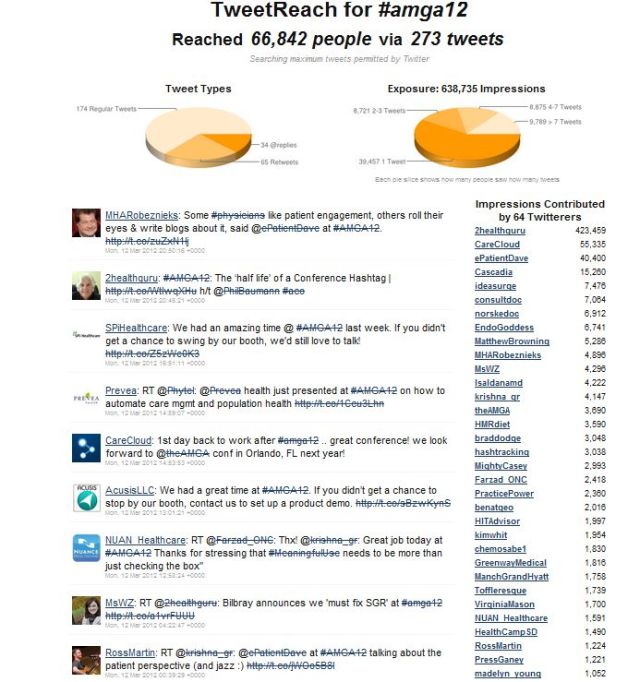
Final ‘digital footprint’ for #AMGA12: Reached 66,842 peeps via 273 tweets & an exposure of 638,735 impressions

The trade group arguably representing a majority of forward thinking and innovation oriented, in terms of the active exploration of what and how accountable care business models can be articulated, the AMGA held their annual conference in San Diego from March 7th, – 10th, 2012.

Courtesy of @ePatientDave who was tagged to deliver the closing keynote on Saturday, I had the good fortune to both ‘crash’ the preso, as well as monitor, tweet and re-tweet the action [there are many excellent preso’s which I will bring forward via future posts]. Editors Note: Compared to most other healthcare conferences I attend, the twitter volume was rather thin – much to my surprise, considering the relationship between technology, healthIT and social media.

None-the-less, a ‘digital footprint’ as we say emerged from the event via both the ‘happy fingers’ in the room as well as tweeps out of the room who collectively engaged in the AMGA’s conference proceedings.

For the complete ‘digital footprint’ report, click here.

AMGA12: The ‘half life’ of a conference hashtag

By Gregg A. Masters, MPH

Thanks to fellow healthtweep @PhilBaumann, I learned of another cool ‘infographic’ app to track and display select hashtag metrics posted to Twitter. Below is the infographic created with Visual.ly for the AMGA 2012 Annual Conference tagged #AMGA12:


infographic created with visual.ly

That’s Not an ACO!

By Gregg A. Masters, MPH

One of the last ‘super PHOs’ standing circa the blood bath, grand ‘risk push-back’ and subsequent unwinding of many physician/hospital JVs of the 90s, Advocate Health Partners (aka @AdvocateHealth) and it’s aligned payor partner, Blue Cross and Blue Shield of Illinois (aka @BCBSIL) went public with their commercial ACO results last week. For complete announcement, click here.

The net takeaway can be summarized as follows:

[though limited to 6 months of data] results thus far are inconclusive but are encouraging

Advocate Health Care is by anyone’s definition a mature integrated delivery system emerging from the independent physician community space though tethered to an institutional partner, vs. the retooling of a closed system to more effectively integrate with the private medical community, i.e., Kaiser, Mayo et al.

The piece, though clearly hedging a ‘good news and bad news’ message, none-the-less settles on the upside of proactive collaboration by the provider community with their local market payor partner.

Yet, what I find of particular interest and worthy of further consideration is the comment proffered by author, lecturer and seasoned veteran in the HMO, and managed competition space, William DeMarco as follows:

This is not an Accountable Care Organization as the shared savings formula and results of quality improvement are put on the back burner in favor of replacing revenue lost in inpatient care. Bundled payment BY ITSELF will not improve care or make providers remove waste from the system, rather providers will merely try and recover what they were loosing by delivering preventable and avoidable care.

So what do you think? Is Bill being too hard on Advocate et al? Or might we be best advised to let ‘innovation’ manifest granularly by local communities of practice vs. against the rules as codified by CMS in the Affordable Care Act & sequelæ?

The Braintrust of Accountable Care aka AMGA Descends Upon San Diego: Who Knew!

By Gregg A. Masters, MPH

In a chance conversation with my friend, fellow ‘healthtweep’ and patient empowerment co-conspirator Dave DeBronkart, aka @epatientdave, I learned yesterday that AMGA aka @theAMGA was holding their annual meeting in San Diego.

This is perhaps the largest concentration of ‘doers’ in the accountable care movement. Many participated in the landmark Physician Group Practice demonstration project which though reporting mixed results none-the-less added to the pool of knowledge and case studies on advancing accountable care.

More later from this ‘resource rich’ health innovation gathering of thought leaders and demonstrators! Below is a select stream of tweets from the event tagged as #AMGA12 (for most recent digital footprint based on last 50 tweets, click here):

TweetReach Report for #AMGA12

Reached 28,389 accounts reached via exposure of 178,271impressions

highest exposure

most mentioned

8mentions

Most Retweeted Tweets

braddodge: Fisher: only way to change future is to create it (a la Drucker) #AMGA12 #in

2healthguru: @ePatientDave pitching #AMGA12via Saturday keynote ‘How Participatory Medicine Can Help Improve the Practice of Medicine’#s4pm

contributors 
Tweets RTs Impressions
1 2healthguru 24 1 138,632
2 Cascadia 3 0 10,648
3 ePatientDave 1 0 9,940
4 ideasurge 1 0 7,471
5 MatthewBrowning 1 0 5,288
6 braddodge 11 1 2,750
7 benatgeo 1 0 2,021
8 theAMGA 1 0 734
9 CejkaSearch 1 0 281
10 HalleyConsults 1 0 268
11 krishna_gr 1 0 171
12 SPiHealthcare 1 0 53
13 HDirections 1 0 10
14 Uggliest 2 0 4

 tweets timeline 

Mar 9, 2012 at 4:52pm UTC

braddodge: Hansen: bad collaboration is worse than none at all#AMGA12. Stakes are high. 3 minutes ago

2healthguru: RT @VinceKuraitis: What’s the Difference Beteween ACOs and “AC-Like” Arrangements? bit.ly/wRQiu8#ACO#HCR#amga12 3 minutes ago
2healthguru: Tweepls check out & monitor tweets for @theAMGA conference Twub for hashtag #amga12 attwubs.com/amga12 4 minutes ago
braddodge: Legit creds for Morten Hansen: PhD in business admin from Stanford #AMGA12 5 minutes ago
braddodge: Virginia Mason Medical Center uses Toyota Production System to achieve quality objectives and eliminate waste. #AMGA12 10 minutes ago
braddodge: Virginia Mason Medical Center wins Preeminence award #AMGA12 14 minutes ago
2healthguru: Collaboration: An Interview with Morten T Hansen @GreatbyChoice | bit.ly/Ajswuu#AMGA12 14 minutes ago
Cascadia: @2healthguru: What to make of anemic Tweetstream from resource rich #AMGA12 conference? Great opportunity to control the message 17 minutes ago
2healthguru: ‘Bad collaboration worse than none..’ @GreatbyChoice#AMGA12 19 minutes ago
braddodge: Nesse: Gotta haves: network of providers, Aligned financial model, Coordinated care, practice Analytics.#AMGA12 20 minutes ago
2healthguru: What to make of anemic Tweetstream from resource rich #AMGA12 conference? Best & brightest in accountable care not leveraging #hcsm 20 minutes ago
braddodge: Dr Nesse: work in the part the problem YOU can address. #AMGA12 23 minutes ago
braddodge: Dr Nesse: stakeholders define problems in hc based on different perspectives. #AMGA12 25 minutes ago
2healthguru: whoa! >> RT @braddodge: Dr. Nesse from Mayo: 70 percent will receive govt sponsored hc in next decade.#AMGA12 29 minutes ago
2healthguru: RT @theAMGA: Welcome to 2012 Annual Conference! Our first general session featuring @GreatbyChoiceMH is about to start! #AMGA12 29 minutes ago
braddodge: Dr. Nesse from Mayo: 70 percent will receive govt sponsored hc in next decade. #AMGA12 30 minutes ago
theAMGA: Welcome to all of our 2012 Annual Conference attendees! Our first general session featuring @GreatbyChoiceMH is about to start! #AMGA12 31 minutes ago
ideasurge: Indeed RT @2healthguru: RT @braddodge: Fisher: only way to change future is to create it #AMGA12 #in 32 minutes ago
2healthguru: RT @braddodge: Fisher: only way to change future is to create it (a la Drucker) #AMGA12 #in 34 minutes ago
2healthguru#AMGA12 keynote on collaboration (go figure) @UCBerkeley Prof Morten T Hansen aka @GreatbyChoice preso here: bit.ly/zDsxjQ 34 minutes ago
braddodge: Fisher: MC patients with 4 chronic conditions requires collaboration between 86 physicians and 36 practices. #AMGA12 35 minutes ago
braddodge: Fisher: only way to change future is to create it (a la Drucker) #AMGA12 #in 38 minutes ago
braddodge: Don Fisher kicks off #AMGA12 general session. #inFull house. Attendance is up. 43 minutes ago
HalleyConsults#AMGA12 attendees will receive a copy of Marc Halley’s Physician Integration Economics on capturing market share w/primary care practices.

Mar 9, 2012 at 4:00pm UTC

2healthguru: Timely! New program to study how to use primary care workforce more effectively rwjf.ws/zhkvHd via @RWJF #AMGA12 about 1 hour ago
Cascadia#AMGA12 American Medical Group Association @theamga presentations vsb.li/melNtR @Farzad_ONC & @ePatientDave keynote about 1 hour ago
Cascadia: RT @krishna_gr Mistakes fledgling ACOs will make ULA Dr. Shortell Failure 2 engage patients in self-care & informed choice #AMGA12 about 1 hour ago
2healthguru: One of the first pieces I’ve seen addressing role of voluntary medical staff organization in accountable care |bit.ly/yiLZ4S #AMGA12 about 1 hour ago
2healthguru: Morning tweepls! The epi-center of integrated & accountable care is in San Diego. Follow #AMGA12 hashtag for insights. #aco about 1 hour ago
SPiHealthcare: Now is the time for optimum performance in#healthcare. Visit us at #AMGA12 booth 115 to learn more!on.fb.me/wcCX1V @theAMGA about 1 hour ago

Mar 9, 2012 at 3:00pm UTC

CejkaSearch: Attend our featured presentations during the#AMGA12 Annual Conference. booth 518.cejkasearch.com/amga2012/ about 2 hours ago

Mar 9, 2012 at 2:00pm UTC

HDirections: @HDirections CEO Daniel J. Marino speaking tomorrow at @AMGA conf. in SanDiego: The Nuts and Bolts of Hosp. & Med. Group Integration #AMGA12

Mar 9, 2012 at 8:00am UTC

krishna_gr: RT @2healthguru: The triple aim: one picture tells @_HealthPartners story: yfrog.com/odczwcp#AMGA12 #aco about 9 hours ago

Mar 9, 2012 at 6:00am UTC

benatgeo: RT @2healthguru: Patients at center = the accountable care driver | yfrog.com/ny6mukp#AMGA12#aco about 12 hours ago
Uggliest: @2healthguru hey bud follur me i hav a secrut fir ya’ hav ta noe #amga12 #aco about 12 hours ago
2healthguru: That’s a wrap on #AMGA12 preso’s. More tomorrow! #aco about 12 hours ago
Uggliest: @2healthguru howdaya drive haelthcar to duh markit? an wat duz agircultin grain with a tool bee adventaguz? watz duh vantage? #AMGA12 #aco about 12 hours ago
2healthguru: Integrating Roles & Governance of the Organized Medical Staff & Large Health System-owned Group Practice |bit.ly/yiLZ4S#amga12 #aco about 12 hours ago

Mar 9, 2012 at 5:00am UTC

2healthguru: CMS bundled payment program [graphic] |yfrog.com/ocxj2pp#amga12 #aco about 12 hours ago
2healthguru: What a surprise! Seen one comp plan, you’ve seen one! yfrog.com/obde1sp#AMGA12 #aco about 13 hours ago
2healthguru: Physician incentive payment guidelines |yfrog.com/nub4xp#AMGA12 #aco about 13 hours ago

Mar 9, 2012 at 4:00am UTC

ePatientDave: RT @2healthguru: @ePatientDave pitching#AMGA12 via Saturday keynote ‘How Participatory Medicine Can Help Improve the Practice of Medicine’ #s4pm about 13 hours ago
2healthguru: Physician compensation: what we’ve learned…then and now. | yfrog.com/nzd96yp #AMGA12 #aco about 13 hours ago
2healthguru: The triple aim: one picture tells @_HealthPartners story: yfrog.com/odczwcp #AMGA12 #aco about 13 hours ago
2healthguru: Transforming Ourselves to Achieve Triple Aim Results and Position Us for the World of #ACOs | bit.ly/w4qVaV #AMGA12 about 13 hours ago
2healthguru: @ePatientDave pitching #AMGA12 via Saturday keynote ‘How Participatory Medicine Can Help Improve the Practice of Medicine’ #s4pm about 13 hours ago
2healthguru: Evolving Physician Compensation Models in a Post-Health Reform Era | bit.ly/yRJXQH #AMGA12 #aco about 13 hours ago
MatthewBrowning: RT @2healthguru: OMG Tweep alert! @theAMGA is meeting in San Diego & I just found out chatting with @ePatientDave. Follow hashtag #AMGA12 about 13 hours ago

Accountable Care: In Search of Anchor Business Model(s) for the ‘All In’ Healthcare Eco-system

By Gregg A. Masters, MPH

Part One in a continuing series exploring the ‘all in’ healthcare eco-system (as enumerated by Reed Tuckson, MD aka @DrReedTuckson below)

There is no room in the cost curve to accommodate things that don’t add value

An article published late last night titled ‘Hospital Groups Will Get Bigger, Moody’s Predicts‘ presented itself while I was just preparing for the extraction process after a long day of engaging with the continued saga of health reform, accountable care, and the delivery mechanisms to witness their growth and efficacy. So I was too tired to do anything but re-tweet the article. This morning energized by caffeine and a modest sense of being untethered from some very important dialogue elsewhere, I am compiling this blog post.

My series of tweets which afford the context of the essential heartburn I experienced reading these ‘deja-vu’ of sorts headlines (I intend to offer further rationale and context interspersed with the tweets) are posted below:

But first up, is the ‘cognitive dissonance’ trigger [as in, you must be kidding, right?]:

2healthguru: Food for thought? NEJM: Patient-centered care poor solution to doctor-centered care bit.ly/Azvc9a via @lsaldanamd #s4pm #epatients

To wit I note an another conventional wisdom assertion (though the track record of strategic market projections may be a little suspect i.e., the mortgage meltdown):

2healthguru: Bond issuer’s think they know healthcare. ‘Hospital Groups Will Get Bigger; Unlikely Partnerships Could Emerge’ bit.ly/Ach16K #aco

Somewhat reminiscent of the crystal ball forecasts of the best and brightest circa mid 1980’s…

2healthguru: Sanford Bernstein’s Abramowitz predicted by the year 2000 there would not be any non-profit hospitals in US. #aco

With reference to the potential over-reach of the Moody’s headline I remind…

2healthguru: Context people. The world wasn’t presented in the last 24 hours! #aco #healthreform

Then the seemingly and perpetually elusive strategic challenge in healthcare, i.e., realizing the proper alchemy between vision and execution as metaphorically enumerated by Dan Fogelberg:

‘..it’s never easy and it’s never clear, who’s to navigate and who’s to steer, and so your flounder drifting ever near the rocks…’

Contrary to the likes of Jeff Goldsmith’s bold and erroneous assertion, that finance and delivery need not be integrated to satisfy & restain the ‘rapacious appetite’ of the healthcare conundrum…

2healthguru: If context is king, history is its oxygen. Leading & bleeding edge sit side by side at alter of c-suite success. Who are you listening to?

So will it be well intended ‘deja-vu all over again’, or have we really learned something this time? Judging from a recent HealthLeaders Media CFO survey, I am not particularly encouraged that we’ve resolved the ‘cultural conflict’ (or perhaps better framed as Deming’s – ‘It is not necessary to change. Survival is not mandatory’) challenge wherein Fogelberg existentially frames the elusive blend between vision, strategy and operations by hospitals or their system parents!

2healthguru: On Moodys: One more time, the ‘finance guys’ are disproportionately represented in the strategy domain. bean counters are not strategists!

I then offer select context from a very large pool of ‘strategic misfires’ aided and abetted by the best and brightest thinkers including the then ‘Big Six’…

2healthguru: Some not too distant strategic gaffs proffered by ‘bean counters’: American Medical International forms AMICARE. #aco #healthreform

2healthguru: Hospital Corporation of America private labels with The Equitable to form Equicor. #aco #healthreform

2healthguru: VHA forms Partners Health Plan in association with Aetna. #aco #healthreform

2healthguru: Aetna merges with US Healthcare. From Aetna, glad I met ya, to Leonard Abramson’s, ‘my way or the highway..’ #aco #healthreform

2healthguru: The ‘ownership churn’ from AMI, to HealthTrust, to Columbia, to Galen, to Epic, to Quorum to you name it, was an unending ‘happy hour’. #aco

2healthguru: The constant? Docs & patients. Left high & dry while hosp ownership rotated like gas prices. NOT an ‘all in healthcare eco-system’ #aco

2healthguru: We need to really think about and flesh out the value proposition in healthcare equation. What/who should be the anchor business model? #aco

2healthguru: Christensen started the conversation, but didn’t answer in Innovator’s Prescription. We need competition of the ‘right kind’. #aco

This led to the following concluding thought/admonition of sorts:

2healthguru: When bondholders drive strategy, it’s all about debt service coverage, not innovation. How does driving via the rear view mirror work? #aco

As mentioned in the introduction, this is a series on the pursuit of the ‘all in heathcare eco-system’ a term I first heard used at the Digital Health Summit at CES 2012 in Las Vegas via United HealthGroup’s Dr Reed Tuckson, Senior VP for Medical Affairs, a man who in my book get’s it.

For Dr. Tuckson’s opening remarks, click here.

As someone who AHIP’s senior brass may not count as a friend per se, i.e., I have been rather critical of their stewardship of the industry since it’s GHAA roots, between the likes of Dr. Tuckson and Mark T. Bertolini, CEO of Aetna aka @mtbert, I actually have some hope for a re-aligned payor community as partner/enablers of ‘patient centered’ accountable care.

L. Gordon Moore, MD on the Role of Primary Care in Accountable Care

By Gregg A. Masters, MPH

In a week when Blue Shield of California served Monarch Healthcare as proxy for Optum aka United HealthGroup a $10.5 million damages demand for arbitration enumerating a number of contractual breaches, the following headline was also in the news (for full article, click here):

Doctors decry Kern Medical Center cut of family medicine [residency] program

Say what? They must be kidding, right? Accountable care, the pursuit of the holy grail ‘triple aim’ and hope from health IT to connect the disconnected and compensate for a silo-ed based sick care eco-system are on everyone’s [with a pulse] radar these days. Certainly health wonks and senior clinical and institutional leadership know primary care is an essential ingredient for any ‘high performing’ health system, and that we face a current shortage as well as imbalance between primary v. specialty care in the US. Yet somehow it makes sense to clamp down on sorely needed primary care capacity?

Fortunately to offer some timely insights as to the role of primary care in accountable care I chatted with thought leader L. Gordon Moore, MD, President of Ideal Medical Practices on Wednesday, March 7th, 2012. We cover some ground from hospital or institutionally led ACOs, to the promise of bundling or outcome based payment to the role of the patient in the ACO.

To listen to the interview, click here.