Day One: You’re Covered!

by Gregg A. Masters, MPH

August 1st, 2016 marked the first day that I’ve been covered by health insurance since leaving the W2 workforce in 2000 as Vice President of Payor and Provider Contracting at Wellspan Health Network a ‘Super PHO’ launched by Texas Health Resources, post combination of Presbyterian Healthcare System, Harris Methodist Health Services and Arlington Memorial Hospital.IMAG2725

Granted the choice to ‘go bare‘ (i.e., self funding my acute, elective or urgent healthcare needs and exposure for accident or injury risk) and incur the tax (shared responsibility) penalty associated with the post ACA era was a conscious choice. The calculus was derived via a cost/benefit analysis of sorts taking into consideration premium costs, plus deductibles, co-pays and co-insurance of principally the ‘silver metal‘ plans offered via Covered California – the State health insurance exchange operating in California.

Going Bare

My decision to remain bare was in part supported by my history as a low utilizer of physician and hospital services, i.e, as a healthcare insider who rarely used his health plan coverage while insured, and saw the consequences and risks of medical errors and hospitalization ‘up close and personal‘, I reasoned though older and therefore at greater relative risk than when I was in my 40s and 50s, if I continued to eat well, stay physically active (running, cycling and surfing) and refrain from avoidable risks (smoking, drinking alcohol to excess, etc.), the decision to self fund the exposure was somewhat of a ‘reasonable’ if not calculated gamble.

But make no mistake, the decision to bear the tax penalty and retain the health risk was principally a matter of economics. As a self-employed small business operator (I am the founder of Health Innovation Media, a boutique digital media agency) with the typical unpredictable start-up income stream and thus low earnings visibility, I chose to preserve cash and remain uninsured. Unfortunately, the ‘affordable nature’ of ACA related health insurance offerings in the exchange marketplace were neither affordable nor of sufficient value for me to dig into my pocket and pull the trigger on coverage.

That I was three years away from Medicare eligibility was also another consideration in my decision to remain bare. Fortunately that chapter in my life ended today. And other than the tax penalties paid, I have remained in relatively good health while still a card carrying member of ‘the worried well‘ club, i.e., I typically though temporarily obsess over this pain, or that bump or lump as signs of my impending demise. For example, though approaching 65 this month, I have NOT had that colonoscopy recommended for men starting in their 50s. So since I don’t know what’s going on down there, I often wonder about the potential for colorectal disease though I have no classical symptoms per se.

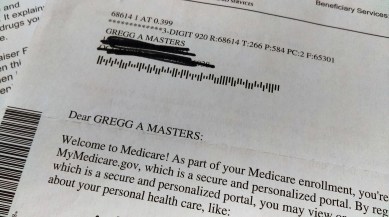
Choosing a Health PlanIMAG2724

As one of the estimated 10,000 baby boomers per day turning 65 and thus qualifying for a ‘public option’ aka ‘Medicare’ one of the first decisions to make is the selection of health plan coverage options via Medicare. There are basically four key considerations:

  • Stay in the traditional Medicare program (Parts A and B); and
  • Optionally purchase a ‘Medicare Supplement‘ plan; or
  • Elect a Medicare Advantage participating health plan (Part C)
  • If principally staying in traditional Medicare, add an optional Prescription Drug Plan (Part D)

Medicare Part A covers ‘hospital services’, while Part B which is optional and requires the payment of a monthly premium covers ‘physician services’. Medicare Supplement insurance typically covers the co-payments and co-insurance present in traditional fee-for-services Medicare. While Medicare Advantage is a private health insurance option that contracts with the Centers for Medicare and Medicaid Services and offers typically HMO plan options to Medicare beneficiaries often with little to no premium payment required, and some plans even add drug benefits without having to elect a Part D Prescription Drug plan. Part D is typically purchased when electing to stay in the traditional Medicare program and layer into your benefits prescription drug coverage.

As you approach your 65th birthday be prepared for the tsunami of marketing materials you will receive from health insurance companies, their participating broker/agents and Medicare Advantage plans participating in your service area.

The Choice

Having made my decision, I can see why the typical senior who is not a ‘insider’ in the ways of healthcare operations and finance might need help working through all the plan options presented. This is a potentially confusing experience with a series of questions and plan options to sort through. Yet, for me the choice was relatively easy. I know the pros and cons of Medicare Advantage, the limits of traditional Medicare (with or without a Supplement) and have written about the limits of the Prescription Drug Program off and on over the years. Further, I am almost within walking distance to a Kaiser Permanente Ambulatory Care Center and Kaiser San Diego offers in my service area a no premium Medicare Advantage program that provides additional benefits including drug coverage and health club participation via the Silver Sneakers program.

When I added the maturity of KP San Diego as a quality operator in the integrated delivery space with a reasonably extensive and accessible ambulatory and inpatient facilities network vs. other options that relied upon ‘IDNINOs’ (integrated delivery networks in name only) commonly associated with name plate hospital/health system operators in San Diego (Scripps Health, UC San Diego Health System, Sharp Healthcare) county in partnership with the likes of Humana, Anthem or United Healthcare, the decision was a relatively easy one.

I reasoned if I get seriously sick, I will be cared for by a coordinated team of health professionals who’s incentives are to keep me healthy and out of the inpatient theater (a literal fail moment). Further, as a real IDN, KP San Diego is more likely to operate in a seamless care coordination manner vs. many of the aforementioned players who have to more or less degrees grafted an IDN culture on top of a traditional, silo-ed fee-for-services network of providers.

Finally, I have watched my mother spend hours on the phone dealing with toxic and dated (in excess of a year) billing matters from UC San Diego associated with her membership in Humana’s Medicare Advantage program. Try as they might, the non KP players in this market have yet to achieve the level of IDN operational excellence demonstrated by KP San Diego (and its sister regions in both Southern and Northern California) from point of care services to any billing and collections infrastructure associated with ‘revenue cycle management’ (RCM) purposes.

So a new chapter has begun. We shall see if I reasoned correctly, and KP San Diego is what I assume it to be. More to be revealed!


Those Failing CO-OPs: Implications for the ACA and its ACO Workhorse

by Gregg A. Masters, MPH

As the battle for the hearts and minds of Americans relative to the Affordable Care Act (ACA) continues, and the tracking sentiment index waxes and wanes between ‘favorable’ and ‘unfavorable’ one front in particular seems to have a fair degree of utility with the narrative profferred by the ‘repeal and replace‘ crowd.

Consumer Operated and Oriented Plan (CO–OP) Program

Nested in Section 1322 of the Affordable Care Act (ACA), the ACA created the Consumer Operated and Oriented Plan Program (the CO–OP program):

‘to foster the creation of new consumer-governed, private, nonprofit health insurance issuers, known as ‘‘CO–OPs.’’ In addition to improving consumer choice and plan accountability, the CO–OP program also seeks to promote integrated models of care and enhance competition in the Affordable Insurance Exchanges established under sections 1311 and 1321 of the Affordable Care Act. The statute provides loans to capitalize eligible prospective CO–OPs with a goal of having at least one CO– OP in each State. The statute permits the funding of multiple CO–OPs in any State, provided that there is sufficient funding to capitalize at least one CO–OP in each State. Congress provided budget authority of $3.8 billion for the program’

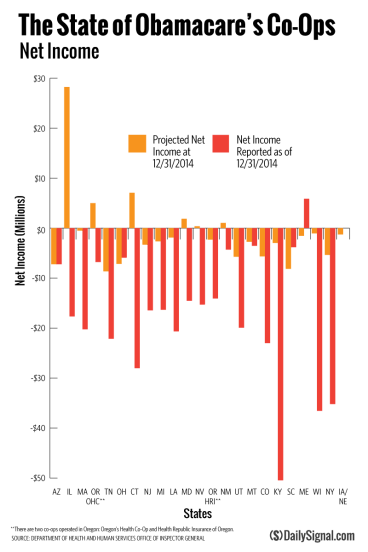
For program details and background see the Notice of Proposed Rule Making (NPRM) hereACOwatch_COOPGraphs_netIncome

As fodder for the anti-ACA crowd, much of the recent headlines have rightfully focused on the problematic ‘failure‘ rate of many of these community based AND governed start-up health plans.

Just witness some of the associated reports recently in the news:

Lets underscore the fact that CO-OPs are de-facto start-up health plans – a problematic undertaking under ideal launch conditions. As any entrepreneur or VCs fueling their vision knows, there is a tender proof of business model period during which an entities’ expenses typically exceed their revenues as they build market share and compete for members or lives in the market where they operate.

The ‘break-even’ (B/E) formula is rather simple:

revenues – expenses + subsidies = profit (or for non-profit entities: surplus revenues over expenses)

While not a golden rule, the B/E crossover point is rarely (if ever) within the first 24 or even 36 months of a stand alone (vs. subsidiary) operations and wholly determined by local market conditions and competitive landscape. Whether capitalization is via private investment or as in the case of CO-OPs via Federal loans this start-up fragility can not be overstated.

The other consideration unique to the CO-OP Program is the locally brewed, governed and accountable nature imbued in the operating culture and mission of these entities.

When you layer in the well established actuarial dynamics of profit and loss cycles predictably inherent in health insurance industry including ALL managed care derivatives, the critical variable of timing of market entry may introduce a volatility factor over-expressed under the current market conditions the ACA has fostered.

In other words, start-up health plans take time to create the infrastructure (people, processes and culture) to market, retain, price and operate successfully under ideal let alone typical market conditions. When you add the disruptive conditions the ACA has created (see: ‘Risk Adjustment Gone Wrong‘) in the small group and individual markets via Federally Facilitated or State run health insurance exchanges that complexity, associated market share gain challenges and ‘volatility ratio‘ can only be expected to play an increasingly important role in the success or failure of the enterprise.

The HMO Act of 1973

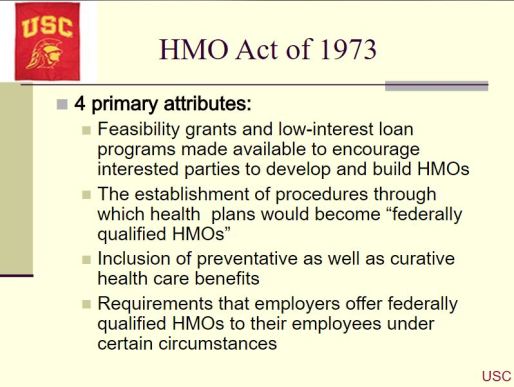
There is precedent to perhaps gauge and contextually consider the relative success or failure of the CO-OP Program spawned by the ACA. When the managed care revolution was birthed by then Republican President Richard Nixon via the HMO Act of 1973 as a market driven solution to remedy the run away costs of healthcare, HMO’s were typically seeded as non-profit, community based AND governed risk bearing health plans with a principal mission to maintain the health ACOwatch_HMO_Actand well being of its members.

HMO’s like the CO-OP program today received Federal support via start-up loans to manage through the typical B/E point associated with the start-up of a community based health plan vs. the typical indemnity based, fee for services insurance companies that dominated the market. The two exceptions to this rule where the non-profits licensed and operating under the Blue Cross and Blue Shield label and at least in California the Kasier Permanente Health Plan.

During the launch trajectory as then designated ‘alternative delivery systems‘ (ADS) HMO’s slowly gained share (both mind-share and members) and made their way out of California, though constrained by their non-profit nature and operating culture including the limited marketing upside of ‘staff’ or group model HMOs portrayed as second class medicine. In the 80s HMO’s went mainstream via the introduction of Independent Practice Associations (IPAs) and later ‘network models’ which attracted the independent private practice cohort into managed care if for no other reason than to defend against an emerging trend that could threaten their livelihood as more and more health benefit plans started to traffic patients to a contracted network of ‘participating providers’.

Shortly thereafter fueled by Wall Street the major health insurance companies went on a acquisition binge of these sleepy, capital constrained community based health plans. This consolidation orgy created a legal bonanza via a new industry of for-profit conversions of community based health plans, the behemoths of which included many of the Blue Cross/Blue Shield licensees. During the ‘urge to merge‘ imperative the seminal transaction was likely the for profit conversion of Blue Cross of California under the stewardship of health wonk Leonard Schaeffer (former Administrator of HCFA – the predecessor agency to CMS). Blue Cross of California was then to serve as the founding member of the for-profit WellPoint empire now re-branded and operating as Anthem, Inc. 

As simple and narrow as HMO (alternative delivery system model) charge was then, it pales in comparison to the charge and expectations placed on the nascent and fragile CO-OP industry. Not only are CO-OPs to stand up entities that provides non-profit, community based alternatives in a competitively vetted, comparably priced tiered benefits package for exchange facilitated marketplaces, they are to do this while the hospital, physician and a health plan communities are rapidly consolidating to gain scale and thus pricing leverage.

Bottom Line

The health insurance industry is a complex and some would argue ‘protected‘ industry (see: McCarran–Ferguson Act) that challenges even best-of-breed leadership (Mark Bertolini, Bruce Broussard et al) to sustainably operate their business as profitable enterprises during the volume to value shift. Witness the ‘urge to merge‘ amidst the majors, i.e., Aetna’s proposed acquisition of Humana, and Anthem’s proposed acquisition of Cigna, both recently challenged by the Department of Justice, and both rationalized by the need for scale to achieve the operating results expected by their investors.

As to ACO implications, clearly there are some. It’s hard to predict the rate of legal and clinical integration and the seamless care coordination and commitment to quality envisioned by 2nd or 3rd generation ACOs (typically risk bearing) or any of their derivative plays as exchanges become the de-facto market place for small group and individual offerings, but the handwriting is clearly on the wall.

So as some of us point to the CO-OP failure rate as another example of ACA over-reach via fundamentally flawed legislation and thus cause for repeal or re-entrenchment from the law, it may be helpful to historically gauge the nature of their challenge AND the market conditions in which they operate. A little humility can go long way here.


POTUS: The De Facto Health Wonk-in-Chief of the US?

by Gregg A. Masters, MPH

United States Health Care Reform


Love him or hate him President Barack Obama continues to demonstrate depth, insight, tenacity and a firm grip on the state of the U.S. Healthcare ecosystem dysfunction (and remedies) well beyond his formal training as a Constitutional scholar. Now as arguably one of the most legislatively accomplished President’s in U.S. history, particularly in light of the catastrophic train wreck he inherited from his predecessor and fueled by the nonstop ‘hell no‘ chorus of his disingenuous (often health policy clueless) political opposition he weighs in to set the record straight and for legacy purposes.

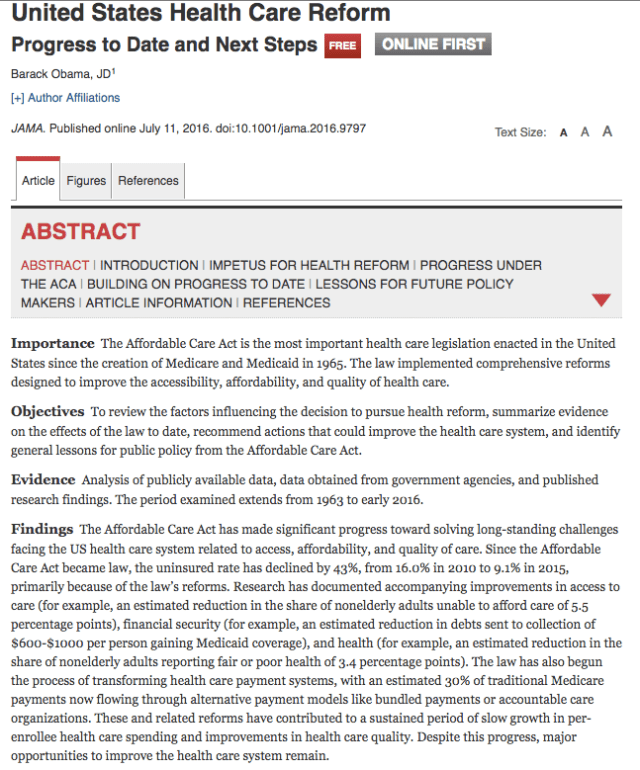
On July 11, 2016, JAMA released ‘United States Health Care Reform: Progress to Date and Next Steps‘ a rather scholarly construed unbundling of the state of healthcare then and now (pre and post ACA implementation). As a rather complex piece of legislation with many moving parts, and staggered implementation timelines (some as a result of political accommodation, some merely in tune with operational and prevailing healthcare delivery and financing legacy inertia) he steps up and in classic barrister narrative fashion lays out his case, and simultaneously calls out the next steps to remedy the U.S. healthcare conundrum.

POTUS aka ‘Health Wonk-in-Chief‘ Barack Obama concludes:

Policy makers should build on progress made by the Affordable Care Act by continuing to implement the Health Insurance Marketplaces and delivery system reform, increasing federal financial assistance for Marketplace enrollees, introducing a public plan option in areas lacking individual market competition, and taking actions to reduce prescription drug costs. Although partisanship and special interest opposition remain, experience with the Affordable Care Act demonstrates that positive change is achievable on some of the nation’s most complex challenges.

I strongly encourage you to click on and read the entire piece. It is well worth your time and wholly consistent with the ‘accountable care’ narrative (the subject of this blog) driving Medicare ACOs, their commercial derivatives and large portions of the moving parts of the ACA including the entire spectrum of ‘value based’ healthcare initiatives.

For this piece, I want to focus on four areas of the ‘next steps‘ called out by POTUS, namely: the ‘Health Insurance Marketplaces’, associated ‘delivery system reform’, AND the introduction of ‘a public plan option in areas lacking individual market competition, and finally ‘taking actions to reduce prescription drug costs’.

Health insurance marketplaces

So much of the ACA oppositional cheerleading liked to stress the ‘buying across state lines‘, and ‘malpractice reform‘ as ‘freedom and choice‘ enabled solutions to the health insurance quagmire. Never mind the rampant marketing, churn, double digit premium increases, retrospective rescissions or opportunistic denial rates, coverage limits and lifetime caps so endemic in the space. Not to mention ‘mini-meds‘ or ‘junk insurance’ so prevalent in the market before some baseline notions of what constitutes ‘insurance‘ in the face of typical health, illness or accident challenges one may experience in life. Here again, coverage baselines and the need for consistency to shop, compare and ultimately purchase real health insurance seemed like too much regulatory over-reach in a market where choice absent basic ground rules somehow seemed like a more attractive solution – at least to the often clueless opposition. The entire over-reach narrative was wrapped up, sold and bought as a ‘Government controlled healthcare takeover‘ per the vacuous talking points proffered by ACA oppositional research.

Google Image Result for http___1.bp.blogspot.com_-FCS-xwHjt8Q_TksRz3PW4CI_AAAAAAAAATo_aR9LEeQ57bU_s1600_medicare-keep-your-hands-off-my-medicare.jpg


Yet, the value proposition of an ‘insurance market place‘ whether Federally run, ‘facilitated’ or state delegated exchange option makes total sense if a transparent consumer market is to emerge from the chaos that is principally the individual market (non employer sponsored health insurance), though the group, or self funded ASO market ain’t much to cheer about either. Yet such a model was/is a proven way (witness the explosive growth of private exchanges) to introduce orderly competition in an otherwise opaque industry.

If you’ve ever run a health plan, built a managed care organization or contracted for hospital, physician, ancillary and pharmaceutical services (I presided over several employer sponsored health plan initiatives, MSOs, PHOs and IPAs tackling both capitated and discounted fee for service plan launch and operational issues in for-profit, voluntary and academic health systems) you will know that prudent (empowered, informed, etc.) purchasing of health insurance options requires clear apples-to-apples covered services comparisons, exclusions and non-covered item disclosures coupled with understandable pricing transparency and the cost sharing burden associated with your election. Absent this comprehensive clarity, listing guidance and/or requirements that an exchange imposes to ‘qualify’ eligible participants as candidates to choose from is virtually impossible. Standing up the infrastructure (people,  process, culture, etc.) to enable informed choice requires such an exchange environment whether public, private or some combination thereof to transparently market their services to the consuming public.

Delivery system reform

This is clearly the ACA’s ‘achilles heel‘ as there ain’t much there, there other than aggregate ‘on the come‘ efforts to tip toe into the waters of ‘clinical integration‘, measured risk assumption and a range of payment reforms collectively recognizing fee-for-service (i.e., do more to earn more) medicine as a burning platform. The most tangible form of this commitment is represented by Secretary Burwell’s call to migrate increasing shares of Medicare beneficiaries (including me, as I turn 65 in August and have elected Kaiser Permanente Senior Plan in San Diego) into Medicare Advantage, ACOs and a broadly cast series of ‘value based‘ healthcare arrangements by certain dates.

Standing Up the ACOFor the most part, ACA focused on insurance market place reforms. While delivery system reform was principally invested in ‘nascent’ ACOs (which are mutating as we speak amidst some 5 and 1/2 years of operating experience under the Medicare Shared Savings Program (one I like to call ‘HMO-lite’ which incidentally and inevitably is morphing into its more traditional gatekeeper HMO predecessor vs. the retrospective attribution methodology that undermines successful ACO risk assumption performance).

Additional delivery system reform was to come from pilots, demonstrations and other ‘innovations’ the Center for Medicare and Medicaid Services (CMS) funded via the Center for Medicare and Medicaid Innovation (CMMI) – who’s budget the Republican controlled Congress is determined to cut.  Here, I might add at the ACO Summit circa 2012 one of the most seasoned and successful risk savvy players I had the opportunity to work for and with in Dallas, Texas Richard Merkin, MD, the founder and owner of Heritage Medical Systems and Heritage Provider Network described as the ‘hidden jewel’ in the ACA.

As much as we’ve progressed into ‘managed care‘ whether discounted, bundled, case rates, per diems or global or partial per member per month (PMPM) capitation or percent of premium the majority (estimated at 80-90%) of healthcare payments are still of the fee for services variety. Back in the 80s when American Medical International (AMI) retained me to develop and preside over their managed care strategy for the California Region’s 19 hospitals I elected ‘Director of Health System Development‘ vs. Regional Director of Managed Care as a title, since I saw the strategic imperative of building and operating a hospital system as a partnership with payors, health plans and employer groups, in order to create value. Since ‘payors’ (as a group) were our customers to grow market share we needed ‘dots on the map‘ to effectively service their employees, members or insureds. That vision and strategy collapsed before taking root since quarterly earnings per share incentives of the hospital CEOs precluded the longer term strategy of acquisitions and divestitures consistent with a dots on the map game-plan could take hold.

Today, many years later health systems are ‘getting [payor/provider partnership] religion’ at least rhetorically, yet the prevailing provider/payor mindset remains ‘your revenues are my expenses‘ – not much progress! So don’t hold your breath on material delivery system reform other than the equivalent of re-arranging furniture on the deck of the Titanic while the ship sinks. Mergers, acquisitions, the ‘death of independent‘ medicine and rise of mega institutionally led health systems more or less ‘clinically integrated‘ notwithstanding.

A public plan option in areas lacking individual market competition

While POTUS stresses the individual market as the target ‘book of business‘ most at risk and dysfunctional absent effective reform the need for a ‘public option‘ across the board (group, self funded/ASO, fully insured, etc) is rather compelling, in my view. The recent failures of the ACA enabled ‘CO-OPs‘ notwithstanding (i.e., startup insurance companies or health plans rarely if ever achieve profitability in such a short timeline given the threshold need for ‘the law of large numbers‘ for actuarial credibility and the inherent volatility of the underwriting profit/loss cycle) do nothing to undermine the argument and need for a public option writ large.

I’ll go one step further and say ultimately our worshipping of ‘pluralism‘ in healthcare delivery and finance will ultimately give way to a ‘Medicare E‘ version as in Medicare for everyone. If public/private partnerships and business models could successfully manage clinical risk and meet the health and healthcare needs of their constituents we would have solved the problem in the 80s and 90s. Who remembers the ‘Harry and Louise‘ narrative battles (‘if the Government choses, we lose‘) on the Clinton Health Security Act aka ‘HillaryCare‘? So perhaps we’ll get there once we exhaust every other option to avoid ‘single payor‘?

Actions to reduce prescription drug costs

This seems to me the segment the easiest to resolve. Here I’d empower Medicare to negotiate direct and on behalf of it’s entire pool of beneficiaries, rather than dilute the market power via a tapestry of variably (under) performing ‘PDPs’. The political compromise that birthed Medicare Part D (the Prescription Drug Plan) materially undermines the market power of the ‘law of large numbers’ to extract best price from vendors, suppliers or providers of services. This make NO sense, and we’re paying the price! Here, politicos assured Medicare could NOT intervene with such market clout instead they routed the business upside to a pool private participants.

Add to this macro market efficiency undermining the challenges of orphan or rare disease market segments and the egregious and unaccountable pricing practices most recently popularized by ‘bad boy’ Martin Shkreli of Turning Pharma and more recently Valeant‘s abusive pricing admissions.

Yes, specialty pharma is at risk and a major source of heartburn for AHIP and it’s employer allies, yet PHRMA has a point. The drug discovery and commercialization process/pathways to market are unpredictable and fraught will high failure rates. Coupled with the long development runways and high costs, but absent a ‘ceiling’ or ‘pricing accountability framework’ pharma’s management credo will remain ‘whatever the market can bear‘ strategy lest ProPublica‘s (et al) investigational journalism (see their guide to investigating non-profit health systems) marshals sufficient public attention and shame forces reconsideration or retraction of Pharma’s lazy over-reliance on raising ‘P’ (Price) vs. the more complex market challenge of driving ‘U’ (units via share gains) becomes their duty and ultimate measure and basis of ‘success’.

So thanks BO! Despite all odds, you (and Max Baucus et al) pulled it off. And yes, it’s only a beginning and there’s lots of work to do. In the words of then Acting CMS Administrator, Don Berwick, who was wrongly blocked (by you know who) for permanent appointment [I paraphrase below]:

This will require no less than an all hands of deck, full court press to make happen [i.e., the triple aim].


The 2016 Medicare Trustees Report: One year closer to IPAB cuts?

by Gregg A. Masters, MPH

From the relentless drone of ‘where are the jobs, Mr. President?’ to the misguided fear mongering of ‘death panels for Grandma’ administered by un-elected, faceless bureaucrats to the de facto death of American Democracy itself the attacks on the Affordable Care Act (ACA), flawed indeed as it is, is starting to log results, some of them are quite impressive as noted by a recent piece at Morning Consult titled: ‘Trustees: Medicare Savings Recommendations Forestalled’.

View more details on Brookings.edu

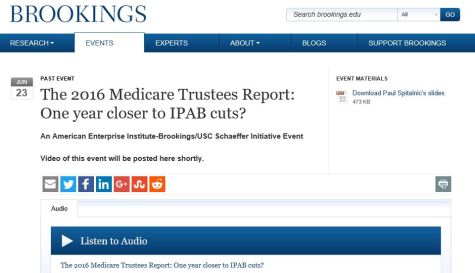
This morning Brookings in association with the American Enterprise Institute and the Schaeffer Initiative for Innovation in Health Policy at the University of Southern California hosted ‘The 2016 Medicare Trustees Report: One year closer to IPAB cuts?‘.

The event is summarized by its organizers as:

For most of the last five decades, the most-discussed finding by the Medicare trustees has been the insolvency date, when Medicare’s trust fund would no longer be able to pay all of the program’s costs. Last year’s report projected that the hospital insurance trust fund would be depleted by 2030 – just 14 years from now. The report also predicted a more immediate and controversial event: the Independent Payment Advisory Board (IPAB), famously nicknamed “death panels,” would be required to submit proposals to reduce Medicare spending in 2018, with the reductions taking place in 2019. Do we remain on this path to automatic Medicare cuts next year?

The American Enterprise Institute and the Schaeffer Initiative for Innovation in Health Policy, a collaboration between the USC Leonard D. Schaeffer Center for Health Policy & Economics and the Brookings Institution, hosted a discussion of the new 2016 trustees report on June 23. Medicare’s Chief Actuary Paul Spitalnic summarized the key findings followed by a panel of experts who discussed the potential consequences of the report for policy actions that might be taken to improve the program’s fiscal condition. You can join the conversation at #MedicareReport.

In the tsunami of misrepresentation and outright deception of the many moving parts of the ACA the ultimate barometer of success – at least from the health policy perspective – is the forecasted effect the law was to have on the U.S. Treasury, i.e., it will bankrupt the country and undermine the roots of our pluralistic healthcare ecosystem, replacing it with a ‘top down’ Government run Federal quagmire.

EDITOR’s NOTE: for the Acting CMS Administrator’s take on the Federally Faciliated and State Run ‘Marketplace’, check out Andy Slavitt’s recap via ‘Marketplace Year 3: Issuer Insights and Innovation (Part 3).

Well the ACA results are in and the truth be told, while not a sealed trend (there are both headwinds and macroeconomic wildcards in the mix), the data is ‘encouraging‘.

Enjoy the audio!


MACRA, MIPS and APMs: A Report from CAPG

by Gregg A. Masters, MPH

So everyone is talking about value based healthcare. No longer is ‘business as usual‘ even an option on the table as the volume driven FFS zeitgeist continues to lose supporters in health policy circles while a growing body of clinical initiatives from ACOs to a range of variably structured and differentially market positioned risk bearing organizations (RBOs) model the new paradigm.CAPG_Guide to APMs

For some this value based healthcare mantra is code-speak for the associated narrative if not mandate to reflect all payment or delivery system model entries that shift clinical risk to providers whether ‘institutional‘, i.e., hospitals and/or their parent health systems (including IDNs), or ‘professional‘, i.e., physician networks, enterprises, medical groups or their managing agents (MSOs). This pool of value based participants includes a range of ACOs whether participating in the Medicare (MSSP or other options) program or their commercial derivatives as negotiated by many of the national or regional health insurance companies; not to mention ‘OWAs’ (other weird arrangements) that arguably incorporate one or more strategies to play and thrive under a range of risk based incentives.

CAPG_Guide to APMs_matrix

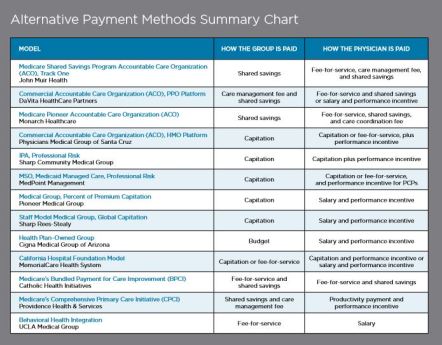
Contributing clarity to an arguably non-homogeneous market including performance results to date via provider entity type use cases is CAPG (fka as the California Association of Physician Groups) who recently published ‘CAPG’s Guide to Alternative Payment Models: Case Studies of Risk-Based Coordinated Care‘. 

This is a timely and resource rich report sourced from an eclectic pool of risk savvy industry players (CAPG members) that CAPG Executives Don Crane, President and CEO, and Mara McDermott, Vice President of Federal Affairs, introduce as follows:

You’ll … learn where each model is successful and strong, and where each has room for improvement. Key areas where CAPG members are demonstrating success in APMs include:

• Improving the quality and efficiency of care for patients. These APMs align physician payment to the achievement of performance objectives.

• Encouraging team-based care and a commitment to primary care.

• Innovating to better meet the needs of patients, particularly those with chronic conditions.

In addition to the significant progress our members are making in improving patient care and innovation, several themes have emerged where there is room for improvement:

• Improving data sharing with payers to continue to drive care improvements.

• Engaging patients in new payment approaches, particularly in accountable care organizations (ACOs).

• Aligning quality measures across programs. This will play an important role in reducing the burden on physician practices and getting actionable information to consumers.
As physicians across the nation embark on this journey toward risk-bearing arrangements, we hope you find this paper a practical, helpful, and invaluable guide. 


Most of you will connect and more or less identify with the ‘it takes a village‘ [to raise a child] admonition popularized by the presumptive Democratic Nominee for President, Hillary Clinton. In the grand transformation of a change resistant and to a very large degree legacy inertia driven healthcare financing and delivery ecosystem, this village idea may just be a gross understatement. Rather, I think the then Acting Administrator of CMS Don Berwick got it right scaling the true nature of the challenge before healthcare leadership, which is to steward the market mandated transformation via an ‘all hands on deck, full court press‘ invitation to make this transformation even remotely possible. In other words, this will take much more than just a ‘village‘.

Major props to CAPG for an important body of work on this nascent and ‘learning as we go‘ industry.


Final Medicare Shared Savings Program Rule (CMS-1644-F)

by Gregg A. Masters, MPH

Creating consistent high quality original content is hard. At ACO Watch, we’re not in the business of breaking news or high frequency posts to drive eyeballs and traffic to this blog so ‘the numbers’ that might attract advertising or sponsorship (there aren’t any). Instead we (mostly me) watch the developments in the sector and offer newsworthy items now and then with some commentary which usually tethers to institutional memory (often failure, some successes) of having been in this dance for a while.cms final rule MSSP

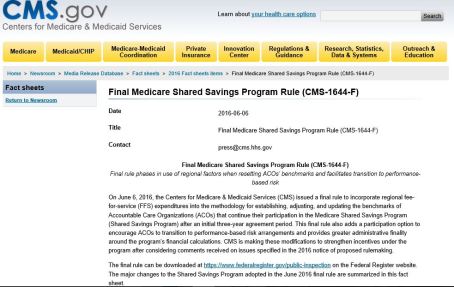
So here’s the latest from CMS on the proposed final rule for ACOs participating in the Medicare Shared Savings Program, see published rule here.

I remember back in the day when CMS was known as HCFA (the Health Care Financing Administration) and inside the Baltimore HHS complex, there dwelled an office with the name ‘Alternative Delivery Systems’ (ADS). This was the locus of staff (very modest at that time) tasked to monitor and track what was then limited to HMOs and the newly minted though ‘lite version’ dubbed PPOs.

Fast forward some 45+ years and those ‘alternative entities’ have become mainstream so to speak. Literally all benefit plans written today are contractually delivered via participating providers (IPAs, PHOs, IDNs, health systems, alliances, networks, direct or more recently ACOs) are some form of ‘managed care’ unless those providers have opted out of Medicare, Medicaid and commercial insurance in favor of Direct Practice or worse ‘Concierge Medicine’.

Since the Secretary of Health and Human Services has recently set a goal to have Medicare move away from its traditional reliance of unbridled fee-for-services medicine to a range of what CMS has or will define as ‘value based care‘ arrangements – everything from bundled payments, to gain sharing, to partial or global risk assumption by providers (hospitals, health systems, IPAs or ACOs (the next generation) much attention has focused on the right combination of incentives, infrastructure and regulatory context to move this historically change resistant healthcare delivery ecosystem into the brave new world of value vs. volume.

This is the latest effort by CMS to tweak the ACOs regs in order to meet some of the persistent objections to the program while scalably incentivizing the essential journey to risk assumption by providers is noted as:

The policies adopted in this final rule are designed to strengthen incentives in order to continue broad-based program participation and improve program function and transparency.

While the broader context is summarized as:

On June 6, 2016, the Centers for Medicare & Medicaid Services (CMS) issued a final rule to incorporate regional fee-for-service (FFS) expenditures into the methodology for establishing, adjusting, and updating the benchmarks of Accountable Care Organizations (ACOs) that continue their participation in the Medicare Shared Savings Program (Shared Savings Program) after an initial three-year agreement period. This final rule also adds a participation option to encourage ACOs to transition to performance-based risk arrangements and provides greater administrative finality around the program’s financial calculations. CMS is making these modifications to strengthen incentives under the program after considering comments received on issues specified in the 2016 notice of proposed rulemaking. 

There is more to the story, and the referenced PR is here.


Blab the Blockchain: Healthcare Implications?

by Gregg A. Masters, MPH

blockchain blab screen grab

Yesterday, April 27th 2016 I joined twitter colleagues and principal co-moderators and my ‘go-to Blab experts James Legan, MD (@jimmie_vanagon) and Charles “Chuck” Webster, MD (@wareflo) for a ‘Blab‘ on ‘blockchain implications in the heathcare space (both delivery and finance).

Our featured expert du jour Jeff Brandt was a no-show, so we winged it with an excellent overview and introduction by Chuck. We’re all learning in this space but one of the potential applications of the emerging technology might be in the granular if not seamless adjudication of complex bundled payments.

During the session many excellent references were included in the chat box. Several resources were mentioned including Smart Contracts, the Consensus 2016 conference, Youbase, and the article posted by Dan Munro on Health Standards, titled ‘Digital health lessons from BART‘.

I have a feeling there will be major application in the healthcare financing and delivery space as we progress into scaled assumption of risk under a value based healthcare incentive structure. Watch and see if you agree with some of the points made in the discussion!


Hey, Remember IPAs, PPOs and TPAs?

by Gregg A. Masters, MPHAAPAN 2016 Forum

In a last man standing of sorts in what some may call the legacy and aging infrastructure of the ‘vote with your feet‘ PPO industry including it’s allies in the TPA (Third Party Administrator) space, the American Association of Payors, Administrators and Networks (AAPAN) is holding its 2016 Annual Forum in my former hometown of Dana Point, California at the Ritz Carlton, Laguna Nigel.

The mission of American Association of Payors, Administrators and Networks (AAPAN) notes it provides:

….the platform for the unification of payers, administrators and networks and the ability for a stronger collective public policy voice to enhance the position of each stakeholder as essential to the future of affordable healthcare delivery options centered on patient choice.

According to its subsidiary the American Association of Preferred Provider Organizations (AAPPO) the ‘PPO chassis’ accounts for:

An estimated 200 million Americans, or about 81 percent of all Americans with health care coverage (excluding those receiving military health care), receive their health care services through a PPO delivery system.

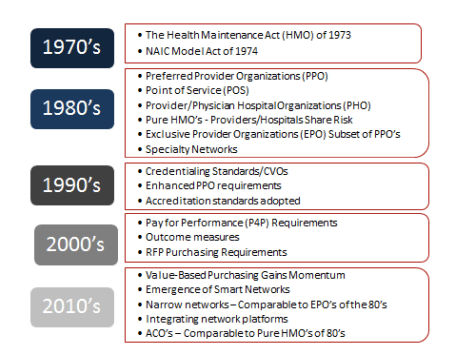
A history of managed care As a ‘collaborative association’ on behalf of the PPO industry initially positioned as a complementary (if not an HMO-lite) alternative to the more aggressive gatekeeper HMO option (see history of managed care era in graphic), AAPAN has a track record of success from advocacy, to thought leadership and operating best practices and solutions.

The Association aligns two potentially silo-ed (though synergistic) interests: the American Association of PPOs (AAPPO), the Third Party Administrators Association of America (TPAAA). For an issue brief on valued based healthcare and the need for network standards, see: The Need to Standardize Network Value-Based Purchasing Requirements.

So one might say, though a larger share of the employer based insurance market remains in a PPO type (vs. HMO) benefit plan design their role and industry leadership visibility may have been somewhat muted (if not, absent from the health reform narrative) since the rollout of the Affordable Care Act (ACA) and it’s emphasis on Accountable Care Organizations (ACOs) dominated the reform narrative.

AAPAN intends to raise this profile and remind many in the space that PPOs, TPAs and even IPAs (Independent Practice Associations) have a material and meaningful role to play in enabling the triple aim even if their initiatives aren’t tagged ACOs per se.

The 2016 Forum hashtag is #AAPAN16, and the digital dashboard is here. Do follow the tweetstream for thought leadership insights from key industry executives, entrepreneurs and change agents. See keynotes and sessions here, including Health Innovation Media co-host, Douglas Goldstein aka @eFuturist.

The program schedule is here.


Must listen JP Morgan Healthcare Conference Webcasts: @MolinaHealth

by Gregg A. Masters, MPH

NOTE: This is the third in a series of ‘Must listen’ webcasts produced at JP Morgan’s 34th Annual Healthcare Conference. The first focused on telehealth sector market leader Teladoc, the second on Centene. For background and details on this august annual gathering, see ‘If It’s January, It’s JP Morgan Healthcare Conference. Remaining companies to detail as they represent important ‘bell weather’ insights relative to their respective sectors, include: Aetna, AthenaHealth, Genomic Health,Universal American, Tenet Health, as well as several from the ‘non-profit’ (tax exempt) sector including Baylor Scott and White

Molina Healthcare’s operations and strategy positioning insights are similar to Centene and in many ways constitute bell weather operators in the same space. Market and performance comparisons are material on a number of levels including the ‘urge to merge’ in the HMO or managed care space, and the implications such continuing consolidation holds for movement towards clinical and financial integration in the provider space. Additionally as many predict the future viability of the Medicare Trust Fund may rely largely on the efficacy of how Part C stakeholders articulate a sustainable vision of Medicare Advantage program to extend and enhance the life cycle of the Medicare program itself.

For direct link to the JP Morgan Healthcare Conference, click here. For the associated Molina Healthcare profile, click here, the deck here and webcast, here.

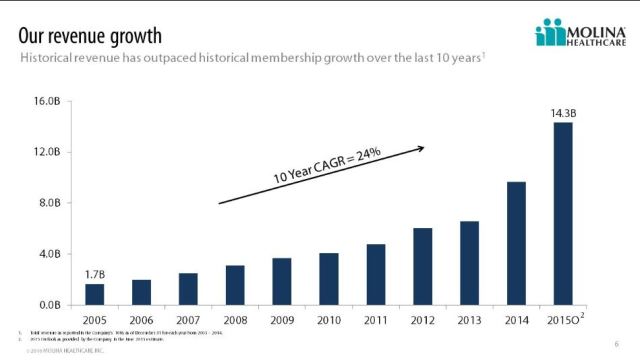
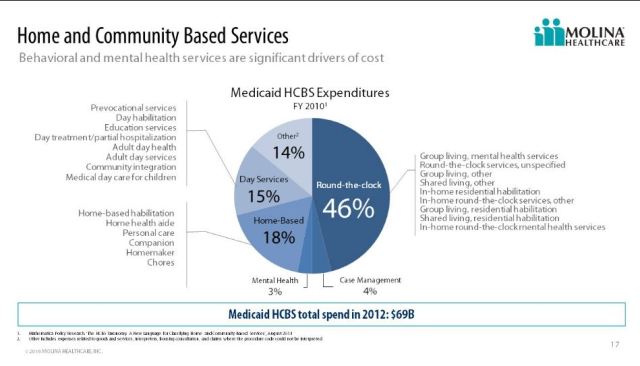
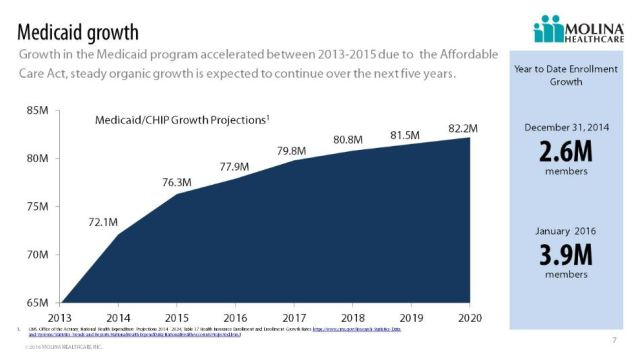
Meanwhile, below are some slides which outline the company’s performance and market sector overall:

JPM_MolinaHealthcareJPM_MolinaHealthcare_revenueJPM_MolinaHealthcare_membership


JPM_MolinaHealthcare_home_community
JPM_MolinaHealthcare_medicaid
JPM_MolinaHealthcare_medicaid_growth JPM_MolinaHealthcare_medicaid_spend

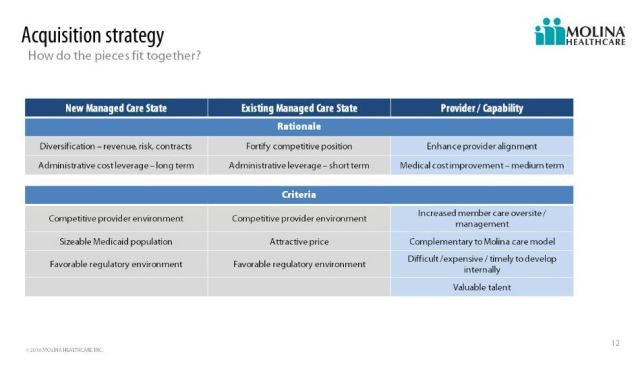
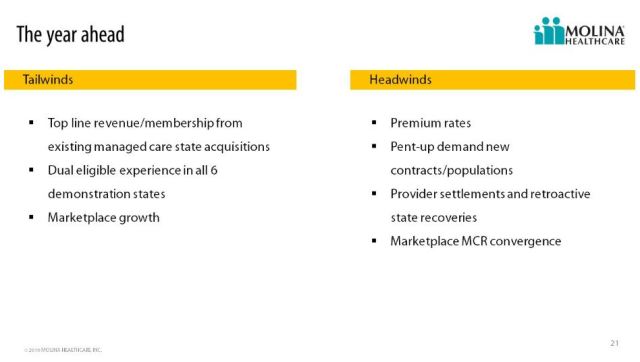
JPM_MolinaHealthcare_acquisition JPM_MolinaHealthcare_year_ahead


Must listen JP Morgan Healthcare Conference Webcasts: @Centene

by Gregg A. Masters, MPH

NOTE: This is second in a series of ‘Must listen’ webcasts produced at JP Morgan’s 34th Annual Healthcare Conference. The first focused on telehealth sector market leader Teladoc. For background and details on this august gathering, see ‘If It’s January, It’s JP Morgan Healthcare Conference. Remaining companies to detail as they represent important ‘bell weather’ insights relative to their respective sectors, include: Aetna, AthenaHealth, Centene, Genomic Health, Molina Health,Universal American, Tenet Health, as well as several from the ‘non-profit’ (tax exempt) sector including Baylor Scott and White

Centene’s operations and strategy positioning insights are material on a number of levels including the ‘urge to merge’ in the HMO or managed care space, and the implications such continuing consolidation holds for movement towards clinical and financial integration in the provider space. Additionally as many predict the future viability of the Medicare Trust Fund may rely largely on the efficacy of how Part C stakeholders articulate a sustainable vision of Medicare Advantage program to extend and enhance the life cycle of the Medicare program itself.

For direct link to the JP Morgan Healthcare Conference, click here. For the associated Centene profile, click here, the deck here and webcast, here.

For two related pieces on navigating the ‘white waters’ of the market’s transformation from volume-to-value as well as the recent ‘collateral damage’ (aka data breach) of healthIT as central spine enabling the transformation, check out ‘Centene–Health Net Entity Could Be Medicaid Leader and ‘Centene loses hard drives with health info on 950,000 beneficiaries, launches search‘, respectively.

Meanwhile, here are some slides which paint the picture both company and industry:

Centene overview

Centene growth 2015

Screen Shot 2016-01-27 at 11.41.27 AM

Screen Shot 2016-01-27 at 11.41.42 AM

Screen Shot 2016-01-27 at 11.41.57 AM

Centene

Centene specialty growth

Centene growth strategy

Centene market vy product

Centene pipeline

Post navigation

Leave a Reply


Centene:

http://jpmorgan.metameetings.com/confbook/healthcare16/company.php?company=CENTENE+Corporation&p=19768&special_list_title=

http://marketrealist.com/2015/07/centene-health-net-entity-medicaid-leader/