Must listen JP Morgan Healthcare Conference Webcasts: Teladoc

by Gregg A. Masters MPH

NOTE: This is one in a series of ‘Must listen’ webcasts produced at JP Morgan’s 34th Annual Healthcare Conference; for background and details, see ‘If It’s January, It’s JP Morgan Healthcare Conference. Remaining companies to detail as they represent important ‘bell weather’ insights relative to their respective sectors, include: Aetna, AthenaHealth, Centene, Genomic Health, Molina Health, Universal American, Tenet Health, as well as several from the ‘non-profit’ (tax exempt) sector including Baylor Scott and White

While telemedicine has been around since the 1980s via traditional ‘pipe to pipe‘ bi-directional points of presence typically found in hospital or academic medical centers, today’s more ubiquitous web enabled presence further leveraged by smart phones and tablets, is an entirely different and new experience and opportunity.

Whether one focuses on telemedicine or the wider swath of ‘telehealth services‘, both the technology and the cast of characters advancing the scope and range of practice opportunities or the body of work establishing use cases and modeling best practices, this remains a fast moving and rapidly iterating ecosystem.

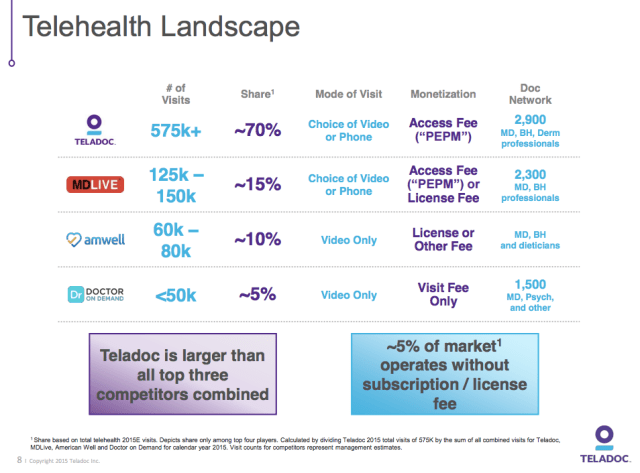
One of the trophy and arguably best-in-class players in the space with both market and mindshare that dwarfs the aggregate total of the remaining three (3) out of the top four (4) players is Teladoc, which according to it’s website is:

…the first and largest telehealth provider in the nation, founded in 2002.

With it’s 2015 IPO we are afforded certain insights enabled by the regulatory reporting process as well as the sometimes behaviorally ‘nuanced’ though strategically insightful ‘management reports of operations’ of publicly traded companies.

As the sole telemedicine or telehealth play with this public standing, this is Teladoc’s first year to report out their experience as well as the issues, obstacles and opportunities it’s management sees for 2016 and beyond.

For context from Teledoc’s Chief Medical Officer Henry DePhillips, MD recorded at the American Telemedicine Association in Los Angeles in 2015, click here.

For direct link to the JP Morgan Healthcare Conference, click here. For the associated Teladoc deck and report narrative, click here.

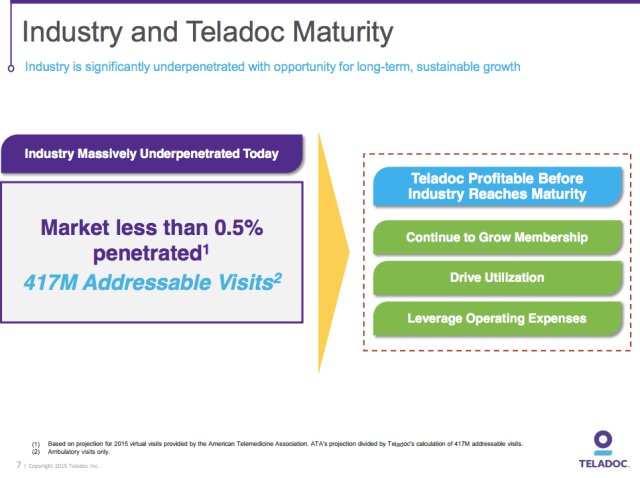
Meanwhile, here are some slides which paint the picture both company and industry:

Teladoc highlights


Teladoc role of smart phone in telehealth

Teladoc growth strategies

Teladoc Comp Model

Screen Shot 2016-01-25 at 10.40.39 AM

CMS Quality Measure Development Plan: A DRAFT

by Gregg A. Masters, MPH

An inspirational leader and ‘disruptive‘ politician taken down well ahead of his time once opined:

“Ask not what your country can do for you, ask what you can do for your country…” John Fitzgerald Kennedy

Fast forward some 55+ years and season such an invitation with the relentless drone of 24/7/365 faux patriotism, hate mongering, intolerance, and emotive ‘hell no‘ sound-bytes proferred by those who self righteously claim title to the ‘take back our country’ narrative and you may ask yourself how did we get from there (the Peace Corps) to here (carpet bomb em)?

Yet, in our unique strain of American democracy even through studies empirically demonstrate a consistent disconnect between what Americans want and what their representatives codify via policy with a capital ‘P’, the bottom line is look in the mirror ‘we are the government’.
CMS_quality_development_planWhether it’s the creation and passage of what merged into the ‘Affordable Care Act‘ (ACA) or how the ‘public’ participates in both the legislative process and its implementation via the rule making process initiated aka the ‘notice of proposed rule making’ (NPRM), we are presented with both the opportunity and as it turns out obligation to engage in and thus granularly shape (via a dialectical bottoms up vs. top down exchange) the ground rules which in turn govern our economy and the conduct of its constituent industry stakeholders.

In the quest to advance the efficacy of quality initiatives (garbage in garbage out) one recent effort is the DRAFT release of the ‘CMS Quality Measure Development Plan: Supporting the Transition to the Merit-based Incentive Payment System (MIPS) and Alternative Payment Models‘.  

As an industry we are process oriented sometimes to a fault. Moreover the ‘check the box’ or drop down nature of many of these measures lends itself to the argument that the state of the industry to actually measure, document and report healthcare quality is at best a crude representation of what is actually going on. Clearly there is more work to be done if this industry is to matter.

To help readers of this blog, the introduction of the executive summary is pasted below:

I. Executive Summary

Background

A transformation of the U.S. healthcare delivery system gained momentum in 2010 with the passage of the Patient Protection and Affordable Care Act (Affordable Care Act).1

The law established the Health Insurance Marketplace to extend consumer access to affordable care through private payers and provided strong incentives in publicly financed healthcare programs to connect provider payment to quality of care and efficiency. 

Building on the principles and foundation of the Affordable Care Act, the Administration announced a clear timeline for targeting 30 percent of Medicare payments tied to quality or value through alternative payment models by the end of 2016 and 50 percent by the end of 2018.
These are measurable goals to move the Medicare program and our healthcare system at large toward paying providers based on quality, rather than quantity, of care.2

The passage of the Medicare Access and Children’s Health Insurance Program (CHIP)
Reauthorization Act of 2015 (MACRA)3 supports the ongoing transformation of healthcare delivery by furthering the development of new Medicare payment and delivery models for physicians and other clinicians. Section 102 of MACRA4,i requires that the Secretary of Health and Human Services develop and post on the CMS.gov website “a draft plan for the development of quality measures” by January 1, 2016, for application under certain applicable provisions related to the new Medicare Merit-based Incentive Payment System (MIPS) and to certain Medicare alternative payment models (APMs).

The law provides both a mandate and an opportunity for the Centers for Medicare & Medicaid Services (CMS) to leverage quality measure development as a key driver to further the aims of the CMS Quality Strategy:

• Better Care,
• Smarter Spending, and
• Healthier People. 5

Measure Development Plan Purpose
The purpose of the CMS Quality Measure Development Plan (MDP) is to meet the requirements of the statute and serve as a strategic framework for the future of clinician quality measure development to support MIPS and APMs. CMS welcomes comments on this draft plan from the public, including healthcare providers, payers, consumers, and other stakeholders, through March 1, 2016.ii The final MDP, taking into account public comments on this draft plan, will be posted on the CMS.gov website by May 1, 2016, followed by updates annually or as otherwise appropriate.i

So here it is… have at it. Perhaps your input will in fact shape the substance and steward the glide-path of how the transformation from volume to value can be realized. Certainly it’s worth your consideration. Afterall, another attributed Kennedy quote with biblical DNA may apply here:

“We are not here to curse the darkness, but to light a candle that can guide us through the darkness to a safe and sure future. For the world is changing. The old era is ending. The old ways will not do.

The problems are not all solved and the battles are not all won and we stand today on the edge of a New Frontier – a frontier of unknown opportunities and perils, a frontier of unfulfilled hopes and threats.

It has been a long road to this crowded convention city. Now begins another long journey, taking me into your cities and towns and homes all over America.

Give me your help. Give me your hand, your voice and your vote.”

John Fitzgerald Kennedy

12 Steps to the Triple Aim or Value Based Healthcare

by Gregg A. Masters, MPH

It has been challenging at times being in the ‘innovation conversation’ dating back to the 70s (who remembers ‘WIN’ [whip inflation now], PSROs or even HSAs (no, not the WIN \ Whip Inflation Nowprivatization funding mechanism, but the CON overlords) watching what get’s reported by industry press or online media as ‘innovation‘ or ‘bold new thinking‘ amidst a ‘cottage industry’s’ 3x trillion spend rate – including it’s culpable supply chain and many vendors (some may even say ‘pigs’) at the trough.

As indicia of the impending collapse of our aging house of cards healthcare delivery and financing industry (continued burnout rates driving physician exits to direct practice or concierge medicine, un-ending and nauseating opposition to the ACA, mega and no so mega hospital mergers, associated practice acquisitions and health plan consolidation, not to mention the codification of the cost shift charade via the lower metals designations of the ACA and including armies of dissatisfied patients suffering in a provider centric culture) continues to accumulate, it affirms what Esther Dyson once presciently characterized as the ‘calcified hairball‘ given it’s ‘resistance is futile’ [to change] nature.

Healthcare Inflation

Recent healthcare inflation moderation trends notwithstanding (see: ‘2014 National Health Spending; The Great Moderation Likely Not Over‘ by healthcare futurist Jeff Goldsmith) whether a function of ACA implementation in part of as a whole, the industry has essentially and collectively failed to deliver on the principles of the triple aim – which existed in spirit considerably before it’s labeling by the Institute for Healthcare Improvement (IHI). Providers continue to maximize their profits or ‘excess revenues over expenses’ for the ‘non-profit’ [aka tax exempt’ sector] often at the expense of community benefit.

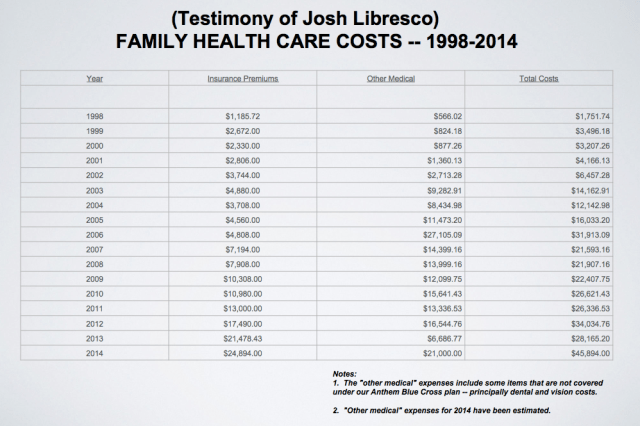
Perhaps no other chart series in line item detail captures and evidences this slow burn of fail as the progressive and relentless growth of one man’s healthcare premiums in California. Take note of the persistent [cost] shift from the payer (health plan) to the patient or beneficiary.  If this is the best we can do via ‘wholesale purchasers’ (market savvy health plans) leveraging millions of members and ‘medical management’ and network contracting infrastructure, how can an army of independent and often clueless if not dis-empowered agents (patients, members sometimes at the point of service) do better?

[Editor’s note: one reason for an earlier post on the need for a ‘new IPA’ i.e., independent patient association]

This testimony was provided by Josh Libresco to the Department of Managed Care in California during their consideration of rate hikes by health plans.

Testimony1

Testimony2


Time for a New Manifesto?

With this history as both context and some may say ‘institutional memory’, I thought I might make sense to take heed of what’s become rather well known in the 12 step recovery community (from AA to Al-anon and many derivatives) which is to admit our ‘addiction’ to the arguably ‘easier softer path’, i.e., fee for services medicine.

Perhaps this can be a manifesto of sorts to embrace as we embark upon this journey for volume to value based healthcare?

Adapted from the 12 Steps of Alcoholics Anonymous

1. We admitted we were powerless over our addiction to fee-for-services medicine – that our healthcare delivery and financing model had become unmanageable.

2. We came to believe that power greater than ‘do more to earn more’ incentives (global capitation) could restore us to sanity and move the needle on the triple aim.

3. Recognizing the finite nature of our healthcare resources we made a decision to dedicate our will and our professional lives to the pursuit of the triple aim and its associated sustainable healthcare economy.

4. We made a searching and fearless moral inventory of our contributions to a seemingly ‘resistance is futile’ healthcare borg.

5. We admitted in our silo-ed huddles and to one another the aggregate nature of our [well intended, though] collective wrongs.

6. We were entirely ready to have a calling to the ‘greater good’ that transforms a profit maximization – at any expense- operating culture.

7. We humbly asked our ‘higher power’ for faith in a value based healthcare economy and for the support to let go of the fee for services addiction.

8. We made a list of all patients, payers, or employers we had harmed, and became willing to make amends to them all.

9. We made direct amends to such stakeholders wherever possible, except when to do so would injure them, others or our ability to facilitate the journey from volume to value.

10. We continued to take personal inventory and when we felt the temptation to default to legacy inertia – promptly admitted it.

11. We sought through mindfulness, meditation and collaboration to improve our vision and practice of value based healthcare, sharing openly for the knowledge, capacity and willingness to deliver on this historically elusive goal.

12. Having had a professional – if not spiritual – awakening as the result of these steps, we tried to carry this message to one another and practice these principles in all our affairs.


The Droids You Are Looking For Are Not Here

by Gregg A. Masters, MPH

Beneath the ideological crossfire and mostly bluster of the ACA ‘repeal and replace crowd’, while the latest ‘new, new, thing‘ aka the defacto Rorschach upside of a litany of mostly vaporware or me too ‘meh‘ digital health apps, platforms or S-1 filings (see: ‘Disruptive Idiots from Silicon Valley‘) stumble into maturity amidst growing calls for validation and evidence of tangible ecosystem sustainability, a pulse of innovation can be found in some less ‘sexy’ sectors.

Some time ago physician innovation pioneer Richard Merkin, MD, the founder and principal visionary behind the Heritage Provider Network and all of its sequelae (Heritage Medical Systems, Heritage ACO, etc.), opined from the stage at the ACO Summit that perhaps the biggest contribution (gold) from the ACA was to be mined from the forward leaning work stimulated by the law’s enablement of the Centers for Medicare and Medicaid Innovation (CMMI) aka @CMSinnovates on twitter.

Richard Gilfillan MDThe indisputable driver of what was then invested in Richard Gillfilan, MD the first CMMI Director (now stewarding the transformation at Trinity Health System, @TrinityHealthMI), was the volume to value imperative.

Into this challenge was cast considerable public capital/incentive funds to model what that meant from a delivery system and financing re-engineering perspective. Perhaps fueling the discounting of CMMI’s early efforts was the poorly constructed ‘Pioneer ACO‘ program, ostensibly designed to attract a more risk savvy pool of players who could reasonably assume greater risk and therefore earn more meaningful bonuses for doing what they already know how to do principally via Medicare Advantage participation. This early cohort of 32 ‘Pioneers’ has dwindled recently to 19 with the recent defection of the trophy Darmouth-Hitchcock ACO, see:Dartmouth-Hitchcock exits Medicare’s Pioneer ACO program‘.

With that as backdrop, consider the following timely guide from the Cooperative of American Physicians titled ‘The Physician’s Guide To Value-Based Compensation‘. Consider this an essential ‘blocking and tackling’ primer of how to incentivize the granular behavior of those who write the ‘purchase orders’ for an essentially supply driven healthcare economy. As my colleague and surfing buddy John Mattison, MD (@JohneMattison), Assistant Medical Director, and CMIO Kaiser Permanente Southern California (@KPshare) often says: ‘we get what we incent’.

CAP_guide to value based comp

[Editor’s Note: and for those of you really interested in where the AMA stands on the bridging the volume-to-value divide, listen to: Health 2.0 Fall Conference 2015: An AMA Deep Dive on ‘The App Cure’].

Whether the ACA is repealed (highly doubtful) or materially modified (also not likely) its essence will not and cannot be ‘undone’ – the horse is out of the barn. Like it or not, the controlling DNA driving the many moving parts articulated in the ACA (and its state lab version ‘RomneyCare’) builds on decades of established health policy thinking on what works in the uniquely American public/private pluralistic partnership of healthcare financing and delivery.

Watch the ‘enablers’

Whether ACOs, fully integrated delivery systems (real IDNs – NOT their IDN lite versions), PCMHs, or one of a number of strains of risk bearing organizations (RBOs) from bundled pricing to full blown per member per month (PMPM) capitation, this is where the sustainable action can and will be found. This other stuff, plays well at CES and the many wannabe healthcare industry copy cat conferences playing an up the ante ‘cool factor’ card to an often ADD crowd, yet it’s tangible contribution to the triple aim or sustainable healthcare economy remains squarely ‘on the come.


Courtesy of our friends at AJMC: ‘5 Things to Know About Accountable Care Organizations’

by Laura Joszt

This week, The American Journal of Managed Care was in Palm Harbor, Florida, hosting the fall live meeting of its ACO and Emerging Healthcare Delivery Coalition, where stakeholders from across the healthcare industry discussed best practices. As the country moves from volume to value, accountable care organizations (ACOs) can play a key role during the transition from fee-for-service. However, ACOs not only remain largely a mystery to the average consumer, but also to providers who may be part of an organization participating in an ACO. Here’s what you need to know about ACOs:

1. ACOs are older than the Affordable Care Act. At least, the theory of ACOs is older. While the inclusion of ACOs in the health reform law has accelerated adoption of the delivery model, the term “accountable care organization” was first coined in 2006 by Elliott Fisher, MD, director of the Dartmouth Institute for Health Policy and Clinical Practice.

2. There are multiple models established by CMS. There are a number of different ACO models being offered by CMS. The most common model is the Medicare Shared Savings Program (MSSP), which has 404 ACOs and is accepting more. The Pioneer ACO Model is for healthcare organizations and providers already experienced in coordinating care, and while it started with 32 ACOs, just 19 remain today. The Advance Payment ACO Model is designed for physician-based and rural providers. And the newest model is the Next Generation ACO, which takes on greater performance risk with potentially greater rewards. The Next Generation ACO model is….

Complete article by Laura Joszt posted here.

FLAACO? What’s That?’

by Gregg A. Masters, MPH

First there was section 30222 prescribed by the Patient Protection and Affordable Care Act (“ACA”), which added section 1899 to the Social Security Act that requires the Secretary of Health and Human Services to establish the [Medicare] Shared Savings Program (MSSP), see: ‘Summary of Final Rule Provisions for Accountable CareOrganizations under the Medicare Shared Savings Program‘.

Leading up to and continuing to this day is a literal potpourri of aligned industry stakeholders and interests who support this emerging ‘new, new thing‘. From the ACO Congress to the ACO Summit and a host of others including the National Association of Accountable Care Organizations (NAACOs) and most recently the ACO Coalition forged by principals at The American Journal of Managed Care (who launched a sister publication the American Journal of Accountable Care) they advocate for and provide both networking opportunities and continuing education into best practices for these nascent entities on which much of the success of the ACA is vested.

ACOs, a once ‘DOA’ (dead on arrival) too little too late or ‘HMO-lite’ model version, seems to be working it’s way into not only the lexicon of managed competition via a growing body of endorsements and reported outcomes data by many both in the public (CMS) and private (Aetna, United, Blues plans, etc) sectors as the preferred mechanism to implement the vision of the triple aim and fuel the transition from volume to value based medicine.

Like much of its era-specific innovation industry predecessors HMOs, PPOs, EPOs, OWAs), i.e., greasing the skids for if not enabling the HMO industry migration beyond the limited appeal of staff models to mainstream medicine penetration via Independent Practice Associations (IPAs), and later followed by the growth and penetration of PHOs (physician hospital organizations), ACO ‘enablers’ (as well as this value based platform) seem to be here to stay.

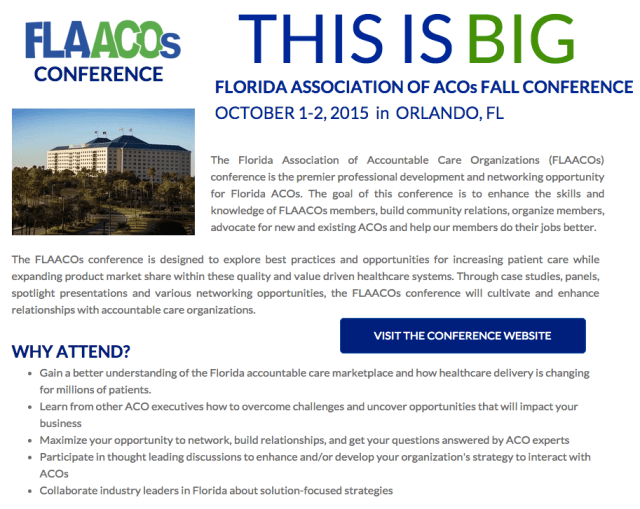
Enter the Florida Association of Accountable Care Organizations (“FLACCOs”) led by former health plan executive Nicole Bradberry (for context listen to interviews with Nicole here and here), which holds its annual conference in Orlando, Florida October 1 & 2nd 2015.

FLAACOs Orlando Conference

The agenda is packed with entrepreneurs and operators in the space from ACO enablement companies including Aledade, to ACOs and vendors who support their risk readiness assessments if not assumption such as RowdMap. Aledade founder and CEO Farzad Mostashari, MD will keynote (see: ‘Former ONC Director Farzad Mostashari, MD Launches @AledadeACO).PopHealthWeek-logo-TWTTR-sq (2)

For the FLAACO agenda, click here and the list of participating faculty click here.

This year my colleague and co-founder of PopHealth Week (formerly, This Week in Accountable Care) Fred Goldstein and I will broadcast live from the event.

If you are not following FLAACOs and are interested in the road to accountable care, you may want to take note and perhaps even consider attending this gathering.

Health Insurance Industry Consolidation: Any ‘Qui Tam’ Exposure?

by Gregg A. Masters, MPH

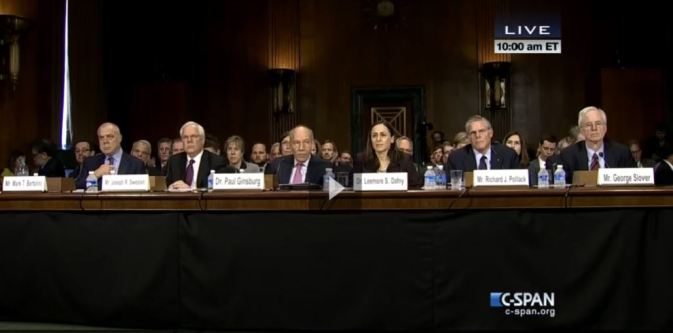
If you’re a health policy junkie like me, then the best show in town (or anywhere for that matter) was in the Dirksen Senate Office Building in Washington, D.C., where HMO industry veteran and Chairman, President and CEO of Aetna Mark T. Bertolini and Anthem President and CEO Joseph R. Swedish among other industry stakeholders testified before the Senate Judiciary Subcommittee on Antitrust, Competition Policy and Consumer Rights on health insurance industry consolidation, for video replay click here or watch below:senate hearing health insurance industry

As most of you reading this blog know, subject to the Department of Justice review Aetna will acquire Humana, and Anthem will acquire CIGNA. Thus, the submitted testimonies and ad hoc answers to sitting Senators on the Subcommittee were potentially a high stakes exchange.

Moreover, the hearing today was nothing short of a tutorial into the dynamics of the managed competition marketplace (both theory and practice since absent complete transparency assuming the salutary benefits of such competition may be more ‘wishful thinking‘ than reality as noted by Senator Blumenthal – CT, the home of the insurance industry) and whether this unique American strain of public/private collaboration can deliver on the oft repeated promises of such integration, i.e., that scale via consolidation drives operating efficiencies, improves quality and lowers costs to end users. We shall see…

As I heard the pitches from the various representatives assembled to offer perspective to the sitting Senators (see list here), I began to wonder if any of their testimony would be subject to the ‘false claims Act‘ if post consolidation the promised benefits do not accrue to the intended benefactors.

For those of you not familiar with the ‘False Claims Act‘ or otherwise known as Qui Tam filings, here a summary including its recent expanded scope via the Affordable Care Act:

The False Claims Act, expanded by the Fraud Enforcement and Recovery Act of 2009, P.L. 111-21 (S. 386), 123 Stat. 1617 (2009), now proscribes: (1) presenting a false claim; (2) making or using a false record or statement material to a false claim; (3) possessing property or money of the U.S. and delivering less than all of it; (4) delivering a certified receipt with intent to defraud the U.S.; (5) buying public property from a federal officer or employee, who may not lawfully sell it; (6) using a false record or statement material to an obligation to pay or transmit money or property to the U.S., or concealing or improperly avoiding or decreasing an obligation to pay or transmit money or property to the U.S.; (7) conspiring to commit any such offense. Additional liability may also flow from any retaliatory action taken against whistleblowers under the False Claims Act. Offenders may be sued for triple damages, costs, expenses, and attorneys fees in a civil action brought either by the United States or by a relator (whistleblower or other private party) in the name of the United States.
If the government initiates the suit, others may not join. If the government has not brought suit, a relator may do so, but must give the government notice and afford it 60 days to decide whether to take over the litigation. If the government declines to intervene, a prevailing relator’s share of any recovery is capped at 30%; if the government intervenes, the caps are lower and depend upon the circumstances. Relators in patent and Indian protection qui tam cases are entitled to half of the recovery.

Not sure if qui tam consideration can or even remotely applies to the upside representations proffered in favor of the acquisitions, since as noted by one or more witnesses today much of the empirical (public) record is incomplete and inconsistent with respect to supporting or discounting the arguments that will or have been made to DOJ as they conduct their anti-trust investigation into the proposed acquisitions or mergers.

[Editor’s Note: Two examples of previous health insurance industry consolidations were noted, including Aetna’s 1999 acquisition of PruCare, and United Health Group’s acquisition of Sierra Health Services. I will post the submitted witness testimony once it becomes available online, including any current discussion ‘tea leaves’ of what and where the DOJ investigation may be headed in both transactions. If you have anything, please feel free to add in comments section.]

This Subcommittee hearing is rich with both fundamentals and nuance considerations of the Affordable Care Act and whether it’s many moving parts can indeed align to meet the legislative intent of its authors.

Stay tuned!

ACOs: The Results So Far (It Depends)

by Gregg A. Masters, MPH

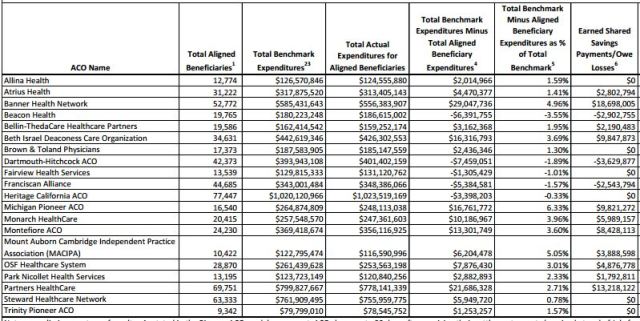
It might have been prescient but minimally it was perfect timing. While Fred Goldstein, President of Accountable Health, LLC, and me were prepping for our session to re-cap on PopHealth Week (@PopHealthWeek) some of the insights from our deep dive series into Population Health and ACOs, reporting insights from embedded executives at physician led, hospital sponsored and health plan enabled ACOs respectively, CMS yesterday (August 25th) posted the results from their participants in the MSSP and Pioneer Programs.

The Pioneer results are displayed below (for a description of the Pioneer program click here):CMS_ACO_Results_Pioneers
Again, while we’re still very early in this game, one bit of ‘cognitive dissonance’ that I experienced is worthy of note and further exploration.

That being the Heritage ACO a physician led enterprise fielded by managed care industry veteran and disruptive innovator Richard Merkin, MD, et al (including my former American Medical International colleague Mark Wagar, President Heritage Medical Systems and most recently CEO Empire Blue Cross and Blue Shield) untethered in any way from an institutional portfolio of healthcare infrastructure (i.e., hospitals) booked zero savings for distribution while hospital tethered and a card carrying member of the Association of American Medical Colleges (@AAMCtoday) (as the principal teaching hospital for Einstein College of MedicineMontefiore ACO booked massive (relative to ‘aligned beneficiares’) savings.

One must ponder the question and ask how can this be so?

It’s common knowledge that ACOs ‘untethered’ from (heads in beds) legacy hospital interests are more nimble and therefore better positioned to manage the volume-to-value transition. Further, when you add into the mix the history of successful risk assumption across a distributed network of ‘aware’ coordinated care practices (both IPA and medical group) you have a material competitive advantage.

So perhaps the ‘devil is in the details‘ as it often is, and the answers are to be found in the formulaic world of risk adjusters, corridors, baselines and severity of illness calculations. We hope top hear direct from Heritage ACO as this author has made that request a number of times previously.

Another interesting result that stands out as it arguably tethers to the presumptively competitively disadvantaged ‘health plan enabled‘ camp of ACOs is the incredible savings generated by the Banner Health Network (a Pioneer ACO), which if memory serves me well is a co-creation of Banner and Aetna via their ‘payor agnostic’ Healthagen subsidiary.

For complete details see the CMS release ‘Medicare ACOs Continue to Improve Quality of Care, Generate Shared Savings‘ and ‘Medicare ACOs Provide Improved Care While Slowing Cost Growth in 2014‘.

Meanwhile for a bit of reading the tea leaves color via Beckers Hospital Review see CMS releases 2014 Medicare ACO quality, financial results: 10 things to know):

1. Ninety-seven ACOs qualified to share in savings by meeting quality and cost benchmarks. Together, they earned shared savings payments of more than $422 million.

2. Fifteen of the 20 participating Pioneer ACOs generated a total of $120 million in savings in 2014, their third performance year. This is up 24 percent from the second performance year when they generated $96 million in savings. Of those that generated savings, 11 earned shared savings payments of $82 million.

3. Five Pioneer ACOs generated losses and three owed CMS shared losses of $9 million.

4. Pioneer ACOs increased their average quality scores to 87.2 percent in performance year three from 85.2 percent in performance year 2. They improved an average of 3.6 percent compared to performance year two on 28 of the 33 quality measures and showed significant improvement in medication reconciliation, clinical depression screening and follow-ups, and EHR incentive payment qualification…

Read complete article here.

Yes we do live in interesting times. And ideological prism not-withstanding there is no way this Genie (ACOs et al, and whatever formulaic derivatives may be forthcoming) gets put back in the bottle – the best efforts of Governor Scott Walker’s ‘bold’ The Day One Patient Freedom Plan (more likevaporware‘) effort to repeal and replace the Affordable Care Act.

This train has left the station. Time to deal with it?

ACOs and Population Health: The Value Narrative

by Gregg A. Masters, MPH

Before there was ‘accountable care’, the current full court press towards innovation – whether digital health app, platform or service delivery model, an emerging culture of transformation or the attendant pursuit of the triple aim, not to mention the most recent obsession with ‘retail as cure’ for that which ails healthcare, the best and the brightest minds (both clinical and administrative guided by thoughtful health policy wonks) convened in the grand theater of ‘managed care’ or managed competition.

The model and industry writ large (both public and private sectors), variably expressed as HMO, PPOs and derivative strains of contracting models stimulating the development of IPAs, PHOs, PPMC’s, MSOs and DPOs (direct purchasing organizations) had a run from the mid 70s until its abandonment as the official vehicle to restrain the rising cost and variable quality of healthcare in the late 90s. What followed was somewhat of a meandering decade of incremental tweaks here and there to an otherwise burning platform of fee-for-service healthcare delivery and financing.

In 2015 with healthcare costs now approaching 20% of the U.S. Gross Domestic Product and the viability of the entire U.S. Government at risk to projected costs increases and unfunded liabilities of the Medicare and Medicaid programs (estimated at $64 trillion), business as usual fee-for-service medicine is no longer an option and the many cathedrals of medicine built by ‘do more to earn more’ largesse are clearly at risk in the shifting sands of value based care.

While the ‘value’ v. volume agenda has been around for a while via risk based contracting including case rates, bundled payment and even capitation – both global and professional only versions – their penetration of mainstream medicine was relatively modest – until now. That is if you can believe the growing prevalence and penetration of risk bearing ACOs arrangements, a tapestry of bundled payment participation via Federal programs and a less transparent portfolio of privately negotiated ‘value based arrangements’.

Into this theater steps one of the trophy consulting companies with both wide (global) and deep (extensive client penetration into the health plan, provider and IDN communities) aka Accenture Health (follow via @AccentureHealth).

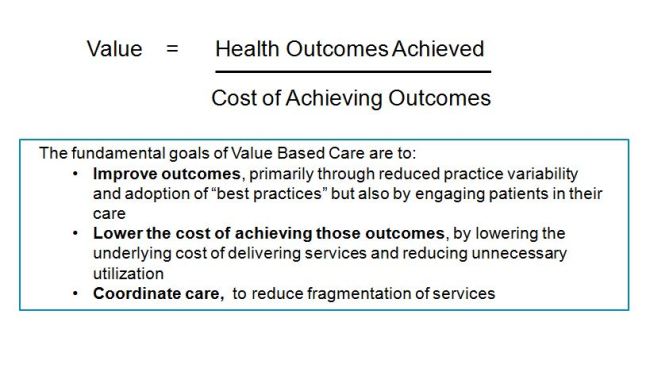
value based care meklausInto this developing narrative with a ‘value tutorial’ of sorts steps Gerry Meklaus, the Managing Director of Accenture North America for Clinical & Health Management Services. We speak with Gerry Wednesday at 12 Noon Pacific/3PM Eastern at Pophealth Week where my colleague and co-founder Fred Goldstein, President of Accountable Health, LLC will engage Gerry in the value conversation and the many touch points between a value framework for ACOs and population health strategies of provider organizations.

Key terms to un-bundle and digest are the ‘BIG Three’: 1) to ‘improve outcomes’ via emerging best practices, the reduction in variation and effective engagement of the patient in shared decision making, 2) the effective lowering of costs from a ‘total cost of care’ perspective (not just niche wins – if you will), and 3) the well known challenge to de-silo the many silos in the healthcare ecosystem driving fragmentation, redundancy and a less than patient centric experience.

Join us as we gain insight into the challenges and successes in the market to date!

Another Milestone Marker in Favor of the ACO Model?

by Gregg A. Masters, MPH

I awoke this morning to an email from a PR rep who supports outbound news for one of the emerging ACO management companies enabling physician led participation in the Medicare Shared Savings Program (MSSP) aka Aledade (@AledadeACO).

I then copy, pasted and tweeted the headline: ‘Aledade Creating New Medicare Accountable Care Organizations in Seven States.

I usually ignore ‘PRs’, yet this announcAledade newsement is material as it lends support via a growing body of evidence on the viability of the ACO model and its enabling ‘consciousness’ if not ‘sentiment shift’ in the prevailing market narrative.

While some still slam the ACA – and by proxy it’s ACO ‘workhorse’ – via relentless yet ‘diminishing returnsimpact of the ‘government takeover‘ fear mongering fueled by strategically sourced oppositional research, there is a building steady body of evidence supporting both the model and the broader context of efficacy of the competitive dynamics the ACA has unleashed on the stewards of our at risk (some say collapsing) healthcare economy.

Ergo my tweet:

Aledade news tweet

Ever since the Senate Finance Committee took up the debate and relentless series of ‘amendments‘ proffered by the ‘Rs’ trying to ‘improve‘ the proposed legislation that eventually emerged as the Patient Protection and Affordable Care Act (I NEVER use the pejorative term ‘Obamacare’), I’ve been a voice in the narrative of trying to get the facts of competitive market dynamics into the post political conversation around reforming our complex healthcare economy.

This is no easy task as the complexity of both the political process and objective reporting of how legislation becomes law including its contextual historical narrative is addressed in ‘A Legislative History of the Affordable Care Act: How Legislative Procedure Shapes Legislative History.

A challenge recognized upfront via admittedly ‘apolitical’ or ideologically agnostic ‘law librarians’ (yeah, you know those agenda driven bullies):

“Using the health care legislation passed in 2010 as a model to show how legislative procedure shapes legislative history, this article posits that legislative procedure has changed, making the traditional model of the legislative process used by law librarians and other researchers insufficient to capture the history of modern legislation. To prove this point, it follows the process through which the health care legislation was created and describes the information resources generated. The article concludes by listing resources that will give law librarians and other researchers a grounding in modern legislative procedure and help them navigate the difficulties presented by modern lawmaking.”

Since social media was starting to pick up in 2009 – 2010 time-frame, and given the angst associated with the public’s consumption of the ACA, I started ACO Watch and latter the hashtag #healthreform to track tweets associated with ACA consideration.

None-the-less, 5 years later the disinformation campaign persists though some of the pieces of the ACA are starting to show some promise of the law’s original intent. ACOs often referred to as a flawed model, perhaps an ACO lite if you will or too little too late to make a difference, the emerging datasets (both government and private market tea leaves) are building a case that the law is working.

Tomorrow on PopHealth Week, join my colleague, co-host and co-founder Fred Goldstein as we chat with Aledade Founder and CEO Farzard Mostashari, MD. This month we’re conducting a series on Population Health and ACOs talking to leadership from each ACO type: physician led, hospital sponsored and health plan enabled.

Listen here! We’re live 12 Noon Pacific/3 PM Eastern, and on demand thereafter.