Care Innovation Summit: A Very Sober Assessment!

By Gregg A. Masters, MPH

This session is well worth the time invested. Two veteran healthcare wonks weigh in on the fundamentals of healthcare transformation and where we stand in the glide-path towards sustainability or fulfillment of the ‘triple aim’.

Former CMS Administrator and healthcare attorney turned investor Tom Scully (Bush I Administration, see Wikipedia profile) and Peter Orszag (former CBO and OMB Director respectively, with tenures in both Obama & Clinton Administrations) reflect on health reform and more.

[NOTE: Their session begins at the 1:45:00 mark.]

Just some amazing and hard hitting reflections on where we are, where we need to go and just what we might be aiming for business model-wise. Spoiler alert: It starts with a ‘C’.

Also, earlier is a worthwhile session from Patrick Conway, MD, Chief Medical Officer, CMS and the Director of the Center for Medicare and Medicaid Innovation (CMMI). Dr. Conway touches on quite a bit including a deeper dives into the many moving parts of the CMMI innovation mission.

CMS Innovation Portfolio


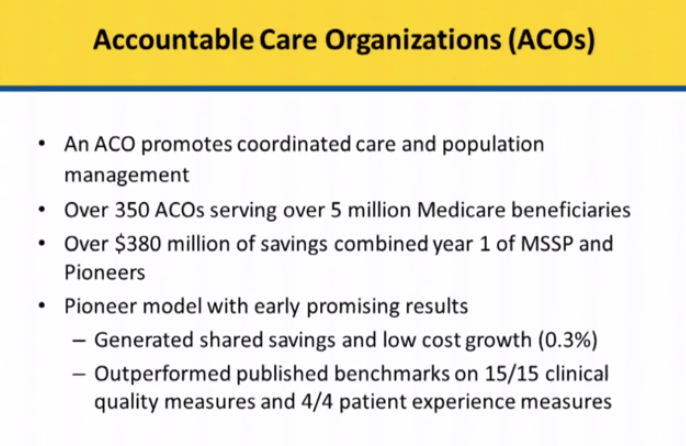
Conway also iterates on the status of ACOs, including what may be generalized from the ‘lessons learned’ via Pioneer ACOS that may be infused in the MSSP class via statute or national ‘scaling.’ [Note: watch for insightful comment about press and question asked by one reporter in audience].

Accountable Care Organization Update

This may be one of the best and candid discussions I’ve heard to date on the ACA, ACOs and where and how we’re going to transform the rapacious appetite of the ‘healthcare borg’. Scully is a brother from another mother, referring to MedPartners and PhyCor in the same breath.

Who says there is no value to institutional memory or grey hair per se! Some of us have been to this dance before!


Care Management: A Deeper Dive

By Gregg A. Masters, MPH

Earlier I was asked by Lumeris to moderate a webinar on Care Management featuring Deborah Robin, MD, MHCM Medical Director and Eric Mueller, JD, MBA, Director, Product Management. This session is an exploration into the importance and key components of Care Management.

In an earlier post, Dr. Robin notes:

In my role at Lumeris I often get asked by our clients, “What does care management really mean?” For me, having spent decades practicing geriatric medicine and teaching the principles of post-acute care coordination at a private research university and medical center, care management can be defined, most completely, as better care at lower cost for people with multiple health and social needs.

I know firsthand the challenges physicians face in providing quality care to high-risk patients and populations. It is hard to believe that better outcomes can be achieved when nationally, re-admission rates remain close to 24 percent within 30 days of hospital discharge, and nearly 80 percent of these re-admissions are for preventable conditions according to MedPAC.

To achieve better care at lower cost, health systems need to change the way they manage high-risk patients and create an entire care community working together to ensure that each patient receives the right care, in the right place, at the right time.

Though that sounds like a far-off health care utopia, I have worked closely with Lumeris at designing a Care Management solution that achieves what may seem impossible. The results of this solution speak for themselves in the Lumeris-operated 4.5 star-rated* Medicare Advantage Plan where health plan staff, physicians and patients have worked together to reduce 30-day hospital readmissions by nearly 13 percent in 2012.

This Care Management solution supports multiple workflows in the coordination of care for high-risk patients and high-risk events. Technology, education and strategy support the health care team in their ability to effectively stratify, engage and manage high-risk patients and populations to prevent adverse health outcomes, while managing cost and delivering optimal patient care.

The complete and original post by Dr. Robin is available here.

[Disclosure: A fee was paid to moderate this session].

Universal American: A Sign of Things to Come?

By Gregg A. Masters, MPH

Per the recent investor call [to listen via archive replay click (and register) here] the theme was perhaps best set via the following comment:

We just want to stop the bleeding… Robert Waegelein

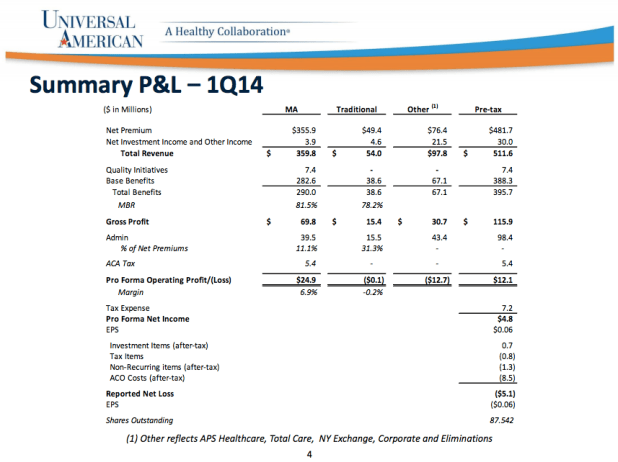
UAM P&L Q1 2014When CMS issued the final rule for ACOs one of the first enterprising companies out of the gate to proactively roll-out an ‘ACO template’ of sorts, that was market specific yet spawned by a ‘mega MSO corporate parent’ was Universal American (UAM).

Branded via the ‘healthy collaboration’ moniker, the company was a first mover into the ‘ACO space’ intent upon building multiple regional if not an assembled national footprint.

As an experienced Medicare Advantage operator, UAM’s approach was to leverage their network and risk management core competencies and structure ACO ‘win/win’ gain sharing scenarios with their network partners – principally physicians who were not risk averse with perhaps some prior or current involvement in the Medicare Advantage program. Afterall, ACOs are merely ‘MA lite’, no?

The UAM collaboration philosophy was detailed in a prior post titled: ‘Universal American: A Healthy Collaboration?’

Who can argue with aligning incentives and sharing the savings? This is a perfect fit for the foundational principles enshrined in the Affordable Care Act and articulated in Medicare Shared Savings Program. It should work, no?

With some baseline experience UAM and other ACOs are beginning to see what works, what doesn’t and perhaps even discerning the reasons why.

Suffice it to say, the clear lessons UAM is drawing from these early ACO results (at least as reported in this conference call) include the need for scale (member concentration) in the market. A couple of hundred Medicare beneficiaries distributed over a loosely tethered provider network neither gets attention nor provides the pricing leverage the company needs to manage to a margin.

Below is a snapshot of UAM’s operations and financial position:

UAM Operating Profile 2014


For additional context and speculation as to the meaning of UAM’s market exits on the continued growth and expansion of ACOs, see: ‘Reform Update: Insurer’s retreat from ACO investment raises questions about Medicare’s program.’

Quoting from the piece:

‘Universal American, a publicly traded insurance company that has invested heavily to become the largest operator of Medicare accountable care organizations, will no longer finance existing ACOs where its executives see little hope of financial return. The decision raises UAM Operating Profile 2014questions about Medicare’s ability to expand the program as the agency continues to seek new participants and hold on to those already experimenting with accountable care.

“Where we’re seeing it’s not working, we’re going to stop investing,” said Robert Waegelein, chief financial officer for Universal American, which contracts with local physicians across 13 states to operate 34 ACOs in the Medicare Shared Savings Program. That’s about one out of 10 ACOs launched under the program since 2012. “We just want to stop the bleeding,” he said.

We are at best in the bottom half of the first inning. There is a long way to go on this journey towards sustainability. So before we get too carried away and perhaps even write ‘the ACO obituary’, I say ‘more will be revealed’ –  so stay tuned!


The Journey to an Accountable Delivery System

By Gregg A. Masters, MPH


Colleague and industry veteran Jim Hansen penned a blog post some time ago titled: Accountable Care 2.0: It’s a Journey, Not a Program’, and we followed up with Jim via an interview: The ACO Narrative: ‘Accountable Care 2.0 is a Journey, Not a Program’ or ‘ObamaCare is Toast’?’.

Shortly thereafter at the AHIP meeting in Washington D.C. on Medicare and Medicaid two Lumeris clinical thought leadership executives presided over a breakout session on ‘The Journey to an Accountable Delivery System’. These insights offered in this session are forged from a Midwest health information technology solutions company that grew out of the experience with ‘at risk’ contracts (sans mission critical clinical, utilization and financial data) with Medicare Advantage. Perhaps somewhat unique in the HealthIT solutions space, Lumeris also operates a top rated 4.5 star Medicare Advantage plan under the as Essence Healthcare brand.Healtheon

Editor’s Note: Lumeris’ disruptive innovation roots dig much deeper into the genealogy of the healthcare transformational challenge via the original and rather ambitious roll-out of Healtheon (turned WebMD and more recently Emdeon), all during the pre-ubiquitous enabling healthIT backbone.

This session is an essential exploration into the convergence of mainstream medicine into accountable care. It is a deep dive into the implications and methodologies for delivery systems aspiring an ‘accountable chassis’ – whether solely clinically integrated network (CIN) or full turnkey (clinical & financial) integrated delivery system (IDS) – upon which to graft and/or plant their sustainable healthcare initiatives.


2nd Annual Leadership Summit on Integrated Delivery Systems

By Gregg A. Masters, MPH

Is the ‘old new again’? Some would say absolutely! However, there is a twist.

May 7th and 8th 2014 the World Healthcare Congress (agenda here) convenes the 2nd in their leadership summit series on ‘integrated delivery systems’, alternately known as ‘IDN’s (integrated delivery networks) at the Hilton Resort on Mission Bay in San Diego.John Mattison MD Keynote 2nd Annual World Healthcare Conference on IDS

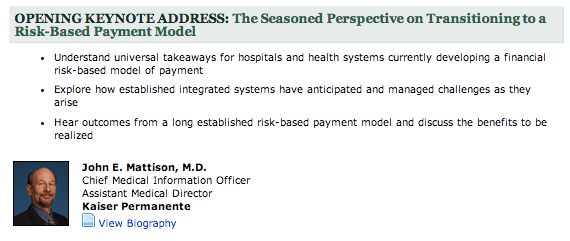
One clue may be sourced from the opening keynote by HealthIT and transformational conference circuit veteran John Mattison, MD, CMIO Kaiser Permanente Southern California, titled ‘The Seasoned Perspective on Transitioning to a Risk-Based Payment Model’.

What triggered me was the reference to the ‘seasoned perspective’ Seasoning implies some maturity or experience over time. Some might even say, institutional memory –  in a 24/7/365 ADD driven sound byte culture is a context asset if not prerequisite of wisdom.

Dr. Mattison is a thought leader and driving force of Kaiser Permanente‘s foray into health information technology. As most know, Kaiser Permanente is a mature and best in class ‘integrated delivery system’ that is no stranger to any of the challenges associated with the triple aim or search for a sustainable healthcare ecosystem business model focused on care management, coordinated care and population health management.

While new to some, the above are not new to established IDN’s. In fact population health  management, care coordination and care management are core principals of real (vs. ad copy based) integrated delivery systems.

Mattison ticked off too many insights and connected a range of ecosystem dots too numerous to jot down during his talk. Fortunately, we were able to film the entire keynote and subject to necessary permissions, we’ll post here when approved.

So, perhaps ‘film at eleven?’

Meanwhile,  here is a very selective recap of some of Mattison’s thoughts.


Accountable Care Round Up

by Gregg A. Masters, MPH

One of the ongoing challenges in ‘new media’ is to effectively discern the content ‘signal to noise’ ratio given the ease of publishing these days. Everyone is a potential publisher and not all curation is of equal value nor newsworthy per se.

As heard at a Health 2.0 meeting some time ago, ‘there’s no such thing as information overload, only filter failure’. I’m not sure if I entirely agree, but I’m in there trying.

Meanwhile if this blog can contribute to the accountable care or more broadly cast quest triple aim conversation via a recap of  ‘must read’ articles, videos or podcasts posted elsewhere then so be it. What follows is week one of a round-up series that you might appreciate:

Managed Care Contract Negotiations Morph Under PPACA

In ‘Managed Care Contract Negotiations Morph Under PPACA‘  HealthLeaders author Greg Freeman points out that:

Negotiating a managed care contract is not the same as it was even a few years ago. Now all of the power providers have in managed care negotiations is in their ability to prove that they can manage quality and cost more effectively than the next guy, says one expert.

In it’s purest form the entire managed care industry experience comes down to an opaque mosh-pit of filing cabinets stuffed with ‘proprietary contracts rates and terms’ as well as the underlying ‘secret sauce’ business models to enable the contractual obligations assumed. One could make an equally plausible argument that the entire accountable care et al sequelae industry will reduce itself to a similar albeit virtual version of this opaque storage of a complex tapestry of provider/payor relationships – not much of a contribution towards transparency here.

One big difference in the mix today thanks mostly to the emergence of enabling health information technology but also ‘new and improved’ sets of performance indices is the more effective (at least in the view of some) measurement of the actual quality of healthcare delivered.

Just remember, ACOs are not gatekeeper entities that traffic patients (members) to their preferred contract network of providers. They must attract and have attributed to their ‘risk pools’ (or share savings budgets) their membership. In this ‘vote with your feet’ environment, a more friendly consumer facing image and experience of care AND better documented quality outcomes (improved population health) will no doubt be a material competitive advantage.

There’s more to the story but one I suggest you read in its entirety.

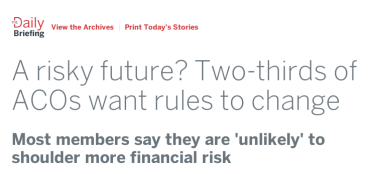
A risky future? Two-thirds of ACOs want rules to change

Over at The Advisory Board (always an excellent independent source of market intelligence) Chas Roades, Chief Research Officer vets the signal from the ACO community to CMS overlords with – you guessed it – more risk pushback: A risky future? Two-thirds of ACOs want rules to change Citing a recent survey from the National Association of ACOs (NAACOs):

  • About 67% of program participants say they are unlikely to adopt a two-sided risk model in the next round of contracts;
  • 46% of its members are “very unlikely” to accept two-sided risk in the next round; and
  • 21% are “somewhat unlikely” to take on greater risk.

So the dance between the regulators and the regulated continues. Whether this NPRM public/private mechanism to source, develop and issue industry ground rules can succeed in crafting a new paradigm of healthcare delivery and finance – short of single payer – that doesn’t bankrupt the country remains to be seen.

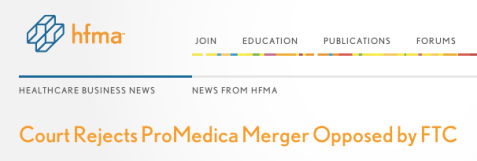
Court Rejects ProMedica Merger Opposed by FTC 

Court Rejects ProMedica Merger Opposed by FTCOne of the ‘counseled’ potential market risks via the ‘Notice of Proposed Rule Making’ process (NPRM) associated with the implementation of the Affordable Care Act and the provisions specific to enabling the formation of Accountable Care Organizations (ACOs) is provider asset concentration in markets to consolidate power, grow share and leverage price. Ergo, the recent unanimous decision via a three-judge panel in the U.S. 6th Circuit Court of Appeals in Cincinnati to deny ProMedica’s petition to overturn a 2011 FTC ruling that ProMedica’s bid to merge with Toledo-area St. Luke’s was anticompetitive is worth a read. Whether the judges can adjudicate pro-market equilibrium also remains to be seen.

DaVita lowers earnings forecast as medical group unit underperforms

Consider this next story as more narrative in the vetting of business models that might work in an ‘ACA implementation quiver’ portfolio of sorts. DaVita lowers earnings forecast as medical group unit underperforms

In today’s murky and mostly transitional but assuredly disruptive operating environment, layered with conflicting financial incentives and nominal to no effective alignment between health systems and their physician ‘partners’ the pursuit of ‘successor’ managed competition models is no sure thing. Sourcing and grafting clinically integrated (both virtual and otherwise) models into local footprints that can legitimately enable the sometimes mutually exclusive (or seemingly so) objectives of the triple aim (better experience of care, better outcomes at lower per capita costs), the acquisition by renal care center operator DaVita of Healthcare Partners and thus entry into the integrated medical group operational theater is one to watch and dissect for clues.

The investor call is well worth the listen, including the entire Q & A from the usual institutional suspects following the industry.

(NOTE: though obviously very smart and knowledgeable you might want to caveat analyst engagement of DaVita/Healthcare Partners leadership with the history of due diligence applied during the vetting of the PPMC industry – a Ponzi scheme that sold many into serfdom while broker/dealers and underwriters pocketed millions).

The rather clever but telling ‘formula’ articulated by Kent Thiry (beginning at the 00:18:50 mark), DaVita’s talented and straight talking CEO is revealing. He nets it out as follows, then articulates the company’s performance on across it’s two principal verticals:

effective rate (OI) – expense x volume x execution risk = performance 

The net for aggregate medical group operations of Healthcare Partners:

down/more down than up/unit growth very promising/legacy solid, new ventures poor

Again, the investor call is well worth a listen if you want a deeper dive into the nexus between strategy and the challenging real world of implementation.

FTC Examining Health Care Competition Workshop: Panel 3: Advancements in Healthcare Technology

 Examining Health Care Competition Workshop - Part 3 The FTC’s ambitious and timely exploration of ‘consumer facing issues’ albeit not in sound byte fashion is a rather compelling and insightful journey into the status of health information technology as enablers [or obstacles] of the integration vision (care management, coordination, de-siloing the silos of American sick care) albeit from a central or more accurately distributed ‘IT’ spine perspective.

The ‘Panel 3: Advancements in Health Information Technology (HealthIT)‘ session focused on the competitive considerations that FTC should incorporate into their process as they catch up with market changes.

This is a MUST watch series for all but especially e-patients and healthIT professionals. The eloquent exploration of industry issues and observations proffered by both former ONC Director Farzad Mostashari, MD and AthenaHealth VP for Government & Regulatory Affairs, Dan Haley are worth the effort of watching the entire clip. As an alternative you can scroll through the transcript of the session pasted here.

There’s more to share, but we’ll roll them into the next Round-Up.

***********


We Don’t Need No Stinkin’ Gatekeepers: Oh Really?

Some have suggested that ACOs are a new and improved as in ‘consumer friendly’ version of their managed care predecessors – HMOs.

Editor’s Note: For an excellent historical overview on the genesis of the American sick-care industry, check out ‘Health Care Coverage in the United States: A Brief History.

As an ‘HMO lite’ derivative of sorts ‘accountable care collaborations’ (including Medicare certified ACOs and a growing pool of commercially negotiated arrangements), ACOs are emerging as hybrids of traditional managed care while incorporating increasing elements of consumer or patient centric care.HMO Said I Ws Fine

Back in the day (circa 1980s & 1990s), HMOs (and there were are range of models from staff to group to network or IPAs) most were of the ‘gatekeeper’ variety – wherein primary care physicians aka ‘PCPs’ were assigned the ‘care coordination’ or care management responsibility to provide basic health services and prudently refer specialty or tertiary care services to a preferred panel of vetted (quality and cost) consultants or specialists.

While sound in theory the real world didn’t work as smoothly as network designers – if not their quant actuaries envisioned. Many PCPs provided little if any of the assumed medical necessity determinations and/or care coordination. They either routinely referred all cases, or none at all. There simply wasn’t a quality set that guarded against ‘sloppy’ or less than standard of care practice, while promoting a more prudent utilization of clinical resources. As a result, HMOs got a bad wrap which came home to roost in the movie ‘As Good As It Gets‘, when actress Helen Hunt expressed the then prevailing sentiment most felt towards these ‘mother may I’ barriers to quality healthcare.

Postscript: As a testimonial to the power of popular culture, shortly after this film United HealthGroup decided to abandon the gatekeeper HMO model and permitted direct access to specialists, thus in one fell swoop the premise (and promise) of gatekeeper medicine came to an end. 

However, one BIG difference between HMOs and ACOs is the latter must indirectly ‘traffic’ referrals ‘in network’ in order to have a shot at meeting savings benchmarks established by CMS. Whereas HMOs typically drove patients into their contracted and thus discounted network of preferred (or even exclusive) providers prospectively via gatekeepers and/or the ‘mother may I’ bureaucracy.

CMS received quite a bit of input on the disproportionate risk assumed via a ‘hands-off’ retrospective ‘attribution’ mechanism. In other words, at the end of the reconciliation period and after all member incurred costs are attributed to an ACO accounting pool, the hope was there would be savings sufficient for distribution and sharing. In a way, this represents the best in a ‘faith based’ performance model.

So at one level one might say, be careful what you pray for! Providers (not just members) also lobbied against gatekeepers and heavy handed managed care overlords, and ACOs are what we got. We shall see whether the faith placed in an accountable care ‘triple aim’ paradigm will be sufficient to drive referral patterns and prudent utilization of delivery system resources, or whether ‘the old is new again’ and gatekeeper medicine returns via a 2.0 iteration.

A recent study published by the American Medical Association in JAMA Internal Medicine titled ‘Outpatient Care Patterns and Organizational Accountability in Medicare‘ is drawing timely attention to the ‘leakage experience’ reported by many ACOs. Specifically:

 66.7% of office visits with specialists were provided outside of the assigned ACO. 

So who knows? Maybe it’s days ain’t over!

The complete results are posted below:

Of beneficiaries assigned to an ACO in 2010, 80.4% were assigned to the same ACO in 2011.

Of those assigned to an ACO in 2010 or 2011, 66.0% were consistently assigned in both years.

Unstable assignment was more common among beneficiaries with fewer conditions and office visits but also among those in several high-cost categories, including the highest decile of per-beneficiary spending.

Among ACO-assigned beneficiaries, 8.7% of office visits with primary care physicians were provided outside of the assigned ACO, and 66.7% of office visits with specialists were provided outside of the assigned ACO.

Leakage of outpatient specialty care was greater for higher-cost beneficiaries and substantial even among specialty-oriented ACOs (54.6% for lowest quartile of primary care orientation).

Of Medicare spending on outpatient care billed by ACO physicians, 37.9% was devoted to assigned beneficiaries. This proportion was higher for ACOs with greater primary care orientation (60.0% for highest quartile vs 33.6% for lowest).

My Chat with Nicole Bradberry

This Week in Accountable Care Meet Nicole BradberryOn the anniversary of the launch of the Florida Association of ACOs and the vital role of MSOs in supporting the operations of disruptive business models chasing the sustainable healthcare ecosystem I had a round two conversation with Nicole Bradberry, President and Chief Operating Officer of Orange Health Solutions and CEO of the Florida Association of ACOs.

Listen as we learn more about the accountable care market one year later, including insights on the investment by Great Point Partners in Orange Health Solutions enabling the acquisition of MZI Healthcare including it’s suite of products built on the EZCAP chassis.


Innovations in Healthcare Delivery: A Brookings Merkin MedTalk Series

In the physician directed and emerging ‘accountable care’ space, few have the depth and range of experience, operating success, learning curves and business model diversity than the collective enterprises associated with the vision and tenacity of Richard Merkin, MD – physician, philanthropist and visionary. In fact, with Davita’s 2012 acquisition of Healthcare Partners into it’s publically traded parent, one might consider Dr. Merkin’s extensive managed (now including ‘accountable care’) portfolio to be a ‘last man standing’ at scale scenario in the physician led integrated delivery system domain.

Clearly there are others, but few match the member scale and market savvy that Dr. Merkin et al, has and continues to assemble. Further consider the C-suite management team behind the Merkin enterprise. Names such as Mark Wagar, President Heritage Medical Systems (AMI, CompreCare, American Physician Partners, Empire Blue Cross and Blue Shield), Richard Lipeles (PacificCare),  Kathy Nix, and Jaya Kurian to name only a few.

So when two trophy nameplates team up, i.e., Brookings and Merkin, to launch the Merkin Initiative industry veterans and health-wonk wannabes should pay close attention.

This impressive series nested at Brookings is titled the ‘Merkin Initiative on Payment Reform and Clinical Leadership‘. It originally streamed live on April 16th, 2014 c/o @BrookingsMed. The program description notes the following:

“Treating Congestive Heart Failure and the Role of Payment Reform: Lessons from Duke University Health System and the University of Colorado Hospital.” The agenda includes seven brief “TED-style” talks that will cover the clinical effects of congestive heart failure (CHF), its economic impact on the health system, as well as firsthand experiences from Duke and Colorado about their CHF care strategies, and how they used alternative payment models to support these innovations.

The tweetstream can be retrieved via #MedTalk.

[Program Note: fast forward to 15:30 mark for beginning of the webcast]

Now sit back and consume this informative series including wrap-up panel of presentations on the ‘tectonic’ ecosystem shift from volume to value. Finally, in the white water of the transformational imperative, I’m reminded of the William Gibson often quoted in tech sectors of late ‘advisory’:

The future is already here — it’s just not very evenly distributed.


Healthcare Change is Not Coming. Healthcare has Changed!

Why Clinical Integration is Essential for the Future of Independent Physicians

Guest post by Ben Humphrey, MD, CPE, MGO Healthcare Consulting (1,2,3)

We’re past the tipping point and are proceeding headlong into new market-driven accountability for quality, cost and value. As these large-scale changes progress, physicians who want to thrive and be positioned for long-term success will have to embrace new ideas and approaches in their practices.Ben Humphrey MD

A few years ago physicians in Ohio created their own physician-owned company to assist themselves with success in the changing world of healthcare. Via their company, The Medical Group of Ohio (MGO), they created a clinically integrated physician network comprised of nearly 2,100 physicians. The vast majority of these physicians are in small independent practices. Being clinically integrated means the physicians are working together, using proven physician-created protocols and measures, to demonstrably improve patient care, decrease cost, and deliver value.

At the heart of medicine is the patient-physician relationship. As physicians we view this as the basis for good health and healthcare delivery. Individually we are providing excellent, yet uncoordinated care. This new approach has allowed MGO to advance a clinically integrated network of physicians and facilities by having the knowledge, tools and confidence that our patients will be receiving the best, most appropriate care possible. That care is coordinated throughout the entire continuum of care. Accordingly MGO has been able to directly and demonstrably affect health outcomes for large populations of patients while also being able to bend the cost curve which is so desperately needed and being demanded in the marketplace.

By their collective efforts MGO physicians have been able to invest in the resources needed to build and enable this network. The cornerstone is proprietary data collection and software that has allowed us to have access to the most complete and trusted patient data offered. MGO has effectively utilized this data to measure the performance of the individual physicians/groups and the network as a whole, rewarded performance, and continuously shared best practices enabling improvement through practice transformation. Simply, MGO has enabled physicians by providing actionable information regarding their patients in a real time fashion.

MGO is a physician-owned and led organization; hence the approach is physician-driven. Physicians are not only “at the table” but are collectively creating and implementing the clinically integrated / accountable care approach.

This approach is having great success in our market and physicians have been rewarded appropriately for their success. To deliver this clinically integrated program has necessitated MGO to collectively negotiate reimbursement rates on behalf of the entire physician network.

Many ask if this type of model is applicable within their own market. The answer is yes. MGO has shared its approach with physicians throughout the country and as a result local, physician-led clinically integrated approaches are developing,

While this approach involves significant change; it is absolutely necessary. As employers and/or payers demand proven value-based healthcare and with the inevitable shift from rewarding volume to rewarding value; physicians must be able to demonstrate a new standard of care to effectively remain competitive for the foreseeable future.
_____________________________________________________________________________
1) Additional information about MGO’s clinically integrated network can be found at http://www.TheMGO.com and http://www.Health4.com.

2) Dr. Ben Humphrey served for nearly 20 years as The Medical Group of Ohio’s CEO- from the company’s inception. He is currently working with MGO Healthcare Consulting. MGO is Ohio’s largest Independent Physician Association (IPA) and along with its hospital partner, OhioHealth, has created a successful clinically integrated network of physicians and facilities called Health4. Health4 has network contracts with the market’s large commercial payers and Medicare advantage plans.

3) Article originally sourced from Florida Healthcare Law Firm.