We Don’t Need No Stinkin’ Gatekeepers: Oh Really?

Some have suggested that ACOs are a new and improved as in ‘consumer friendly’ version of their managed care predecessors – HMOs.

Editor’s Note: For an excellent historical overview on the genesis of the American sick-care industry, check out ‘Health Care Coverage in the United States: A Brief History.

As an ‘HMO lite’ derivative of sorts ‘accountable care collaborations’ (including Medicare certified ACOs and a growing pool of commercially negotiated arrangements), ACOs are emerging as hybrids of traditional managed care while incorporating increasing elements of consumer or patient centric care.HMO Said I Ws Fine

Back in the day (circa 1980s & 1990s), HMOs (and there were are range of models from staff to group to network or IPAs) most were of the ‘gatekeeper’ variety – wherein primary care physicians aka ‘PCPs’ were assigned the ‘care coordination’ or care management responsibility to provide basic health services and prudently refer specialty or tertiary care services to a preferred panel of vetted (quality and cost) consultants or specialists.

While sound in theory the real world didn’t work as smoothly as network designers – if not their quant actuaries envisioned. Many PCPs provided little if any of the assumed medical necessity determinations and/or care coordination. They either routinely referred all cases, or none at all. There simply wasn’t a quality set that guarded against ‘sloppy’ or less than standard of care practice, while promoting a more prudent utilization of clinical resources. As a result, HMOs got a bad wrap which came home to roost in the movie ‘As Good As It Gets‘, when actress Helen Hunt expressed the then prevailing sentiment most felt towards these ‘mother may I’ barriers to quality healthcare.

Postscript: As a testimonial to the power of popular culture, shortly after this film United HealthGroup decided to abandon the gatekeeper HMO model and permitted direct access to specialists, thus in one fell swoop the premise (and promise) of gatekeeper medicine came to an end. 

However, one BIG difference between HMOs and ACOs is the latter must indirectly ‘traffic’ referrals ‘in network’ in order to have a shot at meeting savings benchmarks established by CMS. Whereas HMOs typically drove patients into their contracted and thus discounted network of preferred (or even exclusive) providers prospectively via gatekeepers and/or the ‘mother may I’ bureaucracy.

CMS received quite a bit of input on the disproportionate risk assumed via a ‘hands-off’ retrospective ‘attribution’ mechanism. In other words, at the end of the reconciliation period and after all member incurred costs are attributed to an ACO accounting pool, the hope was there would be savings sufficient for distribution and sharing. In a way, this represents the best in a ‘faith based’ performance model.

So at one level one might say, be careful what you pray for! Providers (not just members) also lobbied against gatekeepers and heavy handed managed care overlords, and ACOs are what we got. We shall see whether the faith placed in an accountable care ‘triple aim’ paradigm will be sufficient to drive referral patterns and prudent utilization of delivery system resources, or whether ‘the old is new again’ and gatekeeper medicine returns via a 2.0 iteration.

A recent study published by the American Medical Association in JAMA Internal Medicine titled ‘Outpatient Care Patterns and Organizational Accountability in Medicare‘ is drawing timely attention to the ‘leakage experience’ reported by many ACOs. Specifically:

 66.7% of office visits with specialists were provided outside of the assigned ACO. 

So who knows? Maybe it’s days ain’t over!

The complete results are posted below:

Of beneficiaries assigned to an ACO in 2010, 80.4% were assigned to the same ACO in 2011.

Of those assigned to an ACO in 2010 or 2011, 66.0% were consistently assigned in both years.

Unstable assignment was more common among beneficiaries with fewer conditions and office visits but also among those in several high-cost categories, including the highest decile of per-beneficiary spending.

Among ACO-assigned beneficiaries, 8.7% of office visits with primary care physicians were provided outside of the assigned ACO, and 66.7% of office visits with specialists were provided outside of the assigned ACO.

Leakage of outpatient specialty care was greater for higher-cost beneficiaries and substantial even among specialty-oriented ACOs (54.6% for lowest quartile of primary care orientation).

Of Medicare spending on outpatient care billed by ACO physicians, 37.9% was devoted to assigned beneficiaries. This proportion was higher for ACOs with greater primary care orientation (60.0% for highest quartile vs 33.6% for lowest).
My Chat with Nicole Bradberry

This Week in Accountable Care Meet Nicole BradberryOn the anniversary of the launch of the Florida Association of ACOs and the vital role of MSOs in supporting the operations of disruptive business models chasing the sustainable healthcare ecosystem I had a round two conversation with Nicole Bradberry, President and Chief Operating Officer of Orange Health Solutions and CEO of the Florida Association of ACOs.

Listen as we learn more about the accountable care market one year later, including insights on the investment by Great Point Partners in Orange Health Solutions enabling the acquisition of MZI Healthcare including it’s suite of products built on the EZCAP chassis.


Innovations in Healthcare Delivery: A Brookings Merkin MedTalk Series

In the physician directed and emerging ‘accountable care’ space, few have the depth and range of experience, operating success, learning curves and business model diversity than the collective enterprises associated with the vision and tenacity of Richard Merkin, MD – physician, philanthropist and visionary. In fact, with Davita’s 2012 acquisition of Healthcare Partners into it’s publically traded parent, one might consider Dr. Merkin’s extensive managed (now including ‘accountable care’) portfolio to be a ‘last man standing’ at scale scenario in the physician led integrated delivery system domain.

Clearly there are others, but few match the member scale and market savvy that Dr. Merkin et al, has and continues to assemble. Further consider the C-suite management team behind the Merkin enterprise. Names such as Mark Wagar, President Heritage Medical Systems (AMI, CompreCare, American Physician Partners, Empire Blue Cross and Blue Shield), Richard Lipeles (PacificCare),  Kathy Nix, and Jaya Kurian to name only a few.

So when two trophy nameplates team up, i.e., Brookings and Merkin, to launch the Merkin Initiative industry veterans and health-wonk wannabes should pay close attention.

This impressive series nested at Brookings is titled the ‘Merkin Initiative on Payment Reform and Clinical Leadership‘. It originally streamed live on April 16th, 2014 c/o @BrookingsMed. The program description notes the following:

“Treating Congestive Heart Failure and the Role of Payment Reform: Lessons from Duke University Health System and the University of Colorado Hospital.” The agenda includes seven brief “TED-style” talks that will cover the clinical effects of congestive heart failure (CHF), its economic impact on the health system, as well as firsthand experiences from Duke and Colorado about their CHF care strategies, and how they used alternative payment models to support these innovations.

The tweetstream can be retrieved via #MedTalk.

[Program Note: fast forward to 15:30 mark for beginning of the webcast]

Now sit back and consume this informative series including wrap-up panel of presentations on the ‘tectonic’ ecosystem shift from volume to value. Finally, in the white water of the transformational imperative, I’m reminded of the William Gibson often quoted in tech sectors of late ‘advisory’:

The future is already here — it’s just not very evenly distributed.


Healthcare Change is Not Coming. Healthcare has Changed!

Why Clinical Integration is Essential for the Future of Independent Physicians

Guest post by Ben Humphrey, MD, CPE, MGO Healthcare Consulting (1,2,3)

We’re past the tipping point and are proceeding headlong into new market-driven accountability for quality, cost and value. As these large-scale changes progress, physicians who want to thrive and be positioned for long-term success will have to embrace new ideas and approaches in their practices.Ben Humphrey MD

A few years ago physicians in Ohio created their own physician-owned company to assist themselves with success in the changing world of healthcare. Via their company, The Medical Group of Ohio (MGO), they created a clinically integrated physician network comprised of nearly 2,100 physicians. The vast majority of these physicians are in small independent practices. Being clinically integrated means the physicians are working together, using proven physician-created protocols and measures, to demonstrably improve patient care, decrease cost, and deliver value.

At the heart of medicine is the patient-physician relationship. As physicians we view this as the basis for good health and healthcare delivery. Individually we are providing excellent, yet uncoordinated care. This new approach has allowed MGO to advance a clinically integrated network of physicians and facilities by having the knowledge, tools and confidence that our patients will be receiving the best, most appropriate care possible. That care is coordinated throughout the entire continuum of care. Accordingly MGO has been able to directly and demonstrably affect health outcomes for large populations of patients while also being able to bend the cost curve which is so desperately needed and being demanded in the marketplace.

By their collective efforts MGO physicians have been able to invest in the resources needed to build and enable this network. The cornerstone is proprietary data collection and software that has allowed us to have access to the most complete and trusted patient data offered. MGO has effectively utilized this data to measure the performance of the individual physicians/groups and the network as a whole, rewarded performance, and continuously shared best practices enabling improvement through practice transformation. Simply, MGO has enabled physicians by providing actionable information regarding their patients in a real time fashion.

MGO is a physician-owned and led organization; hence the approach is physician-driven. Physicians are not only “at the table” but are collectively creating and implementing the clinically integrated / accountable care approach.

This approach is having great success in our market and physicians have been rewarded appropriately for their success. To deliver this clinically integrated program has necessitated MGO to collectively negotiate reimbursement rates on behalf of the entire physician network.

Many ask if this type of model is applicable within their own market. The answer is yes. MGO has shared its approach with physicians throughout the country and as a result local, physician-led clinically integrated approaches are developing,

While this approach involves significant change; it is absolutely necessary. As employers and/or payers demand proven value-based healthcare and with the inevitable shift from rewarding volume to rewarding value; physicians must be able to demonstrate a new standard of care to effectively remain competitive for the foreseeable future.
_____________________________________________________________________________
1) Additional information about MGO’s clinically integrated network can be found at http://www.TheMGO.com and http://www.Health4.com.

2) Dr. Ben Humphrey served for nearly 20 years as The Medical Group of Ohio’s CEO- from the company’s inception. He is currently working with MGO Healthcare Consulting. MGO is Ohio’s largest Independent Physician Association (IPA) and along with its hospital partner, OhioHealth, has created a successful clinically integrated network of physicians and facilities called Health4. Health4 has network contracts with the market’s large commercial payers and Medicare advantage plans.

3) Article originally sourced from Florida Healthcare Law Firm.

The Medicare Shared Savings Program: Class of 2015

By Gregg A. Masters, MPH

The clock is ticking and the CMS continues its community outreach via their series of National Provider Calls on the application process for ACOs interested in submitting for the Medicare Shared Savings Program.Medicare Shared Savings Program

The deadline for the class of 2015 is approaching with the next call scheduled for Tuesday, April 22nd 2014 from 1;30 – 3PM Eastern.

You can register for this call here.

Space is limited and demand for these calls often exceed available slots, so get your registration in early.

Meanwhile, the description of the program is as follows:

During this MLN Connects™ National Provider Call, CMS subject matter experts cover helpful tips on completing a successful application, including information on how to submit an acceptable ACO Participant List, Sample ACO Participant Agreement, Executed ACO Participant Agreements, and Governing Body Template for the Medicare Shared Savings Program application. A question and answer session follow the presentation.

The Shared Savings Program Application web page has important information, dates, and materials on the application process. Call participants are encouraged to review the application and other materials found on this web page prior to the call.

Target Audience

Potential 2015 ACO Applicants

Presentation

The presentation for this call will be posted at least one day in advance of the call on the MLN Connects™ National Provider Calls and Events web page. Select the call date and scroll to the “Call Materials” section to locate the slide presentation. A link to the audio recording and written transcript of this call will be posted under the “Calls Materials” section in approximately 2 weeks following the call.

Registration will close at 12:00 p.m. ET on the day of the call or when available space has been filled.

An ACO ‘Deck-o-Topia’ at HiMSS14

By Gregg A. Masters, MPH

This is the fourth year in  row that I have participated in the largest annual gathering of parties in interest to the health informatics ecosystem. From payor to provider to regulator to vendor to the patient and/or consumer of healthcare services, there is always much flare to consider, discard or assimilate. HIMSS14

This year’s gathering is expected to attract somewhere between 30 to 35 thousand attendees. Second only to CES the HiMSS sea of humanity is a distinct strain of conversation to experience.

From one of the tracks that directly appeals to readers of this blog is the track devoted to accountable care and/or ACOs in particular. More later with an individual dive into the more interesting presentations, but the entire decks can be accessed via: Transitioning to Fee-for-Value through ACOs, Care Coordination and Clinical Integration.

Patient Engagement in an ACO World

By Gregg A. Masters, MPH

Last June I had the honor or moderating a panel on ‘unlocking innovation in patient engagement’ in an ACO World at MedCity News’s ENGAGE conference. Joining me on the panel are: Libby Webb, Director, Product Management, Athenahealth, Lanie W. Abbott, APR, Senior Communications & Outreach Coordinator, EMHS Population Health Management and Colin Ward, MHS, Executive Director, Greater Baltimore Health Alliance.

During the session we discuss ACO implementation issues and how early movers are mobilizing and organizing to drive sustained patient engagement while conforming to a complicated set of ACO policies. Patient engagement will continue to be the missing link in new value-based reimbursement programs until the quality of patient communications leads to consistent behavior. We discuss how new ACOs are investing in benchmarking tools and communications interventions that will measurably improve the quality of physician-patient communication.

More than Half of ACOs ‘Save Money’ Only 1/4 Bonus Providers

By Gregg A. Masters, MPH

In the narrative matters department and following CMS’s press release on January 30th, 2014 of the ‘interim financial results for select Medicare Accountable Care Organization (ACO) initiatives, an in-depth savings analysis for Pioneer ACOs, results from the Physician Group Practice demonstration, and expanded participation in the Bundled Payments for Care Improvement Initiative’ several downstream headlines are instructive in this continuing battle for the hearts and minds of the American public towards the Affordable Care Act.

Physician Standing Up the ACOOver at Healthcare IT News, Bernie Monegain, Editor chimes in via: ‘More than half of ACOs show savings: Accountable care organizations are helped by the use of health information technology.’

While at Kaiser Health News staff writer Jenny Gold notes: ‘ACOs Saving Some Money, But Medicare Is Short On Details.’

And Melanie Evans at Modern Healthcare asserts ‘Providers net uneven results from ACO experiment‘ re-capping the data as follows:

Slightly more than half of the 114 organizations to join one of two Medicare accountable care efforts in 2012 did not reduce health spending below targets during their first 12 months trying to do so, newly released CMS data show. 

Of the remaining organizations, 29 reduced spending enough to keep some of what they saved during the first 12 months. The rest slowed health spending, but marginally. 

Take your pick, there are plenty more to chose from and whether your view is from a glass ‘half empty’ or ‘half full’ perspective your answer to whether the ACA is working or not, and in particular, can ACOs enable the required transformation is likely to be shaped by whether you have a dog in the hunt if not personal skin in the game.

To sort through and make some sense of this nascent industry ‘report card’ are three industry veterans who will help us dive past the headlines and into the weeds of the ACO experience. Recognizing that ACOs not a homogeneous bunch and vary operationally and by market, there is a fair amount of context setting to actually interpret the results.

On the next episode of ‘This Week in Accountable Care‘ I am joined by three seasoned players in and around the space including Fred Goldstein, Jim Hansen and David Crais.

For live or archived replay of this episode, click here.

Join us for an informative chat and tag your tweets with #ACOchat and will put your questions and/or comments into the conversation.

It’s All About the Network

By Gregg A. Masters, MPH

2014 has kicked off to a challenging pace and doesn’t look to let up any time soon!

Over at Health Innovation Media where we follow health innovation from ‘idea to business model’ including accountable care platforms, ‘apps’ or infrastructure plays,  Dr. Pat Salber, CEO of early mover in the ‘rewards based’ crowd funding and innovation challenge space HealthTech Hatch and curator of The Doctor Weighs In and me are in workflow overflow from the mHealth Summit 2013 in National Harbor, VA.

If that wasn’t enough of a stretch for our new media startup, we just concluded the better part of the week in Las Vegas covering digital health developments at CES 2014 (see: Amidst the CES 2014 Firehose: Brands, Blogs & ‘PR’ Compete for Relevance in the Digital Economy) and it’s internally nested ‘Digital Health Summit‘, only to return to California challenged by the depth and breadth of the proceedings from both the JP Morgan Healthcare Conference and lesser known OneMed Forum.

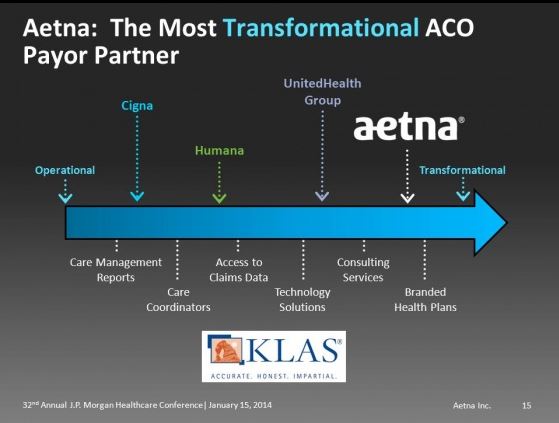
One vetted message with relevant context to accountable care and the associated quest for the triple aim is sourced from the above JP Morgan Healthcare conference. The inspiration for this post’s headline and specifically it’s inherent ‘managed competition’ wisdom is courtesy of the CEO of the most ‘transformational ACO payor partner‘ – at least from the point of view of KLAS‘s ‘Accountable Care Payers: Partners in a Changing Paradigm‘. That player is Aetna or perhaps an attribution more holistically made to the aggregate activities of it’s fire-walled innovation sub Healthagen.

JPM14 KLAS transformer recognition

In his talk Mark Bertolini Aetna Chairman, President & CEO a man who’s career was forged squarely in the belly of HMO culture inside a traditional service vs. indemnity play,  via a rust belt domiciled ‘Blue plan’ competitor lays out the challenge not just for Aetna, but anyone in the accountable care space whether payor, provider or hybrids intent upon the co-creation of a sustainable future.

(NOTE: The entire series of JP Morgan webcasts including decks (where supplied) are accessible here. You’ll  need provide your email for a one time registration process to access all sessions, but the benefits are well worth it).

Back to Bertolini’s message, here are some note-able quotes from a very insightful and smart senior executive who sets the transformational imperative as follows:

This is how people feel about the healthcare system, it was designed in 1945 after WW2. It was funded by Hill Burton, and not much has changed over that time period in the way we run our healthcare system.

We leave the consumer to try and find their way through the system without much information, without much transparency.

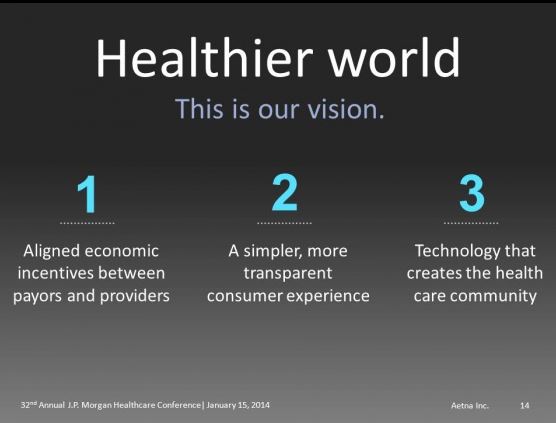
So our goal is to change the system to align the incentives on the provider side [with the payor], give the consumers the tools so these questions can be answered and they can find a direct line of sight about how to use healthcare.

Our view is the system should work around the member, that it should be all about the member and  that it should be a personalized experience where all of these issues come together in one way… [i.e., the triple aim]

JPM14 Aetna healthier world


‘Line of sight’ what?

Heresy one might say from a once ‘all in’ little-to-no copay access to comprehensive health benefits HMO guy to now espouse a role for a marquee health plan operator to drive ecosystem integration between a tech enabled but evolving retail medicine (aka consumer directed or high deductible health plan world) segment and the costly, inflated, siloed and opaque sick care non-system.

But there’s more as the story is not so simple, nor easily analogized.

Bertolini continues and goes to the fundamental drivers of the Affordable Care Act and the enabling ACOs, ‘accountable care arrangements’ or their derivative plays that will ‘chop the wood and carry the water’ of this unprecedented transformation of a WW2 vintage legacy paradigm on life support.

If you’ve seen one ACO, you’ve seen one ACO, we do not call all of our value based contracting an ACO.

We have 100’s of value based contracting arrangements and various incentive programs in place, but for us, an ACO is an enabled provider network that’s at risk with us to improve the overall outcome for the patient and get rewarded as a result of making that happen.

Branded health plans is the next step [in the KLAS continuum noted above] and our most recent relationship with Inova we have launched Innovation Health Plans which is a branded private product of the Inova Health System in Northern Virginia.

This whole idea is to create transformational relationships with providers that let them be in the business of providing health plans to their community, allow them to change their revenue model by enrolling their patients and getting [Aetna] out of the middle of that relationship. We provide the risk mechanism, the technology and the intellectual property to allow it to happen, and that is what our ACO model is.

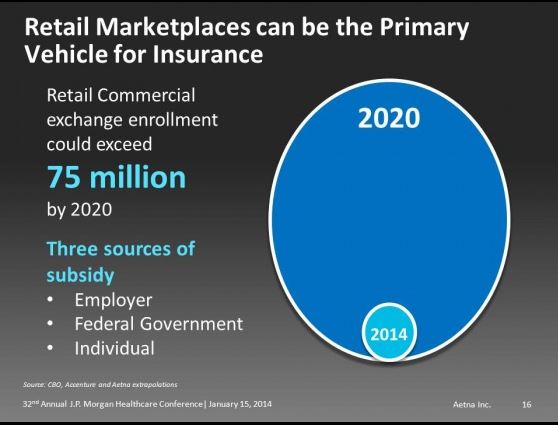
Bertolini then pivots to adding value in this expanding ‘retail’ market where Aetna enables informed choice via tools that empower members with the requisite ‘line of sight’ and thus gain share given projected enrollment of 75 million by 2020.

JPM14 Aetna retail projections

May I say, with the posting of this strategic glidepath the pivot of Aetna as a proxy for the legacy carrier health insurance business (including their forays into the HMO business) comes to an end. Rather re-skinned PPO’s, POS’s, and OWA’s morphed into ACOs of varying stripes intent upon passing increasing ‘skin in the game’ exposure to their members or insureds to vote with their feet and thus pocketbooks is now permanently enshrined as the defacto standard of ‘health insurance’ (whether ASO, fully or now retail/exchange based) in the U.S.

In this new model, health plans will morph into ‘utility companies’ who’s core competencies will center or transactional efficiency, member empowerment (to promote informed line of sight choices) and ecosystem stakeholder homeostasis largely as benefit solutions providers more and more with local or regional provider co-branding and sponsorship DNA.

Don’t get me wrong, I respect Mark and his chief architect Chuck Saunders, MD who’s assembling these consumer, informational and transactional empowerment capabilities inside the Aetna mothership via a ‘fire-walled’ Healthagen. From MediCity to iTriage and Active Health, this is precisely what the new zeitgeist requires of the legacy health insurance business.

Lets just call it as it is, AHIP and it’s member partners (principally the Health Insurance Association of America/HIAA constituency, exclusive of the Group Health Association of America/GHAA contingent) have failed at managing clinical risk and have effectively thrown in the towel, i.e., managed care was never more than mere contracting for discounted pricing, as armies of medical directors rarely denied more than 1% of referrals and/or admissions.

So today, surprise, surprise, it’s all about the network – as in ‘high value networks’ – tighter, smaller value based clusters of high performing provider collaborations.

Again, this is a fabulous pitch by Bertolini and one I highly recommend you listen to in it’s entirety.

Next up similar insights from AthenaHealth CEO Jonathan Bush followed by a somewhat anemic if not apologetic performance of Universal American’s CEO I’ll title ‘a not so healthy collaboration.’

As always, your thoughts, opinions or challenges are welcome.

123 ACOs Join the Shared Savings Dance Card

By Gregg A. Masters, MPH

CMS has announced another round of certified ACOs participating in the Medicare Shared Savings Program effective for January 1, 2014. The complete list is available here.

One observation I’ll make is Universal American (UAM) seems to remain active in building a national footprint of managed ACO collaborations. Their risk sharing model was previously addressed here. Yet, all is not well in ‘dodge’ as Zack’s recently downgraded UAM to ‘strong sell.’ For the complete Zacks piece, see: ‘Universal American Slips to Strong Sell.’

Per their reasoning (and this doesn’t bode well for the UAM business model – at least yet). Earlier in the 90s there was a similar ‘roll up’ i.e, venture backed top line fueled growth by American Healthcare Services, Inc. (AHI) that seems somewhat of a similar glide-path – we shall see.

Why the Downgrade?

Universal American witnessed downward estimate revisions following weak third-quarter 2013 results, which included a negative surprise of 214.3%. Shares of this life-insurer lost nearly 5.2% since the company reported soft results on Nov 7 and given its expected negative earnings growth rates in the upcoming quarters, we feel it has more downside left.

Meanwhile, per the CMS press release on December 23rd, 2013, here are the details and preferred narrative on ACO growth:

More partnerships between doctors and hospitals strengthen coordinated care for Medicare beneficiaries  

123 New Accountable Care Organizations Join Program to Improve Care for  Medicare beneficiaries

Doctors, hospitals and other health care providers have formed 123 new Accountable Care Organizations (ACOs) in Medicare, providing approximately 1.5 million more Medicare beneficiaries with access to high-quality coordinated care across the United States, Health and Human Services Secretary Kathleen Sebelius announced today.

CMS App ClippedDoctors, hospitals and health care providers establish ACOs in order to work together to provide higher-quality coordinated care to their patients, while helping to slow health care cost growth. Since passage of the Affordable Care Act, more than 360 ACOs have been established, serving over 5.3 million Americans with Medicare.  Beneficiaries seeing health care providers in ACOs always have the freedom to choose doctors inside or outside of the ACO. ACOs share with Medicare any savings generated from lowering the growth in health care costs when they meet standards for high quality care.

“Accountable Care Organizations are delivering higher-quality care to Medicare beneficiaries and are using Medicare dollars more efficiently,” Secretary Sebelius said.   “This is a great example of the Affordable Care Act rewarding hospitals and doctors that work together to help our beneficiaries get the best possible care.”

“This program puts the control in the hands of physicians and allows them to take the lead in an innovative way to deliver the right care to the right patient at the right time,” said Kelly A. Conroy, executive director of the Palm Beach ACO and South Florida ACO.  “We are honored to be a Medicare Shared Savings Program Accountable Care Organization, and after 18 months in the program, can proudly say that we have seen measurable success.  We are so impressed with our participating physicians’ enthusiasm towards the cultural shift, and it demonstrates that physicians are primed for the future of medicine.”

The ACOs must meet quality standards to ensure that savings are achieved through improving care coordination and providing care that is appropriate, safe, and timely. The Centers for Medicare & Medicaid Services (CMS) evaluates ACO quality performance using 33 quality measures on patient and caregiver experience of care, care coordination and patient safety, appropriate use of preventive health services, and improved care for at-risk populations.

The new ACOs include a diverse cross-section of health care providers across the country, including providers delivering care in underserved areas. More than half of ACOs are physician-led organizations that serve fewer than 10,000 beneficiaries. Approximately 1 in 5 ACOs include community health centers, rural health clinics, and critical access hospitals that serve low-income and rural communities.

Affordable Care Act provisions have a substantial effect on reducing the growth rate of Medicare spending.  Growth in Medicare spending per beneficiary hit historic lows during the 2010-2012 period, and this trend has continued into 2013. Projections by both the Office of the Actuary at CMS and the Congressional Budget Office estimate that Medicare spending per beneficiary will grow at approximately the rate of growth of the economy for the next decade, breaking a decades-old pattern of spending growth outstripping economic growth.

The next application period for organizations interested in participating in the Shared Savings Program beginning January 2015 will be in summer 2014.

More information about the Shared Savings Program, including previously announced ACOs, is available at:http://www.cms.gov/Medicare/Medicare-Fee-for-Service-Payment/sharedsavingsprogram/News.html.

For a list of the 123 new ACOs announced today, visit: http://www.cms.gov/Medicare/Medicare-Fee-for-Service-Payment/sharedsavingsprogram/Downloads/2014-ACO-Contacts-Directory.pdf.
# # #