From FutureMed to ACO Congress and Health Insurance Exchange West Summits

By Gregg A. Masters, MPH

Today I drove north some 150 miles or so from San Diego to the Century City Plaza Hotel complex in Los Angeles on the suitably named ‘avenue of the stars’ adjacent to the Fox entertainment empire. The Sunday session at FutureMed hosted at the Hotel Del Coronado was infectious and upbeat with as usual forward thinking and doing entrepreneurs, scientists and the people who love, follow or aspire to be one of them. BYQPw7vCUAAVaWr.jpg-large

The day was packed with inspirational speakers and concluded with a keynote than none other than San Diego’s digital health superstar and agitator for the creative destruction of medicine – Eric Topol, MD.

For a tweetchat dashboard of the action at FutureMed – the event runs through this Wednesday – click here. For the program agenda and schedule click here, while the transcript to date can be accessed here and the digital dashboard chronicling reach of the footprint is here.

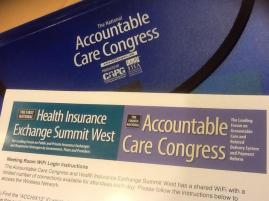
Meanwhile here we are at the current sessions of the 4th National ACO Congress and the 1st ‘Health Insurance Exchange Summit West’ which will no doubt be a annual affair for the near term – given the disastrous rollout of HealthCare.gov and the contrasted ‘successful’ reviews of those state administered exchanges in California aka Covered California and Kentucky aka Kynect.

As I sat in the audience at FutureMed hearing the passion of the presentors I regularly kept asking myself, ok this is all awesome stuff – from 3D printing/manufacturing of just about everything from organs to guitars, but how does it assimilate and disrupt our house of cards if not ‘calcified hairball’ (per Esther Dyson) of a healthcare financing and delivery system? And coincident as it turns out, the session I am attending for the next two days represent the best and brightest – if you will, of the aggregators if not orchestrators of the sustainable healthcare ecosystem envisioned by the triple aim?

We shall see! I will be monitoring both event hashtags via #ACOcongress and #FutureMed – and so can you.

The Merck Heritage Provider Network Innovation Challenge Posts a $240,000 Purse

By Gregg A. Masters, MPH

I received the following heads-up via email from former Senior Adviser to CTO Todd Park, now Health IT & Data Partnerships, Business Development, and Strategy at @Merck Aman Bhandari aka @GHIdeas on Sunday morning and wanted to make the challenge known to the innovation community especially those in hacking away at the triple aim via ACOs or accountable care derivatives. Merck Heritage Innovation Challenge

Innovation absent relevance to move the needle towards the triple aim whether at the business model, platform or app level is hardly innovation worthy incentivizing via challenges. Here we have an example of innovation that can matter of interest to any entity or enterprise managing risk and/or quality at the population level.

In the ’80/20 rule’ towards the drill down into where the greatest return can be realized via care management or adherence innovation, the focus is rightfully placed on the pandemic of diabetes with an annual total spend of $245 billion, heart disease $108 billion and the to be realized contribution from the digital health economy in the real world of healthcare operations.

The details of the challenge are as follows:

The Merck | Heritage Provider Network Innovation Challenge calls on entrepreneurs, data scientists, designers, healthcare providers, and big thinkers to create the products or services that will support patients with diabetes and/or heart disease in adhering to their care plans.

For people living with these chronic diseases, a care plan maps out critical recommendations around healthy behaviors, medication management, and nutrition. At the same time, the care plan can feel like a daunting regime with unattainable goals.

Submitted concepts should focus on human-centric opportunities to achieve health and wellness, draw on rich data sets to understand real-life behaviors of patients, and leverage the patient ecosystem to create novel methods for personalized support.

  • 5 Finalists get $20,000 and a 3 day intensive design, business modeling and prototyping bootcamp
  • 2 Finalists gets another $20,000 to potentially run a mini pilot with Heritage
  • 1 Finalist gets $100,000 to take the prototype and turn it into a real life solution

To enter the challenge, click here.

Thanks to Aman for the heads up!

ACOs ‘In the News’

Gregg A. Masters, MPH

heritage masthead

As the drip, drip, drip of the reported collateral fallout – both perceived and actual – of the stalemated resolution of the Federal shutdown makes it way into the American psyche we’re also seeing reports from the front on the success, indifference or failure of the ‘ACO vision’ to successfully pivot the healthcare borg from a fee-for-services (volume) to a fee-for-value paradigm.

Today’s news reports on two entities with which I am somewhat familiar – Texas Health Resources (THR) and Heritage Medical Systems (Heritage Provider Network) both parents respectively of first generation CMMI Pioneer plays. I served as the Vice President for Managed Care and Network Development at THR’s branded affiliate ‘Wellspan Health Network” (including System Health Providers (SHP) and consulting roles to Genesis Physicians Group) pre and post merger of Presbyterian Healthcare Resources and Harris Methodist Health System into THR, while at Heritage Southwest Medical Group, I championed provider network development and management including capitating specialty services for a global risk contracts.

Sourced from: ‘Digging Deeper: Lessons from an ACO Success Story.‘ Texas Health Resources

Perhaps framing the irony surrounding the confused narrative associated with the signature accomplishment of this President against a history of persistent previous legislative failure, the author notes:

We all know that the word “Obamacare” elicits immediate emotion from a good chunk of the American public. Thanks to late night TV host Jimmy Kimmel, and a media poll or two, we know that the words Affordable Care Act (ACA) do not elicit the same kind of emotion.

This only makes sense if you can buy with a straight face the sensibilities of the Tea Party cheerleading line of ‘keep your stinkin’ Government hands off my Medicare’ rant.

Meanwhile, the decisions of these two entities shed light on the underlying motivations likely to be driving in one case the decision to ‘step down’ in the risk ladder (THR) while in the second expressing a warp speed determination to proactively manage the risk exposure and deliver on the triple aim.

The author cites THR’s CIO Ed Marx aka @marxists on twitter as follows:

[THR] ….wanted to avoid paying a penalty, but was still focusing on ACO efforts. 

Whereas, Jonathan Gluck senior executive and counsel at the Heritage Provider Network notes, we’re:

…all in on the program.

This differential approach to risk is illustrative. Both entities at least in the Texas market have erratic performance. Heritage Southwest Medical Group ultimately declared bankruptcy during the global risk days in the late 90s, while THR returned to it’s hospital roots when the succession leadership vetting was over and the insurance culture of the then CEO of Harris Methodist Health System demurred to the predominant hospital culture of the Presbyterian leadership (aka the Smith v Hawthorne succession dance) by selling the Harris Methodist Health Plan to PacifiCare Health Systems.

It should come as no surprise that a physician organization untethered in any material ‘bricks and sticks’ sense to hospital infrastructure other than a drawer full of partial (at best) risk contracts should embrace the Pioneer model; whereas a hospital system even in partnership with a risk savvy physician organization the likes of ‘NTSP’ aka North Texas Specialty Physicians (_NTSP_), the JV partner in the Pioneer ACO) would step down and recalibrate their pathway options into this value shift.

The jury is out whether institutionally led health systems can re-engineer their culture let alone their asset portfolio to meet the vision quest of the triple aim via ACO intermediaries. If I were a betting man, my money would be on Dick Merkin and Mark Wagar, et al to tame the unrestrained appetite of the often maldistributed, excess capacity and misaligned production based assets.

AHIP Back in the ‘huddle’ and Reminiscent of the ‘GHAA Revolution’?

By Gregg A Masters, MPH

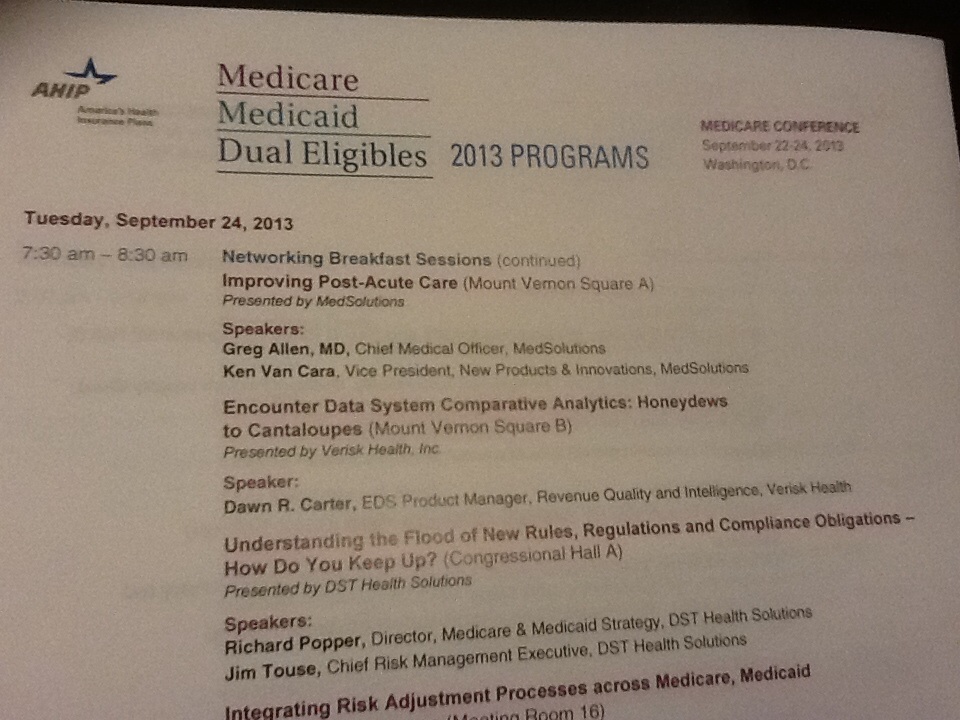
It’s been a very long time since I participated in an AHIP event. In fact for the record I have NEVER been to an AHIP event – that is before this week in DC. I attended, filmed, tweeted, broadcasted from, and now blog about AHIP’s ‘Medicare, Medicaid and Dual Eligible 2013 Program series.AHIP Medicare, Medicaid, Duals DC 2013
As someone who’s guided, counseled and implemented (at times successfully and other times not) some rather large proprietary, non-profit (ah hem, I mean ‘tax exempt’) health systems and their national or regionally branded provider sponsored ‘managed’ (ah hem, I mean ‘discounted’) health plans dating back to the 80s and into the millennium this is awkward if not curious (‘N’ of one?) state of affairs.

AHIP is after all is the ‘go to’ resource for the health plan community and their aligned provider and health system partners.  Yet somehow in my non traditional yet ‘mangled’ healthcare career path I managed somehow to stay outside of that tribe of dedicated and passionate healthcare professionals.

Back then, half of AHIP’s predecessor iteration was known as GHAA – the ‘group health association of America.’ This was an multi-dimensional trade label, as ‘group’ could be seen from an employer’s wholesale purchasing of group health insurance (vs. the ‘individual market)’ perspective but also from the point of it’s constituent member health plans mostly built upon ‘risk savvy’ medical group practice infrastructure – Friendly Hills, Mullikin, Bristol Park, Harriman Jones et al, at least in Southern California – though peer equivalents peppered the national lanscape, ie, Dean, Kelsey Seybold, Scott & White, InterMountain, Park Nicollet, Virgina Mason.

It’s been a while since the vertical integration and rabid consumption of group, IPA, or network model HMOs by national nameplates storming into the managed competition market and away from their indemnity roots (Aetna/US Healthcare, Prudential/PruCare, United HealthGroup, The Equitable/Equicor), but the players back then included the likes of HealthNet, PacifiCare, TakeCare, Maxicare (RIP)’ and many other national startup wannabes ie, Partners/VHA, UniHealth/CareAmerica, HealthPlan of America, HealthCare USA, to name just a few.

Nonetheless, GHAA meetings radiated with excitement and enthusiasm as the disruption vibe of the day was to bring this HMO thing from marginal (a 2nd tier class of docs, hospitals and ‘ancillary providers’ aligned with ‘HMO medicine’) into the mainstream. HMOs other than Kaiser Permanente, Mayo Clinic and the Cleveland Clinic were seen as less than quality ie, ‘cheaper’ medicine. Yes, back then comprehensive HMO benefits where the ‘value play’ in the group health portfolio.

Fast forward to today September 25th 2013. Consider the following: the Affordable Care Act (ACA) though approved by Congress, signed into law by the President and affirmed constitutional by the Supreme Court is a hostage to the antics of the junior Senator from Texas leading a ‘defund ObamaCare’ filibuster of sorts amidst a very real threat of a Federal Government shutdown. [Editor’s Note: Consider this the leading edge of wasting taxpayer dollars to pursue a political, not healthcare solution agenda].
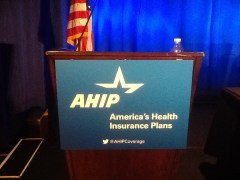
AHIP podium signage
Whereas, in the ‘roll up your sleaves and lets get er done’ tribe, less than a mile away at the AHIP meeting a flock of dedicated healthcare professionals and aligned stakeholders from every sector of the healthcare ecosystem [perhaps absent the patients voice?] are ‘huddling’ to share best practices, enterprise models and the technical guidance that can assist the implementation of both the spirit and intent of a very complex and mostly certainly less than ideal law.

Wow what a contrast! That ‘juxtaposition of irony’ did not escape many of the faculty including no less than one warrior of a previous similar battle, the then OMB Director Alice Rivlin, now Co-chair, Bipartisan Policy Center’s Domenici-Rivlin Task Force and Interim Director of Brookings’ Engelberg Center for Health Care Reform who opined:

‘It really is a very strange time to be here in [Washington DC] the most extreme partisan politics in my memory and I’m afraid the most broken that I have seen our democratic process. Healthcare and health insurance are caught right in the middle of this dysfunctional situation……and [in view of the potential Federal Government shutdown] given this ‘disconnect’… you might wonder, have they lost their minds? And the answer is YES!’ – Alice Rivlin

So amidst this self imposed ‘faux’ crisis the title of the blog is to analogize the ‘return’ of AHIP to its original revolutionary roots. Given the scope, range and depth of the Act, making the ACA work is in the words of previous acting director of CMS and champion of ‘the triple aim’ Don Berwick an ‘all hands on deck’ affair. We need each other all rowing in the same direction if ‘we’ are to matter this time.

If not, the party for the public/private hosting of American medicine – both financing and delivery may be over.  It’s certainly debatable whether AHIP ever migrated away from their GHAA roots or not, but this is one observer’s experience in prior team huddles.
A Juxtaposition of DC Irony

By Gregg A. Masters, MPH

It’s Monday in DC and the Capitol is distinctly vibrant albeit with a peculiar though eclectic mix of create vs.  deconstruct energies.

imageSome might say this attitudinal ‘chemical cocktail’ is in part sourced from a mix of ‘doers’, but also a smidge if not even a heaping portion of the just say ‘hell no’ [to Obamacare] crowd. For reference see: the latest effort by the House to derail health reform via a defund the act showdown with the Democratic controlled Senate and the President himself.

Yet amidst this continuing dance of oppositional strategizing we’re at the Renaissance Hotel DC for a series of one might characterize as ACA ‘implementation conferences’. These are principally the health plan doers who are under a mandate to reinvent themselves, and craft a sustainable market role for their members. The AHIP cohort is perhaps most visible via Aetna, Humana, United HealthGroup as well as others, who are intent upon making the best of this complex piece of legislation known as ‘the Affordable Care Act’. This gathering of players has huddled to support each others efforts and identify and share best practices to model as the industry collectively pursues the triple aim or alternatively cast as the coveted sustainable healthcare ecosystem.

One can assume the overwhelming mission of those attending the AHIP Conference trilogy are here to learn about if not advocate for the three pillars associated with the ACA: the tweaking of Medicare from volume to value via ACOs and other innovations, the significant expansion of Medicaid and the rapid expected growth in  ‘Dual Eligible’ population.

For conference schedule click here.

The hashtag for the conference is #AHIPMCMCConf.

ACO’s as Sinkhole Medicine? Nah…

By Gregg A. Masters, MPH

sinkhole

As the battle for the accountable care narrative grinds on both in the media and the respective P&Ls of participant ACOs, a recent article in Healthcare Finance News titled: Accountable care organizations: cost-effective solutions or financial sinkholes? is noteworthy.  At first I chuckled, then thought, more headline ‘eye porn’ or is there really a message here?

So lets start with the remark that caught my viscera –  the ‘sinkhole’ attribution. The piece is written by Paul Cerrato aka Twitter @plcerrato ‘a healthcare editor and writer for 30 years, publishing extensively in a variety of healthcare and business journals’. Pauls sets context for the sinkhole visual here:

But although the costs of care for all the Pioneer ACOs grew by only 0.3 percent, compared to 0.8 percent for similar Medicare beneficiaries outside the program, the fact remains that only 13 generated shared savings [emphasis mine]. Seven of the Pioneer ACOs have decided to move to other pay for performance programs that involve less financial risk, and two of the participating organizations have decided to leave Medicare accountable care altogether.

Then he tees up the underlying ‘Jerry Maguire‘ strategic question:

Given the uneven financial performance of these pilot ACOs, C-suite executives are no doubt wondering: What secret sauce allows some ACOs to succeed while others fall short of their financial goals?

While acknowledging the increased risk exposure to the Pioneers:

Any risk benefit analysis should keep in mind that ACOs come in many different sizes and shapes, and given that the Pioneer ACO model is riskier than the standard Medicare Shared Savings Program, it would not be fair to conclude that the ACO model is flawed, per se.

So digging a little deeper into Paul’s narrative, it’s not about the ACO model. The sinkhole remark is really about the de minimis cost impact associated with the performance of the Pioneer class. Yet, in defense of ACOs and the ACA (a position I am often in) we need take into account the key question of:

ACOs as sinkholes, compared to what? 

ACOs are proactive on a number of levels. Whether a statutory MSSP, or a pilot or demo via CMMI or a private mutation via the ‘ACO collaborations’ of Aetna, United, Humana or the Blues, they are something other than ‘biz as usual’. Anything less is the unrestrained appetite of the healthcare borg, i.e., a business as usual strategy. Bottom line is the current paradigm of healthcare costs, coverage and access is the SINKHOLE with or without an ‘ACO contribution’.

The article is worth a read since it points to both ‘culture’ and the ‘long term investment’ ACOs will require before generating an economic ROI. Unfortunately, tell that to CMS, as they are measuring two pillars of the triple aim (experience & quality), but the driver in the equation is fundamentally the third pillar – per capita savings at the population level.


An ACO ‘Shell Game?’ Of Arrows, Pioneers & Patsies’

By Gregg A. Masters, MPH

In ‘Pioneers Take Arrows While Settlers’ Get the Land’ I reported in a ‘just the facts ma’am’ fashion the developing narrative as proferred by Modern Healthcare, CMS, and the AMGA as to whether this was to be seen as good news or bad news.

Pioneer with arrow in backRecently the witty industry veteran and futurist  Ian Morrison weighed in via ‘Why Some ACO Pioneers Turned Back, as did Oliver Wyman via ‘The Year of the Pioneers’ and even the health policy braintrust, aka the ‘…aw shucks, we just really want to help Obamacare out’ cheerleading squad at the American Enterprise Institute weighed in via ‘Reforming Medicare integrated care: An alternative to the Obama administration’s accountable care organizations. Whoa can you say bandwidth consumption?

Indeed, rather than parse out each, I will address them separately via individual consideration. I just wanted to get them on the blog before more time passed.

I might add that as far back at June of 2012 at the jointly sponsored CAPG (California Association of Physician Groups) and IHA (Integrated Healthcare Association) ACO Congress word on the streeet had it  ‘all was not well in Pioneer land’. So fresh as some of these insights and realization may claim to be, some of the more chronic challenges have been on the record for quite some time.

You  might enjoy the reading ‘From ‘Unicorns to Multicorns” ACOs Morphing Below Radar’ which followed the ACO Congress.

As some say….

More will be revealed

Leavitt Partners on ACO Growth and Dispersion: An Update

By Gregg A. Masters, MPH

Per Leavitt Partners:

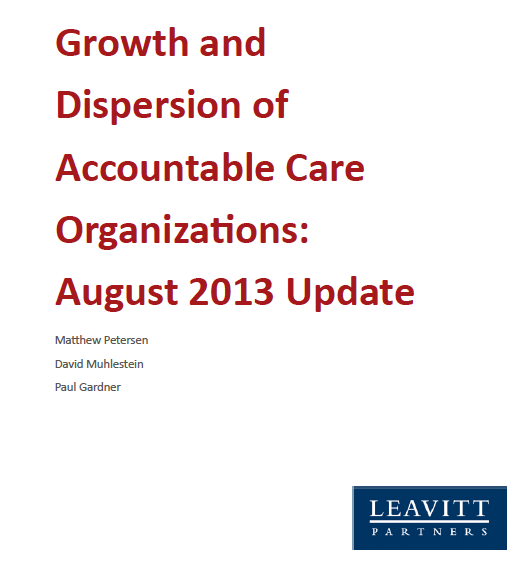
A ‘Growth and Dispersion of Accountable Care Organizations: August 2013 Update.’

The Leavitt Partners Center for Accountable Care Intelligence releases new white paper entitled “Growth and Dispersion of Accountable Care Organizations: August 2013 Update”Growth and Dispersion of ACOs August 2013.Screen shot 2013-08-15 at 12.09.40 PM

Salt Lake City, August 15, 2013 — Drawing from an ongoing study by Leavitt Partners, The Center for Accountable Care Intelligence has released an ‘August 2013 Update’ to the previously acclaimed white paper: Growth and Dispersion of Accountable Care Organizations.

The report details how the growth and proliferation of accountable care initiatives has unabatedly continued over the last twelve months. The broad adoption of accountable care paired with the emergence of preliminary results has provided some clarity to the overall accountable care movement.

Analysis of the current accountable care landscape highlights three significant findings:

The number of accountable care entities is increasing. Leavitt Partners is currently tracking 488 accountable care entities through the end of July 2013, more than double the number from June 2012.

Medicare ACOs are growing faster than non-Medicare ACOs. Medicare ACOs now comprise more than half of all accountable care contracts nationwide.

There are many different models of accountable care. No single model has emerged as most successful and as accountable care expands, we continue to see variety in organization and execution.

About Leavitt Partners

Leavitt Partners is a health care intelligence business. The firm delivers collaborative, high-value intelligence that helps clients transition to new models of care. Through its member-based collaboration called Health Intelligence Partners™ and direct services to clients, the consulting firm provides the best available window to the future of American health care. For more information visit LeavittPartners.com or call (801) 538-5082.

The ACO Innovation Summit

By Gregg A. Masters, MPH

One of the few ACO gatherings I’ve missed since the birth of the industry (and there have been quite a few since there are ‘experts’ everywhere), but the line-up NEHI put together is well worth a look.

Both Steven Shortell and Molly Coye are definitely change agents on the front lines as is the balance of the faculty. Molly is pulling levers of a major institution with, some might say, an impossible reinvention agenda given its governance complexity and cost efficiency obstacles – unlike many other private institutions similarly challenged, while Shortell has a pulse on the healthcare ecosystem DNA, the macro policy dynamics of managed competition, and the empirics of business or service delivery models that work.


Thanks to the organizational initiative of NEHI staff. A bit of a delay (this is raw footage), but fast forward to 9:10 mark for introductory remarks by NEHI President Wendy Everett, ScD. About NEHI:

‘…NEHI is a nonprofit, health policy institute focused on enabling innovation that will improve health care quality and lower health care costs. Working in partnership with members from across the health care system, NEHI brings an objective, collaborative and fresh voice to health policy. We combine the collective vision of our diverse membership and our independent, evidence-based research to move ideas into action.’

As discussed elsewhere the battle at the moment is for the narrative on ACOs and by proxy the Affordable Care Act aka “Obamacare”. For context see: The ACO Narrative: ‘Accountable Care 2.0 is a Journey, Not a Program’ or ‘ObamaCare is Toast’? 


Key take-aways from the summit included:

  • ACOs necessitate thinking about “packaged” innovations – the organizational culture, process improvements, and payment models that surround a particular innovation.
  • Bundled payments, global budgets and other new ACO payment innovations are beginning to create the “markets for health” that will move the system from a culture of care to a culture of wellness.
  • In an ACO world, physicians require comparative effectiveness research, real world evidence, and ongoing guidance from industry to achieve improved patient outcomes.
  • ACOs are transforming the research landscape by turning previously unintegrated health systems into research organizations.
  • ACOs have created new opportunities for cross-sector partnerships to share data and enhance the pace of innovation.

Accountable Care, ACOs and the ‘New OS’: An Emerging Zeitgeist?

By Gregg A. Masters, MPH

…or might the movement just be the very oxygen essential to achieve the triple aim?

We’ll get one man’s take on the Wednesday July 24th 2013 broadcast at 12 noon Pacific/3PM Eastern when my special guest is thought leader, deep thinker and advocate for patient centric healthcare Leonard Kish, aka @LeonardKish progenitor of the ‘Patient Engagement is the Blockbuster Drug of Century‘ characterization by Dave Chase.

To listen, go to ‘This Week in Accountable Care‘. This Week in Accountable Care | @ACOwatch | Hosted by Gregg A. Masters

I’ve titled the interview: Leonard Kish On Accountable Care and the ‘New OS’. In a recent blog post Leonard equated the push into Accountable Care (generically speaking and ACOs as one subset) as the equivalent of the ‘new, new thing’ or even zeitgeist shift as the ‘new OS’ required to move the needle forward on our paths towards ‘triple aim’.

Tieing comments from @lumeris VP Jim Hansen on the disruptive nature of ACOS, i.e., ‘Value-based care is a transformational journey, not a backend contract driven program that you overlay onto your existing delivery system organization’s people, processes and technologies and expect different results” to a Microsoft PC/software era value proposition analogy made by Tim O’reily Leonard notes:

..the OS abstracts away the difficulty in managing all the devices and processes the computer runs so applications can focus on what the user wants to do. When Microsoft entered the market in the 80s that was their value proposition, simplicity for developing new applications by abstracting away the other processes. Health care, under value-based payment, will soon have the same opportunity.’Leonard is a deep and insightful thinker in the space, our previous discussion of his take was in the form of ‘dark matter in healthcare: patient goals.

We shall see if the ‘OS’ metaphor holds traction for the transformaton.

To join us live or via archived replay click here.