JP Morgan Healthcare Conference 2013

By Gregg A. Masters, MPH

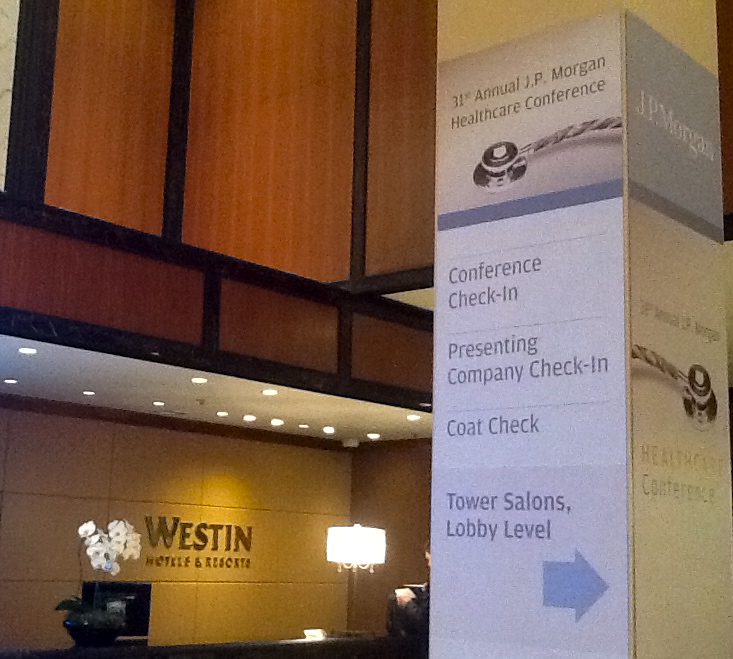
We’re here in the ‘city by the bay’ for the 31st annual assembly of biotech and pharma peeps and the money they seek from the venture capital world. Not exactly my tribe, but my interest was sparked by the generous ‘non profit track’ with many nameplate integrated delivery systems in the strategy and market management conversation.JP Morgan Healthcare Conference

For details, links and some humor on the event including ‘twit’ offered by conference attendees see: JP Morgan Healthcare Conference TweetUp or JP Morgan 31st Annual Healthcare Conference.

Major kudos as JP Morgan is livestreaming portions of the event. This is public but you will need to register on their site.

More later….

More or Less Confusion in ACO World: Who Really ‘Certifies’ ACOs?

By Gregg A. Masters, MPH

The ‘signal to noise’ discernment premium went up a notch recently with the following tweet:

@NCQA Read more about newly recognized ACO @KelseySeybold and their commitment to quality and value in the Houston Chronicle http://ow.ly/g6vzl 7:39 AM – 14 Dec 12

NCQAlogo And with that breaking news announcement (Kelsey Seybold is the first ACO to be recognized by NCQA) another piece of the ACO puzzle has been laid before American public as well as industry stakeholders. Unfortunately one cannot simply graft the information on top of an expanding but orderly base of journalistic reporting and therefore public assimilation of how their healthcare experience can be expected to cKSC-logohange. The fast developing (i.e., ‘bottoms up’, vs. alleged ‘top down’ dictates of an overreaching Federal overlord) world of ACOs are just not that simple to grasp due to the underlying absence of operating standards, the best intentions of Government and the private sector notwithstanding.

A closer look reveals some of the unintentional misdirect or potential for market confusion. The referenced Houston Chronicle article (aka @HoustonChron) erroneously identifies the NCQA as:

…the entity that certifies ACOs.

Yet, NCQA (the National Committee on Quality Assurance) is a ‘private non-profit healthcare measurement group’ based in Washington, D.C. that has organized a voluntary, fee based ‘ACO accreditation program.’ NCQA’s ‘ACO standards’ focus on the following seven core competencies:

  • ACO Structure and Operations
  • Access to Needed Providers
  • Patient-Centered Primary Care
  • Care Management
  • Care Coordination and Transitions
  • Patient Rights and Responsibilities
  • Performance Reporting and Quality Improvement

For context, private, nongovernmental entities typically recognize submitting applicants via a certification or ‘accreditation’ consideration process that approximates a ‘good housekeeping’ or ‘JD Power’ like ‘seal of approval’. They do not license nor legally certify ACOs per se, unless that authority is delegated to them by some governmental entity.

The authority that officially ‘certifies’ ACOs as legal entities for participation in the Medicare Shared Saving Program (MSSP) is the Center for Medicare and Medicaid Services (CMS), aka @CMSgov. ACOs are codified in Section 3022 of the Affordable Care Act and serve as the principal market based vehicles to fulfill the goals of the Medicare Shared Savings Program.

Even here though, the story is not that straightforward, as CMS certifies entities for participation in the MSSP, while its innovation arm, a division within CMS, the Center for Medicare and Medicaid Innovation (CMMI) aka @CMSinnovates, both admits and ‘certifies’ participation in the ‘Pioneer Program’.

Splitting hairs? Maybe. But there are structural differences of what constitutes an ACO to the Feds vs. NCQA vs. those effectively deemed an ACO via contractual agreements with one of more payers under the terms of an ‘accountable care collaboration’ or derivative arrangement.

So perhaps the correct narrative is that NCQA is ‘an’ entity that certifies some ACOs, not ‘the’ entity per se. More accurately though and per terms of their program, NCQA ‘accredits’ ACOs (as defined by NCQA) via a seal that signifies:

Organizations that earn accreditation may have extra credibility and first-mover advantages in their local markets. Being an early adopter of ACO accreditation may also help an organization become eligible to participate in demonstration projects or pilot programs that public and private health plans sponsor.

Finally, it’s interesting to note, that Kelsey Seybold Clinic though now recognized by NCQA is neither participating in MSSP, nor as a risk savvy medical group, perhaps even integrated delivery system, in the Pioneer Program designed and administered by CMMI for more advanced risk bearing participants.

So you be the judge. The slog continues?

Standing Up the ACO: Lessons from South Park?

By Gregg A. Masters, MPH

On Sunday I was chatting with a friend in the biz and the conversation turned to ACOs, wherein he whimsically laughed and then relayed a story from a recent California Medical Association (CMA) sponsored event on health reform, the future of medicine and Accountable Care Organizations, wherein one of the keynote speaker’s (I suspect Mark Smith, MD, of California Health Care Foundation), queried the audience asking for a show of hands:

How many of you watch South Park?

To wit, an estimated 350 out of 500 hands went in the air (South Park is apparently popular with many physicians). The speaker then recounted the gist of the ‘Gnomes underpants’ episode, analogizing their ‘business plan’ to the current state of the art in the accountable care industry at large (for detailed plot, click here).

The apparent resonance of the narrative is the fitting metaphor of a three phased business strategy [absent the mission critical second phase] to effectively profit from the ill gotten underpants gains’. Some say the ‘accountable care’ development and management glide-path is equally clouded by the absence of a similar mission critical body of knowledge and practice bridging theory with mission fulfillment. Clearly the humor lay in the leap of faith (or invisible hand(s) of the market) required, i.e., now that we formed this ACO thing, what is it we need do to make it profitable? Or in South Park terms, that thing in between acquiring stolen property, and projected assumed profit. Perhaps the context or challenge to organizers of ACOs is best reflected in the oft repeated (and variably credited) refrain:

The accountable care organization is like a unicorn, a fantastic creature that is vested with mythical powers. But no one has actually seen one. – Ian Morrison

Does this accurately reflect the state of ‘accountable care’? While the jury may be out, the empirical data is starting to accumulate. We shall see, and starting in Q1 2013 @ACOwatch will present examples from the broad tapestry of the ACO industry including representatives from the Pioneer class, independent physician led ACOs, their hospital centric alternatives, and hybrid ‘accountable care collaborations’ typically associated if not led by a single or multi payor partner(s).

New England Healthcare Institute (NEHI) ACO Innovation Summit

November 27th, 2012 [Editor’s note: portions of broadcast present with low audio].

NEHI Summit Explores Innovations In the Emerging ACO Landscape

The opportunities – and the challenges – presented by the rapid movement towards Accountable Care Organizations were the subject of a recent NEHI summit that drew perspectives from across health care:

“I think ACOs have a whole lot of opportunity to improve the patient experience.” Amy Whitcomb Slemmer, Executive Director, Health Care for All

“This new model has changed the conversation. We now have information that lets us understand total medical expense.” Dr. Justine Carr, CMO, Steward Health Care System

“The ACO model has promise in terms of providing better feedback data along the whole continuum of care.”
Kathleen Buto, VP Global Health Policy, Johnson & Johnson

“In an ACO environment, how you use resources is something that people need to be held accountable for.”
Dr. Gene Lindsey, President and CEO, Atrius Health

NEHI is a Massachusetts based nonprofit, member based national health policy institute focused on enabling innovation that will improve health care quality and lower health care costs. Working in partnership with members from across the health care system, NEHI brings an objective, collaborative and fresh voice to health policy. We combine the collective vision of our diverse membership and our independent, evidence-based research to move ideas into action.

For recent NEHI insights into health reform, click here.

Accountable Care: It’s Growth, Complexity, Prevalence and Promise?

By Gregg A. Masters, MPH

From Leavitt Partners. a webinar held on November 8th, 2012. The focus is on ACOs, and represents an update post elections from their previous reporting here.

A/C/O: ‘Another Compromised Organization’ or ‘A Coordinated Orchestra?’

By Gregg A. Masters, MPH

Last Friday I moderated the HealthIT social media focused tweetchat tagged ‘#HITsm’, see context piece here, and transcript here. The theme centered on the value or centrality of HealthIT to ACO success. The conversation was lively (for additional context, ACO surprise provides metrics on dispersion and penetration into Medicare and commercial markets), and in part reflective of popular notions of whether these rapidly emerging ‘multicorns’ can succeed but more specifically served by social media.

Screen shot 2012-12-03 at 9.29.42 AM

One tweet in particular caught my eye. While specific to a question on the role of social media to ACO development, it resonates with the bearish camp on ACOs in general (a view I challenge on a regular basis). I paused since the tweet was proffered by one of the brighter bulbs in the tool shed of EHR and HealthIT thought leadsership. It was in response to the following tweetchat question:

@HealthStandards #HITsm T5: Can social media ‘detect and amplify’ (preconfigure) preferred community referral interactions to grease the skids of an #ACO? Fri Nov 30 9:48:06 PST 2012

@ehrandhit Hard to see social media doing much to bring together ACOs. Within ACO’s social connections can really help though. #HITsm Fri Nov 30 9:52:28 PST 2012

I centered on this tweet as I engage with John Lynn (@techguy) in health reform and transformation exchanges now and then. In this case, I could not disagree more with his take. To wit the following exchange ensued:

@2healthguru really? Surprised to hear this especially from you!! #HITsm Fri Nov 30 9:52:40 PST 2012

@ehrandhit Not enough providers on it and discussing patient care. Maybe one day. Social principles, yes. Social media, no. #HITsm Fri Nov 30 9:55:44 PST 2012

@ACOwatch T5 I know of no other accelerator to connect like minded docs (i.e, culture) than #hcsm. A virtual ACO tribe preconfigured. #HITsm Fri Nov 30 9:55:49 PST 2012

I then wondered: what am I not seeing here? Is John correct by distinguishing between ‘social media principles, yes’ and ‘social media, no’? Does the low relative participation/utilization of social media limit it’s potential to inform ACO network development? Good questions! What are social media principles vs. the application of social media? Can they be separated? How? Why? How are we measuring physician involvement in social media?

If social media leverages the wisdom of the crowd, reveals, extends and informs conversations, enables collaboration or otherwise energizes social learning (both personal and professional), might the technology serve the interests of an ACO (a de-facto social network), or any series of structured activities designed to advance the triple aim? Intuitively I answer yes, but want to use this line of thinking to vet the reasoning process.

Finally, a broader sensitivity ties to the larger question of the value proposition of ACOs to enable the triple aim or build the sustainable healthcare ecosystem. So discerning the larger sentiment (bullish v. bearish) question might be whimsically framed in the search for wisdom by comedian/actor Steve Martin in the movie classic ‘the jerk’ wherein he was mentored in the less than nuanced discrimination of ‘sh*t from the shine-ola’.

This bearish attribution to ACOs, is a matter near and dear to my heart, since its camp includes some very smart people including the likes of Jeff Goldsmith, Regina Herzlinger, among some of the top in the pyramid of health-wonk thought leadership, while their suspect upside is more than offset by the likes of Elliott Fisher, Don Berwick, and more recently Don Crane to name a few.

Yet, the question remains amidst the market narrative, as most recently evidenced at Not Running a Hospital by Paul F Levy, in a blog post titled ‘Neither accountable nor caring nor organized’, which offers more thought fueling the bearish camp. (NOTE: A thank you to Dan Munro for the heads-up).

The net result” of ACOs, says Federal Trade Commissioner J. Thomas Rosch, “may therefore be higher costs and lower quality health care—precisely the opposite of its goal….

So back to the original question and the title of this blog post. Can social media connect like minded dots and pre-configure if you will an ACO? You betcha! Just look at its growing traction, and measure the social capital and utility created by connecting tweeps via this simple and corny to some medium. It is powerful, tribal, additive, collaborative, chaotic and democratic. Ideas surface and float on the basis of relevance and merit, not personalities nor politics.

From a gravity and use case point of view, applications are being demonstrated daily. For one measure, just look at the constantly expanding database of the healthcare hashtags project hosted by @Symplur. Take a measure of conferences, tweetchats and ‘regular’ hashtags added to their repository on a daily basis.

If the medium is the message, what we’re learning from the explosion of social media, is there are lots of voices/ideas looking for ways to make a difference. Some of those voices concern themselves with important healthcare considerations and need be collaboratively tapped and channeled in service of worthwhile societal needs. One of those consensus needs is the pursuit of the triple aim or creation of a patient centric, sustainable healthcare ecosystem. Why not use social media to reveal underlying referral patterns? Or to screen physicians for their values toward coordinated, seamless care? Or the willingness to be part of a team – the bottom line definition of an ACO?

None of the Ransomed Ever Knew How Deep Were the Waters Crossed

By Gregg A. Masters, MPH

Ah yes, those ‘white waters’ of health reform or more aptly put ‘transformation’ (you know, the triple aim thingy). As more has been revealed, I offer a quasi ‘mea culpa’ of sorts…

Light years ago, or so it seems, as I began at least the blogging portion of my social media participation I penned this post, headline below dateline: August 18th, 2009 – pre-passage of the Affordable Care Act.

Health Reform 101 – ‘None of the Ransomed Knew How Deep Were the Waters Crossed!

The intention was to frame the ‘grand canyon’ nature of the challenge (many were called, but all failed), and contextualize the likely ‘win’ from the eventual ‘against all odds’ success of national health reform.

It further signaled an impending hollow if not ‘pyrrhic victory’ followed by the recognition of certain legacy health insurers of the ‘burning platform’ nature of their business models. Bottom-line, the industry needed to reinvent itself as ‘value added’ players if not architects of a sustainable ecosystem less they find themselves at risk of extinction. A ‘racket’ of collecting large group ASO fees, while reducing covered benefits, and floating ever increasing premium to their clients (lets leave the small group and individual market disasters out at this point), just doesn’t cut it anymore.

I opined at the time, that the net effect of the ambitious health reform effort would be a sellout on top of a sellout, i.e., the abandonment of the public option, Medicare ‘E’ (everyone), and the categorical rejection (no consideration) of single payer as a potential solution. And worse yet, albeit via subtext, was to anticipate the storm of premature ‘strategic solutions’ typically proffered by ‘name plate’ consulting firms supported by armies of junior MBAs (on site associate project managers) with clipboards, ties and not ready for prime time answers.

While legitimate concerns at the time, the broad tapestry of the Affordable Care Act (the reconciled compromise), and the range of creativity its fostering in the accountable care space, including patient centered medical homes, and derivative accountable care collaborations both payor and provider led, have caused me to pause and be more hopeful that in the aggregate, there may be more magic in those 906 pages than may be apparent at first blush.

I keep coming back to @Aetna as one legacy health insurer’s ‘re-positioning’ (from @iTrage as a payor agnostic platform to ‘accountable care collaborations’ engineered via their Accountable Care Solutions Group) as indicia of a genuine commitment to build a sustainable, transparent, affordable, accessible and value driven healthcare ecosystem that actually works. Time will tell…

ACOs: Here, There, Everywhere? Or Are We Quibbling at the Edges?

By Vince Kuraitis, JD, MBA

A  recent analysis of the ACO market by Oliver Wyman market suggests we’re well on our way toward being “there”.

My personal take on this report:

Provocative, fresh, thoughtful, well reasoned, expansive — albeit a bit of a stretch.

However, I suspect many others will describe it as:

Speculative, harebrained, unsupported, overly extrapolative, out-to-lunch, wishful to the point of being woo woo.

So now that I hopefully have your attention, what’s this report all about? In a nutshell:

The healthcare world has only gotten serious about accountable care organizations in the past two years, but it is already clear that they are well positioned to provide a serious competitive threat to traditional fee-for-service medicine. In “The ACO Surprise”, our analysis finds that 25 to 31 million Americans already receive their care through ACOs—and roughly 45 percent of the population live in regions served by at least one ACO.

Let’s dig in to the report. In this blog post, I’ll summarize their math, surface their critical assumptions and observations, and comment on their reasoning. I’ve indented direct quotations from the report and have italicized wording that spells out the major assumptions.

While I don’t agree with all of Oliver Wyman’s math and assumptions, I applaud them for the process they have gone through. Please take my commentary as “quibbling at the edges” and that overall I’m on board with their methodology and conclusions.

First, set the playing field with a broad definition of “ACO”.

…we’ll use ACO as a catch-all term for providers participating in population-oriented, value-based care delivery and reimbursement models.

That means we won’t count providers that have only progressed to the level of piloting bundled payment programs

Commentary: using a broad definition of ACO makes perfect sense.  As I’ve previously explained, ”accountable care” needs to be divided into two buckets: 1) Formal Accountable Care Organizations (ACOs) by which care providers contract with Medicare, and 2) Informal Accountable Care-Like (AC-Like) arrangements between care providers and commercial health plans.

Second, count and project the Medicare ACO numbers.

Start with 2.4 million Medicare patients. Medicare’s ACO patients are covered under avariety of programs, including 6 Physician Group Practice demos, 32 Pioneer ACO demos, 27 first round Medicare Shared Savings Program (MSSP) ACOs, and 89 second round MSSP ACOs.

Commentary: nothing controversial here. Just a recap of the facts.

Expect those numbers to grow. More than 500 organizations have applied for the third round of MSSP, slated to begin in January 2013. If this round follows the same pattern as previous rounds, as many as 40 percent of the applications will be rejected—typically because of failure to meet the required minimum number of attributed Medicare beneficiaries. Even if this happens, the number of Medicare ACOs will more than double.

Commentary: while these numbers are projections, they are realistic and fit others’ accounts of the size of the Medicare ACO pipeline.

When the third-round of MSSP participants is announced in January 2013, we anticipate not just more new participants but far more patients per organization, as many larger health systems, which have been slower to apply, finally join in.

Commentary: This is a biiiiiggggg stretch. The authors are correct in noting that early Medicare ACO’s were small – a new, unexpected species.  But it’s a leap of faith to conclude that the next round of Medicare ACO’s will be any larger. Maybe they know something I don’t know about the applications are Medicare pipeline, but I would label this assumption as questionable.

Third, extrapolate the impact of Medicare ACOs on non-Medicare patients.

Add 15 million non-Medicare patients in Medicare-oriented ACOs. When a healthcare provider signs up for one of Medicare’s ACO programs, it commits itself to a new way of delivering services and a new way of being compensated—a new model of healthcare delivery. And it is extremely difficult for a provider organization to apply that model to its Medicare patients and not to its commercial patients.

Commentary: Not so fast. My take is that many of the early ACO’s are viewing their participation as an experiment, not necessarily a long-term commitment.

We know that major cost savings opportunities in ACO’s are concentrated in the top 5% of a population that will consume 60% of healthcare costs. A key tactic of ACO’s is concentrating care management attention on this 5% of the population. For example, one of the most effective techniques being employed by a range of physician practices is the use of a nurse care manager to coordinate care for patients with complex needs. This approach is so successful that health plans are proactively suggesting that physicians hire care coordinators and many are offering to pay for the costs through direct subsidy of salaries, additional care management fees, or even a bump in base rates paid to primary care physicians.

Thus, while experimenting with an ACO might (and hopefully would) create a long-term commitment to a new way of delivering services, this doesn’t necessarily need to happen on day one. The nursing care coordinator example is one way that clinicians might carve out a segment of their population for particular attention, but not necessarily change their practice style and work flow for all the patients in their practice.

Fourth, guestimate the impact of commercial, AC-Like arrangements.

Add an additional 8 to14 million patients in non-Medicare ACOs.

While government sponsored ACOs tend to take up much of the spotlight, there are roughly the same number contracting with private payers.

Commentary: while speculative, this assumption is2 reasonable, and the numbers strike me as in the ballpark. Unlike Medicare ACO’s which are highly visible, AC-Like arrangements are typically negotiated behind closed doors, terms aren’t public, and thus they are impossible to count and compare with precision.

Fifth, add it all up.

These three patient groups add up to 25 million to 31 million US patients receiving their healthcare through ACOs—or roughly 10 percent of the population

Sixth, opine on the implications.

When we examine the landscape on the level of primary care service areas (PCSAs), 45 percent of the population live in PCSAs served by at least one ACO

Commentary: Wow! While some will argue that this statistic is meaningless, it strikes me as a good leading indicator of ACO market penetration — a stat worth monitoring over time.

The Bottom Line

Kudos to the Oliver Wyman analysts. While overall my personal numbers would be slightly more conservative,  their overall approach is sound. ACOs are well on their way toward being “there”!

Vince Kuraitis JD, MBA is Principal and founder of Better Health Technologies, LLC (BHT) consults to companies in developing strategy, partnerships and business models for chronic disease management and eHealth applications delivered in homes, workplaces, and communities. This article originally appeared here.
ACOs, Oncology and the Future of Better Cancer Care

By Gregg A. Masters, MPH

As originally posted at JustOncology.

The best business model for oncology care is not yet obvious to me. But it is crystal clear that innovative new models are being hatched before our eyes.. via Oncology Times

Since CMS (via HHS) issued the final rule addressing ACO provisions and specifically ‘excluded’ oncologists from participating as ACO organizers, instead relegating their involvement in at least via the Medicare Shared Savings Program to ‘participants’, there has been rumbling underneath the surface of ‘ACO-dom’.

Perhaps as best evidenced by the April announcement of a tripartite venture between FlordiaBlue, Advanced Medical Specialties (a former US Oncology Affiliate now part of the McKesson fold), and Baptist Health System, the competitive positioning in the oncology market is not sitting idly by as other medical specialties, including primary care, carve out their niche and actively experiment with their version and local vision for accountable care aka ‘the triple aim.’

In the broader conversation on ACOs or their derivatives including medical homes or accountable care collaborations, etc, there has been much discussion from very smart and accomplished wonks including periodic banter, i.e., Goldsmith v. De Marco] as to the significance and forward [reasonably expected] benefits from duly organized [or in the latter case – arranged] ACOs. Bottom-line,  there is a fair amount of credible disagreement over whether these entities as variably configured actually make a difference?

Meanwhile, in the oncology domain, much of the action seems relegated to a few forward thinking players who have taken the initiative regardless of CMS’ decision to limit their participation (at least to this point in time) to contracted participant suppliers of specialty services.

For a deeper dive into the question: ‘Who Is Taking the Lead in Incorporating Oncology into ACO Thinking?’ see: The Rapidly Evolving ACO World, we have the following observation and summary data:

There are several examples of organizations that have stepped up and have taken the lead in exploring payment re-design in oncology, some within an ACO shared savings context and some outside the ACO context.

The vanguard includes:

  • Consultants in Medical Oncology & Hematology. Oncology Patient Centered Medical Home®, Drexel Hill, PA
  • United Healthcare (5 episode payment pilot sites)
  • Texas Oncology/Innovent Oncology and Aetna
  • Oncology Physician Resource (OPR) and Michigan Blue Cross
  • Wilshire Oncology and Wellpoint, Southern California
  • CareFirst Blue Cross pathways and medical home initiative, Maryland
  • Priority Health oncology medical home initiative, Michigan
  • Florida Blue, Baptist Health South Florida and Advanced Medical Specialties Oncology ACO, Miami
  • Harvard Pilgrim Health Plan with oncology medical home demonstration pilot, Massachusetts;
  • Innovative Oncology Business Solutions with CMMI Innovation Challenge grant to demonstrate value proposition of community oncology medical home (COME HOME) at 7 community oncology practices nationwide.

And certainly there will be more organizations joining the vanguard in the near future.

We are working on getting Ronald Barkley, CCBD Group, and Linda Bosserman, MD, President and CEO of Wilshire Oncology and Hematology Associates to share their thoughts on ‘This Week in Oncology’. We’ll keep you posted when we’re able to lock them down.

Meanwhile, with the elections now behind us, the future is rather clear at least for those who want to manifest the spirit and intent of the Affordable Care Act, so ‘warp drive Mr. Zulu’ as the ACO movement shifts into overdrive.

The ACO Surprise

By Gregg A. Masters, MPH

Timing can be everything at times, no?

Just after completing the post:From “Unicorns to Multicorns” ACOs Morphing Below Radar, I received information from Oliver Wyman, a Marsh McLennan Company, previewing a study which documents (at least for some) ‘unexpected’ results in the world of ACO penetration.

For background market scaling or ‘ACO virality’ context, be mindful we had a bit of an energetic but collegial exchange between HMO industry veteran William DeMarco and noted healthcare futurist Jeff Goldsmith. DeMarco was opining on the prevalence of ACOs et sequelae, while Goldsmith ridiculed DeMarco’s referenced math via the post ACO Explosion, carried forward into Are Hospital Business Models on a Burning Platform? Not Yet, But It’s Inevitable’ by Vince Kuraitis at the Healthcare Blog. DeMarco notes that:

….20% of Medicare beneficiaries…will be connected to Medicare through their ACO by 1.1.13..’

[add] Medicare Advantage beneficiaries [27%]…a factual statement…[and ACO share will approach] 50% of Medicare population.’

To wit, Goldsmith skeptically retorts:

The Medicare ACO program “covers” less than 5% of Medicare beneficiaries, and a tiny fraction of it will actually resemble full risk. There is simply no evidence of momentum toward risk-sharing with hospitals in the current payment stream. Medicare Advantage is growing at 10% a year, but most of the hospital contracts are not shifting risk to hospitals. DeMarco’s forecast is laughable.

Now add to this thread data from the Oliver Wyman Group (aka @OliverWyman) structured inquiry. (Editor’s note: Marsh McLennan is not a newcomer to the healthcare risk, actuarial, underwriting or consulting broker universe. Progenitors of InterQual’s the ‘Potentially Compensable Event’ hospital survey commercially morphed into the ‘generic screening criteria’ for the Intensity of Service/Severity of Illness data set, they could be arguably considered one of, if not the principal founders of the clinical risk management or quality assurance industry. Take away: listen to what they have to say, tweeps!).

In just two years, a new model of healthcare captures 10 percent of the market.

The healthcare world has only gotten serious about accountable care organizations in the past two years, but it is already clear that they are well positioned to provide a serious competitive threat to traditional fee-for-service medicine. In “The ACO Surprise”, our analysis finds that 25 to 31 million Americans already receive their care through ACOs—and roughly 45 percent of the population live in regions served by at least one ACO. While relatively few organizations have achieved the full potential of the model, the top performers are already generating savings and delivering improved care.

For the complete Oliver Wyman report, click here.

Man, things are really starting to get interesting!