Don Berwick’s preso at 1st Accelerated Development Learning Program

On June 20th through the 22nd, 2011 the Centers for Medicare & Medicaid Services (CMS) held the first of its ‘ACO Accelerated Development Learning Sessions (ADLS)’. The sessions are ‘to provide the executive leadership teams from existing or emerging ACO entities the opportunity to learn about essential ACO functions and ways to build capacity needed to achieve better care, better health, and lower costs through improvement.’

‘Four ADLSs will be offered in 2011. Each will offer a focused curriculum on core competencies for ACO development, such as improving care delivery to increase quality and reduce costs; effectively using health information technology and data resources; and building capacity to assume and manage financial risk.’

The goal of these sessions is to prepare participants to:

  • Understand their current readiness to become an ACO.
  • Identify organization-specific goals for achieving the three-part aim of improving care delivery, improving health, and reducing costs through improvement.
  • Begin to develop an action plan for establishing essential ACO functions.
To watch Dr. Berwick’s presentation, click here.

Continued Insigthts into ACO’s: 5 Key Findings

By Molly Gamble for Becker’s Hospital Review

1. Approximately 40 percent of healthcare administrators and physicians say physician-staffing alignment is the biggest challenge with accountable care organizations. A June survey based on 882 responses found 40 percent attributing delayed progress towards ACOs to alignment. After physician and staff alignment, 31.4 percent of respondents attributed the delay in ACO formation to a lack of capital and 26.2 percent cited a lack of integrated IT systems.

2. ACO start-up costs can peak to as much as $26.1 million. A May study projected the start-up costs of ACOs to be between $11.6 million and $26.1 million. These findings were significantly higher than the original estimate of $1.8 million by the Centers for Medicare & Medicaid Services in its proposed rule.

3. More than 70 percent of hospital executives have cynical view of ACOs. In a February survey, 74 percent of hospital executives said they are cynical of the effect of medical homes and ACOs will have on their bottom lines. Of that percentage, two-thirds of hospital executives said the new models will cause hospital margins to slide.

4. Nearly half of physicians do not know what an ACO is. In January, a survey found (for complete article, click here).

ACO Onramp or Sideline?

Listening in and tweeting about the CMS Days 1 & 2 (partial only) ‘Accelerated Learning Program’ yesterday and today, I am struck by the candor and willingness of CMS to both acknowledge & signal their intentions to work with the provider (both institutional and professional) and payor communities.

As noted today by Rick Gilfillan, MD, Acting Director, the Center for Medicare and Medicaid Innovation:

‘We can’t write the perfect [rule] model from Washington. You need tell us what works, why & how to structure it.’

I also sense a steady but open hand via the recurrent reminder, that this isn’t just about keeping provider and to a lesser degree those transaction processors (aka ‘health plans’) happy. This is first and foremost about patients: keeping them safer, healthier, and for less cost. The Medicare Trust fund outlays are not sustainable (nor are group or individual health insurance premiums for that matter, editors note). As one member of the audience commented, health care cost run rates are at $2.5 trillion currently, and expected to hit $4 trillion within 5 years….Ooops!

Apparently in the room at this first CMS Accelerated Development Learning Program session where an eclectic mix of willing and ready representatives from the ‘Pioneer Model group’, as well as the intermediates and also the ‘newbie crowd’.

My sense is this event does not rise to the level of a ‘Rick Scott-esque’ staged attempt to show off CMS flag waving supporters and make a statement to the Mayo’s and Cleveland Clinics’ of the world (including the most visible trade group representing risk savvy medical groups, i.e., AMGA, who’ve signaled their displeasure with the NPRM, and intention to not participate in the ACO program). Yet I came away with the distinct sense that CMS was issuing the following appeal: ‘either walk the talk’ (i.e., collaborate with us), or ‘get out of the way’ (again, emphasis and interpretation are solely mine).

When I met Dr. Gilfillan in DC at the Healthcare Innovation Summit earlier this month and had the privilege of interviewing him (see his keynote here), I urged him and CMS via proxy, to stand firm and not lower the bar regardless of what may have amounted to some unexpected push back by certain mission oriented ‘friends’ (AMGA, et al). By lower the bar here I do not mean ignore some of the salient feedback offered by the industry as a whole, but crater to the repeal and unwind crowd cheerleading the opposition to a CMS lead innovation conversation and rule implementation process.

May we [continue] to live in interesting times….and indeed we do!

Day 2: Acquiring Core Competencies for ACO Success

8:00 – 8:15 Welcome to Day 2 – and Day 1 Summary 
8:15 – 9:00 Remarks by CMS Leadership
Don Berwick, MD, MPP, Administrator, Centers for Medicare & Medicaid Services
Rick Gilfillan, MD, Acting Director, Center for Medicare and Medicaid Innovation, CMS
9:00 – 10:30 Overview of Core Competencies Essential to ACO Success
Overview of Competencies Related to Organizing & Delivering Care
James Rogers, MD, St. John’s Health System, Springfield, Missouri
Overview of Competencies Related to Assuming & Managing Risk
Mark Eustis, MHA, Chief Executive Officer, Fairview Health Services
10:30 – 10:45 Break
10:45 – 6:00 Learning Modules:The remainder of Day 2 will be structured as a series of break-out sessions each presenting a learning module related to one or more core competencies.

  • One track of learning modules will address the competencies related to the delivery of care. These modules will be attended by clinician member(s) of each team.
  • A second track of learning modules will address the competencies related to financial and risk management. These modules will be attended by the manager member(s) of each team.

Within each track, participants will break into two smaller groups.

  Track 1: Clinicians Track 2: Management/Operations
10:45 – 12:00 Module 1: Connecting providers (EHR/HIT)Glenn Loomis, MD, St. Elizabeth Physicians, Keith Hepp, HealthBridge, John Blair, MD, MedAllies, Susan Stuard, MBA, THINC Module 6: Describing your population’s risk profile. David Knutson, MS, Department of Health and Human Services, David E. Kelleher, MS, HealthCare Options Inc.
12:00 – 12:45 Lunch Break Lunch Break
12:45 – 2:00 Module 2: Describing your population’s clinical profile. Steve Bernstein, MD, University of Michigan, James Rogers, MD, St. John’s Health System Module 7: Risk management. Shashank Kalokhe, PhD, Everett Clinic, Greger Vigen, FSA, Independent Actuary
2:00 – 3:15 Module 3: Coordinating care for high-risk patients, Steve Bernstein, MD, University of Michigan, Barbara Walters, MD, Dartmouth-Hitchcock Medical Center Module 8: Financial modeling, Greger Vigen, FSA, Independent Actuary, Rob Parke, FSA, Milliman
3:15 – 3:30 Break Break
3:30 – 4:45 Module 4: Primary care and specialist services, Rich Baron, MD, CMS, Jeff Schiff, MD, State of Minnesota Public Programs Module 9: Capitalization Barbara Spivak, MD, Mount Auburn Cambridge Independent Practice Association, Matthew Mazdyasni, MS, HealthCare Partners
4:45 – 6:00 Module 5: Leading care process improvementChristine Sinsky, MD, Medical Associates Clinic and Health Plans, David Moen, MD, Fairview Physician Associates Module 10: Incentive paymentsCraig Sammit, MDDean HealthBarbara Spivak, MD, Mount Auburn Cambridge Independent Practice Association

CMS: Accelerated Development Learning Program June 20 & 21, 2011

Day 1: ACO Formation: Leadership and Priority Setting

On Day 1, presentations and discussion will emphasize the importance of understanding patient populations, market environment and the core functions of an ACO as a starting point that will guide ACO formation and provider relationships. The plenary, case studies and team based exercises will show how data and market intelligence can be used to set strategic ACO goals and priorities that bind providers and inform ACO development. Participants will also leave the day 1sessions with an understanding of the other ACO competencies they will need to develop

  • 1:00 – 1:15 | Welcome & Introductions
  • 1:15 – 1:30 | Opening Remarks from CMS

Rich Baron, MD, Group Director, Seamless Care, CMS Center for Innovation

John Blum, Deputy Administrator, Centers for Medicare and Medicaid Services

  • 1:30 – 3:30 | Setting Priorities and Leading ACO Formation

How becoming an ACO changes perspective, priorities, and leadership

John Bertko, F.S.A., M.A.A.A., CMS

Essential questions an ACO needs to ask – and what it takes to answer them

Paul M. Katz, MBA, Chief Executive Officer, Intelligent Healthcare | This session will introduce the two-day program. It will demonstrate the importance of grounding the ACO’s strategy on a solid understanding of the population for which it will be responsible, existing patterns of care and opportunities for improvement in that population, clearly defining the role and responsibility of all participating providers for meeting the needs of the population and achieving strategic goals for improvement, establishing a workable organizational structure, and leading efforts to change the way care is organized, delivered and managed. This session will introduce the notion of a “recipe for success” that reflects an ACO’s understanding of the local market it operates in, the specific goals that it will need to achieve, and the core competencies it both has and needs to develop, given the different starting points of each organization.

  • 3:30 – 3:45 | Break
  • 3:45 – 5:30 | Insights from the Field

Participants will learn from the real-world experience of ACO leaders who have developed and implemented organizations that perform the functions of an ACO. Issues to be addressed include leadership and management functions such as priority setting, decision making, and negotiating provider relationships.

Case Study 1: Building an ACO on the foundation of an Integrated Delivery System (IDS)

Craig Samitt, MD, Chief Executive Officer, Dean Health

Case Study 2: Building an ACO on the foundation of an IPA

Karen van Wagner, PhD, Executive Director, North Texas Specialty Physicians

Case Study 3: Building an ACO on the foundation of a Physician-Hospital Organization (PHO)

Lee Sacks, MD, Chief Executive Officer, Advocate Physician Partners
The 5 Imperatives of Accountable Care

By Jaan Sidorov, MD

In order to manage the financial risks of being “accountable” to a population, provider organizations that want to be ACOs will have to do five things:

1) assess their assigned members’ individual risk (using health risk assessments (HRAs) and predictive modeling,

2) that then segment or stratify the population into three “buckets”:  high, medium and low.  Then….

3) deploy a full spectrum of communication interventions, including telephone, mail, email and social media, the purpose being to…..

4) recruit patients into the appropriate care pathways that are tailored to the level of risk.  Patients at highest risk need case management.  Patients at lower levels of risk may require less intense coaching, such as preventive counseling, telephonic reminders and, if available, wellness interventions.  Patients with a high level of readiness to change are most likely to benefit.  The purpose of all this is to…

5) apply evidence-based medicine and guidelines using shared decision making so that patients can reconcile the the care they need with what they want and, simultaneously, reduce claims expense (an example is here).

And who is responsible for all this you ask?

Many naive policymakers, out-of-touch regulators, inflexible legal experts and physician-leader apparatchiks will tell you the primary doctors will do it.  According to this policy-insider elite, giving PCPs electronic records, 10% pay increases and medical home status will unleash the physicians’ hidden lust for becoming accountable.  They’ll want to counsel patients in the course of their office visits.

Poppycock, says the DMCB.  Docs don’t mind being ultimately responsible, but they have little interest in reviewing, recruiting or educating lists of patients.  They’re more than happy to “outsource” that job to case managers.  The DMCB thinks of these professionals as the ones who review the lists, oversee recruitment rates, provide counseling services and assure that maximum numbers of patients become engaged in their self care.  Plenty of those patients will need an appointment to see a doctor for diagnosis and treatment, and – thanks to a working relationship with their docs – the case managers can make that happen.

In other words, the case managers will be the linchpin to assuming ACO success.  Where the rubber hits the road.  Where the light shines.  Where the action is.  Where the return on investment will be achieved.

Jaan Sidorov, MD, is a thought leader, ‘ blogvocateur’ and the author of over 35 peer-reviewed publications and presenter at 60 health conferences, Dr. Sidorov is a seasoned primary care physician with a working familiarity with health insurance, corporate governance, health service research, disease management and health care quality. Dr. Sidorov also publishes ‘The Disease Management Care Blog which is the original source of this blog post.

ACO’s: If You Build ‘em, Will They Come?

Even the models for health reform hate the new HHS rule.

The Obama Administration is handing out waivers far and wide for its health-care bill, but behind the scenes the bureaucracy is grinding ahead writing new regulations. The latest example is the rule for Accountable Care Organizations that are supposed to be the crown jewel of cost-saving reform. One problem: The draft rule is so awful that even the models for it say they won’t participate.

The theory for ACOs, as they’re known, is that hospitals, primary-care doctors and specialists will work more efficiently in teams, like at the Mayo Clinic and other top U.S. hospitals. ACOs are meant to fix health care’s too-many-cooks predicament. The average senior on Medicare sees two physicians and five specialists, 13 on average for those with chronic illnesses. Most likely, those doctors aren’t coordinating patient care.

This fragmentation is largely an artifact of Medicare’s price control regime: The classic case study is Duke University Hospital, which cut the costs of treating congestive heart failure by 40% but then dumped the integration program because it lost money under Medicare’s fee schedule.

Intelligent liberals now concede this reality but claim that the government merely needs to devise better price controls. By changing the way it pays, Medicare under the ACO rule is effectively mandating a new business model for practicing medicine. The vague cost-control hope is that ACOs will run pilot programs like Duke’s and the successful ones will become best practices. While the program is voluntary for now, the government’s intention is to make it mandatory in the coming years.

But what if they had an ACO revolution and no one showed up? The American Medical Group Association… (read complete article here).

ACO’s, CMS, and ‘Tea Leaves’

Not sure what the latest count is on the comments to the ACO NPRM, see submitted comments on anti-trust enforcement, here, but amidst the range of direct commentary, and downstream banter, the following read is proferred: the stakeholder community (broadly cast) is rather, uh hum, ‘engaged’.

It’s been said, the opposite of love is not hate, but ‘indifference’. Extrapolating here, the fact that every healthcare special interest group from providers, to payers, to their channel partners and/or intermediaries, is now on record either in favor or, or opposed to specific provisions or principles the ACO rule and sequelae, ie., Pioneer Model et al add ons, there is no shortage on conversation on ACO’s. The pro-rule, pro shared governance and patient centered indicators consumer voice is reflected here.

Advantage CMS?

Having listened to, interviewed, and generally followed engaged peeps in the ACO conversation including CMS, my sense is our ‘transformationally inclined’ friends in DC are both encouraged and hopeful with the process. Rather than retrenching or feeling overwhelmed by the level discourse, or perceived need to retool their approach, my sense of their thinking is ‘isn’t it great we have so much engagement in the process?’

Since we’ve been at this ‘bend the cost curve’ and improve quality by minimizing variance and promoting evidence based medicine, via a series of acronyms too lengthy to mention, truth be told, we have collectively failed. The rapacious appetite of the healthcare borg is alive and well. The percent of GDP we consume remains on it’s unsustainable and upward trend.

ACO’s whether in principle or operational terms (yet to be finalized) are here to stay. The transformational imperative is perhaps more acute than ever in the 30 years that I have been engaged in the drama, dating back to the ‘office of alternative delivery systems’ in HCFA.

The time is now. Rather than find ways to point fingers, sit on sidelines or otherwise contribute copy to the ‘naysayer echo machine’, let’s be about the continuing business of transformation. The ‘event horizon’ is in sight, i.e., when GDP hits 20%, the private sector will be kicked out of the sandbox and Government will issue a top down remedy, no doubt anathema to our pluralistic commitment to public/private partnership solutions.

ACO: The Narrative Unfolds (Consumer v. Provider?)

This is an abstract of the article posted on KHN News titled: ‘ACO Defenders Emerge As Comment Period Ends‘. Editors note: now the conversation begins in earnest. The bottom-line question seems to be ‘how much GDP do they need’?

Meanwhile, in other health law implementation news, timing issues related to Department of Health and Human Services regulations are flummoxing some states.

CQ HealthBeat: As ACO Rule Limps Toward Finish Line, More Defenders Emerge

Deadline day arrived Monday for comments on Medicare’s much-abused proposal for accountable care organizations. And supporters of the Obama administration championed its pro-patient provisions in the face of criticism from the health industry. Early industry feedback on the ACO rule focused on the expense and complexity it posed for hospitals, doctors and health organizations interested in teaming up to achieve higher quality, better patient care and lower costs. Many providers were deeply skeptical that they could participate and urged a major rewrite (Norman, 6/6).

Politico Pro: Patient Groups Like ACO Rule

The groups representing patients and consumers have some concerns about the accountable care organization rule — but they are generally much more optimistic about the program than providers have been, according to comments filed with HHS on Monday. One advocate pointed to the new ACO rule as an example of how the current administration is more patient friendly than the past administration (Coughlin, 6/7).

Politico Pro: HHS Regulations Timing Troubles Some States

New Hampshire state Sen. Ray White started off 2011 looking to get a bill moving on a health exchange, but he backed off because HHS regulations for state-run exchanges were not expected until June. While White opposes the Affordable Care Act, he also recognizes that it’s standing law. He did introduce a bill in February 2011 that would have authorized the state to set up the health exchange, curtailing the possibility of the federal government coming in and doing the task (Feder and Kliff, 6/7).

And, from the employer perspective, a survey found… (To read complete article, click here).

This is part of Kaiser Health News’ Daily Report – a summary of health policy coverage from more than 300 news organizations. The full summary of the day’s news can be found here and you can sign up for e-mail subscriptions to the Daily Report here. In addition, our staff of reporters and correspondents file original stories each day, which you can find on our home page.

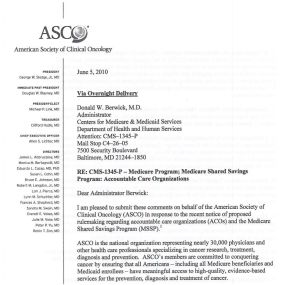
ASCO Comments on ACO Rule

By Allen S. Lichter, MD, CEO, American Society of Clinical Oncology

Dear Administrator Berwick:

I am pleased to submit these comments on behalf of the America Soceity of Clinical Oncology(ASCO) in response to the recent notice of proposed rulemaking regarding accountable care organizations (ACOs) and the Medicare Shared Savings program (MSSP).1

ASCO is the national organization representing nearly …. (for complete letter submission, click here).