By Gregg A. Masters, MPH
A Profile of ACO’s Selected for July 1, 2012 Start Date
Per CMS Annoucement:
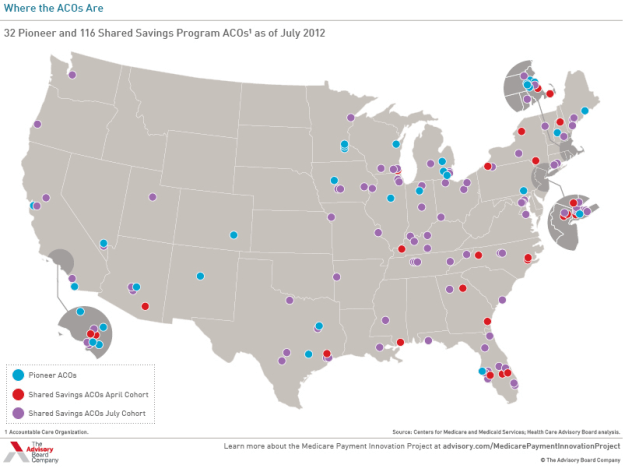
On July 9, 2012, the Centers for Medicare & Medicaid Services (CMS) announced the selection of 89 additional Accountable Care Organizations (ACOs) to participate in the Medicare Shared Saving Program. The selected organizations will take responsibility for coordinating care for nearly 1.2 million beneficiaries in 40 States and Washington, D.C. In total, there now are 154 organizations participating in Medicare shared savings initiatives, serving over 2.4 million Medicare patients across the country.
All ACOs that succeed in reducing the rate of growth in the cost of care while providing high quality care may share in the savings to Medicare. To ensure high quality of care, ACOs will report performance on 33 measures relating to care coordination and patient safety, use of appropriate preventive health services, improved care for at-risk populations, and patient and caregiver experience of care.
Five of the ACOs announced today applied for a version of the program that allows them to earn a higher share of any savings by also being held accountable for a share of any losses if the costs of care for the beneficiaries assigned to them increase.
Participation in an ACO is purely voluntary for providers. Because the Shared Savings Program is part of the original Medicare fee-for-service program, beneficiaries served by these ACOs will continue to have free choice about the care they receive and from whom they seek care, without regard to whether a particular provider or supplier is participating in an ACO.
[More.]
CMS Names 89 New Medicare Shared Savings Accountable Care Organizations
Arizona Health Advantage, Inc, located in Chandler, Arizona, is comprised of networks of individual ACO practices, with 73 physicians. It will serve Medicare beneficiaries in Arizona.
John C. Lincoln Accountable Care Organization, LLC, located in Phoenix, Arizona, is comprised of partnerships between hospitals and ACO professionals, and hospitals employing ACO professionals. It will serve Medicare beneficiaries in Arizona.
Fort Smith Physicians Alliance ACO, LLC, located in Fort Smith, Arkansas is comprised of networks of individual ACO practices, with 78 physicians. It will serve Medicare beneficiaries in Arkansas and Oklahoma.
ApolloMed Accountable Care Organization Inc., located in Glendale, California, is comprised of networks of individual ACO practices, with 130 physicians. It will serve Medicare beneficiaries in California.
Golden Life Healthcare LLC, located in Sacramento, California, is comprised of networks of individual ACO practices and partnerships between hospitals and ACO professionals, with 57 physicians. It will serve Medicare beneficiaries in California.
John Muir Physician Network, located in Walnut Creek, California, is comprised of ACO group practices and networks of individual ACO practices, with 197 physicians. It will serve Medicare beneficiaries in California.
Meridian Holdings, Inc., located in Hawthorne, California, is comprised of ACO group practices and networks of individual ACO practices, with 60 physicians. It will serve Medicare beneficiaries in California, District of Columbia, Florida, Georgia, Maryland, North Carolina, South Carolina, and Texas.
North Coast Medical ACO, Inc., located in Oceanside, California, is comprised of ACO group practices, hospitals employing ACO professionals, and a federally qualified health center, with 281 physicians. It will serve Medicare beneficiaries in California.
Torrance Memorial Integrated Physicians, LLC, located in Torrance, California, is comprised of partnerships between a hospital and ACO professionals, with 398 physicians. It will serve Medicare beneficiaries in California.
MPS ACO Physicians, LLC, located in Middletown, Connecticut, is comprised of networks of individual ACO practices, with 38 physicians. It will serve Medicare beneficiaries in Connecticut.
PriMed, LLC, located in Shelton, Connecticut, is comprised of ACO group practices, with 116 physicians. It will serve Medicare beneficiaries in Connecticut.
Accountable Care Coalition of Northwest Florida, LLC, located in Pensacola, Florida, is comprised of networks of individual ACO practices, with 60 physicians. It will serve Medicare beneficiaries in Alabama and Florida.
Accountable Care Partners, LLC, located in Jacksonville, Florida, is comprised of ACO group practices and networks of individual ACO practices, with 65 physicians. It will serve Medicare beneficiaries in Florida and Georgia.
Allcare Options, LLC, located in Parrish, Florida, is comprised of ACO group practices and networks of individual ACO practices, with 198 physicians. It will serve Medicare beneficiaries in Florida.
Florida Medical Clinic ACO, LLC, located in Zephyrhills, Florida, is comprised of networks of individual ACO practices, with 153 physicians. It will serve Medicare beneficiaries in Florida.
FPG Healthcare, LLC, located in Orlando, Florida, is comprised of ACO group practices, with 142 physicians. It will serve Medicare beneficiaries in Florida.
HealthNet LLC, located in Boynton Beach, Florida, is comprised of networks of individual ACO practices, with 55 physicians. It will serve Medicare beneficiaries in Florida.
Integrated Care Alliance, LLC, located in Gainesville, Florida, is comprised of networks of individual ACO practices, with 115 physicians. It will serve Medicare beneficiaries in Florida.
Medical Practitioners for Affordable Care, LLC, located in Melbourne, Florida, is comprised of networks of individual ACO practices, with 126 physicians. It will serve Medicare beneficiaries in Florida.
Palm Beach Accountable Care Organization, LLC, located in West Palm Beach, Florida, is comprised of networks of individual ACO practices, with 337 physicians. It will serve Medicare beneficiaries in Florida.
Reliance Healthcare Management Solutions, LLC, located in Tampa, Florida, is comprised of networks of individual ACO practices, with 36 physicians. It will serve Medicare beneficiaries in Florida.
WellStar Health Network, LLC, located in Marietta, Georgia, is comprised of partnerships between hospitals and ACO professionals, with 1,203 physicians. It will serve Medicare beneficiaries in Georgia.
Advocate Health Partners, located in Rolling Meadows, Illinois, is comprised of partnerships between hospitals and ACO professionals, with 2,237 physicians. It will serve Medicare beneficiaries in Illinois.
Chicago Health System ACO, LLC, located in Westmont, Illinois, is comprised of ACO group practices, networks of individual ACO practices, partnerships between hospitals and ACO professionals, hospitals employing ACO professionals, and federally qualified health centers, with 523 physicians. It will serve Medicare beneficiaries in Illinois.
Deaconess Care Integration, LLC, located in Evansville, Indiana, is comprised of ACO group practices, networks of individual ACO practices, partnerships between hospitals and ACO professionals and a hospital employing ACO professionals, and a rural health clinic, with 323 physicians. It will serve Medicare beneficiaries in Illinois, Indiana, and Kentucky.
Franciscan AHN ACO, LLC, located in Mishawaka, Indiana, is comprised of partnerships between hospitals and ACO professionals, with 245 physicians. It will serve Medicare beneficiaries in Indiana.
Indiana University Health ACO, Inc., located in Indianapolis, Indiana, is comprised of ACO group practices, networks of individual ACO practices, partnerships between hospitals and ACO professionals and hospitals employing ACO professionals, and a federally qualified health center, with 1,837 physicians. It will serve Medicare beneficiaries in Indiana.
Genesis Accountable Care Organization, LLC, located in Davenport, Iowa, is comprised of hospitals employing ACO professionals, with 312 physicians. It will serve Medicare beneficiaries in Illinois and Iowa.
Iowa Health Accountable Care, L.C., located in Des Moines, Iowa, is comprised of ACO group practices, networks of individual ACO practices, a combination of hospitals employing ACO professionals, a federally qualified health center and a rural health clinic, with 1,551 physicians. It will serve Medicare beneficiaries in Illinois, Iowa, and Missouri.
One Care LLC, located in Des Moines, Iowa, is comprised of partnerships between hospitals and ACO professionals, with 402 physicians. It will serve Medicare beneficiaries in Iowa.
University of Iowa Affiliated Health Providers, LC, located in Iowa City, Iowa, is comprised of partnerships between hospitals and ACO professionals, with 1,791 physicians. It will serve Medicare beneficiaries in Iowa.
Owensboro ACO, located in Owensboro, Kentucky, is comprised of networks of individual ACO practices, with 26 physicians. It will serve Medicare beneficiaries in Indiana and Kentucky.
Quality Independent Physicians, located in Louisville, Kentucky, is comprised of ACO group practices, with 74 physicians. It will serve Medicare beneficiaries in Indiana and Kentucky.
Southern Kentucky Health Care Alliance, located in Smiths Grove, Kentucky, is comprised of networks of individual ACO practices, with 35 physicians. It will serve Medicare beneficiaries in Kentucky.
TP-ACO LLC located in Baton Rouge, Louisiana, is comprised of networks of individual ACO practices, with 50 physicians. It will serve Medicare beneficiaries in Florida, Louisiana and Tennessee.
Central Maine ACO, located in Lewiston, Maine, is comprised of ACO group practices, networks of individual ACO practices and partnerships between hospitals and ACO professionals, including a combination of hospitals employing ACO professionals. It includes 566 physicians. It will serve Medicare beneficiaries in Maine.
Maine Community Accountable Care Organization, LLC, located in Augusta, Maine, is a federally qualified health center with 125 physicians. It will serve Medicare beneficiaries in Maine.
MaineHealth Accountable Care Organization, located in Portland, Maine, is comprised of networks of individual ACO practices, partnerships between hospitals and ACO professionals and hospitals employing ACO professionals, with 1,595 physicians. It will serve Medicare beneficiaries in Maine.
Accountable Care Coalition of Maryland, LLC, located in Hollywood, Maryland, is comprised of ACO group practices, with 109 physicians. It will serve Medicare beneficiaries in Maryland.
Greater Baltimore Health Alliance Physicians, LLC, located in Baltimore, Maryland, is comprised of partnerships between a hospital and ACO professionals and a hospital employing ACO professionals, with 399 physicians. It will serve Medicare beneficiaries in Maryland and Pennsylvania.
Maryland Accountable Care Organization of Eastern Shore LLC, located in National Harbor, Maryland, is comprised of ACO group practices, networks of individual ACO practices, with 15 physicians. It will serve Medicare beneficiaries in Maryland.
Maryland Accountable Care Organization of Western MD LLC, located in National Harbor, Maryland, is comprised of ACO group practices and networks of individual ACO practices, with 23 physicians. It will serve Medicare beneficiaries in Maryland, Pennsylvania, and West Virginia.
Circle Health Alliance, LLC, located in Lowell, Massachusetts, is comprised of partnerships between hospitals and ACO professionals, with 353 physicians. It will serve Medicare beneficiaries in Massachusetts and New Hampshire.
Harbor Medical Associates, PC, located in South Weymouth, Massachusetts, is comprised of ACO group practices, with 116 physicians. It will serve Medicare beneficiaries in Massachusetts.
Accountable Healthcare Alliance, PC, located in East Lansing, Michigan, is comprised of networks of individual ACO practices, with 29 physicians. It will serve Medicare beneficiaries in Michigan.
Oakwood Accountable Care Organization, LLC, located in Dearborn, Michigan, is comprised of partnerships between hospitals and ACO professionals, with 1,546 physicians. It will serve Medicare beneficiaries in Michigan.
Southeast Michigan Accountable Care, Inc., located in Dearborn, Michigan, is comprised of ACO group practices and networks of individual ACO practices, with 333 physicians. It will serve Medicare beneficiaries in Michigan.
Essential Health, located in Duluth, Minnesota, is comprised of a combination of ACO group practices, critical access hospitals, and a rural health clinic, with 1,404 physicians. It will serve Medicare beneficiaries in Minnesota, North Dakota, and Wisconsin.
Medical Mall Services of Mississippi, located in Jackson, Mississippi, is comprised of networks of individual ACO practices and a federally qualified health center, with 487 physicians. It will serve Medicare beneficiaries in Mississippi.
BJC HealthCare ACO, LLC, located in St. Louis, Missouri, is comprised of a combination of hospitals employing ACO professionals, and rural health clinics, with 556 physicians. It will serve Medicare beneficiaries in Illinois and Missouri.
Heartland Regional Medical Center, located in St. Joseph, Missouri, is comprised of a hospital employing ACO professionals, with 199 physicians. It will serve Medicare beneficiaries in Kansas and Missouri.
Nevada Primary Care Network ACO, LLC, located in Las Vegas, Nevada, is comprised of ACO group practices and networks of individual ACO practices, with 89 physicians. It will serve Medicare beneficiaries in Nevada.
Concord Elliot ACO LLC, located in Manchester, New Hampshire, is comprised of partnerships between hospitals and ACO professionals, with 234 physicians. It will serve Medicare beneficiaries in New Hampshire.
Barnabas Health ACO-North, LLC, located in West Orange, New Jersey, is comprised of partnerships between hospitals and ACO professionals, hospitals employing ACO professionals, with 435 physicians. It will serve Medicare beneficiaries in New Jersey.
Accountable Care Coalition of Syracuse, LLC, located in Syracuse, New York, is comprised of ACO group practices, with 105 physicians. It will serve Medicare beneficiaries in New York.
Asian American Accountable Care Organization, located in New York City, is comprised of networks of individual ACO practices, with 239 physicians. It will serve Medicare beneficiaries in New York.
Balance Accountable Care Network, located in New York City, is comprised of hospitals and networks of individual ACO practices, with 1,069 physicians. It will serve Medicare beneficiaries in New York.
Beacon Health Partners, LLP, located in Manhasset, New York, is comprised of networks of individual ACO practices, with 261 physicians. It will serve Medicare beneficiaries in New York.
Chautauqua Region Associated Medical Partners, LLC, located in Jamestown, New York, is comprised of partnerships between hospitals and ACO professionals, with 200 physicians. It will serve Medicare beneficiaries in New York and Pennsylvania.
Healthcare Provider ACO, Inc., located in Garden City, New York, is comprised of networks of individual ACO practices, with 395 physicians. It will serve Medicare beneficiaries in New York.
Mount Sinai Care, LLC, located in New York City, is comprised of networks of individual ACO practices and a hospital(s) employing ACO professionals, with 2,249 physicians. It will serve Medicare beneficiaries in New York.
ProHEALTH Accountable Care Medical Group, PLLC, located in Lake Success, New York, is comprised of ACO group practices, with 281 physicians. It will serve Medicare beneficiaries in Florida and New York.
WESTMED Medical Group, PC, located in Purchase, New York, is comprised of ACO group practices, with 250 physicians. It will serve Medicare beneficiaries in Connecticut and New York.
Cornerstone Health Care, PA, located in High Point, North Carolina, is comprised of ACO group practices, with 313 physicians. It will serve Medicare beneficiaries in North Carolina.
Triad Healthcare Network, LLC, located in Greensboro, North Carolina, is comprised of networks of individual ACO practices and a hospital employing ACO professionals, with 759 physicians. It will serve Medicare beneficiaries in North Carolina.
Mercy Health Select, LLC, located in Cincinnati, Ohio, is comprised of hospitals employing ACO professionals, with 365 physicians. It will serve Medicare beneficiaries in Indiana and Ohio.
ProMedica Physician Group, Inc., located in Toledo, Ohio, is comprised of ACO group practices and networks of individual ACO practices, with 250 physicians. It will serve Medicare beneficiaries in Michigan and Ohio.
Summa Accountable Care Organization, located in Akron, Ohio, is comprised of partnerships between hospitals and ACO professionals, with 612 physicians. It will serve Medicare beneficiaries in Ohio.
University Hospitals Coordinated Care, located in Shaker Heights, Ohio, is comprised of partnerships between hospitals and ACO professionals, with 1,770 physicians. It will serve Medicare beneficiaries in Ohio.
North Bend Medical Center, Inc., located in Coos Bay, Oregon, is comprised of ACO group practices, with 112 physicians. It will serve Medicare beneficiaries in Oregon.
Coastal Medical, Inc., located in Providence, Rhode Island, is comprised of ACO group practices, with 100 physicians. It will serve Medicare beneficiaries in Massachusetts and Rhode Island.
Accountable Care Coalition of The Tri-Counties, LLC, located in Charleston, South Carolina, is comprised of networks of individual ACO practices, with 108 physicians. It will serve Medicare beneficiaries in South Carolina.
AnewCare LLC, located in Johnson City, Tennessee, is comprised of partnerships between hospitals and ACO professionals, with 673 physicians. It will serve Medicare beneficiaries in Tennessee and Virginia.
Cumberland Center for Healthcare Innovation, LLC, located in Nashville, Tennessee, is comprised of networks of individual ACO practices, with 33 physicians. It will serve Medicare beneficiaries in Tennessee.
MissionPoint Health Partners, located in Nashville, Tennessee, is comprised of hospitals employing ACO professionals, with 544 physicians. It will serve Medicare beneficiaries in Tennessee.
St. Thomas Medical Group PLLC, located in Nashville, Tennessee, is comprised of ACO group practices, with 41 physicians. It will serve Medicare beneficiaries in Tennessee.
Summit Health Solutions, located in Knoxville, Tennessee, is comprised of hospitals and ACO group practices, with 474 physicians. It will serve Medicare beneficiaries in Tennesse.
BHS Accountable Care, LLC, located in San Antonio, Texas, is comprised of ACO group practices, networks of individual ACO practices, partnerships between a hospital and ACO professionals and a hospital employing ACO professionals, with 348 physicians. It will serve Medicare beneficiaries in Texas.
Memorial Hermann Accountable Care Organization, located in Houston, Texas, is comprised of networks of individual ACO practices and partnerships between hospitals and ACO professionals, with 332 physicians. It will serve Medicare beneficiaries in Texas.
Methodist Patient Centered ACO, located in Dallas, Texas, is comprised of ACO group practices, networks of individual ACO practices and partnerships between hospitals and ACO professionals, with 269 physicians. It will serve Medicare beneficiaries in Texas.
Essential Care Partners, LLC, located in Austin, Texas, is a federally qualified health center with 275 physicians. It will serve Medicare beneficiaries in Texas.
Physicians ACO, LLC, located in Houston, Texas, is comprised of networks of individual ACO practices, with 75 physicians. It will serve Medicare beneficiaries in Texas.
Texoma ACO, LLC, located in Wichita Falls, Texas is comprised of ACO group practices and networks of individual ACO practices, with 52 physicians. It will serve Medicare beneficiaries in Texas.
Central Utah Clinic, P.C., located in Provo, Utah, is comprised of ACO group practices, with 173 physicians. It will serve Medicare beneficiaries in Utah.
Accountable Care Coalition of Green Mountains, LLC, located in South Burlington, Vermont, is comprised of ACO group practices and networks of individual ACO practices, with 42 physicians. It will serve Medicare beneficiaries in Vermont.
Polyclinic Management Services Company, located in Seattle, Washington, is comprised of ACO group practices, with 296 physicians. It will serve Medicare beneficiaries in Washington.
Aurora Accountable Care Organization LLC, located in Milwaukee, Wisconsin, is comprised of ACO group practices, with 275 physicians. It will serve Medicare beneficiaries in Wisconsin.
Dean Clinic and St. Mary’s Hospital Accountable Care Organization, LLC, located in Madison, Wisconsin, is comprised of ACO group practices and a partnership between a hospital and ACO professionals, with 701 physicians. It will serve Medicare beneficiaries in Wisconsin.
ProHealth Solutions, LLC, located in Waukesha, Wisconsin, is comprised of partnerships between hospitals and ACO professionals, with 697 physicians. It will serve Medicare beneficiaries in Wisconsin.





 acowatch.me